







The More, the Merrier: Michelle Tea On the Possibilities of Polyamory
On the Benefits of Open Relationships and Open Marriages
My first marriage was illegal. Well, we weren’t breaking any laws, I guess, so it wasn’t illegal, just not legal. I eloped with my trans boyfriend, Aldo, following a regular Bingo party at my house. The Bingo party at least was illegal. In the long list of illicit activities that occurred in the Blue House, the queer, punk household where I spent my twenties, a little Bingo game among friends who drank beer and ashed their cigarettes on my floor might seem like small potatoes, but we were playing for cash, so it was technically an illicit gambling ring. One night, after the game disbanded, me and Aldo absconded to the home of Jo-Jo and Tommy, an elder butch-femme couple, low-key famous for having made award-winning lesbian porn movies, and throwing sex parties in the loft where their open marriage thrived.
Jo-Jo was a witch, and when I’d asked her to marry Aldo and me, she took it very seriously. Her fee was $19.99, some of which she spent on a sheet cake from Safeway. Aldo, while browsing the veritable bazaar that lined the streets near my home—blankets covered with all sorts of goods being sold by unhoused neighborhood denizens—spotted a silky, shiny, pale blue dress and asked if he could buy it. Only if you promise me a pretty girl’s gonna get married in it, the proprietor said, and just like that my wedding dress was blessed by the streets. For a veil I popped by a Target, and in the children’s department found a crown woven with ribbon the same pearly blue as my dress, stuck with fake butterflies. I was ready for my elopement.
Jo-Jo and Tommy welcomed us with shots of tequila and the heavily frosted cake, decorated with makeshift wedding figures—a little plastic doll whose hair had been colored blue with magic markers (me) and a squat, posable Batman (Aldo). Jo-Jo pinned a rhinestone brooch to my dress for “something borrowed” and told us that, as she married us, she was basically our pastor now, and we should come to her with any marital woes and absolutely seek her counseling should we ever consider divorce, neither of which we did. Before pronouncing our vows, Jo-Jo checked in to make sure we weren’t in the throes of any secret drug addictions. We were, of course, but if we told her they wouldn’t be secret anymore. And so, we were married. I felt a heady rush of intoxication when I pledged myself to Aldo, better than the cut of MDMA we had dosed ourselves with a couple nights ago. When Jo-Jo had inquired about addiction, it was our clandestine opiate use I’d kept mum about. My primary addiction—to love, romance, marriage—was still a secret even to myself.
Opening up a marriage pushes you to look at your spouse as a freaky and unique individual, not an extension of your own self.
By the time Aldo and I eloped in 2000, the radical activist collective Gay Shame was in full force, creating spectacles in the street, crashing Pride parades, printing snarky propaganda, and leaving their graffitied mark around San Francisco. At the turn of the century it was becoming clear to queers of a certain sensibility that we could not have our rebellious, antiestablishment cake and eat the crumbs of mainstream acceptance, too. Our outcast status had laid bare what was wrong with society—its racism and classism, the grotesquerie of capitalism, its ableism and lookism and misogyny. Our vision cut through hypocrisy, recognizing the horrors of what queer poet Allen Ginsberg called Moloch in Howl: “Moloch the incomprehensible prison! Moloch the crossbone soulless jailhouse and Congress of sorrows! Moloch whose buildings are judgment! Moloch the vast stone of war! Moloch the stunned governments!”
Ginsberg was invoking the ancient Hebrew deity who demanded parents murder their children in his honor—and wasn’t that modern capitalism, parents sending their children to the vast stone of war, both literally and figuratively, to feed the moneyed beast? Isn’t that what assimilationist queers were buying into, chasing status points such as marriage and the right to join the military—to participate in the country’s dark history of colonialism? They were fighting for the right to serve Moloch, and Gay Shame would have none of it.
As Pride became mainstream, Dykes on Bikes and PFLAG contingents were joined by the gay cops tasked with arresting gay sex workers, by giant corporations whose labor ethics were anything but radical. Gay Shame called themselves a virus in the system, both a wink at direct-action forebears such as ACT UP as well as a nostalgia for the days when queers were seen as diseased. For in our monstrosity we had possessed the power, perhaps, to destroy the system, not become seduced by it.
“The gay elite has hijacked queer struggle, and positioned their desires as everyone’s needs—the dominant signs of straight conformity have become the ultimate signs of gay success,” wrote Gay Shame co-founder Mattilda Bernstein Sycamore in “Sweatshop-Produced Rainbow Flags and Participatory Patriarchy: Why the Gay Rights Movement Is a Sham.” Gays (don’t call them queers)—in particular those with privileges of the white, cisgender, able-bodied, and moneyed variety—were selling out, making a grab for personal safety on the backs of their more vulnerable siblings and allies. Anti-gay-marriage queers were furious that real resources—money, activist labor, the courting of allies—were being funneled to a type of luxury problem, rather than being harnessed to fight more urgent issues such as police brutality, affordable housing, violence against people of color and sex workers and trans folk: issues that threaten queer people’s basic survival.
Gay Shame flared up at the turn of the century and faded away, partly a victim to how “so often in radical queer spaces people treat one another just as horribly as in dominant straight culture or mainstream gay culture,” as Sycamore explained to the San Francisco Bay Times. The sword of radical queer analysis, though brilliant, cuts both ways. Sometimes, a lack of heart or a larger perspective, an inability to stop seeing problems absolutely everywhere, within everyone, tears revolutionary efforts down. The movement reemerged in 2013 in San Francisco, organizing around prison abolition and the violent gentrification of the city. It’s good work, and it’s always been good work. But I never did get too close, scared as I was by what sometimes felt like a purity test I was bound to fail. I agreed that the survival-level problems plaguing the most vulnerable queers was more urgent than marriage, but I also thought that everyone deserved to get married.
The idea that any part of the population is banned from doing what the rest are permitted is just wrong. It’s reprehensible. And the reality was—is—marriage ceremonies are important to people. They’re meaningful. Sure, have a ceremony, why get the state involved, is one argument. But marriage confers privileges, whether they be tax privileges or the right to be by your beloved’s side in a hospital, the ability to marry a noncitizen, to keep them with you. Of course, we should fight for tax reform, and the right to have your chosen family around you, and the rights of immigrants. Yes, yes, yes. But meanwhile, there is a system that grants these rights, and a sizable portion of the population was forbidden to access it.
When conversations about queer marriage would pop up in my sphere—and they did, frequently—I liked to say that I was for gay marriage so that I could abuse it, like heterosexuals do. In the style of Elizabeth Taylor I wanted eight marriages, with a different enormous, thrift store dress for each one. How glamorous! Marry early, marry often, I’d quip.
My marriage with Aldo ended simply. Having not been allowed a “legal” marriage, no paperwork was needed to undo our bond. The only complication was that we lived together. When Aldo confessed that he didn’t know if he wanted to be with me anymore, but he did know that he wanted to be with the girl he’d begun seeing while I was traveling, I had to kick him out. I had to summon Aldo’s mother to dig his somewhat feral cat out from the closet where she’d taken to hiding when not attacking me, resentful at his absence. I had to tell a million people, again and again, that we were no longer together; we had been a low-key public couple, me with my writing and him with his music. I had to run into him and his new girlfriend, again and again on the street, at the club, at 12-step meetings, and they both would wave and say hello, as if they hadn’t ruined my life.
The final months of Aldo’s and my marriage, when he was canoodling with his new girl and I was away performing in Brooklyn, carrying on with a trans painter who bore an uncanny resemblance to Matt Dillon, were in many ways the best of our seven years together. Opening up our marriage had breathed a lot of fresh air into it, allowing us each to re-bond with our own sense of self, and to feel an enormous sense of gratitude toward each other for the trust, love, and encouragement with which we took our nonmonogamous leap. I remember smoking a cigarette out the painter’s window, exhaling clouds over the twinkling, industrial landscape, feeling like I was really living, and understanding that it was Aldo who’d turned on these jets of adventure. I loved him so much. Why would he want to end this ideal situation, only to become monogamous with another person he’d ultimately leave? But such is the way of serial monogamy.
The grand challenge of marriage—a sacred challenge, really—is to make yourself see, again and again, those things that initially attracted you to your partner, even and especially when they’ve been crusted over with all the things you later learned repelled you. Opening up a marriage pushes you to look at your spouse as a freaky and unique individual, not an extension of your own self, not some cumbersome extra limb, a polyamorous bonus that can actually help you realize the heady ideals of marriage. To keep honoring the sacred singularity of this person, your person. Seeing the divine in them and all that. It’s my favorite challenge, but one that both partners need to be embrace.
In the lead-up to the Supreme Court legalizing gay marriage in 2015, a particularly hysterical line of reasoning—the “slippery-slope” argument—claimed that once humans were permitted to tie the knot with others of the same assigned sex, nothing would prevent them from marrying all sorts of inanimate objects (toasters?) and nonhuman creatures (dogs?) that no one has really expressed an interest in marrying (though I do know a number of lesbians who would happily marry their dog). One point within the slippery-slope debate was a bit less fanciful: as the justices stated their cases, Samuel Alito wondered aloud how a state permitting queer marriage could logically deny the right to a mixed-gender foursome? In his dissenting opinion John Roberts concurred, declaring that a lot of the majority’s logic “would apply with equal force to the claim of a fundamental right to plural marriage.”
Plural marriage has a bad cultural rap in the US, conjuring images of megalomaniac straight men presiding like cult leaders over harems of hoarded women. Women born into especially oppressive strains of Mormonism, forced into a group marriage; girls too young to be married to anyone at all betrothed to old men. It’s creepy. The 2006 HBO Mormon drama Big Love dipped into some of the ickier manifestations of religious polygamy, but foregrounded the dramatics of a more basic and suburban polygamous clan, written to be more or less relatable to the average viewer. It wasn’t meant to be persuasive propaganda in favor of group marriage, but it sort of wound up like that. In spite of the tired jockeying for wifely status and male attention, and the patriarchal double standard forbidding the women to have multiple partners of their own, the show almost certainly influenced Aldo’s and my decision to open up our own marriage. Maybe it was Chloë Sevigny as impetuous wife Nicki and her not not hot daddy issues, not to mention her French braid and covetable wardrobe, cottage core with a western edge. Aldo was hot for Nicki/Chloë, and I wouldn’t have minded raiding the closet of such a sister wife—mutual hair-braiding, maybe more?
No doubt Aldo and I were the rare couple who took the fantasy of that show and ran with it. Regardless of Big Love’s spicy charm—or the imagined “anything goes” vibe post-gay-marriage—conservatives’ fear of a polypocalypse did not come to bear. In 2018, courts rejected a throuple’s use of John Roberts’s dissent to fight for the right for a legal group marriage, and civilization thrummed on, unscathed.
No free love. You pay the price, everyone knows, in long nights of processing. But, even if it’s not free, exactly, maybe it’s still worth it.
An unimaginative 2012 study out of the University of British Columbia came to the conclusion that outlawing polygamy and enshrining monogamy is a net good for culture. Relying solely on societies that practice a strict polygyny version of group nuptials—one man, many women—it argued that allowing higher-status men to “hoard” women leaves less available brides for the average Joe; violence ensues. States the study, “monogamy’s main cultural evolutionary advantage over polygyny is the more egalitarian distribution of women, which reduces male competition and social problems.” I’m not about to go to bat for the examples of polygyny we’ve got to work with, which look like patriarchal, religious control of women. But it’s equally gross to hear women be referred to as objects to be distributed to men who have some inherent right to them.
The study’s conclusions also reflect the truth that most all social control of women can be traced back to men’s inability to keep their shit together. Surely, there are arguments for polygyny’s dividing of wifely duties—how many straight ladies in a long-term relationship would love for a sister-wife to take their man off their hands a few days a week? There’s also the prospect of class-jumping and the financial security marriage can offer a femme. Given the choice between being hoarded by the wealthy village baller, versus scraping together a living with an equally patriarchal, single, broke man, I know I’d be looking to pledge for that sorority of well-off wives.
Ten-plus years after the legalization of queer marriage, polygamy isn’t exactly on the cultural table, but polyamory sure is. And while the prevailing theories of polyamory don’t have a lot of room for something as traditional and dyadic as marriage, what about folks—like that litigious throuple, whose marriage license was revoked—who are both polyamorous and marriage-minded?
During my early time as a polyamorous, married mom, my spouse and I spent many mornings cramming best practices for opening up, via Eve Rickert and Franklin Veaux’s polyamorous bible, More Than Two. Drinking coffee in bed together while our toddler remained asnooze, I would read aloud from the book. I desperately wanted to do polyamory right, because I understood that to do it wrong would make it all go away, and between my queer true loves and my throwaway Tinder dates with cis guys, I was having way too much fun to go back to “normal” life. We learned good and helpful things from the book. Like, if you’re feeling jealous you should ask your partner for what you need, rather than trying to control the cute stuff they do with their dates. When I felt threatened by my spouse getting concert tickets for their girlfriend, I told them I’d like to go to concerts with them, too, and they surprised me with tickets to see Halsey for my birthday. Of course, COVID happened, and the concert was canceled, and then we got divorced, but still—I appreciated the effort.
More Than Two also insisted that being polyamorous doesn’t make you more enlightened or evolved, which I agreed with. It cautioned against forbidding your partner to visit certain places or engage in particular sex acts, encouraging lovers to instead find that specialness they’re looking to protect within one another, not in something external. It felt good to metabolize the lessons and stories in More Than Two, except when it felt terrifying and deeply threatening. Like the story of the poly person who married his newer partner while his long-term partner stood there smiling.
*
It’s interesting to think about multiple marriage. Would it simply gentrify polyamory, the way gay marriage has defanged queer culture? Or would poly weddings be just a celebration of love, an excuse for a party and a fancy dress, a step toward legal equality and social acceptance that makes life safer and easier. My friend Mara would very much like to marry both of her partners, each of them a wide-minded Aquarius who can handle her fiery and creative Leo verve. Born in Puerto Rico, Mara lives in Brooklyn, where she writes plays. I met her at a queer artists’ retreat upstate and loved talking with her, playing with tarot cards, thrifting together in the small town outside the rural residency. She has long, thick black hair and eyebrows to die for, is lanky and gives off a vibe of intense freedom. And she let me ask her a bunch of questions about her polyamory.
“Going against the grain comes naturally to me,” she responds from a voice message I play on my phone. “Being queer in my identity and in my relationship, that is appealing to me. The level of comfort, the level of maturity we’ve gone through as a throuple—there is such peace, and relaxation”—my heart warms, my own open relationships having been mostly tense and emotional—“even,” she continues, “when there are contentious conversations and we have to discuss something, or have an argument.” Ah. Of course. No free lunch. No free love. You pay the price, everyone knows, in long nights of processing. But, even if it’s not free, exactly, maybe it’s still worth it, maybe it’s a bargain, even, considering what you get—more love, more sex, a more honest and hands-on relationship with jealousy and insecurity. The satisfaction of knowing you’re living according to your own code, maybe a little less brainwashed than you once were.
Mara agrees. “At the end of the day, it’s so comforting and relaxing to have these two beautiful souls share themselves and share me. It gives me a level of comfort that allows me to do the traditional stuff like get married, though I don’t think we’re even allowed. We’re just doing what we want to do—having lots of sex and kissing each other and loving each other.” She considers it all, the current prohibitions against the maximum classic expression of her love. “We don’t have to be ‘married,’ you know?” she relents. “Maybe we’ll just have a huge party!”
I do hope I get invited.
______________________________
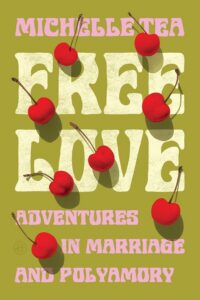
Excerpted from Free Love: Adventures in Marriage and Polyamory by Michelle Tea. Reprinted with the permission of the publisher HarperOne, an imprint of HarperCollins. Copyright © 2026 by Michelle Tea.

Michelle Tea
Michelle Tea is the author of over a dozen books, including the cult-classic Valencia, the essay collection Against Memoir, and the memoirS Black Wave and Knocking Myself Up. She is the recipient of awards from the Guggenheim, Lambda Literary, and Rona Jaffe Foundations, PEN/America, and other institutions. Tea's cultural interventions include brainstorming the international phenomenon Drag Queen Story Hour, co-creating the Sister Spit queer literary performance tours, and occupying the role of Founding Director at RADAR Productions, a Bay Area literary organization, for over a decade. She also helmed the imprints Sister Spit Books at City Lights Publishers, and Amethyst Editions at The Feminist Press. She produces and hosts the Your Magic podcast, where she reads tarot cards for Roxane Gay, Alexander Chee, Phoebe Bridgers, and other artists, as well as the live tarot show Ask the Tarot on Spotify Greenroom.