







The Limits of Rationality: On Gulliver’s Travels at 300
Ed Simon Considers What Jonathan Swift's Novel Can Reveal About Our World Today
On every birthday, Jonathan Swift would take off his starched, powdered wig with its cascade of white curls, gingerly place it down by the candle-light illuminated stained-glass window of the Deanery of Saint Patrick’s Cathedral. He would mark the anniversary of his birth by mumbling from Job 3:3—“Let the day perish wherein I was born.” This incongruous scene of the greatest satirist since Juvenal meditating upon Job’s lamentations while dressed only in the simple black cassock of a parish priest would later be compounded when the poor just outside of Dublin’s traditional walls—weavers, spinners, dyers, and combers laboring in the textile industry—gathered in the November chill on the cold cobble-stones so as to sing anthems and light bonfires in honor of that great Irish patriot the Dean of Saint Patrick’s.
On his 59th birthday in 1726, the undesired festivities remain a few years in the future. Swift had already achieved acclaim on both side of the Sea of Ireland for A Tale of a Tub and The Battle of the Books, not to mention a panoply of pamphlets arguing on behalf of everything from the purchase of Irish goods to denouncing predatory currency devaluation. His most consequential book Gulliver’s Travels had been published a month earlier (and 300 years ago today). Though often misremembered as a boy’s adventure book, Gulliver’s Travels is both summation and rejoinder to the Enlightenment and how innumerable sins can result when the idolatry of reason leads to humans being treated as objects. “I said the thing which was not,” says Swift’s titular character, who is describing what a lie is to creatures that are incapable of it. But “the thing which was not” is also an apt summation of fiction and its own charged power.
Gulliver’s Travels is both summation and rejoinder to the Enlightenment and how innumerable sins can result when the idolatry of reason leads to humans being treated as objects.
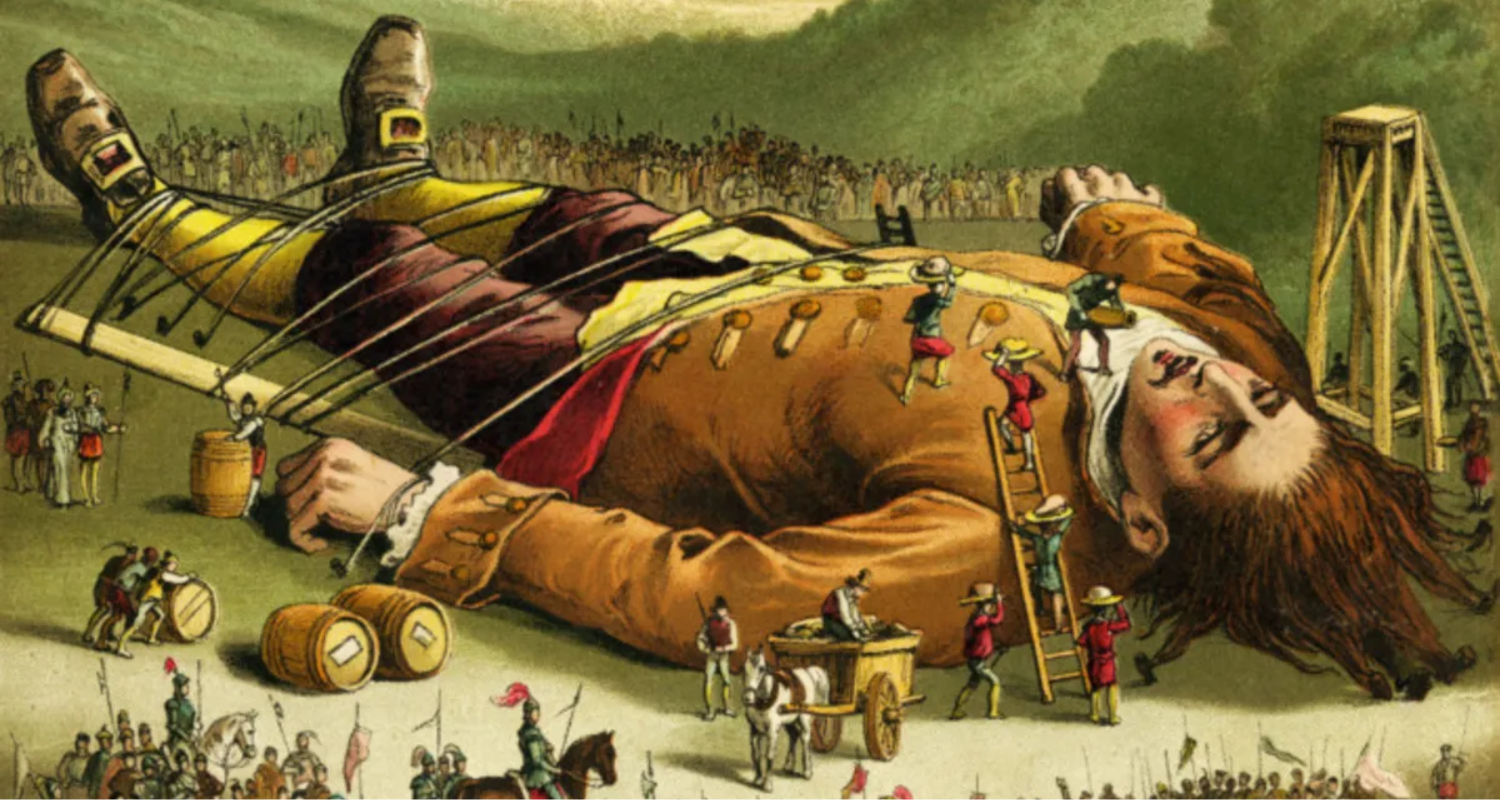
For many, perhaps mostly familiar with Gulliver’s Travels from redacted childhood editions or the several film adaptations, or maybe just from Swift’s influence on the language from words like “Brobdingnagian” and “Yahoo,” the novel inevitably calls to mind its protagonist constrained by the diminutive Lilliputians with thick coils of rope that are nothing but strings to the main character who awakens on the beach of an imagined island to the sound of tiny little hammers affixing said rope to the ground. With his stockings, britches, heavy overcoat and buckled shoes, the eighteenth-century gentleman is nonetheless a gigantic monster to the Lilliputians, a threat that must be neutralized as he drifts in from the Indian Ocean as if Leviathan. First examining one of his captors as the Lilliputian ascends the mountain-of-a-man, Gulliver notes that “I perceived it to be a human creature not six inches high, with a bow and arrow in his hands, and a quiver at his back.” Much of the humor in Gulliver’s Travels is of proportion; this self-important elf with his insignificant weapons, the imperial Lilliputians who wage war with their cousin-miniatures in Blefscu across an infinitesimal channel, how the Englishman is able to defeat that latter kingdom’s navy as if a child playing with toy boats in the bathtub, and how Gulliver is tried for treason (and escapes) after he ingeniously puts out a fire in the Lilliputian royal palace by pissing on it.
The Lilliputians are as small-minded as their size and conduct querulous, violent debates about which end of an egg to crack (so obviously similar to the theological complexities of Swift’s own day). They are to be contrasted with the massive, high-minded Brobdingnagians to whom Gulliver is but a doll, yet among whom all of the grotesqueries and degradations, decays and ulcerations of the human body are made telescopically clear because of their massive size. In contrast to the sectarian, martial Lilliputians, the Brobdingnagians are kind and cerebral, contemplative and pacifistic, but they also assault Gulliver with their overwhelming body odor, with the way in which every cavernous pore and hair-sprouting mole is made manifest. Eighteenth-century intellectuals understood themselves as having emerged from past eras of superstition and darkness, but as Swift’s biographer Leo Damrosch notes, the author’s position was that “Whether in religion, science, or politics, people are all too frequently insane,” and disgusting for that matter, a framing that has long given the writer a (not undeserved) reputation for misanthropy.
Reducing Gulliver’s Travels to only a topsy-turvy tale of humans both tiny and massive is to ignore the savage intellect that penned its words. Irish journalist Fintan O’Toole described the author, at a 350th birthday celebration in Saint Patrick’s Cathedral, as possessing “moral rage, the savage indignation that may have lacerated Swift’s heart but that…can still blow open a passage” in our own. Along with Cervantes’ Don Quixote, Swift’s is among those novels with an outsized influence on the culture. As the numbers of people who have actually read Gulliver’s Travels have dwindled, its name recognition holds on, though today the adjective “Swiftian” just as likely calls to mind Taylor as Jonathan. A predicament to our own detriment, for Swift provides as full of a diagnosis of our own diseased era as his own.
Swift’s only work that is as widely known as Gulliver’s Travelers is his still shocking 1729 essay “A Modest Proposal” in which the narrator recommends as a solution to the hunger and impoverishment amongst the suffering Irish poor that they simply sell their children as meat to the ruling English (first suggested by “a very knowing American of my acquaintance”). Composed out of both grim Malthusian calculation and cannibalistic recipes, “A Modest Proposal” was disturbing for those allergic to irony both then and now, but by pushing the logics of colonialism and capitalism to their ultimate conclusions, Swift demonstrated the horrific antihumanism of any system that valorizes cold reason over human feeling. So unnerving does “A Modest Proposal” remain that when actor Peter O’Toole performed it at Dublin’s Gaiety Theater in 1954, Swift’s two-centuries-old words were met with boos and hisses. By comparison, Gulliver’s Travels feels safe, an adventure saga akin to Robert Louis Stevenson’s Treasure Island or Swift’s great nemesis Daniel Defoe’s Robinson Crusoe. But to miss the profound subversion riven through all of his novel is an interpretive error, a warning that the author himself gave when he said that his intent was to “vex…rather than divert.”
As an Anglo-Irish priest in the Episcopal Church of Ireland (first in that long-line, from W.B. Yeats to Maud Gonne, of Irish Protestant patriots) Swift was preternaturally avoidant of zealotry, with the obscure religious wars between the Lilliputians and the Blefscuans over how to crack an egg reminiscent of internecine Christian schisms concerning the real presence in the Eucharist. More than anything, what bothered Swift were claims to certainty, of fervency either in religion or rationality. As such, Gulliver’s Travels is nothing less than the foundational critique of the Enlightenment’s excesses, hypocrisies, and hidden tyrannies. “Enlightenment, understood in the widest sense as the advance of thought, has always aimed at liberating human beings,” wrote Theodor Adorno and Max Horkheimer in their 1944 Dialectic of Enlightenment, yet the “wholly enlightened earth is radiant with triumphant calamity,” something that Swift could have told them.
Adorno and Horkheimer were writing after it was clear that rationalist actuary tables, schematics, calculations, and formulas facilitated the Holocaust (and later Hiroshima), but Swift could see the danger of valorizing reason two-hundred years earlier. Because of the latitudinarian Church of Ireland, Swift had an Anglican’s ambivalence toward certainty, describing himself as a Whig in politics and a Tory in faith, though that flexibility allowed him to weave through Adorno and Horkheimer’s dialectic with an understanding that there is practical benefit to reason, and catastrophe in its unhampered worship. Reason’s ignominy when divorced from emotion is best observed when Gulliver comes to the realm of Laputa, a kingdom far less known among readers than either Lilliput or Brobdingnag, a magnetized, floating island that rules over Balnibarbi below, a country “unhappily cultivated, with houses ill-contrived and ruinous, and its people’s countenances expressing misery and want.”
Having some familiarity with smaller islands cruelly and violently exploited by wealthier ones, Swift presents the Laputans as not just oppressive towards Balnibarbi, but also as literally and figuratively floating in astral realms as they spend their days hypothesizing as to whether sunlight can be derived from cucumbers or if there is a manner in which political corruption can be ascertained by smelling an individual’s shit. This satire of scholars “so taken up with intense speculations, that they neither can speak, nor attend to the discourses of others” is a not-so-subtle jab at the Royal Society in London, which Swift often parodied, but the combination of ethereal contemplation combined with wanton (if obscured) cruelty equally calls to mind the so-called British empiricist George Berkeley. The younger Anglo-Irish philosopher (and friend of Swift’s) claimed that the entire material world might just be an extension of human thought even while he oversaw an American plantations of the enslaved (Swift’s position on trans-Atlantic slavery remains a topic of debate), all arranged in a manner which made the utmost economic, though not moral, sense. “Reason,” said O’Toole, “is no good without indignation.”
Cynicism may appear to be the great enemy of the human, but in Gulliver’s Travels that noun means less a hatred of humans than of sadness.
If there is any ghost that Swift appears to be trying to exorcize, however, it’s not that of the still-living Berkeley, but of the century-long-dead Francis Bacon. Bacon’s own utopian fantasy The New Atlantis imagines a brave technocratic future, and seemingly predicts everything from submarines to genetic modification and the internet. Bacon enthuses that the “our foundation is the knowledge of causes…and the enlarging of the bounds of human Empire, to the effecting of all things possible.” Swift’s task, as a good anti-colonial, was to nip at the heels of that empire, whether British or technocratic
That was the spirit in which Swift denounced that other great eighteenth-century novelist Daniel Defoe, describing him in an 1709 pamphlet as an “illiterate scribbler,” a writer that was so “grave, sententious, [and] dogmatical a rogue that there is no enduring him.” Unlike the High Church Swift, Defoe was a puritan (in many things), and where the former was suspicious of the economic instrumentalization that turned people into commodities, the latter was positively bullish on the market economy. The titular adventurer of Defoe’s 1719 Robinson Crusoe, a ship-wrecked sailor who like Gulliver washes up on shoals unaccounted for and in lands unexplored, isn’t an observer of human folly, but a shaper of it. He is a water-logged boot-strapper, a rugged individualist who through his own labor (and that of course of the enslaved Friday) turns a South American desert island into his private empire.
Crusoe reflect that “by stating and squaring everything by Reason, and by making the most rational judgement of things, every man may be in time master of every mechanic art.” Both are works in that long tradition of castaways forced to survive, but in many ways, Crusoe—a colonist and capitalist and the later a jaundiced observer of the worst excesses of those systems—is the opposite of Gulliver. Where Gulliver’s Travels is filled with wonder and strangeness, Robinson Crusoe is a novel of schedules, organizational planning, and economic strategizing. There is, in the cold, rational, and most-of-all humorless heart of Defoe, intimations of a world to come (which is our own).
More than anything, Swift’s masterpiece stands athwart Utopia and denounces the risky delusions of such a no-pace—for the most part. For there is, after all, a perfection that Gulliver discovers when living among the Houyhnhnms, a race of sentient, empathetic, benevolent, and egalitarian horses (their name is pronounced appropriately like “whinny”). The Houyhnhnms are to be contrasted with the barbaric Yahoos, humans reduced to our most feral, bestial, barbaric, and cruel state. Gulliver must explain to the Houyhnhnms how among humans, “poor nations are hungry and rich nations are proud,” but that there is no actual rational justification for such inequity, so that when the explorer “thought of my family, my friends, my countrymen, or human race in general, I considered them as they really were”—Yahoos.
Instrumentalization, utilitarianism, positivism, rationalism—and rationalization. These were the targets of Swift’s wit; what today would he make of our own era of ICE detainment camps and genocide in Gaza, dystopian data centers and livestreamed executions? Our reality is Swift’s nightmare of statistics and algorithms; mechanization and industrialization as commenced without any concern for the vagaries of the beating human heart. Cynicism may appear to be the great enemy of the human, but in Gulliver’s Travels that noun means less a hatred of humans than of sadness. Gulliver, that great anti-Crusoe, witnessed any number of indignities and absurdities during his travels, but it was the example offered by the Houyhnhnms which finally broke him.
Returning to England, Gulliver finds it impossible to live amongst his fellow humans with their vanity and selfishness, their myopia and their meanness. As a result, he opts to spend his final days atop the piss-soaked straw of his own horses’ stables. Just as the Dean of Saint Patrick’s spent his increasingly ill and demented days at the stables where he kept his own horses, the plot named “Naboth’s Vineyard” after a Bible story involving land stolen from its rightful owners (an anti-colonial colonial’s witticism). When he died at 77, Swift would be buried next to his beloved (most likely secret wife) Stella in a cathedral where Cromwell had once stabled his horses during those genocidal campaigns against the Irish only a few decades before the author’s birth, a place of repose for those innocent Houyhnhnms conscripted into the brutal wars of the Yahoos who claimed that their fight was for something called “civilization.”
Gulliver’s Travels is inevitably discussed in terms of utopianism, its ironic pose a critique of Thomas More’s neologism from two centuries before Swift published his greatest work (though More was himself more than a bit ironic). But Swift’s novel is far more complicated, and far sadder, than a mere rejoinder to the idea of a perfect society. The best comedy is simply tragedy divorced from melancholy, the results being paradoxically all the sadder for it. Every one of the great satirists, from Swift to Mark Twain, Dorothy Parker to Richard Pryor, had at their core the dejected emptiness of losing that which we never had access to in the first place. In the end, Gulliver’s horses are “strangers to bridle or saddle; they live in great amity with me, and friendship of each other.” The final and most heartbreaking lesson then is this—that there is utopia, just not for us.
Ed Simon
Ed Simon is the Public Humanities Special Faculty in the English Department of Carnegie Mellon University, a staff writer for Lit Hub, and the editor of Belt Magazine. His most recent book is Devil's Contract: The History of the Faustian Bargain, the first comprehensive, popular account of that subject.