The Jerusalem of the East: When Billy Graham Visited Pyongyang
From Jonathan Cheng’s Cundill Prize-Shortlisted Korean Messiah
In the fall of 1991, Rev. Billy Graham, the American evangelist, received an unexpected invitation from Pyongyang. “It will be a great joy to welcome you to our church,” read the letter, which was sent by leaders of North Korea’s state-sanctioned Protestant and Catholic churches.
Rev. Graham, then seventy-three years old, had preached the Christian gospel to perhaps more people than any man in history. In addition to appearing before an estimated 215 million people in evangelistic “crusades” from New York’s Madison Square Garden to Moscow’s Bolshoi Theatre, the minister had reached hundreds of millions more through his televised rallies, and had the ear of an unbroken succession of U.S. presidents stretching back to Harry S. Truman. As much as any one person could be said to embody twentieth-century American Christianity to the world, Rev. Graham—“America’s Pastor”—was it.
Graham used his influence widely and was accustomed to preaching in peculiar settings. In addition to the trips he made to the Soviet Union, including several at the height of the Cold War, he regularly brought his crusades to countries behind the Iron Curtain, preaching a simple but powerful message of personal salvation: that God had sent his only begotten son for the redemption of humankind. Regardless of political ideology. Regardless of history. Regardless of war, famine, genocide, and the horrors of this most brutal of ages.
Kim sought to portray himself as the true Messiah, displacing Christ as “the benevolent sun” of the world.
Even so, the invitation from Pyongyang was unusual. Unlike East Germany, Poland, and the other Communist bloc countries that had been swept up in revolution around the time of the fall of the Berlin Wall in 1989, North Korea—which emerged as a satellite state of Moscow in the aftermath of Japan’s defeat in World War II—hadn’t shown any signs of buckling. Kim Il Sung, the founder of the Democratic People’s Republic of Korea, as North Korea formally calls itself, had ruled without interruption for nearly a half century. Aside from a benign growth on his neck about the size of a clenched fist, Kim had shown no obvious signs of ill health, nor had intelligence agents in the U.S. or in North Korea’s rival regime in South Korea picked up any signs that Kim’s rule was being seriously challenged. Indeed, while Nikita Khrushchev had systematically dismantled Joseph Stalin’s cult of personality in the Soviet Union in the 1950s, and while Deng Xiaoping had curbed the excesses of Mao Zedong worship in China beginning in the late 1970s, in North Korea, Kim Il Sung’s power—and his remarkable cult of personality—seemed only to grow with time.
In portraits in homes and classrooms, in daily photographs on the front page of the country’s main party newspaper, on the lapel badges that citizens had pinned over their hearts, Kim’s image was the very iconography of the state. Even when he wasn’t visible, Kim Il Sung was omnipresent, in plaques at factories commemorating his visits, in hymns sung in praise of him by schoolchildren, in the white cloths draped over subway seats that his posterior had once graced and on which nobody could ever sit again. Foreign visitors were shocked to hear the man hailed as nothing less than a god, the Sun of Korea. North Korea’s state media regularly hailed citizens who, amid earthquakes and floods, laid down their lives to protect sacral images of Kim Il Sung. “Corpses were dug out of the silt. Found out in their bosom were portraits wrapped with vinyl sheets to prevent them from being spoiled by water,” North Korea’s official news agency recounted after floods swept one rural county.
Kim Il Sung’s deification was a decades-long process. In 1972, to mark Kim’s sixtieth birthday, the nation erected a gleaming sixty-six-foot-tall statue of him on a hill in the capital, Pyongyang. In 1982, for Kim Il Sung’s seventieth birthday, an Arch of Triumph was built roughly a mile to the north, similar to Paris’s version but taller, to commemorate his fictionalized defeat of the Japanese Imperial Army. Across town, a stone obelisk—similar to Washington’s but, again, taller—was constructed with 25,550 blocks of white granite, one for each day of Kim’s seven decades of life. “The campaign to glorify him,” wrote one biographer in 1988, “has surpassed fanatic religious fervor. The North Korean ‘sun of the nation’ shines both day and night, and it is hard to escape his ubiquity.”
To ensure the people’s devotion to Kim Il Sung alone, North Korea—founded as a Marxist-Leninist state—spent decades stamping out rival faiths, most notably Protestant Christianity, killing pastors and thousands of lay believers; the mere possession of an unauthorized Bible could mean imprisonment. North Korea’s propagandists rewrote history to hold American missionaries responsible for Korea’s misfortunes, while state-sponsored novels, plays, and museums portrayed them as jackals who subjected Koreans to vile human experiments and branded them with acid. Instead, Kim sought to portray himself as the true Messiah, displacing Christ as “the benevolent sun” of the world. “People of the world, if you are looking for miracles, come to Korea!” the North’s official party newspaper declared in a Christmas 1980 editorial. “Christians, do not go to Jerusalem. Come rather to Korea. Do not believe in God. Believe in the great man!”
Even by the standards of the world’s foremost traveling minister, the invitation that Rev. Graham received from North Korea—timed just ahead of Kim Il Sung’s eightieth birthday—was puzzling. In Beijing, two days before boarding his flight to Pyongyang, Graham told reporters that he still didn’t know why the North Koreans had invited him.
*
Rev. Graham pled ignorance, but he knew more than he let on about the history of one of the world’s most isolated and least understood countries.
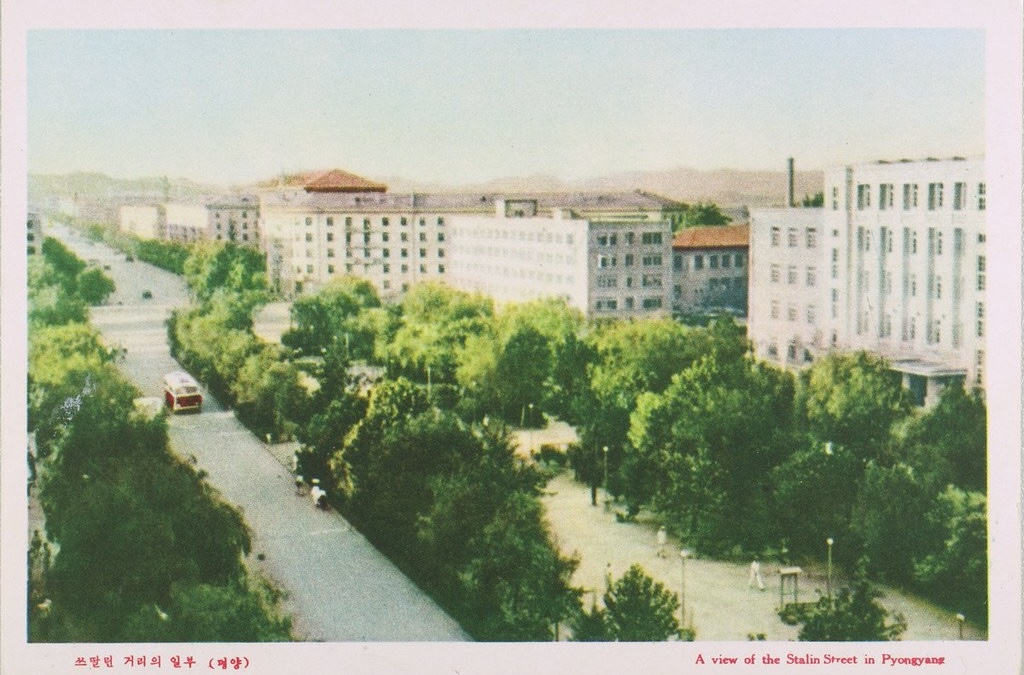
Pyongyang was, in fact, a familiar place for the Graham family. In the 1930s, his wife, Ruth Bell Graham, had attended high school there, on a sprawling Presbyterian mission compound on Pyongyang’s west side. There, missionary kids like Ruth from across the region—her parents were missionaries to China—attended school amid some of northern Korea’s earliest and most prestigious Western institutions: its first missionary-run high school, college, and modern hospital, as well as a Presbyterian seminary, the world’s largest. Then there were the churches, none greater than Pyongyang’s Central Presbyterian Church, which was packed to the rafters each week—even for Wednesday evening prayer meetings, which could draw standing-room crowds of 1,400 people. The city of Pyongyang had become so dominated by Christians, in fact, that it acquired a nickname: the “Jerusalem of the East.”
Rev. Graham pled ignorance, but he knew more than he let on about the history of one of the world’s most isolated and least understood countries.
By the time Rev. Graham boarded his plane in Beijing on March 31, 1992, bound for Pyongyang, the Jerusalem of the East was no more. The devastation of the Korean War, and decades of Kim Il Sung’s rule, had systematically wiped out the churches and Christian schools in the northern half of Korea, driving the 300,000 Christian believers in the North into hiding—or across the thirty-eighth parallel to the U.S.-backed South. That historic exodus helped turn the Republic of Korea, as South Korea is formally known, into a stronghold of the Christian faith and one of the world’s biggest exporters of missionaries. Meanwhile, Pyongyang became the centerpiece of a new state that was staunchly religious in its own way, but with a set of symbols and rituals that revolved around one man: Kim Il Sung.
Despite its peculiarities, it was immediately apparent to visitors like Rev. Graham that the ideology and imagery of the system Kim had erected had much in common with Christianity. When he arrived in Pyongyang, he was greeted by Rev. Kang Yŏng-sŏp, chairman of Pyongyang’s state-run Chosŏn Christian Federation and a relative of Kang Pan-sŏk, Kim Il Sung’s mother. “I warmly welcome you to our country in the name of Jesus Christ,” Rev. Kang told the American preacher, who was accompanied by a CNN news crew, his son Ned, and a small entourage of Korean-speaking Americans, including two descendants of Presbyterian missionary Eugene Bell, a Kentucky native who had first arrived in Korea in 1895. “Pyongyang now has both a fine Protestant church and a beautiful Catholic church, and I have heard that more places of worship are under construction or contemplated,” Rev. Graham said in a toast on his first evening in the North Korean capital. “This was wonderful news to me.”
When the American evangelist visited the humble thatched hut on the outskirts of Pyongyang where Kim Il Sung was said to have been born on April 15, 1912, the pastor and his delegation could only shake their heads at the similarities with the other faith that had once dominated the city. “All they’re missing are the manger and the three wise men,” the preacher quipped. In a sermon delivered at one Protestant church that Kim had ordered built in the late 1980s, Graham reflected on his wife’s high school years in Pyongyang and then urged the packed pews of North Korean congregants to accept God’s love and forgiveness, quoting from his favorite passage, John 3:16: “For God so loved the world, that he gave his only begotten Son…” “Seldom have I had a more attentive audience,” Rev. Graham said following the service, adding that his roughly four hundred listeners “certainly knew those hymns.”
Visiting a newly rebuilt seminary in Pyongyang, Rev. Graham stood beneath a portrait of Kim Il Sung and urged the gathered North Koreans to communicate the Christian gospel of salvation to others. Later, while strolling around the city, Graham had a chance to chat informally with some students. A photograph taken by a member of the preacher’s entourage captures the moment, complete with a slogan on the building behind the men, a supplication for Kim Il Sung’s immortality: “We Reverently Pray for the Eternal Life of Our Great Leader.”
Before departing, Rev. Graham left two gifts for his hosts: a sculpture of a crane to “His Excellency” Kim Il Sung, and a carving of a globe with white doves to his son Kim Jong Il, North Korea’s Great Successor and Dear Leader. For the elder Kim, the American evangelist added two extra gifts: an inscribed Bible and a copy of his bestselling 1953 book, Peace with God.
Speaking to a roomful of reporters in Hong Kong on April 6, 1992, days after departing Pyongyang, Graham sounded a hopeful note. “I believe it is impossible to say exactly what might have been accomplished by this trip,” the evangelist said. “Only time will tell.”
____________________________
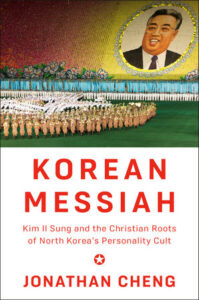
From Korean Messiah: Kim Il Sung and the Christian Roots of North Korea’s Personality Cult by Jonathan Cheng. Copyright © 2026. Available from Alfred A. Knopf, an imprint of Knopf Doubleday Publishing Group, a division of Penguin Random House, LLC. Korean Messiah has been shortlisted for the 2026 Cundill History Prize.
Jonathan Cheng
Jonathan Cheng is the China bureau chief for The Wall Street Journal, and was previously the Korea bureau chief, running coverage of the Korean peninsula, including politics and society in both North and South Korea. A native of Toronto, he lives in Beijing. He has traveled to North Korea twice.