The Craft Challenges of Writing Political Fiction
Abigail Savitch-Lew on the Twelve-Year Struggle Behind Her Debut Novel
In the 1950s, the Iowa Writers Workshop received funding from the CIA to push a writing style that centered the emotional life of the individual while decentering the social and political forces that shape human behavior. “The Workshop popularized an idea of craft as non-ideological,” writes Matthew Salesses, summarizing Eric Bennet’s history of post-World War II MFA programs, “but its claims should make clear that individualism is itself an ideology.”
This ideology—that good craft centers “apolitical” individualism—has continued to affect the teaching of writing well into the 21st century. In 2010, my peers in an undergraduate creative writing workshop critiqued my work as “too political.” Granted, there was a lot to criticize in my writing, which was suffering from all sorts of problems, from structural incoherence to insufficient character development to—yes—didactic heavy-handedness that broke the reader’s immersion. Yet even as I tried to absorb their feedback, I was resistant to the notion that there was such a thing as “too political” fiction.
What, anyway, is a political novel? There is no single definition. For some, who apply the term broadly, it’s any book of fiction engrossed in political and social themes and asking difficult questions; for others, it’s a novel with a specific message about the way power is distributed or society organized. In the least flattering of definitions, it’s ham-fisted propaganda. While I did not want my writing to feel like the tracts stuffed in my hands whenever I changed trains at Atlantic Avenue, I did want to do more than ask questions.
I learned by doing—and by failing, a dozen times.
My favorite novelists—Toni Morrison, Gabriel García Márquez, Leo Tolstoy—expressed opinions through their work. And, as a biracial millennial New Yorker growing up in an age of endless war, financial recession, anti-Black violence, Islamophobia, a surging eviction crisis, and climate disaster, it felt like a moral abdication not to have an opinion. In college, I decided that I was going to be a proud writer of political fiction. I just needed to learn to do it effectively.
When I graduated, I began working on my debut novel, Livonia Chow Mein. I learned by doing—and by failing, a dozen times. The writing process took twelve years from start to publication.
Livonia Chow Mein was always about a family of Chinese immigrants living in Brownsville, Brooklyn during the 20th century, but early drafts lacked any kind of propulsive force. They included long passages describing the lives of the immigrant characters, systemic barriers they faced, and the characters’ prejudices against Black Americans. These were interwoven with chapters set in the present-tense and centering Cleo, the descendent of these immigrants and, like me, a half-white, half-Chinese millennial. They explored how Cleo’s blind spots led her to engage in problematic ways with Black Brooklynites.
Clearly I had plenty to say—about xenophobia, anti-Black racism within Chinese families, and my own mistakes—but I was admittedly asking a lot from readers. The story was plodding, the characters frustrating, and the transitions through time poorly executed.
Several years into the revision process and after receiving valuable feedback from Jess Row and others, I realized I needed a plot that would both hook readers and tighten the connections between the various threads of the story. There was a seed for this in the original manuscript; a vague suggestion that Richard, Cleo’s grandfather and one of the Chinese immigrant characters, had participated in an act of arson that had burned down the home of an Afro-Latina character named Lina. My friend Lorenzo Menajem Davis suggested I start the novel with the fire itself.
It became clear to me, then, that Livonia Chow Mein could work as a whodunnit story, a crime mystery. As Tobias Carroll writes, this is a classical strategy to draw readers into political fiction; writers like Derek Raymond and Paco Ignacio Taibo employ “elements of crime fiction to comment on the societies that produced them” and to “point to systemic issues that cannot be neatly solved by a dogged investigator.” After this revision, there was now a reason for readers to spend time with my characters in their daily lives, and to travel through time with them: they’d want to crack the case.
I struggled, too, in early drafts, with a level of cringe in some of my characters.
I’ll add—and spoiler alert here—that equally important to adopting the structure of a crime mystery was deciding who was the culprit. At first, I thought it was Richard—this, after all, seemed to fit with my original goal of exposing anti-Blackness in Chinese communities. Yet some part of me knew that making Richard guilty of an unconscionable crime was contrary to other goals: of writing complex, believable, empathetic characters, of giving Black and Chinese readers an opportunity to walk in each other’s shoes, and of encouraging cross-racial solidarity in the fight against white supremacist structures.
Ultimately, I decided that Richard would be complicit in the crime, but not its primary architect. The real culprits—an arson ring called “The Leviathans”—would remain somewhat intangible and clothed in mystery, characterized by little more than its members’ wealthiness and whiteness. My hope is that I’ve managed to both retain the complexity of my central characters and prevent an overly neat ending while still leveling a critique of immigrant complicity in white supremacy.
I struggled, too, in early drafts, with a level of cringe in some of my characters. What made the passages with Cleo cringe was not only that Cleo made wrongful assumptions about the Black people she met in Brownsville. It was, rather, a cringey move on the part of the writer: I had invented a series of Black and Brown characters, including Lina and others, who appeared to exist merely to enlighten Cleo. These Black and Brown characters were likeable, but they had no flaws, no arcs—nothing to suggest they were human and that their emotional lives deserved as much attention as Cleo’s. I had fallen into a pattern that emerges too often in multiracial storytelling by white writers, nicknamed the “Black best friend” trope.
I wanted to give readers a window into real-world debates and an opportunity to weigh the arguments.
When early readers pointed this out, I was embarrassed, but I also found it difficult to revise. I was anxious: what if, in the process of making my Black characters more flawed, they read as negative stereotypes? Also: my Black characters came bearing truths about race and politics that I still believed in and wanted to convey through the story: that Black people do not need white saviors, and that guilt-driven white (or Asian) allyship is not an effective tool against racial oppression. If I made my Black characters more complicated humans, would I risk distracting readers from this message? Such questions of representation are often raised in discussions of “how to write the other” but they also emerge in the process of writing political fiction. The difficulty is creating space for a righteous character’s wisdom without reducing them to an angelic caricature.
Ultimately, I spent the next several years hanging out with Lina, on the page and in my head. It was a process of getting to know her whole story—her relationships with her siblings, her romantic life, and her experience of being of both Puerto Rican and African American descent. It eventually became clear to me what should have been obvious: Lina was likeable and possessed critical insights into race in America, but in private, she suffered from PTSD, survivor’s guilt, and cynicism—and she deserved her own journey to heal. I ended up deleting all of Cleo’s chapters and replacing them with a story thread focused on Lina and a new character named Sadie (a young woman similar to Cleo but a bit less self-pitying). In the final manuscript, Lina and Sadie are both of equal importance, as are the distinct lessons they learn in their relationship with each other.
Finally, I had to learn to create a balanced debate with emotional stakes. For much of the time I was working on Livonia Chow Mein, I was employed as a city reporter covering urban policy issues. This experience, along with the research I was doing on Brownsville’s history, soon found its way into the pages of the novel. I had started Livonia with something to say about interpersonal relationships between Chinese and Black Brooklynites; now I had even more to say—about the inequities perpetuated by government policies.
I felt my novel’s message would be stronger if I played fair and “showed both sides.” While I’m more politically aligned with Lina and her fellow community organizers, I gave my fictional real estate developers and city planners time on the page to make their best case. I wanted to give readers a window into real-world debates and an opportunity to weigh the arguments.
The evil secret of journalism is that there is no such thing as neutrality: every article has a slant, determined by the details and context the reporter chooses to include (whether the reporter is aware of this or not). The trick of the journalist is to make a piece feel as fair as possible to the typical reader of the publication. I think the same is true of writing political fiction: to avoid lecturing, a writer must allow the reader enough space to have their own opinions, or at least the illusion of such space. The reader must, unknown to themselves, be so moved by the emotional stakes of the debate that only one outcome feels justifiable.
In the case of Livonia, I am hoping that even a pro-development reader like New York Times columnist Ezra Klein, co-author of Abundance, would be so taken by Lina’s multi-decade struggle for community control that he could not help but want her to win, even if his feelings contradicted his public stance on economic development. If that emotional tug forces him to ask questions he hasn’t yet asked, I will have done something I could not have accomplished as a journalist—something that can only be done by a political novelist.
__________________________________
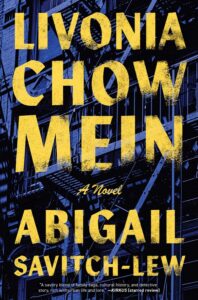
Livonia Chow Mein by Abigail Savitch-Lew is available from S&S, an imprint of Simon and Schuster.

Abigail Savitch-Lew
Abigail Savitch-Lew is a writer of fiction and nonfiction and an American of Jewish and Chinese (Ashkenazi and Toisanese) descent. She has a BA in literary arts from Brown University and an MFA in fiction from Rutgers University-Newark. She is the author of the novel Livonia Chow Mein, and her short stories have been published in The Round, Post Road, The Best Teen Writing of 2010, and The Apprentice Writer. Previously, she was a staff reporter for City Limits, an Asian American Writers’ Workshop Margins Fellow, and an adjunct professor of creative writing at Rutgers. She lives in Brooklyn with her husband, the artist Emmanuel Knight, her sister-in-law, and their cat.