The Before
Evie eased onto the thin goose‑feather mattress and set her mouth to tell her man that it had been a good day, a good night, but Atlas whispered to her first.
“Man in Monroe want to buy the chair for his wife. A gift for Christmas,” he said.
And the way he leaned in close, she could tell he was trying not to wake the baby girl between them. That made her feel tender toward him. Considering his mother, where he came from, she was always looking for those kind gestures from him. She would never say it aloud, but Evie knew in her heart that not all humans were meant to be parents. Her biggest fear was finding a bit of that truth in the man she loved.
In another life, a life that was kind to black people, Atlas would’ve been a scientist or a king or a master craftsman. He carved all sorts of creatures as gifts for their children. They had doll babies and houses and smooth wooden bears. He’d even hand‑carved a wooden bust of Evie before the children were born. It was the only likeness of a person he’d ever made and the only one of his creations Evie wouldn’t allow to be sold. She considered it her most prized possession and she kept it hidden, even from him.
Atlas had spent months working on the chair he now wanted to sell. He’d carefully smoothed out the thick chestnut oak and made the high back look like a throne. Evie’s favorite thing about it was the way he’d carved the jackal‑headed Egyptian man and woman on the seat back. The chair was entirely wooden and therefore likely uncomfortable to sit on for extended periods, but she’d hoped he’d save the throne for himself. Or for her. It was something she wanted to pass on to their children. A good thing to cancel out so much bad.
He had finished it on a Saturday some months ago. When he called her out to the barn and she set her eyes on it, she loved him right there on the ground. Took no thought for the children or the horse or the mule or for anything else that could’ve happened upon them; he’d clawed ravenously at her breasts before she tore at the rope that held up his pants. They were careless in ways they hadn’t been in a long while.
After they were spent, she rested her head on his chest. “Been thinking of Beulah lately. Wish I could’ve give her something like this here chair,” he said. Bile rose in Evie’s throat and her body stiffened under his touch.
Atlas’s mother had been part of their life together even if they didn’t speak of her often. Evie found it strange that he’d picked that moment to bring her up. That moment that found him with his pants down past his hips and her dress caught up over her breasts. The air hitting her nipples, causing them to firm. The most private parts of themselves in the open and there he was thinking of Beulah. A woman with no secrets. A woman with no shame or sense enough to hide her senselessness. Evie thought of that lovemaking when he mentioned the sale of the chair and she thought of Beulah Gardner before she whispered across their daughter’s head. “Man know the quality that chair? That it ain’t easy to come by. Hope he willing to part with at least three dollars for it.”
Atlas sighed. “More than likely, man gone give me what he want me to have. Ain’t really no arguing that.”
She smacked her lips and placed her hand on the back of the baby, who was now stirring, her tiny hand landing softly on her father’s face. And then the child began to whimper, slowly waking from her sleep. “No,” she whined in a raspy voice. “Pa, no go. Him burn.”
Evie felt Atlas’s side of the bed freeze, go stiff, as if frigid air had suddenly come along, causing his breath and all bodily functions to stop. She couldn’t hear a thing except the pulsing of her own heart. The inside of her went warm and then hot, like the words had set her aflame. She brought her hand to her neck, like a reflex, and was close to clawing at herself when the flute of her breathing opened and all the outside sounds, the crickets, the cicadas, and the crows, erupted in her ear. It seemed as if the child’s words stretched out for hours between them before Evie could finally inhale. And then she shushed her daughter too late and too soft.
“What that baby say?” Atlas asked, scooting away from the child. “What she say?” Evie could hear how disturbed he was by the rattle in his voice.
And there it was. She recognized the thing in that voice—the thing in him. The baby shouldn’t have been making words so young. Yes, that was disturbing. She was just a little over a year. Through the darkness, Evie watched and felt the distance he created between himself and the child. That baby is your daughter. Our little girl, she wanted to tell him.
Evie knew what they said about her husband. About what made his mother. She had watched him closely with the other children. Watched to see if he could hurt them. With Nannie, she had let her guard down. After all, he’d been a good father to the other six. A doting one even. And he was learned in a way that Beulah had never been. He was almost a genius. He read to them each evening. Dreamed of schools far away from cotton fields for his children. He wasn’t one for superstition and conjuring tales. Atlas was a good man. He was nothing like what made him.
But as the silence hung above them, for the first time Evie felt a strangeness in him.
Eventually, he settled down, allowing the tension of the moment to dissipate. He let Nannie climb onto his chest and hummed her a song until her soft whimpers turned to snores. Evie stayed awake all night, playing the child’s words in her head. Pa, no go. Him burn. And she stayed awake watching over her baby, making sure that Beulah’s ghost didn’t surface in their home. At some point, just before morning, it dawned on Evie that this was a different situation. Beulah had killed her child for a different reason. Her child hadn’t seen Beulah’s death. Beulah had touched him and seen his.
In Evie’s mind, it seemed fitting—right—the time given Atlas’s mother in the Louisiana State Penitentiary. She’d drowned her own baby just a few days after giving birth to him. What felt wrong to Evie was that Beulah was ever let out at all. She’d served only a few years before she was released after saving the lives of two white children drowning in a pond on the prison property. After, she was ostracized by her own community and lived the rest of her life isolated in a shack in the woods. Everyone knew the story. Knew that Beulah’s mind had rattled loose. Her surviving children were all raised by relatives and other different people in the community. They tried visiting her, but no one ever really knew Beulah after she murdered her child.
The After
It had been three days since Evie had seen Atlas. She hadn’t slept or eaten or done much outside of take care of the children. His absence wasn’t normal. Atlas was a man who came home to his family every day. He didn’t drink. Didn’t put his hands on his wife more than he was supposed to.
He’d told Evie he was going to Monroe, which wasn’t even an hour’s walk. Maybe, she thought, he stopped by to see one of his siblings or another relative. She didn’t want to think about the only place he’d ever disappeared to like this, but she couldn’t help it. The woman’s face was etched in her memory. She’d never be free—they’d never be free—of that woman or the child Atlas made with her.
On that third day, she sat on the porch shelling peas. She was numb. She’d been slow to start that morning. She’d had to bandage up Two’s foot after he stepped on a rusted framing nail that went straight through, from sole to top. She’d taken that as a bad sign, an omen even. Two was the oldest and strongest of their children. The boy moved through the crops much faster and more careful than anyone she knew, including her and Atlas. He was the leader—the driver of their children on days when Atlas couldn’t be in the fields. He’d lead them all down the steps of the porch and set them on the path to the cotton, like some mother duckling taking her little ones to a pond. She’d walked the house with sage and then pulled the bust from underneath the floorboards and sat with it for a while, placed her hands on it and prayed for Atlas’s return. When one of her husband’s brothers, Exie Gray, arrived out of breath, she’d only been on the porch with the peas for an hour or so and had hardly filled her bucket. There was panic on Exie Gray’s sandy-colored face and a slight terror in his eyes. “You got to come with me,
Evie,” he said. “Celestine say they got Atlas.” And for a moment, she sat
there with a pod caught between both thumbs and index fingers. “Huh?” she finally uttered. “Who got him? What you mean?” Those words were familiar to her. They got him. They got a brother and sister of hers in 1919 and her father before that in 1910. Surely it wasn’t how he was saying it. Not Atlas. Not in 1936.
She stretched out her neck, like a cat looking for what cats look for, and allowed her eyes to graze the cotton field that stretched out as far as she could see. She squinted. Sometimes the children played a game where they blindfolded one and gave him a spin. When his eyes were finally freed, he was tasked with turning his head without turning his body and locating the Bolden house from wherever they were on the land. It was never an easy win. Sometimes the cornstalks were too tall. Sometimes the sun was too bright, or the moon wasn’t bright enough. A smart winner would usually squint his eyes and angle his head just right to make out the grand house far off in the distance. That day was perfect for playing the game. No bright sun. No tall stalks. The big house sat clear, taunting their one‑room shack with its size, her children somewhere swallowed in the expansiveness of the land. She exhaled, shifting her eyes over her shoulder. Nannie had risen from where she’d been sitting with the pea casings before Exie Gray’s arrival and was standing behind her. The shells usually kept her occupied while her mother worked. Evie often listened as the child counted them, spoke to them in a way that she wondered about. She hadn’t taught the girl to count and the other children hadn’t spoken complete sentences the way Nannie did until close to their third birthdays.
Evie’s eyes widened when they set on the child. She snatched her up and strapped her to her back before they started down the hill, toward the edge of the property, where they set out to follow Exie Gray to Monroe on foot.
It took them a little over an hour to get there. When they were close enough to hear the noise of a crowd, Exie Gray turned to her and said, “Let’s steer clear of the commotion, Evie. We don’t want to . . .” And he let his words trail off.
They stood just beyond a crowd of about a hundred white men, women, and a few children. Other blacks stood near Exie Gray and Evie, just far enough to get away if the man they had wasn’t enough for the hungry mob; the heads of the blacks were slightly bent toward the ground, but their eyes were on the hanging man.
“Lord, Jesus. Give her to me,” Exie Gray said, looking toward the hanged man. Then he grabbed at Nannie and freed her from her mother’s back. “She don’t need to see this.”
He hung from a post in the center of everything, not moving or screaming but badly bloodied and bruised and burning. It dawned on Evie as she looked down at the ground and then up at him that he was already dead. That she’d missed that part. She stood there and watched without watching, never allowing a tear to fall from her eye. She stood there as long as she could, committing the scene to memory before turning her back to the hanged man and scanning for Exie Gray, who was holding Nannie’s hand a few feet away from her. Nannie’s eyes were peering in the direction that hers had just turned away from. Her little lips were moving and there were no tears in her eyes. Evie turned back to the man on the stake, rested her hand on her protruding stomach, and thought of the other children in Mr. Bolden’s cotton field. She stood there as if Atlas—her Atlas—was telling a joke or preaching one of his sermons or making furniture out in the barn. She stood there as if watching him burn was a normal activity. A thing she did every day.
The corners of her lips twitched the same way they would when she
was trying to keep from laughing at a joke he’d told. Never had such sweet filth touched her nostrils. The charcoal scent of his hair, the metallic, sulfuric stench of his blood, and the putridity of his organs would haunt her every time she caught the scent of roasting meat. She would always remember his flesh falling from his body in charred chunks and white people cheering while those few blacks around her swayed in sorrow.
“Atlas. Atlas,” she whispered, inhaling every part of her man.
At some point, she closed her eyes and thought of the life they made together. Of the shack and how they squeezed their family into it. She thought of Mr. Bolden and how often he smiled on Atlas. How he vouched for him with other whites. Called him a “good boy.” She thought of how smart her man was, how often Mr. Bolden asked him for help with his books. How Mr. Bolden often wondered out loud how Atlas had come to know so many things. She felt herself smiling as she thought about the book he often read to them at night. The Three Musketeers. It was his favorite. So much that he’d named their second‑born D’Artagnan.
They had laughed about it, as Evie thought D’Artagnan a fool. She rallied for Aramis, who she believed made the best choice in the end. But when Atlas explained D’Artagnan’s passion, compared it to the world he wanted to build for her and the children, she embraced the name he’d chosen.
And she’d almost forgotten Nannie was there when the child slipped her little hand into Evie’s free one and said, “Pa. Him burn.” And then the little girl started to cry, making Evie aware of her in a way that no mother wants to be aware of her child. Of what her little lips must’ve been saying when she saw them moving moments earlier. Of what she had said three nights ago. She knelt in front of the child, still clutching her hand. “Did you do this, child? What did you do?” she asked, trying her best to cage her tongue with her teeth.
She could feel tears forming. She wanted to shake the life from her child; she wanted to do what Beulah had done.
“How did you know?” she asked weakly. “What curse done passed through your lips?”
“Pa. Him burn,” Nannie whined again. Evie stood up, keeping her eyes on the child, who she realized was not a child at all but something else altogether. Something not of her world; something wicked and unkind. She let go of the girl’s hand and never meant to touch her again.
__________________________________
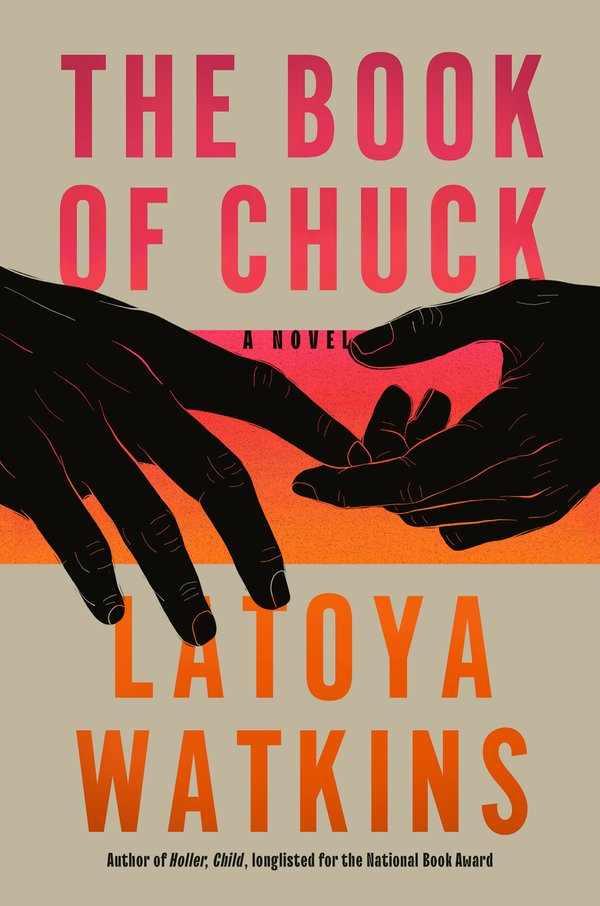
From The Book of Chuck by LaToya Watkins, published on August 18, 2026 by Tiny Reparations Books, an imprint of Penguin Publishing Group, a division of Penguin Random House LLC. Copyright © 2026 by LaToya Watkins