







The Annotated Nightstand: What Katrina Dodson is Reading Now, and Next
Featuring Nicholas Boggs, Tom Overton, Mónica de la Torre, and More
Small horn toot for the hundredth Annotated Nightstand! Thrilled to have this incredible guest for this milestone column. For years I have considered Katrina Dodson a high priestess of translation, quietly yet relentlessly exerting herself in her work translating Brazilian literature into English, including Mário de Andrade’s playful, slippery, iconic Macunaíma: The Hero with No Character. But Dodson is best known for her unparalleled translations of Clarice Lispector. How many to-read lists were graced with The Complete Stories for what felt like years? I read it at a slow drip, hefted from my nightstand nightly before sleep. It took me two luxurious years to get through the doorstop of Lisepctor’s short fiction. When finished, I had a similar sensation as when reading Stephen Mitchell’s Rilke translations—how two formidable minds (writer and translator) came together in the creation of this work in English, and how deeply the latter exerted herself to honor the original author. The Complete Stories was undeniable, rigorous, and a labor of love. (Dodson writes amazingly of this effort at The Believer—including talking to a psychic.)
For those who yearn for a more totable collection of Lispector via Dodson, she has provided just that with Covert Joy: Selected Stories, just out in paperback. This has some of Lispector’s greatest, including “The Smallest Woman in the World,” “The Egg and the Chicken,” “Happy Birthday”—totaling to twenty pieces. Covert Joy also includes new short essays by Rachel Kushner and one of Lispector’s sons, Paulo Gurgel Valente. Valente writes of hearing his mother’s typewriter while he slept, finding her on the couch each morning when he awoke. “There she sat, with the typewriter on her lap,” he writes, “creating all those stories, right from the moment that I started to understand who I was.”
— Diana Arterian
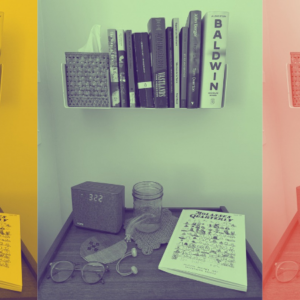
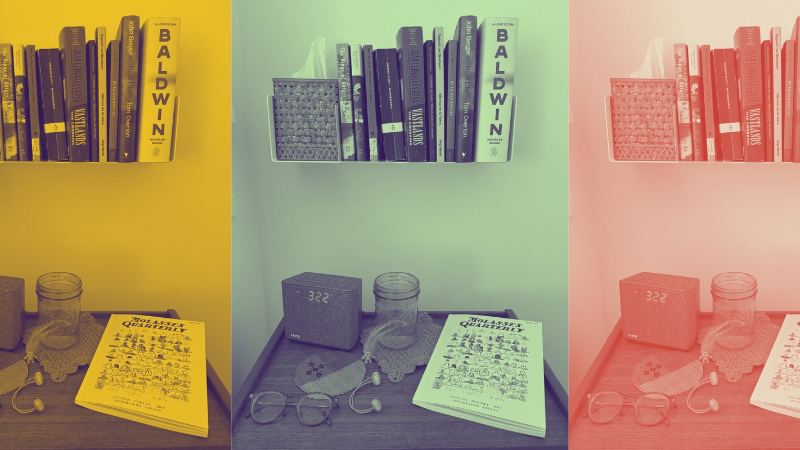
My nightstand got so out of control that I installed a floating shelf for books and my Kleenex box (in a metal holder from my salad days in San Francisco when I was constantly thrifting). Here’s what remains on the nightstand:
— my beloved clock radio (to wake up to the news or WFMU 91.1)
— my glasses (though sometimes I read in bed with one eye super close to the book)
— a coaster from my last trip to Vietnam, where we visited my mom’s village
— a doily made by a friend’s mom, used as another coaster for tea or my three-year-old daughter’s milk cup when we read at bedtime
— random toddler detritus: one of the tiny trolls that the makeup artist on my husband’s last film job was handing out, and a sparkly hair tie
— the new issue of Molasses Quarterly that I just picked up at Molasses Books in Bushwick, Brooklyn, which I think of as the translators’ clubhouse, since I always see translator friends there, at events like the Us&Them reading series. I did an interview for this issue with the shop’s owner Matt “Hen” Winn.
I was starting to worry that my reading brain was broken after a) too much compulsory reading for work and b) three tender and harrowing years of being a mom. Thankfully, I’ve turned a corner and am feeling triumphant about finishing W.G. Sebald’s The Rings of Saturn after a decade of repeatedly picking it up, then petering out. I got so addicted to his digressive, dense-yet-hallucinatory style that I went right into The Emigrants. But I’m feeling the most triumphant about having read Middlemarch (for the first time!), which becomes a page-turner somewhere past the 400-page mark. I was inspired to read it by my friend Sarah Chihaya, who is writing about it in her moving and compelling book, Incomplete Works (still in copy edits). So Sarah and George Eliot healed my reading brain! Hallelujah! Here’s what else I’ve been reading:

Nicholas Boggs, Baldwin: A Love Story
This is an incredible labor of love, a work of deep, deep care, imagination, and research. I adore how Boggs captures James Baldwin’s many lives in various milieus, from Harlem to Paris and Switzerland and back to the West Village and beyond, but also reads Baldwin’s work in a nuanced way without forcing overly biographical interpretations. My friend, filmmaker Barry Jenkins (who adapted If Beale Street Could Talk), devoured it in a week, but I’m savoring it slowly, checking in with Jimmy at regular intervals.
Tom Overton, John Berger: From Life
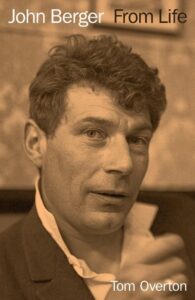
I’m excited to start this biography of John Berger, one of my favorite people to think and look alongside; he’s so charismatic on the page but also on the screen, especially in his 1972 BBC television series Ways of Seeing. Another filmmaker friend, Brett Story, is working on a documentary about Berger and recently gave a riveting talk about her process, so I’ve been thinking about his life and its contradictions lately.
Jen Calleja, Fair: The Life-Art of Translation
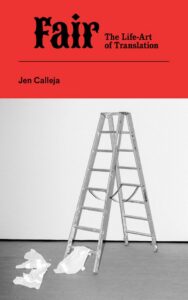
Speaking of life and art together, the British writer and translator Jen Calleja recently visited my MFA seminar at Columbia University while on tour for her book, which just came out in North America. It’s a kaleidoscopic window onto what happens in a translator’s inner and outer worlds, something like Kate Briggs’s This Little Art, but with a punk-clown vibe. I recommend it as a handbook for anyone interested in becoming a translator and entering this strange carnival, or fair, if you will.
Mónica de la Torre, Repetition Nineteen
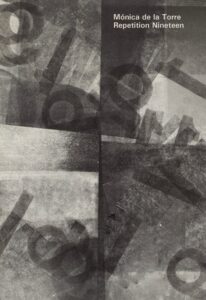
My course this semester is called “Impossible Translations,” and we just read this collection of poetry and short essays that find their energy in the accidental collisions and missed connections that happen when we move between languages. Mónica also visited our class and talked about leaving behind her Mexican poet self when she moved to New York in the ’90s and started writing in English, and how Repetition Nineteen was a way of opening all the valves that she usually turns on one at a time. One section cycles through retranslations of a poem she originally wrote in Spanish, including a homophonic translation by someone who barely speaks Spanish and a poem that her phone’s autocorrect function created in English from the Spanish version that she texted to a friend.
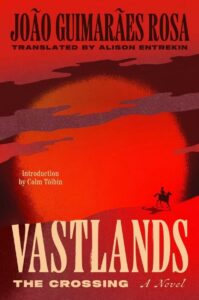
João Guimarães Rosa, Vastlands: The Crossing (translated by Alison Entrekin)
This is coming out next January and will be the translation event of 2027 and a huge landmark for Brazilian literature in translation. There are two books known as “the Brazilian Ulysses,” for the ambitious scope of their language experiments and the epic journeys they depict. One is Mário de Andrade’s 1928 modernist classic, Macunaíma: The Hero with No Character, which I translated, and this is the other: João Guimarães Rosa’s 1956 Grande sertão: veredas, previously translated into English as a kind of Western gothic, The Devil to Pay in the Backlands. Alison’s been working on this much-needed new translation for over ten years, and when I opened the galley, it made my head explode. It’s so gorgeous and hypnotic; I can’t believe what she’s done with it. Get ready!

Diana Arterian
Diana Arterian is the author of the recent poetry collection Agrippina the Younger (Northwestern UP, 2025), which received the 2026 William Carlos Williams Award from the Poetry Society of America. She is also editor and co-translator of Smoke Drifts (World Poetry Books, 2025), a collection of Nadia Anjuman's poetry. A Poetry Editor at Noemi Press, Diana has received fellowships from the Banff Centre, Millay Arts, and Yaddo. She writes “The Annotated Nightstand” column at Lit Hub and lives in Los Angeles.