I nearly didn’t make it to Paris.
We were about to board the plane in Berlin when the airline personnel announced that the airport was being closed because of the gale-force winds. I looked out through a large window. Gale-force winds? What gale-force winds? Rumors began to circulate around us passengers that the airport, whether due to these mysterious winds or to some capitalist plot, would not be reopening until the following day. Some left in a temper. Others exchanged their tickets. I went and sat down in a chair, resigned but still worried because I might not make it in time for my conversation that night at the Fondation Cartier with the Mexican photographer Graciela Iturbide. After a three-hour wait, however, we were informed that the winds had abated a little or at least had stopped being so gale-forced and the airport authorities had decided to resume the operations of the takeoff and landing of airplanes, and we all boarded. When we finally got to Paris, just an hour before my event was set to begin, a rather young and confused airline rep told us in bad English that not a single one of the suitcases had arrived, and I, already rushing for the exit with just my leather satchel over my shoulder, imagined a huge beautiful whirlwind carrying them all off through the grayish Berlin sky.
A taxi driver of Algerian heritage, more chatty than friendly, comprehended how anxious I was and drove like a maniac down the highway and then through the narrow streets of Paris to drop me off at the entrance of the Fondation Cartier. I was a bit nauseous, a little disheveled, but on time.
In front of the building, standing on the sidewalk, were Graciela Iturbide and my friend Alexis Fabry, the moderator of the event and curator of Graciela’s retrospective show, whose opening we were there to mark. I was surprised to see them standing outside, until I noticed Graciela was holding a cigarette. I greeted Alexis with a hug and told Graciela I was delighted to meet her. Then I apologized to them both, telling them the story of my delay and also explaining my casual and disheveled dress. Graciela smiled and, perfectly grasping my state of mind, held out the white-and-gold pack of Marlboros and offered me a cigarette, and the cloying smoke immediately made me feel better, both more awake and more relaxed. Well, you look very elegant to me, Eduardo, said Graciela, holding my hand in both of hers just as my Egyptian grandmother used to do in years gone by—as if the two of them, Graciela and my grandmother, wanted to take care of me or protect me from something with just their hands. We smoked for a few more moments in a pleasant silence, until Alexis said it was time to go in.
The hall was full. There were people on all the chairs and sitting on the floor in the aisles and even standing at the back, leaning up against the wall. The three of us walked onto the stage and sat down in black leather armchairs. After a few words of introduction, Alexis started asking Graciela and me questions about our creative processes, about the importance of surprises in art, about the relationship between photographs and stories, about memory and mourning and pain. The conversation with Graciela was enjoyable, fluent, sometimes very emotional. She talked about the death of her teacher and mentor, the photographer Manuel Álvarez Bravo, and about the death of her daughter at the age of six; I talked about the slow death of my Polish grandfather while he raved delirious in his bed (he believed he was once again a prisoner in Auschwitz, that there was a troop of SS soldiers right there in his room, waiting to take him away in the small hours to the much-feared black wall of Auschwitz’s Block 11, where he would be shot), and about the death of the boy Salomón, my father’s older brother (an actress did a reading in French of that extract from one of my books). After an hour of conversation, Alexis opened it up to the audience, a group comprising an infinite succession of anonymous faces that I had barely been able to make out because of the spotlights pointed directly at me. One gentleman requested the microphone and asked Graciela about the new photographs of stones that she had taken specially for this exhibition. A woman standing at the back of the hall asked me in French about the story I’d written for the catalog, and which did in fact end with the boy Salomón’s premature and mysterious death. Another woman asked Graciela about her famous picture of the lady of the iguanas. Then Alexis announced we only had time for one last question, and a woman stood up in the front row and requested the microphone and asked me nervously, stammering a bit, about my relationship with Guatemala and with Judaism, and before answering—an answer I know by heart—I sat in silence for a few seconds and brought my hand to my forehead to block out the intense white light.
Regina?
*
I woke up too early despite my tiredness and not having had enough sleep, and I just lay there on my back in bed, letting the rest of the Parisian world wake up too. The daylight was only just starting to be daylight. The bedroom, on a corner of the building, was the shape of an irregular quadrangle. The mattress on the bed was a little short and my bare feet hung off the edge, beyond the light white sheet. I looked at my feet for some time, motionless, focused—while my hand was seeking or feeling or seeming to feel the lump in my belly—and I went on looking at my feet until suddenly I had the clear image of a small beige tag tied to my right big toe. My feet were now the feet of a dead man. My feet were my feet in the morgue and my eyes were the eyes of my son looking at the feet of his father.
I was dead and lying faceup on a metal slab in the morgue, with a white sheet covering me, all except my feet, those same feet that were now poking out at the far end of this other white sheet and hanging off the edge. And my son came into the morgue and walked over to the metal slab, whose surface was at his exact height, and looked at the small beige tag and then looked at the pale uncovered feet hanging off the edge and in those dead feet he was able to recognize his father.
I leaped out of bed, as if shaking off not only the white sheet but also those images and thoughts.
I took a leisurely shower, in the thick lethargy of sleeplessness, and still naked I started to walk around the bedroom, somewhat indecisive, trailing water and leaving dark stains on an old terracotta-colored carpet. Finally I got dressed in the same clothes as the night before and, shouldering my leather satchel full of papers and books and pencils and even a black prehistoric talisman (because any literary act, as a stuttering friend used to say, needs a talisman), I left the small third-floor room and also the small hotel on the place de l’Odéon.
The February air was motionless, intangible. The clouds were a single heavy gray dome, and I made the same walk to the same café, located on a dark, rarely visited corner opposite the Jardin du Luxembourg, inside of which time seemed to stand still. I’ve never known, nor even cared, what it was called. It’s too noisy. The wooden chairs are hard and uncomfortable. It smells of mothballs. The coffee is good, though not great. The croissants and baguettes are undoubtedly made at an industrial bakery. But when I’m in Paris, I like staying at the same hotel, if I can, and going out early from that same irregular corner room on the third floor, if it’s available, and having a croissant for breakfast in that same café and then sitting for a few hours, drinking several espressos while I read a bit and write by hand. I never write by hand, and I never write in cafés. But once, years ago, on a brief stop in Paris, I did write in that small café, by hand and in a burst and on a series of paper napkins that I went on filling up and crossing out as if deranged, a key scene about the death of the boy Salomón. And since then, whenever I’m in Paris, I like to repeat that same ritual every morning, maybe out of superstition, or maybe out of gratitude to the old man with the white hair and Cossack beard who’s always behind the bar and who serves me without the slightest trace of enthusiasm, or maybe out of hope, thus far unfulfilled, that that magical literary outburst might strike again.
And sitting in my usual chair, beside the window overlooking the black bars surrounding the Jardin du Luxembourg, and with a mediocre croissant and a still-warm espresso on the table, I saw Regina come in.
__________________________________
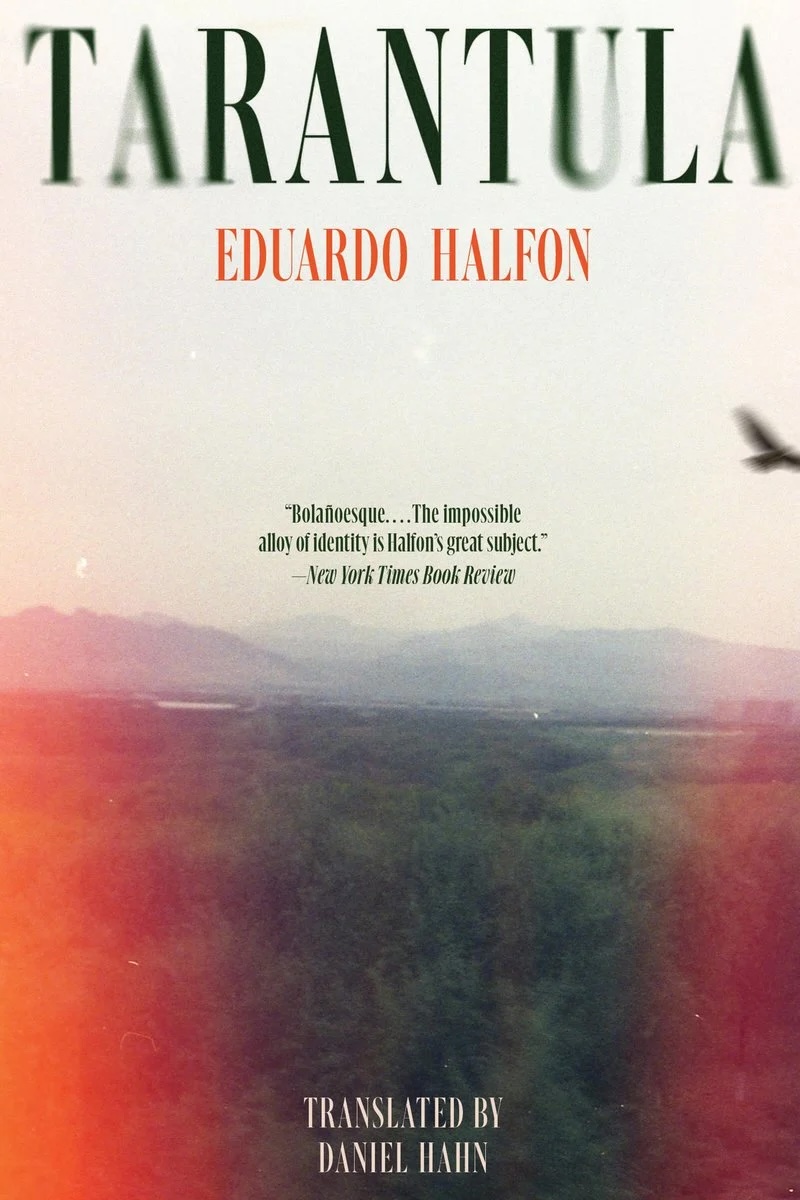
From Tarantula by Eduardo Halfon. Translation copyright © 2026 by Daniel Hahn. Published by Bellevue Literary Press: www.blpress.org. Used by permission of the publisher. All rights reserved.