Searching For the Elusive Snow Leopard Deep in the Himalayas
Kulbhushansingh Suryawanshi Explores the Habitat and Habits of a Majestic Animal
The Himalaya, India, January 2008
At minus sixteen degrees Celsius, it was warm for a winter’s day in the Himalaya. I was in the Spiti Valley of Himachal Pradesh, a huge gorge that cuts deep into the mountains of the Greater Himalaya and Tibet. Wind‑lashed, with temperatures dropping as low as minus thirty‑five degrees Celsius, this is a high‑altitude land of vertical rock faces and torrential glacier‑melt rivers.
I had come to study the winter foraging behavior of the blue sheep (Pseudois nayaur), a unique species of wild goat with sheeplike traits. Standing some ninety centimeters tall at the shoulder, the blue sheep live in herds that range as high as nineteen thousand feet above sea level. Superb climbers, they have an uncanny ability to “disappear” into the slopes and cliffs, where their gray coats camouflage them against the rocky backdrop. When startled, they give a burst of three or four loud football‑referee‑type whistles to alert their herd to danger. The males have thick, ridged horns that curl sideways and back, whereas the females have thin, short, straight horns. Found across the Tibetan Plateau and the Greater Himalaya, these blue sheep are known by many names—bharal in Hindi, yán yáng in Mandarin, naur in Nepali, na or sna in Tibetan, and more—and are the snow leopard’s favored prey.
My plan was to spend the winter of 2007 in Spiti, tracking the blue sheep herds as they foraged, meticulously recording their behavior and the plants they chose to eat.
Seeing the snow leopard changed the course of my life, and every new snow leopard sighting reminds me to go in search of the unknown, instills me with a sense of meaning and purpose.
That particular day, I had left camp at six in the morning and by half past seven reached the spot where I had seen blue sheep the day before—but there was no sign of them. I thought they might have gone beyond the next hill, but no such luck. After another two hours of looking for my study herd, I decided to rest a while before resuming the search. Tired and cold, I was now at the edge of a rolling plateau named Hom. On my right was a gorge, a vertiginous thousand‑meter drop to the Shilla River, an important tributary of the Spiti. When a golden eagle flew below me in the gorge, I pulled out my camera to photograph this king of the Himalayan birds, but the device refused to start; its battery had been drained by the chill.
An hour of hard climbing through knee‑deep snow took me to the crest of the plateau at an altitude of forty‑five hundred meters. I gasped for breath in the rarefied air. The endless Tibetan steppe extended in front of me, the dark and frigid gorge to the Shilla River on my right. Resting my weight on my ice axe, I was admiring the panoramic view when the cliffs below me suddenly came alive as a house‑sized boulder plunged with a crash into the gorge. By now, I was used to seeing rockfalls but never anything of this scale. A deep silence followed.
A chirpy whistle broke the quiet: the blue sheep’s alarm call. It rang from somewhere very close, but I couldn’t see the animals. Then I spotted them nearby in the gorge—a group of twelve blue sheep grazing on one of the rock ledges only a hundred or so feet diagonally below me. My systematic observation of their behavior and feeding could finally begin. Over an hour passed without much activity from the herd. The sky turned gray, and feathery flakes of powdered snow filled the air.
My body stiffened. The whole canyon was frozen—boulders covered with snow, a few leafless trees, no water flowing in the gorge—and the only sounds were those of the occasional tumble of smaller rocks into the abyss.
A small movement caught the corner of my eye. This was not a falling rock; there was no sound. The movement was on the same slope as my blue sheep and me. I looked carefully where I thought the ripple had come from. It moved again, and this time I saw it: the ghost of the mountains. The snow leopard. He was so well camouflaged that I never would have noticed him had he not taken a step forward. The blue sheep were unaware of the snow leopard; the snow leopard was unaware of the blue sheep. He was on a ledge about four hundred feet below me and his prey. He must have been there the whole time. He seemed young, a little small to be a full‑grown adult. He sat down briefly but stayed alert, with his neck stretched, head up, and eyes scanning the horizon. I was trying to pick out any peculiarities in his fur to identify him, but it was impossible to fix upon details at this distance. He got up and started padding along the cliff, moving gently, hardly leaving a footprint in the deepening snow. I had become so familiar with these mountains that I knew exactly where that ledge would lead him. He would pass directly below the blue sheep herd I was watching, then below me, then finally emerge on a wider slope farther to my right.
Now the quest was to reach the starting point of the ledge before the snow leopard did and then hide there to get a better look. I ran at full tilt, struggling in the thin air. The shoulder of the plateau gave me complete cover from the snow leopard beneath. The start of the ledge on which the snow leopard walked was slightly broad and had a little grass on it, so it was no surprise to find a herd of blue sheep grazing there as well. Seeing these blue sheep in the path of the approaching snow leopard, I was certain about two things: The snow leopard had not yet arrived, but when he did, there was going to be a scene.
I took cover between two boulders, using the one in front to prop up my elbows like a tripod—for my binoculars—and the one behind me to support my back. Hours seemed to pass, but there was still no sign of the snow leopard. The weather had turned windy, and with the sun behind the clouds, the deep cold began to freeze the sweat on my clothes. I was considering whether the leopard might have turned and gone when, suddenly, another alarm whistle rang out: The snow leopard had arrived. He must be close—the blue sheep were running—yet I could not see him.
I had to think like a snow leopard: Where would I be if I were him? I scanned the ledge along which I was expecting the snow leopard to appear and eventually sighted him sitting under an overhanging rock, perfectly camouflaged. He was indeed a little young. On many occasions, I had seen two sets of pugmarks—the footprints of a mother and her cub—in this very area. A camera‑trap picture had shown the cub to be a male. Could this be him? Had he been weaned from his mother already? And where was she? Dead—or perhaps trying to mate again this winter? I was smiling with the sheer joy of seeing this incredible creature, but my mind was a roller coaster. Would he know how to hunt? Would he be able to make a kill anytime soon?
And then, without warning, the snow leopard got up and gently glided down the steep sides of the gorge, disappearing into the boulders at the bottom.
Only then did I become conscious of my surroundings. An inch of snow had accumulated over the last few hours, a remarkable fall for one day in the Trans‑Himalaya. The temperature had dropped further, and only when I tried to move did I realize that my feet had frozen. I had been sitting still for too long. I found an overhanging rock (just like the one the snow leopard had used for shelter), gathered some twigs, and lit a small fire. Taking off my boots, I gasped as warmed blood rushed into my feet, triggering intense pain—my toes thawing.
I sat for a while, my body aching with fatigue but my heart full of happiness. Under that rock, with the small fire to keep me toasty, the snow falling all around me, I was overcome with emotions.
I had seen snow leopards once before, but this was special. For the first time, I had experienced a perfect harmony between the mountains, the snow, the leopard, the blue sheep, and me. I had spotted one of the rarest animals in the world in its natural habitat and accurately predicted its behavior. The tranquility of the experience told me that I was not an outsider anymore. I was one with the landscape, and I felt accepted. It was impossible not to romanticize this encounter as an invitation into the world of the snow leopard. Studying this animal had been a dream of mine, and now I had been initiated. I was alone with the snow leopard and the blue sheep, deep in the Himalaya. In that moment, I understood what it meant to be a snow leopard biologist, and I knew what I wanted to do for the rest of my life. Throughout my career, I have continued to seek such moments of oneness with the mountains.
*
Yet the question about the number of snow leopards is nearly always followed by a question about whether I’ve ever caught sight of this most elusive of animals. Why do we care so much about seeing wild snow leopards, and what fuels our desire to witness them in their natural habitat? Snow leopards have a singular grip on the human imagination. In the early 1970s, George Schaller, a wildlife scientist, became the first‑ever person to photograph a snow leopard in the wild. The picture was published with fanfare by National Geographic just a few years after the moon landing, and the snow leopard became a symbol of the mysteries that still exist on planet Earth.
In my first encounters with the snow leopard, I mythologized them as part of a faraway world, removed from humans. But I soon came to realize how closely their lives are entwined with our human world.
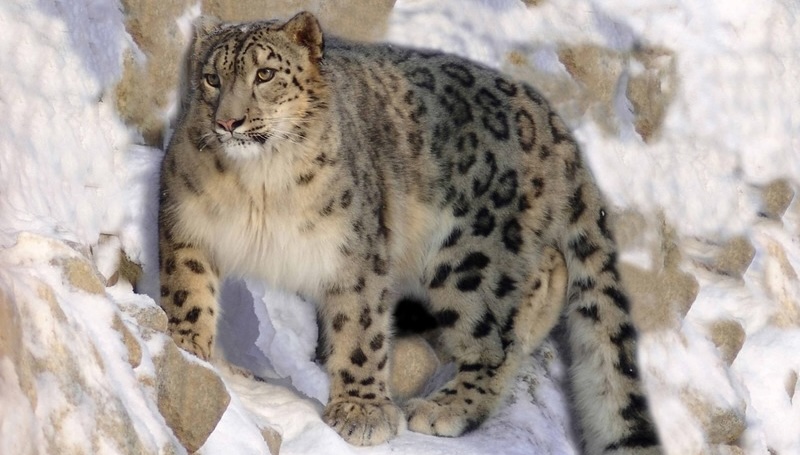
Then, in 1978, Peter Matthiessen, Schaller’s friend and travel companion, published The Snow Leopard. In it, Matthiessen writes of an expedition he undertook with Schaller, shortly after his wife’s death, to see the snow leopard in the Dolpa region of Nepal. Matthiessen never did see the snow leopard, but the creature’s allure—its aesthetic beauty, its idyllic but desolate mountain habitats, its wary, almost mythical behavior—draws us to this day. Shaped to perfection by evolution, snow leopards live solitary lives in the highest reaches of the Himalaya, surrounded only by glaciers, snow, rocks, and icy peaks. They are shy, and their silvery‑brown‑and‑white coats, marked with dark rosettes, work like magic cloaks, offering such good camouflage that they can disappear in plain sight. They have long, furry tails—the longest of any cat in the world—which they wrap around their bodies like mufflers on cold nights. As they maneuver around exposed cliffs, their tails also work like the balancing poles of tightrope walkers. Their thick, wide paws, lined with fur, act like snowshoes, helping them walk on snow like elves. They are silent predators, unable to roar. They move through the cliffs and rock faces like smoke. For me, nearly two decades and several sightings later, every snow leopard encounter is still a transcendent experience, like the crack of dawn after a dark night. Seeing the snow leopard changed the course of my life, and every new snow leopard sighting reminds me to go in search of the unknown, instills me with a sense of meaning and purpose.
Snow leopards are an endangered species, sparsely distributed in mountainous terrain in the twelve countries that straddle the Himalaya and Central Asia. They are legally protected in all these countries, but given their remote mountain habitat and inaccessible high‑elevation dwellings, their conservation did not gain urgency until recently. How could anyone prioritize the conservation of a species that we knew so little about? Knowing the animal would come before worrying about its survival. Snow leopards were safe, it was thought, in their rugged and isolated mountain abode; humanity would never breach their Himalayan kingdom.
But climate change now threatens the glaciers and rivers of the Himalaya. Globalization has connected distant places into a complex web of supply chains across the planet, where consumer decisions in distant countries threaten the survival of species they have never seen and, sometimes, have never known existed. Extractive mining has reached the highest mountain peaks and the deepest oceans, and there is no protection in even the most remote corners of the earth.
Yet the story of the snow leopard is one of hope. In my first encounters with the snow leopard, I mythologized them as part of a faraway world, removed from humans. But I soon came to realize how closely their lives are entwined with our human world. As my research progressed, I came to understand that I would be blessed with more glimpses of the snow leopard if I learned more about the things that surround them: the mountains where they live, the herbivores they hunt, and the people who share this landscape with them. During nearly twenty years of research, I have attempted to understand these entanglements as much as the biology of the snow leopard itself. The local people—the real custodians of the mountains and their wildlife—and my time spent with them have made me a firm believer in a bright future for the snow leopard.
____________________________
From The Ghost of the Mountains: Unraveling the Secrets of the Snow Leopard by Kulbhushansingh Suryawanshi. Published on August 25, 2026 by Riverhead Books, an imprint of Penguin Publishing Group, a division of Penguin Random House LLC. Copyright © 2026 by Kulbhushansingh Suryawanshi.

Kulbhushansingh Suryawanshi
Kulbhushansingh (Kullu) Suryawanshi is an ecologist and conservationist who has spent almost two decades studying snow leopards in the wild. He is a Fellow of the British Ecological Society, the director of the India program of the Snow Leopard Trust, and a scientist with the Nature Conservation Foundation. He is a CIFAR fellow and National Geographic Explorer and was a fellow of the Wissenschaftskolleg zu Berlin. He lives in Bangalore, India, with his wife and daughter.