Sanna Wani on Crafting a Poetics of Daughterhood
“There was the daughter I had been and the daughter that I was becoming. Both went hand in hand with poetry I was writing.”
I have always been a writer that draws on my personal life in my writing. The two—my creative practice and my life—often travel often side by side, one after the other, each taking turns leading. So when I am asked a question during an interview about how daughterhood fits into my understanding of myself as a poet, I don’t know how to answer. Is it because daughterhood is too deeply entwined with my sense of self? Or because it is so disparate, so singular?
I am writing a story that revolves around a daughter coming to terms with a fraught, fragile relationship with her family. An absent father—mourning a mother—a startling lack of siblings but a plethora of cousins—exile from her community.
This is barely a description of what actually happens, but more of an understanding of what lies beneath the surface of the plot, the emotional core of the adventure at hand, maybe even what critics sometimes call the driving force of a novel.
While a label like ‘woman’ has always felt stifling and strange, ‘daughter’ doesn’t carry that heaviness. To be a daughter is to know a particular kind of duty. It is a labor of love, a practice of attention, a relation of care. A vocation, even.
What I say to the interviewer, eventually, is that maybe what happened with the book we’re discussing—Lantern—is that I was spending a lot of time as I wrote untangling what it means to be a daughter. There was the daughter I had been and the daughter that I was becoming. Both went hand in hand with poetry I was writing and the life I was building: the schism between them, the echo.
To be a daughter is to know a particular kind of duty. It is a labor of love, a practice of attention, a relation of care. A vocation, even.
My dad always says, Betiyaan wafadar hoti haan. Meaning: Daughters are loyal. Or maybe “tend to be” or “often are”—I’m not sure how to capture the tone in which he says it: slightly wistful, sure, tender. Translation’s fallacy, I guess. He’s usually thinking about sons too—or his son—but that’s another story. This wafadari was part of what I was contesting. Where loyalty’s root lies in law, wafadari’s lies in promise. What had I been promising? To whom and by which laws? What were the bounds, how was I breaking them? What were my expectations or my parents’ of what a good life should look like?
This is an old story. This is a story that has already been told too—loving and complicated families, prodigal daughters, contact, and closure. “There is a cost to closure,” I write in a poem about my family in the collection. There is friction, most times for most people, between who you are and where you come from. In my own version of this story, I must come to terms with my telling’s failure as a much as its success in every attempt. I am comforted by the fact that those who will understand will understand, and those who won’t, won’t. I return often to Edouard Glissant’s injunction on the right to opacity in Poetics of Relation: the right for individuals and cultures to withhold, to not be fully understood, or made transparent by dominant (usually Western) frameworks or systems of thought.
So even as I write to you about daughterhood, there are limits to my explanation. I will not make transparent, the conflict between my family and me. I will not make transparent what I did wrong or what they did. I refuse to become a vessel of morality, a lesson in honor or lack thereof, and most of all, I refuse to conflate myself with Western narratives about love, freedom, duty or shame.
But I wrote about it, in my way. I had to. When I was in high school, I started writing poetry partially because I found out that my mother was reading my journal. I was horrified, of course, and she regrets it now, but it created for me a language that was solely my own. That, even if someone else read the words, perhaps some part of it could be withheld, could be sheltered. It could only to be shared if the experience was—if the feeling was.
In Audre Lorde’s seminal essay, “Poetry is Not a Luxury,” Lorde writes that freedom is rooted in feeling: that “poetry coins the language to express and charter revolutionary awareness and demand, and actions are the implementation of that freedom.” Poetry creates the “quality of light by which we scrutinize our lives.” This light and its scrutiny form the foundation for a poetics of daughterhood I was practicing; for the kind of daughter I still am.
____________________________
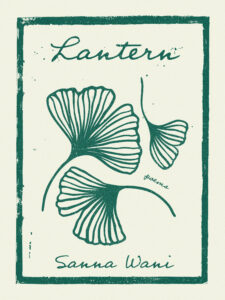
Lantern by Sanna Wani is available from House of Anansi.

Sanna Wani
Sanna Wani is a Kashmiri writer, editor, and translator based in Toronto. Her debut collection, My Grief, the Sun, won the 2023 Trillium Award for Poetry. Her writing has been widely published, including in Best Canadian Poetry, Brick, Hazlitt, and Poem-A-Day. She is the creator and host of the podcast, Poet Talk; poetry editor at The Ex-Puritan; and Publicity Manager at Between the Lines. Learn more at sannawani.com.