Sad Love Stories Are the Best Stories: A Reading List in Praise of Messy Love
Alicia Upano Recommends Crystal Hana Kim, Kamila Shamsie, Louise Kennedy, and More
Despite the prevalence of happy romantic heroes, I’m most intrigued by the ambiguous love story. My favorite titles reveal that the land of love can be treacherous terrain—migration, murder, parental illness, a stranger impregnated. Occasionally, even, the lover dies—shot in bed, languished in a cave, or disappeared by the government.
Trouble is expected—what is a love story, if not a series of escalating tests of love? But this is not trouble that leads anyone down the aisle, so why do these ambiguous stories resonate? For many, the happy ending is the point. The world is a shitshow last I checked, and what joy those happy stories provide.
I am not immune. I inhaled Heated Rivalry almost as fast as Shane Hollander can say, I kind of prefer being the hole rather than the peg. In book form, I devour the wit and yearning leading to the lovers’ midway union. With that desire fulfilled, another must appear. Not just happiness, but certainty.
Here the breezy fun veers into a reality I don’t buy, because much of life is uncertain, neither happy nor ever after. The world we actually live in is a dangerous and messy place. Promises—like hearts—can be broken, sometimes beyond repair.
My debut novel, Everything to the Sea, is likewise a love story set against a stark reality that tests our lovers. We meet our heroes the summer before a tsunami levels their hometown and follow them over a decade as they grapple with grief, rebuild their lives, and try to find their way back to each other.
As a reader and writer, I’m most interested in romantic love as a process of transformation, not a terminus. A union as risky as it is worthy, come hell or high water. Here are books that do just that.
*

Gabriel Garcia Marquez, Love in the Time of Cholera
If love is patient, then there is no lover more patient than Florentino Ariza, who waits for his youthful love some 50 years, 9 months, and four days. I first read this novel in a comparative literature course that emphasized how the topic of romantic love spans geography and time in global literature; its thrill and agony central to the human condition.
Florentino does not while away the years alone, instead passing the time with 622(!) affairs. He thinks “that one can be in love with several people at the same time, feel the same sorrow with each, and not betray any of them. Alone in the midst of the crowd on the pier, he said to himself in a flash of anger: ‘My heart has more rooms than a whorehouse.’”
Yet his heart ultimately belongs only to one, Fermina Daza. Come what may—an inconvenient husband, a cholera epidemic—the novel asks, does love ever expire?
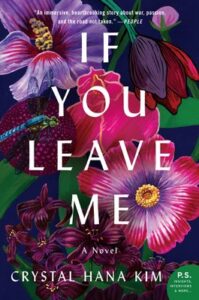
Crystal Hana Kim, If You Leave Me
If You Leave Me follows feisty young refugee Haemi as she navigates war and its aftermath in South Korea between 1951 and 1967. Haemi must choose between her desire for childhood friend Kyunghwan and his wealthier cousin, Jisoo, whose station in life offers life-or-death stakes to Haemi’s beloved brother, Hyunki. At this juncture, 16-year-old Haemi asks her mother of Jisoo, “What if I don’t love him?” Her mother responds, “No one’s telling you to love anybody. … What do you think will happen to our country? To us?”
Told in multiple first-person narratives—we watch as Haemi endures through war, marriage, and motherhood. Her life is full of the practical choices she must make for her family, and yet circumstance can’t eradicate her desire for an ill-advised and irrepressible love. Not only a portrait of a woman, but a country at a pivotal point of change. Be warned, this is a tragedy—think Anna Karenina—but Haemi will haunt you, as she haunts her daughters, well past the final page.
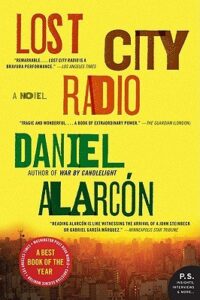
Daniel Alarcón, Lost City Radio
The novel takes its name from the most popular radio show in this unnamed Latin American country, as listeners attempt to reconnect with their loved ones lost in the war. Listeners believed show host Norma was “able to pluck the lost, estranged, and missing from the moldering city”—with the notable exception of her husband, who went missing 10 years before. Then an 11-year-old boy from the village where her husband vanished shows up at the radio station…
A friend recommended this novel, wistfully, jealous of the joy I would have in reading it for the first time. Because the lover has disappeared, the love story doesn’t carry the present—much like, say, Ondaatje’s The English Patient—yet it nevertheless drives the story. The multiple perspectives and the weaving of past and present allow the reader to discover both love and its consequence, not to mention its myriad obstacles—politics, incarceration, betrayal. The novel asks, how far will Norma go to discover the truth? And what will Norma risk to set things right?
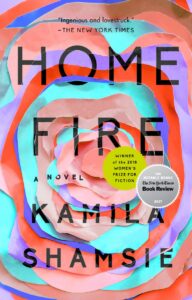
Kamila Shamsie, Home Fire
Home Fire is a novel that is both modern and timeless, featuring a family of British Muslims in a reimagining of Antigone. Like Antigone, the novel is told in five acts, er, parts, each corresponding to a central character. An eldest sister left to care for her siblings after their mother died and their jihadist father imprisoned, her two younger siblings, a powerful politician, and his handsome son. The stage is set for political and domestic explosion, and love is the spark.
After their first union, Eamonn (the handsome son, of course) wakes to Aneeka praying. “He should have left immediately, but he couldn’t help watching this woman, this stranger, prostrating herself to God in the room where she’d been down on her knees for a very different purpose just hours earlier. Finally, the depth of her immersion in a world other than that of bodies and sense made him go back to the bed, wondering if she’d return.” It’s a book that battles with loyalty, faith, and seduction—not just of bodies, but of ideas and identities—woven amid arrivals and departures.
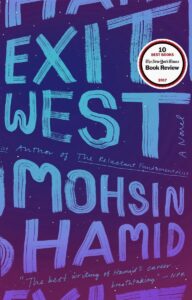
Mohsin Hamid, Exit West
This slim book is magical. Love blooms between Saeed and Nadia as civil war breaks out in their unnamed city. The stakes could not be higher, as Hamid writes as the novel opens, “[O]ne moment we are pottering about our errands as usual and the next we are dying.” In such a landscape, what are young lovers to do?
Exit West explores the tension between duty and independence, desire and convention, and how to move forward when the present is untenable. Our young lovers must leave their families and country, fleeing through the first of many doors as refugees. This novel highlights the refugee crisis, with sharp interstitials of global violence, while also grappling with the questions of any relationship that is no longer new: How do we change through every door we pass through? Have we passed through so many doors that we are no longer the people we were? Can we continue this journey together? And will you remember me, no matter how this journey ends?
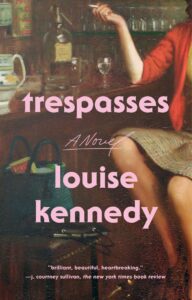
Louise Kennedy, Trespasses
A quietly devastating depiction of a secret affair in 1970s Belfast between 24-year-old Catholic Cushla and married Protestant barrister Michael. Each morning in her classroom, Cushla must review “The News”—another bomb in Belfast. “Booby trap. Incendiary device. Gelignite. Nitroglycerine. Petrol bomb. Rubber bullets. Saracen. Internment. The Special Powers Act. Vanguard. The vocabulary of a seven-year-old child now.” At night, she navigates the streets of army checkpoints, soldiers swinging rifles and eyeing her thighs. By day, she delivers food to a pupil whose father has been beaten and thus unable to work.
This is the loaded landscape in which Cushla falls in love. Certain happiness is impossible from the get-go—not only religion, but his marriage, her youth, the violence that will undoubtedly mark them. This is a novel about how we get through the worst of times—recognizing humanity, snatching love, and seeking justice.
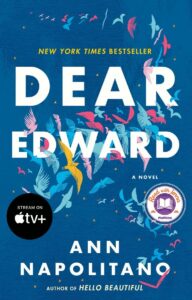
Ann Napolitano, Dear Edward
Dear Edward is a book that is so much larger than its premise: protagonist 12-year-old Edward is the sole survivor of a plane crash in which he loses his parents and brother. How, we ask, will he go on after such monumental loss? How will he rebuild his family? Restore his heart?
This is a big-hearted book that makes me cry even on re-reads. While the novel beautifully weaves in the lives of other passengers, I am most touched by the community of people who surround Edward as he comes-of-age with his surviving aunt and uncle and befriends the girl next door. Unlike other books on this list, it is not a dive into adult romance, but into the many types of love that make our lives meaningful. As Edward navigates his new life, he’s prompted to lift weights to escape the overwhelm of his high school gym. “You’re tougher than I thought,” his gym teacher tells Edward after a few months. “And you’re getting stronger.” In this novel, the heart is a muscle.
__________________________________
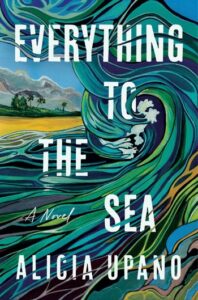
Everything to the Sea by Alicia Upano is available from William Morrow.

Alicia Upano
Alicia Upano was born and raised in Hawai’i. She is the recipient of the Poets & Writers Maureen Egen Writers Exchange Award Hawai’i, the James Jones First Novel Fellowship, and a Bread Loaf-Rona Jaffe Scholarship. Her short fiction has appeared in The Massachusetts Review, The Southern Review, The Best Peace Fiction: A Social Justice Anthology, and more. After years in Asia and both U.S. continental coasts, she now resides on O’ahu with her family. Everything to the Sea is her debut novel.