Pollinating Our Stories: What Bumblebees Taught Me About Writing
Eileen Garvin: “As writers, our minds and hearts go from story to story like blossom to blossom picking up the bits and pieces of answers to our questions.”
Feature image by Rich Hat.
The summer she was seven years old, my older sister went missing at the family lake house in Idaho. At the time, Margaret didn’t speak more than a few words and her severe autism made it difficult for her to communicate in other ways. A short newspaper story from that day reads that she “wandered away from home into the hills above Casco Bay.” The brief search included “a sweep by boat along the shoreline,” suggesting, I suppose, that the sheriff thought she might have drowned. Brief though it was, that search must have seemed endless for my parents. Margaret reappeared tripping nimbly down the forest path in her saltwater sandals like she was returning from a social call. In fact, my parents eventually met the neighbors who reported how my silent sister would sometimes let herself in to make toast in their kitchen, not seeming to mind that they were there.
I was three that summer and though I don’t remember the sheriff or the boat search, I remember the constant concern about Margaret’s wandering and the fear in my mother’s voice when she called Margaret’s name up into the thick woods during other disappearing acts. We four other kids all looked for her whenever she took off, which never seemed to help. Margaret eventually came back, never said where she’d been, and did not appear to register our worry.
My young hypervigilance had the aim of forestalling trouble, but it made me notice things other people might miss and capturing detail turns out to be quite useful in storytelling.
For a time, my parents clipped a rope to the back of her life jacket to decrease her risk of flight but stopped doing so when they watched her unclip it, go inside to get a drink of water, and re-attach it upon her return. At night I’d lay next to her in the bed we shared and listen to the waves lapping the beach. Margaret would whisper in the dark and laugh quietly, entertained by her own incommunicable thoughts.
The day she disappeared was not the first time nor the last time my sister turned the household upside-down. It was the normal state of things for our family. Her difficulty communicating led to frequent, epic meltdowns because she couldn’t articulate her needs and we couldn’t help her. As her younger sister, I never knew life without her and her way of being in the world. Living with Margaret meant paying attention; I was constantly tuned into her moods but also to the environment, other people, and the sounds, smells, and sights around us. Who knew what might set her off?
In recent years I’ve realized how Margaret trained me to be a writer. My young hypervigilance had the aim of forestalling trouble, but it made me notice things other people might miss and capturing detail turns out to be quite useful in storytelling. As Mary Oliver offers in her poem “Sometimes,” “Instructions for living a life: / Pay attention. / Be astonished. / Tell about it.”
Margaret also showed up personally in my writing, first in my memoir about our childhood and then later in my fiction. In one novel a mute little boy wanders from his family’s lake house and takes refuge with a neighbor during a storm. Their friendship blossoms over an injured baby crow the neighbor has taken in. It wasn’t until the book was published that I realized I’d cribbed that scene from our lives.
In another novel, a character grapples with life-changing disability after an accident. How can he live his best, most independent life? I asked myself in writing his story. He finds the answer in raising honeybees and in community. My family has asked this question about Margaret for five decades.
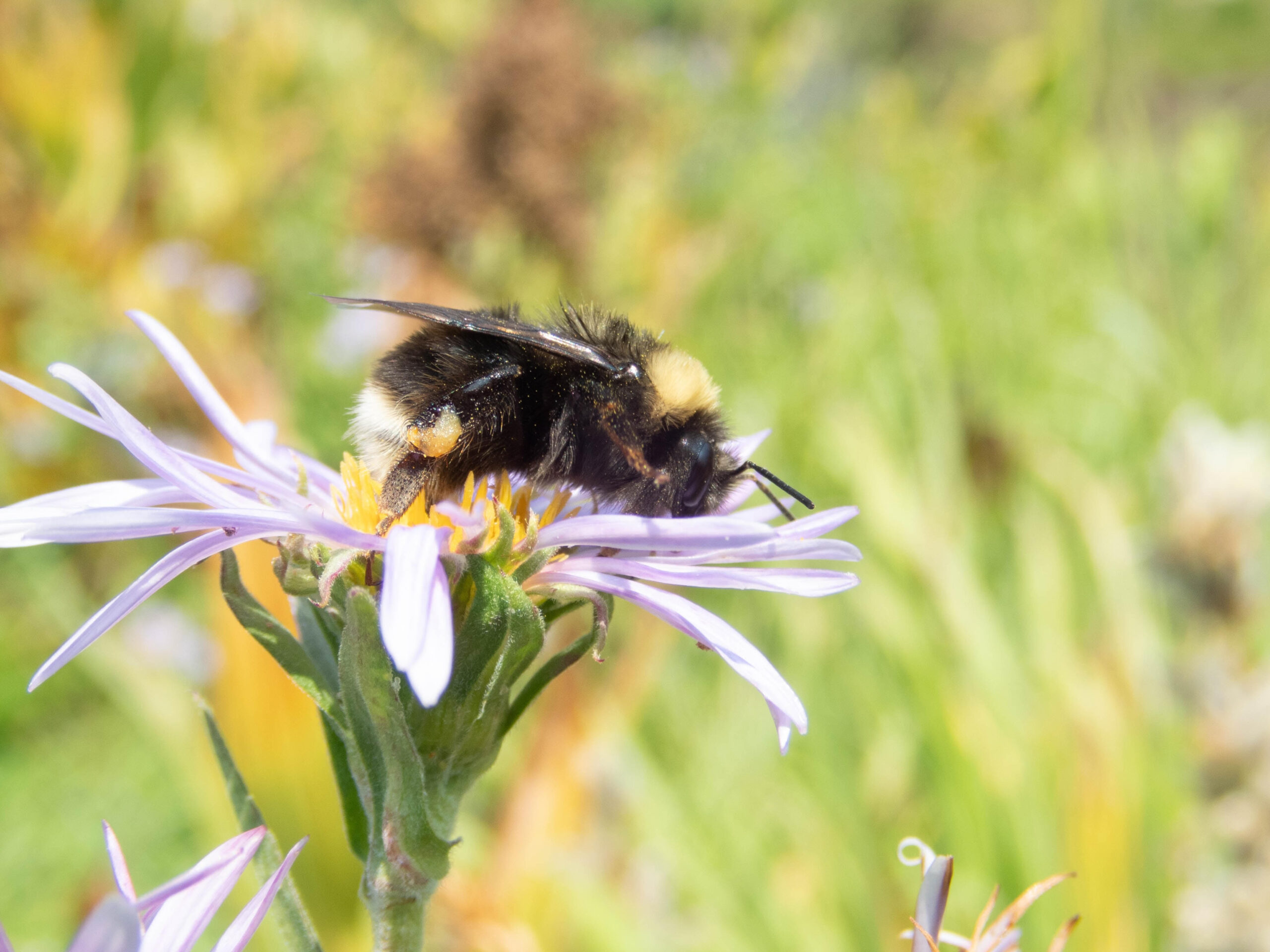
Recently I discovered a video archive from the early summer of 2020 while I was revising that first novel. In those early days of the pandemic, by myself at the family lake house, I made dozens of videos of bumblebees. Later I identified the bumblebees in question as Bombus mixtus, or Fuzzy-Horned Bumblebees. These wooly black bees, with their yellow heads and back saddles and orange rumps, were quite noisy going about their business. Hearing a ponderous drone, I’d jump up and run out the back door to give chase through the wet woods, which were doused daily with passing storms. The videos are all similar—a thick swath of woods in the background, the soft understory of thimbleberry bushes waving their leaves like hands in dappled sunlight, and the low drone as the bee lowers herself into a flower.
I don’t remember what compelled me to chase bumblebees through the thimbleberry patch on those rainy June days. It was probably a helpful break from editing. And it was so quiet out there that pandemic summer. No fishermen trolled the shoreline at dawn, their quiet conversations reaching me where I sat on the front steps. No music blasted from wake boats careening down the bay. The water was empty even of puttering lake cruises, which were always sparsely populated in early summer anyway. These were still, tranquil days, which was probably why I heard the bumblebees in the first place.
In the quiet, I became intrigued by their sound. The bumblebees elicited two tones; a baritone drone in flight and a teeth-grinding tenor during buzz pollination—the process by which they would shake pollen out of the anthers of flowers by vibrating their flight muscles. In some videos you can hear a raven cronking overhead or the music of an approaching rainstorm.
I rediscovered those videos while completing my third novel and was amused to recognize the connection, for here bumblebees show up in full force. This novel features an untethered young woman who finds a place of belonging for herself in advocacy for bumblebees. And watching the videos, I remembered another summer, another bumblebee, and another strange adventure with Margaret.
To our internal stories, our origin stories, we return again and again in an attempt to understand where we came from and, perhaps, where we’re going.
That particular summer a very large bumblebee became trapped in the house, and my mother caught it in a glass freed it—because that’s what we do with insects having been raised on Be Nice to Spiders. After Mom released it, Margaret, who was talking more by then, screamed and cried for it. Another bee got trapped inside on the living room window and she leaned in to watch it with binoculars, poking at it and eventually getting stung. Her hand swelled up and her eyes puffed out, but she remained focused on the creature, which died under her close attention. When it stopped moving, she was inconsolable. “The big black bee!” she wailed. “Where is the big black bee!” She screamed for hours, which was something that happened frequently during those years.
As usual, we were powerless to help and we all spent the day in misery, Margaret especially as she cried herself hoarse. Finally, someone taped the body of the Big Black Bee to a glass and gave it to her, which seemed to help. She slept with it next to our bed, checking on it at night, and after a few days she seemed to forget all about it. Someone threw it away later but not until it had sat collecting dust for a very long time because to throw it out prematurely could start the whole cycle again. We never knew what might happen next with Margaret.
Margaret has never and will never live independently. She can’t drive or take the bus by herself or write a letter or pick up the phone and have a conversation. But her life is her life. She completed twelve years of public school in a special education program she loved. Since 1995, she’s lived in a staffed house, set up by my parents, with friends. She has sometimes had a little work and been happy when she did, though the right employer has been hard to sustain. She’s a medal-winning Special Olympian swimmer and her musical interests range from opera and disco to eighties pop and Canadian crooner Roger Whitaker. Like each of us she has her own mysterious engine that makes her tick; she just can’t really explain it. But that’s not an easy task for any of us, is it?
Discovering this cache of bumblebee videos from that pandemic summer was a reminder of my sister’s indelible influence on me as a person and as a writer. Through fiction and in memoir, I’m always trying to untangle what I can know about her and what I can’t. On one level it’s because she’s family and I love her and wish I could know her better. I long for an intimacy with her that is impossible. But on another level, she fascinates me because Margaret represents the conundrum of every human relationship. My struggle to connect with her lays bare the truth that no matter how much we love each other and want to be known, human connection is an imperfect and even impossible project. She’s also taught me to accept that there’s much I will never understand—about her, about wild creatures, about our world—and to love it all anyway.
Maybe this is why my characters find solace in wild creatures—in the orderly habits of the honeybees in their hive, in the community of crows raising fledglings, and in the solitary bumblebee queen provisioning her new nest on a bright summer morning between rain showers in the quiet woods.
To our internal stories, our origin stories, we return again and again in an attempt to understand where we came from and, perhaps, where we’re going. Even when those early stories are rife with difficulty and pain. As Adrienne Rich wrote in “Diving into the Wreck,” “I came to explore the wreck. / The words are purposes. / The words are maps. / I came to see the damage that was done / and the treasures that prevail.”
In this endeavor, as readers and as writers, our minds and hearts go from story to story like blossom to blossom picking up the bits and pieces of answers to our questions like golden pollen, the treasure we need to sustain ourselves in art and in life, one precious grain at a time.
__________________________________
Bumblebee Season by Eileen Garvin is available from Dutton, an imprint of Penguin Publishing Group, a division of Penguin Random House, LLC.

Eileen Garvin
Eileen Garvin is the author of the national bestselling novel The Music of Bees and the acclaimed memoir How to Be a Sister. Born and raised in Washington State, she lives in Oregon.