Opening the Door: On the Secrets Old Buildings Can Keep
Doireann Ní Ghríofa Explores Our Need to Know the Stories Behind Broken Glass and Dark Corridors
It began with a mistake. A glitch in the library’s database mismatched her name to an address from her past, an error that sent letter after letter falling through a door she’d rented years before. Sweetbriar Lane.
Opening that door had never been easy, since she always seemed to be tangling the key among other things, trying to steer a small scooter over the step while library books shifted and slid against her chest, or fumbling a bin bag and a football and the clammy fingers of a toddler. They only left Sweetbriar Lane because the landlord’s family needed it, although that was what landlords always said—some brother or cousin would suddenly return from Australia, desperate for somewhere to stay, but then, within weeks, the house would be seen advertised at a higher rent. She was too busy scrubbing the grime from their next set of rented rooms to mourn the loss of the sunlit kitchen where her babies had been little. She knew she couldn’t return, either to those years or that door—but then this glitch insisted on sending her name back there again and again and again. Every time she requested a library book, a confirmation slip landed on that mat, to be lifted with a stranger’s sigh and slammed onto a growing stack.
When the estate agent rang to request a forwarding address for all her letters, she blushed at the tiresomeness she’d caused and promised to have any future notices diverted to her home. Once she’d hung up, she tried to continue folding the laundry, but the sight of the agency’s name on her phone had brought a sign to mind, one that always turned her head as she made her way home.
FOR SALE
On a hill over the city, a derelict mental hospital had been partly converted into apartments, and now the hospital chapel was being advertised as a development opportunity too. She counted herself among the many who flinched as they passed that old institution. Had her birth occurred in another decade, she—whose distress had twice sent her clambering river railings seeking her ending—might have lived within those walls.
Neither home nor sacred space, to her the building felt stuck between states, stubbornly shaking its head.
She called it a whim, the force that lifted the phone and made her thumb ask a favor: if the agent was arranging viewings of the chapel, might he allow her to pop in afterwards, just for a quick look? It all happened quite quickly then, the phone began to ring in her hand, and within fifteen minutes, she was watching him unlock the gate.
Among mounds of overgrown gravel, a bankrupt digger sat abandoned, its rust-ruptured bucket still holding a final load of dirt aloft, a garden of dandelions and ragwort thriving mid-air. Beyond, the chapel stood as it always had, waiting for her to find it. Once the old key entered, the old lock nodded. There you are.
Inside, darkness. Panels of plywood had been fixed to every wrecked window. She picked her way through dim scatterings of debris while her eyes adjusted to the gloom. Thin partitions marked an early attempt to slice the space into smaller rooms, but the original brick walls remained bare, shivering with cobwebs, where someone had pasted a picture of a man, holy hands bracketing a redbrick heart. A plywood sheet had dropped a knot, admitting a finger of light so sharp that she grimaced, lifting a hand to shield her eye, but that beam gripped her chin and turned it.
Look, it insisted, pointing.
Look—there.
On a new wall, a blazing circle was floating, drawing a ring of light in which the clouds outside were swirling again, spun upside down or inside out—and oh, she breathed, fingers flying to her mouth. Oh.
It was only because of her grandfather’s fondness for this phenomenon that she recognized it, naming it to the man in giddy astonishment—camera obscura!—repeating what he used to say: all it takes is a tiny hole in a dark room—a pin pierced through a heavy drape or a blackout blind, say—to conjure the world beyond all over again. She pulled the phone from her pocket to photograph it in delight, but the man was already walking on, so she click-clicked and hurried after the song of his steps.
No candle, no statue, no altar, no pew—if not for the scale of the windows, those small new rooms wouldn’t feel like a church at all. The agent’s voice kept moving onwards, narrating a vision of the home it would become, and she tried to follow this fiction—yes, maybe a sofa would sit here in the amber spell cast by a reading lamp, and yes, maybe this dim nook really would whirr with suds—but her imagination kept stumbling. Neither home nor sacred space, to her the building felt stuck between states, stubbornly shaking its head.
The addition of a raw staircase led to a newly built floor, which let her approach the upper windows. Her hands felt for the absent glass, storm-blown or stone-smashed, probably tossed into builders’ skips and driven to landfill. Now those gaps were empty, glazed only by the view of leaf-greens and sky-blues. Turning, she wandered the warren of new rooms, emerging from a walk-in wardrobe to find the agent waiting—time was growing short, was there anything else she’d like to see?
The bell tower tricked her into thinking that she was looking not upwards, but directly ahead, down a long corridor. She blinked, dizzied. No bell? Stolen. She felt her brows tangle, imagining what it would take to effect such a theft. This lost bell, she guessed, had probably met with an ending of cash and melt, but she chose to imagine it clanging elsewhere instead, invisible waves rippling invisible calls to the dead: a summoning. She could nearly hear it herself.
Did he remember where the original altar had been located before the renovations? Glancing up from his phone, he nodded to where she’d seen the beam of light. The sky had clouded in the meantime, deleting the circle from the wall—she’d arrived just in time to witness it.
Outside, he had an urgent call to return, so she wandered the perimeter alone, craning her neck to peer up at the buckled windows. A bramble scratched her ankle, then held. Wincing, she unhooked its claw from her stocking, only to see something winking underneath. Pushing those briars aside revealed a single splinter of stained glass, bright as a ruby and warm as blood.
Under a pair of crumpled beer cans, she found more shards, golds and pinks and greens, some grime-crusted, some still connected by lead. Digging them from dirt, she felt the bite of their sides and thought teeth, thought mouth, thought song, then speech. The vapors that had risen from warm bodies in the pews would have carried syllables mixed with candle-soot, distilled as condensation on the chapel windows. Every one of these fallen fragments would have known the touch of such vapors, before being flung into this world of briar and rain and the fleshy slip of snails. There was something about these shards. She could feel it. They still held a holy light, glimmers of human longing embedded in them, like fossils in stone. She gathered as many as she could, as the man nodded in bemusement from his phone. Mine, she thought in delight.
She chose to imagine it clanging elsewhere instead, invisible waves rippling invisible calls to the dead: a summoning. She could nearly hear it herself.
Walking back uphill to her car, she was so absorbed in daydreaming a kaleidoscope that might twirl these shards to life that she didn’t notice the split pavement until she was already tripping over it, a cartoonish plunge that opened her fist in fright. One panel was falling, then smashing on the path, lead relinquishing its long grip on the glass.
Lifted from the pavement, that lead spelled a letter in her hand.
L
As soon as she read it, she knew it was a sign.
*
Gave no name. Some mild delusions:
messages, apparitions, signs. Collects rubbish
she says, “held a holy light.”
*
The city, she said, held an archive in which it stowed all its oldest maps and contracts, along with love letters, photos, and promises. When she learned that it also held records from the old hospital, she made an appointment.
Arriving, she found it locked. She could hear the bell lifting its echo within, but the door didn’t open. Had she confused the date? She waited a while, pressed again. Nothing.
Hands to the glass then, brow between them, to see the interior: a tiled floor, a coat stand, and a table, bare but for some pencils and a large bottle of hand gel. She tried a knock. Too gentle. A crumpled crisp bag flung itself past her ankles. She knocked a little louder, then let her gaze soar skywards in a clutch of pigeons, rollercoasting over the bookies and pubs and terraced rooftops, over the hairdresser and the tyre shop, before flapping back to the powerlines over the archive. Those birds, she knew, would show her what to do, so she counted them as they landed, all cluck and coo.
One. Two. Three—four. Five.
If a sixth…If a sixth, she would leave.
As if triggered by this thought, the door buzzed itself open, startling the pigeons from wire to wing, a grand scattering. She stepped in. When the door fell shut, locking her in, she felt the birds disappear.
____________________________
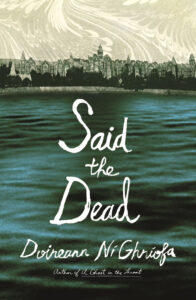
Excerpted from Said the Dead by Doireann Ní Ghríofa. Published by Farrar, Straus and Giroux, September 2026. Copyright © 2026 by Doireann Ní Ghríofa. All rights reserved.

Doireann Ní Ghríofa
Doireann Ní Ghríofa is a poet and an essayist. Her first prose work, A Ghost in the Throat, was a National Book Critics Circle Award finalist; the winner of the Irish Book Awards' Book of the Year, the Foyles Nonfiction Book of the Year, and the James Tait Black Prize; and a nominee for the Rathbones Folio Prize. It was named a best book of the year by The New York Times, NPR, The Guardian, The Observer (London), The Irish Times, and The Globe and Mail. Ní Ghríofa is also the author of numerous acclaimed books of poetry. She is the recipient of a Lannan Literary Fellowship, the Ostana Prize, a Seamus Heaney Fellowship, and the Rooney Prize for Irish Literature.