One Night in Frankfurt: Scenes From the Incomparable Heinrich Maria Ledig-Rowohlt Translation Prize Dinner
Morgan Entrekin on One of His Favorite Nights at the Frankfurt Book Fair; With Speeches From Jo Lendle and Stephan Kleiner
Forty years ago in October 1986 I attended my first Frankfurt Book Fair. On the first day of meetings my friend and colleague Gary Fisketjon and I were introduced to Heinrich Maria Ledig Rowohlt, an elegant, charismatic 78-year-old German publisher who we had vaguely heard of because his family publishing house Rowohlt Verlag is one of the most distinguished literary publishers in Germany. Ledig asked about authors we were publishing and regaled us with stories of drinking with Hemingway in Berlin, accompanying Thomas Wolfe to the Olympic Games in 1936, and generally welcomed us warmly into the community of international publishers. He became a friend and mentor and I always looked forward to our annual meeting in the lobby of the Hessicherhof Hotel during the book fair.
After Ledig died a foundation was established by his wife Jane that since 1996 has awarded prizes to translators for the important work they do. Each year, on Friday night, the last day of the fair, there is a lovely dinner where the winners are recognized. It is one of my favorite nights of the fair both because I sit and remember my friend Ledig but also because after a week of nonstop business and publishing news and gossip and more business the translation dinner is a moment to slow down, put the business aside and reflect on what is at the center of what we all do: the literary text. And of course to celebrate the extraordinary work that the dedicated translators do to bring authors’ work to a new language and a new audience.
Every year there are wonderful speeches that are insightful, amusing, and often very moving and remind me that I am lucky to do what I do. To give a flavor here are two from a previous year: the laudatory by Jo Lendle, the excellent publisher of Hanser Verlag, introducing Stephan Kleiner who has translated among others Irvine Welsh, Keith Gessen, Michel Houellebecq, Tao Lin and Charlie Kaufman; following that is Stephan’s charming acceptance speech.
Note: if you are a young international publisher who attends the fair reading this you should reach out to Karsten Kredel who oversees the prizes and see if you can snag an invitation one year. And if you want to know more about the prizes and the foundation you can go to the Heinrich Maria Ledig-Rowohlt Foundation website.
–Morgan Entrekin
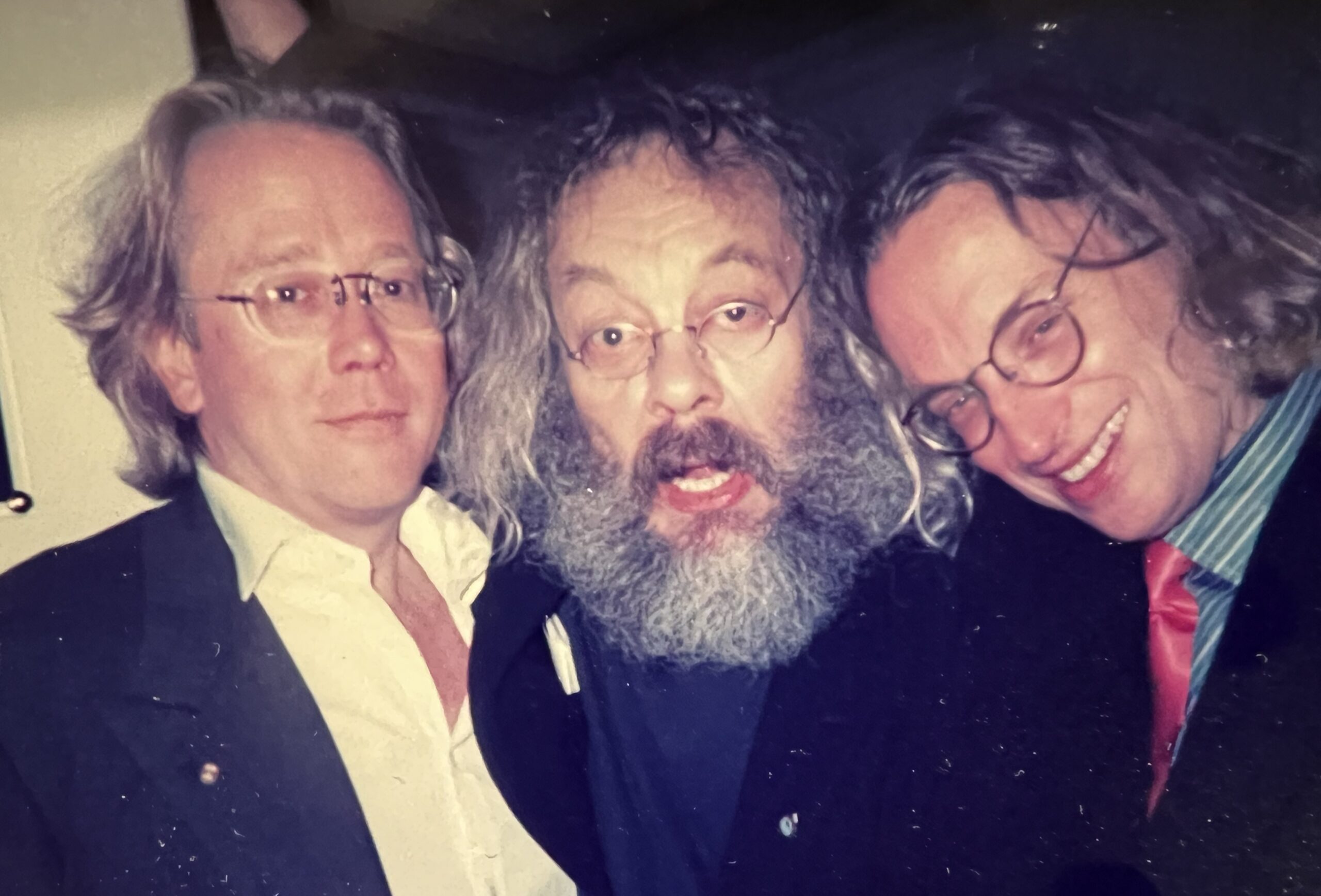 Gary Fisketjon, Harry Rowohlt (half brother of Heinrich), and Morgan Entrekin, c. the late 1980s.
Jo Lendle
Words of Praise for Stephan Kleiner
Heinrich Maria Ledig-Rowohlt Prize 2024
We’ve got you now! You wanted to be an outsider, dear Stephan, a lone wolf, who shuns the pack. A distant planet circling the bright, hot light of the business on an outer orbit, emitting a reflective brightness to the centre, while not denying some residual powers of attraction. The observer at the edge of the dance-floor, secretly swaying with the rhythm. But you didn’t include us in your calculation. Your pack, gathered here as the primed, spruced-up inner circle of the business, has ordered you, through the panel of judges, to make an appearance. There you are, wishing yourself far away, but we won’t let you.
By employing the means of an all-out embrace strategy we are bringing you into the fold, to the centre of the mosh pit. Free hugs are the thing of yesterday, today there are paid hugs. You deserve both, the hugs AND the money. I am sorry, but you won’t be able to get away from this embrace. Welcome to the Heinrich Maria Ledig-Rowohlt cage, our admiration the grille behind which you sit. Still, it is a roomy cage, there is space to roam around in.
You deserve this award. The translations you have produced in the last one and a half decades are impressive, no hide can carry the load—a quick preview of the leathery metaphor to come later. In the beginning, in 2009, the double hit: Tao Lin’s “Gute Laune” (Eeeee Eee Eeee) and Keith Gessen’s “All die traurigen jungen Dichter” (All the Sad Young Literary Men)—from the beginning you were master of the whole range of tones and moods.
For the next seven years your list of translations referenced a certain DuMont Verlag. That is not accidental, after all, you were editor there. A true master of sushi also spends seven years boiling rice in the back room. But you were not content with this, from the beginning you got out the knife and rolled and chopped the true makis.
The publishing house allows us to follow your existence as a translator. At the bottom of your heart, I maintain, you are still an editor, if you understand the role of the editor as that of the sceptic—the ideal starting point for everything else. And you are a master sceptic. I am in a position to say that, having watched you for five years getting a foothold in this strange profession. That you would be invited to the in-house training program in 2008 was a matter of course, after your fittingly self-confident application. And that you would soon become indispensable was unsurprising. What did surprise us, however, was that you also made yourself indispensable as a translator and managed to slip away through that hidden door.
If you wander through Stephan Kleiner’s oeuvre of translated works looking for shoes, you inevitably come across Charlie Kaufman.
I don’t know if the name Erwin Helmchen means anything to any of you. No? More’s the pity. With 900 goals to his name he will forever be Germany’s record goal-scorer and a mid-Silesian legend. The second half of his professional life Helmchen spent as trainer—and whenever his team was losing, he brought himself into play and scored a few goals which calmed things down.
The same goes for the recipient of today’s prize. To be sitting on the sidelines as the editor and watch a translation sink in the mud of the centre of the pitch was anathema to him. So, true to his conviction, “I can do better than this,” he brought himself into play. If Thomas Bernhard were alive today, he would call Stephan a prevention artist. But Bernhard is dead, so we need new gnarly kings.
Poems by Michel Houellebecq or Chad Harbach’s The Art of Fielding—Kleiner played in all positions. With the translation of Hanya Yanagihara’s bestselling novel “Ein wenig Leben” (A Little Life) he surpassed himself visibly. Getting from there to tonight’s prize-giving ceremony was just a question of time.
Literary awards have had bad press recently. The other day there was the case of Caroline Wahl who complained bitterly because she had not been nominated for the German Buchpreis. Understandable, and I say this without irony. From the point of view of statistics, however, not very well informed. Sometimes you get a prize, other times you don’t. Stephan Kleiner could intone a lament, it would be a subdued melody, a dance with slow movements, then a Sforzato into the Finale Furioso—ending with the Fortissimo of our applause tonight. Caroline Wahl concluded her statement with the wistful lament that all she was left with now was her double one—referring to her two new books heading the Spiegel Bestseller List. The Süddeutsche Zeitung commented, “Don’t be too sad, Ms. Wahl. Your prize is the recommended retail price.” Which finally brings us to the true subject of my little speech tonight—the shoe.
The ultimate definition, fixed into all eternity, of the adequate price for a book comes from Joseph Caspar Witsch who on the longlist of legendary publishers ranges straight after Ledig-Rowohlt. Many decades ago Witsch said, “The price for a book is the same as that for a single man’s shoe.” Such a joyful and inflation-resistant statement!
If you wander through Kleiner’s oeuvre of translated works looking for shoes, you inevitably come across Charlie Kaufman. You would have ended there sooner or later anyway, if you were looking for one of the defining talents of tonight’s prize winner—his inclination for jokes. There, in the dizzy heights of allusion, rhythm and punchline, Stephan Kleiner truly comes into his own, way above the tree-line, below which other translators roaming fields and woods and meadows cry out “untranslatable!” as soon as a play on words comes into view. Language becomes vertiginous and exposed when it verges towards the comic.
As for example in Hipster Hitler, one of Kleiner’s favorite books, where history and the present are on a collision course, and also in Charlie Kaufmann’s hefty work “Ameisig” (Antkind). Here is a piece of advice: Don’t ever translate anything by Kaufman, if you don’t want to be driven mad by the humor. “Ameisig” is driven by the fact that over nine hundred pages the characters continually misunderstand each other, mishear what the other says, don’t respond to each other. For translators it’s hell on earth. If this weren’t enough, there is also an almost pathological shoe fetishism. Time for Stephan Kleiner to throw some coal on the fire in the hell of puns. Here is just one example:
A figure in the novel designs all manner of footwear, and that includes shoes for dogs “and designer baby shoes with cute names like Gucci-Gucci-Goo, Marc-Fisher-Price and Toddler Oldham.” Sweet, but of course the designer Todd Oldham is not known in Germany. So Stephan writes: “Designer Babyschuhe mit niedlichen Namen wie Gucci-Gucci-Gu, Marc-Fisher-Price und Kuckuck Chanel.” To say it from within the novel, where among other things a whole film is made from the viewpoint of shoe soles: “Acting from the sole,” or, in Kleiner’s version, “Zäh wie eine Schuhsohle.” Gerrit Bartels called this “linguistic creative madness,” translated into German bei Stephan Kleiner with admirable aplomb. Fit that onto your foot!
All in all shoes are the perfect metaphor for translation. You have the right shoe and are looking for the left one. Starting point and transfer. Original and reflection. The same and yet completely different, as seen in a mirror. Of course you could print the corresponding object on a 3D-printer and you would have something that would do. But can you polish such a thing? More importantly still: Can you walk in it? What good is a shoe if you lack the fundamental understanding of what lives within? A person, or rather his or her foot. Don’t feet have souls?
Whereas Robert Frost said, “Poetry is what is lost in a translation,” Stephan Kleiner would answer, “Then there is no poetry.” For him everything can be translated. He lives by the orthopedic dictum, “There is a shoe for every foot.” Klaus Walter said on a program on the WDR about “Eine kleine Geschichte von sieben Morden” by Marlon James (A Brief History of Seven Killings), an untranslatable novel had been translated here, “and that is a good thing.”
Dear translation cobbler, we miss you as editor, of course, but stick with your last. You fit the big boots of those who came before you. My heartfelt congratulations.
Translation: Susanne Höbel
*
Stephan Kleiner
Words of Thanks: Heinrich Maria Ledig-Rowohlt Prize 2024
Some reflections on receiving the Heinrich Maria Ledig-Rowohlt Preis 2024.
I am standing here in front of you because I was bad at maths.
I was bad at maths, I could not make head or tail of it, but I wasn’t too bad at languages. Alas, there was no subject “languages,” you had to make a decision. My young, resettled parents made the decision for me in favor—plot twist—of French as a first foreign language because that way they could claim subsidies for the bus pass. Our French class in year five was a very small Gallic village. We were a tightly knit group in down-at-heels shoes and passed-down clothes, and we bent our heads over the Cahier d’Exercises, the first sentences of which imbedded themselves indelibly into my brain beneath the hacked pudding-bowl haircut. “Il pleut. La rue est grise et triste.” Couldn’t that be the first line of a poem by Houellebecq? But I had no knowledge of that then. I was simply thrilled by the idea of being able to speak in foreign tongues and disclose to people in the street that it was raining, and whatever other wonderful things there might be.
I want to explain what starts off the process of translation in me—curiosity, the ardent desire to understand, to penetrate, to decode. To wrench the secrets from a text…
It turned out to be a zero-zero game, for the money saved on the bus pass soon had to be forked out for extra maths tuition. My tutor, Torben, himself still youthful and at the same time a strangely ageless polymath with the gaze of a hyper-alert tracking dog, rode a racing bike and had the requisite aerodynamic figure, he listened to classical music instead of normal music, and he played chess and exotic woodwind instruments—in other words, we had nothing in common. But in our conversations after the sessions, which were agonizing for both of us, we started talking about books.
Torben was—of course—extremely well-read, and of course he read foreign-language books in the original. Perhaps out of pity and from the wish to boost my confidence or to nourish a talent that was as far removed from mathematics as possible so I could do no further damage in that field, he allowed me to select a book from his well-stocked library. I chose Tolkien’s The Hobbit, a book I had read—under the title Der kleine Hobbit—in childhood and that had opened up the world of Lord of the Rings.
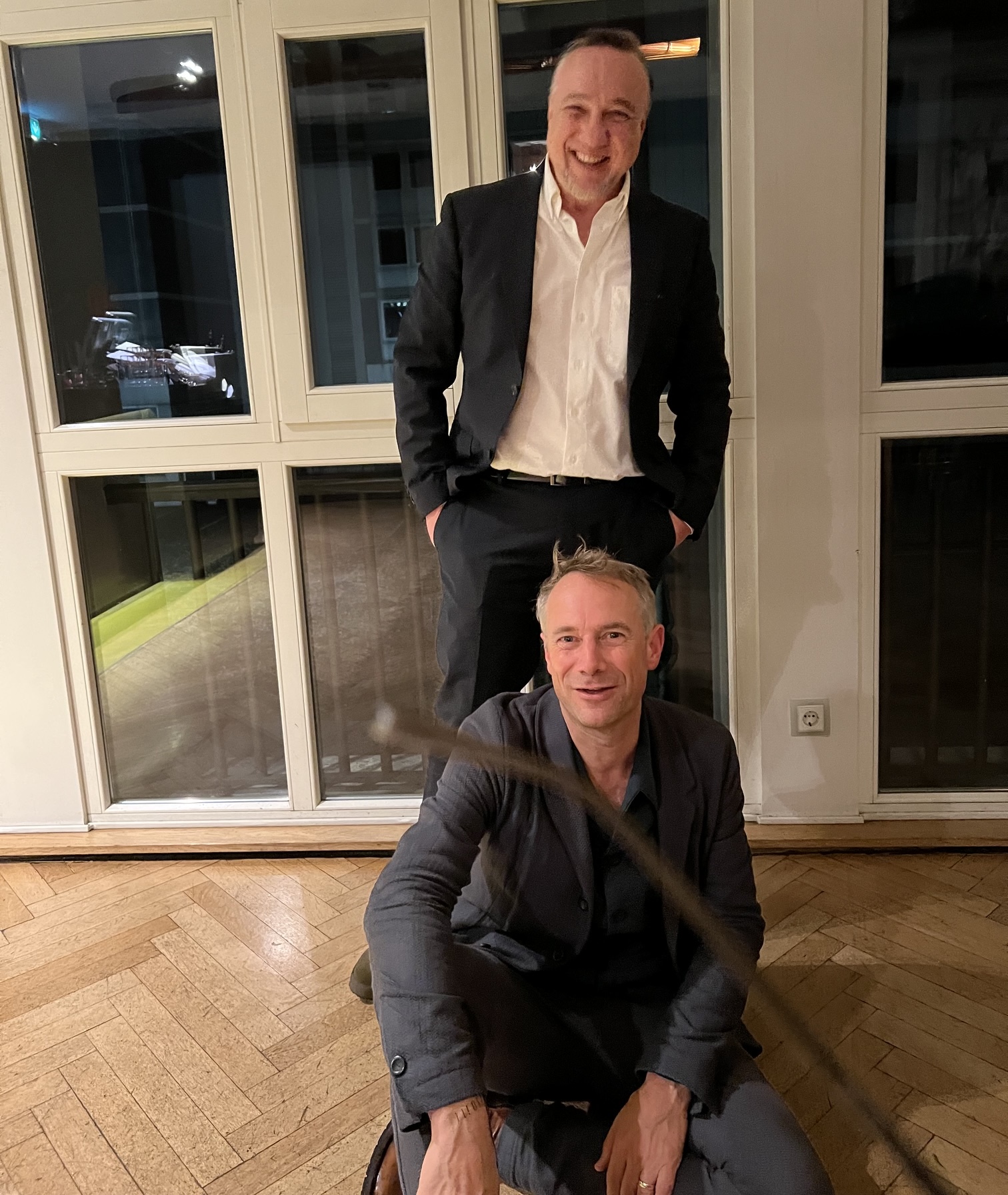 Stephan Kleiner and Jo Lendle (seated), 2024.
What can I say? On the way home I started reading (there were no mobile phones then, so we had to occupy ourselves in other ways while riding a bike). With the book open on the handle-bar, I devoured the first few pages on the ride home. I was intoxicated, I merged with the book and sat at home and between lessons at school reading the book. Not that I understood every word, but I gleaned the meaning. Whenever I came across an unknown word for a second time, I deemed it important enough to look it up and commit it to memory. Initial moments of epiphany dawned, I began to recognize “false cognates.” No, this is not a synonym for Artificial Intelligence, but I learned that wand was not “Wand” (wall), and actually did not mean “aktuell,” but takes on a host of different meanings depending on context. How fascinating!
Soon my second foreign language became more familiar to me than French. I penetrated deep into Anglo-American pop culture, produced (by means of dictionaries, as cyberspace was still only William Gibson’s fantasy) stilted translations of lyrics and coerced my only vaguely interested fellow students into reading them. Soon afterwards I read Irvine Welsh whose phonetically transcribed dialect had a similar effect on me as Nadsat in Anthony Burgess’s Clockwork Orange. Here droogs and tollchocks, there giro-drops and plookie radges—the jargon reached me like a Moloko plus with knives. Hermeneutics as a gateway to the nucleus of spoken language, the same feeling as during childhood experiments with secret codes.
Why am I telling you all that? I don’t know. After all, I am not an author, only a translator. Or perhaps because I want to explain what starts off the process of translation in me—curiosity, the ardent desire to understand, to penetrate, to decode. To wrench the secrets from a text, to dismantle them and in the next step—and this is the disinterested part—make them comprehensible for others.
Years later, at one of the usual book fair parties, I once again bumped into Jo Lendle, who, as usual, seemed to have come straight from the award ceremony for the Ledig-Rowohlt translators’ prizes, and he said to me—something he probably says to all translators—“You too will receive one of these one day.”
When at the beginning of the year I committed myself to translate the Murdle Series puzzle books (they are very amusing) for hanserblau and thereby came full circle, I wrote to Jo with a dash of irony that there is no chance any of the prestigious prizes will come my way now. It was a few weeks later that I received a phone call from Karsten Kredel—whether that was because of the puzzle books or despite them, I don’t know, but I want to offer my heartfelt thanks to the members of the jury. My thanks are due to the publishers Sabine Cramer, Britta Egetemeier, Kerstin Gleba, Margit Ketterle, Barbara Laugwitz and Felicitas von Lovenberg, to the editors Helga Frese-Resch, Mona Lang, Emily Modick, Simon Lörsch , Ricarda Saul, Thomas Tebbe and Annette Weber, to name but a few whose trust in me I have always endeavored to repay.
Finally thanks the authors, those giants on whose shoulders I am allowed to stand, for reasons that are beyond me. I would be nothing without you. Do carry on writing, please.
Thank you, dear Heinrich Maria Ledig-Rowohlt, though we never met. Thank you, Jo. Thank you, Torben.
I want to dedicate this prize to my family—to my father for his unintentional post-dadaist puns. To my mother who would have preferred me to have written a book myself, my patroness, whose generosity enables me to pursue this expensive hobby, and in particular to my daughter who never seems entirely certain whether there is a deeper meaning to my pottering that to her is somewhere between cringe and random. I regret not being able to encourage her to follow in my footsteps. It is possible to succeed without maths, but if you can do it with maths that’s fine.
I want to conclude with the words borrowed from Christoph Marthaler via Dieter E. Zimmer:
Thank you for this good morning
Thank you for this splendid prize
Thank you that I am free now
of all worries. (Line untranslatable.)
Thank you.
Translation: Susanne Höbel
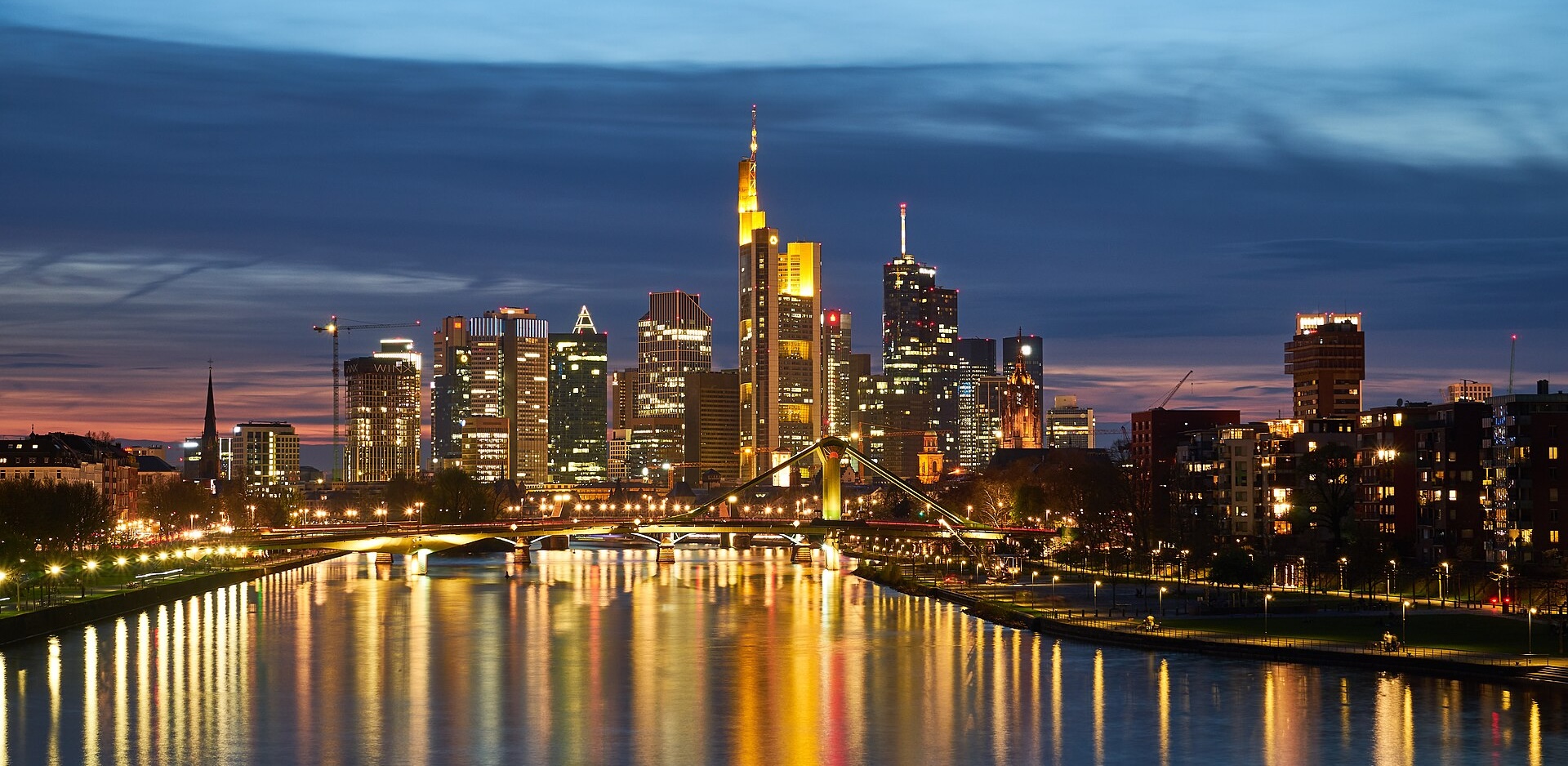
Featured image of the Frankfurt Skyline at night by Mathias Konrath, courtesy.