On Waking Up As an American During the Fall of the Soviet Union
Jamison Firestone Remembers the Moments Leading Up to the Collapse of the World’s Largest Communist State
On the evening of August 18, 1991, my friend Terry and I were staying at the Pribaltiyskaya Intourist hotel, a huge Soviet hotel complex built in an ugly brutalist style on a windswept island close to the Gulf of Finland, far from the center of Leningrad.
On the morning of August 19, I tried to wake Terry for breakfast. He was having none of it and told me to go on my own. So I walked over to the lift, pushed the button, and got in. As the door closed, a tall American looked down at me and said, “Do you speak English?”
“Yes.”
“So I guess we’re all going home.” “What?”
“Haven’t you heard? There’s been a revolution! Gorby is out.
There are tanks in the streets!” “What?! You are kidding!”
“Turn on your TV, watch CNN.”
Shocked, I went back to the room and woke Terry.
“Terry! Terry, get up! There has been a revolution! Gorbachev is out! There are tanks in the streets! Your mom was right, and you can bet she’s worried. Call her!”
Terry cocked an eye. “Seriously?”
Euphoria was in the air. I couldn’t believe what happened, nor could anyone else. The people had stood up. Soviet tanks had backed down.
We then turned on the TV to find Swan Lake was playing on all the Soviet channels. This was something the Soviets usually did before making a huge announcement, as when a leader died or had been replaced. However, CNN was broadcasting live, and we watched in shock as tanks rolled into Moscow and then President George H. W. Bush spoke about the coup. It wasn’t really clear what was going on, other than a group of eight hard-line high communist officials and KGB officers were trying to remove Gorbachev from power, claiming he was “sick” at one of his country houses. I watched as President Bush urged the new government of the Soviet Union to honor its foreign debt and other international obligations. WTF? This thing wasn’t even over yet, and the president was treating it as a done deal. What had I gotten us into? I wasn’t terribly worried about our personal safety. It seemed unlikely that people were going to go out of their way to kill foreigners. I just kept thinking, Is this coup really a done deal, and if so, how the hell do we get home?
Unfortunately, even though we were in a hotel specially built for foreigners, we just couldn’t get a call through to the US. In the Soviet Union international calls had to be ordered hours in advance. As we couldn’t afford to stay in the hotel indefinitely, we decided to leave that night for Moscow, where we could stay in one of Stefan’s apartments.
Just before we left the hotel, we watched President Bush make another speech on TV. He expressed his concern that Gorbachev’s reforms would be undone and said that this was a coup led by the KGB and the military. And then he said the magic words: “It’s also important to note that coups can fail. They can take over at first and then they run up against the will of the people.”
No shit.
From what we could see on the ground, no one knew what was going on, and the game was very much still in play.
Whatever happened, we needed to get back to Moscow, so we talked our way onto a night train. Not a nice night train with cabins and beds, but one where you sat upright all night, and it took eight hours to cover the 600 kilometers (373 miles) to Moscow.
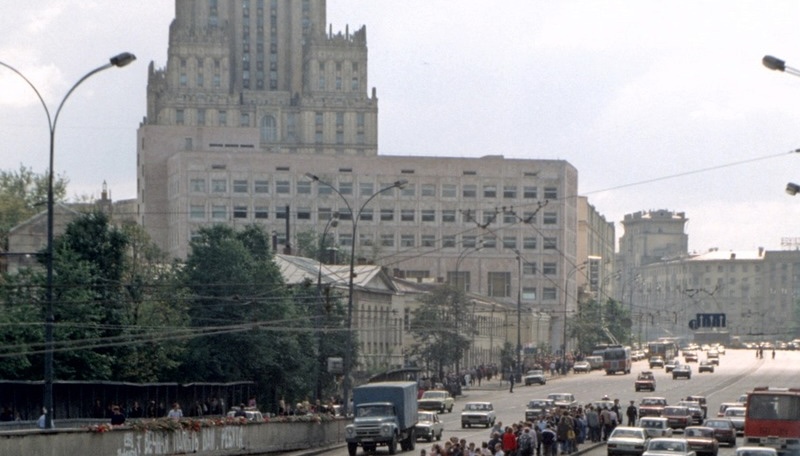
I don’t know what I expected to find in Moscow, but we arrived on the morning of August 20 into a surreal situation.
The plotters behind the coup had rolled tanks down the main streets, parking them at strategic locations all over the city. There were tanks at the beginning of Gorky Street, right by the Moscow Hotel, which was as close as any street got to the Kremlin. They had even rolled tanks up to the White House, the Parliament of the Russian Soviet Federative Socialist Republic. This was not the Soviet Parliament, but it was the seat of power for Boris Yeltsin, then president of the Russian Soviet Federative Republic, the most important member of the USSR. Regardless of stereotype, the Soviet Union and Russia were not the same thing.
In theory the USSR was a voluntary federal union of independent communist (Soviet) republics. As supposedly independent states, all members of the USSR had their own presidents and parliaments. However, the Soviet Union was an empire controlled by Russia. National identities, the use of local languages, and the expression of different cultures were all subject to control from Moscow. Resource allocation was also controlled from Moscow. All of this was a source of ongoing friction; and the glue that held the USSR together, military might and communist ideology, had been crumbling for some time. Surrounding the Russian Parliament with Soviet tanks set something in motion. It wasn’t yet a “them against us” situation, meaning Soviets against Russians, because for Russians the USSR was us. But it wouldn’t stay that way for long.
The day before, while we were still in St. Petersburg, crowds of people had come to the White House and surrounded it, using their bodies as human shields to protect it from the tanks. Boris Yeltsin, to everyone’s shock, had then walked through the crowd and climbed one of the Soviet tanks besieging him. Standing on that tank, he had proclaimed the coup illegal. Urging the military to stand down, he had called for the population of the entire Soviet Union to go on strike until the people behind the coup withdrew and released Gorbachev, the USSR’s lawful president.
So when we arrived in Moscow from St. Petersburg, control of the Soviet empire was in play, and Yeltsin had come down on the side of Gorbachev. The streets were packed but not with demonstrators. People weren’t doing anything in particular other than walking around. Nobody really knew anything more than that there had been a coup and the new freer Soviet reality created by Gorbachev might be ending.
All the state television channels were still showing Swan Lake on an endless loop. The men behind the coup had made a broadcast or two, but at least one of them was drunk. Nobody knew what would happen.
The people who worked for cooperatives were particularly afraid. Doing business had until recently been speculation, a serious crime. “They are going to arrest us all! It will be like the 1920s when everyone who started a business under Lenin’s New Economic Policy was later labeled an enemy of the state by Stalin.”
They weren’t overreacting. They feared losing not only their newfound success but also their freedom—and possibly their lives.
Meanwhile, on the streets things were getting stranger. I found myself climbing a tank with a Japanese tourist and having my picture taken with a tank commander who looked no older than me. While I was standing on that tank, it was suddenly surrounded by a group of screaming babushkas.
A Russian babushka is a wonderful, warm, and at times alarming sight. A grandmother who lived through the Second World War in Russia has probably seen terrible hardship. Russian grandmothers, warm and loving as they may be, are often tough as nails. In the USSR, grandmothers often lived with their adult children to help raise the grandkids, and they did a lot of the shopping and waiting in line. As respected authority figures, they were experts in yelling at misbehaving youth. Use foul language, litter, or cut a line, and in a matter of seconds someone’s lovable grandmother would be furiously tearing into the offender until amends were made.
Gorbachev was back in the Kremlin, and the Soviet flag was flying above it once again, but nothing would ever be the same.
Standing in front of the tank were a bunch of babushkas, yelling at the young soldiers beside me. “You’re not going to kill us! We are your mothers, your grandmothers! What are you doing?! Think about what you are doing!” And the kids in that tank looked miserable. They had no idea what they were supposed to be doing, but it was clear from their faces that killing their own grandmothers wasn’t it.
That evening, Terry and I decided to keep a low profile. We went back to our flat, and Terry went out on a date. Even in the face of revolution, the rhythms of normal life continued.
I woke the next morning, on August 21, my twenty-fifth birthday, to an empty apartment and the news that the coup had failed. Tanks and troops were leaving Moscow. Three people had apparently been killed, but the men behind the coup had backed down and Gorbachev was being released.
This was still years before mobile phones, and I had no idea where Terry was. I waited a few hours for Terry and then when he failed to come home, I searched the city, talking to everyone at places we had visited who might know where he was. I couldn’t find him. I didn’t even know which girl he had taken out on a date. He had met her at a Moscow shop before we went to Kiev and Leningrad, but I had forgotten which. So I went home, and I waited.
In general, when someone disappears, one goes from “Where the hell is he?” to “If he’s not dead, I’ll kill him myself.” By 5:00 PM, when Terry finally walked through the door, I had progressed to terror. One does not casually disappear during a revolution. I didn’t know whether to hug or kill him.
“Where the hell have you been? I’ve been worried sick!”
Looking embarrassed, he replied, “I ended up at a party, we got drunk, I woke up about two hours ago and had no way to call you and had to walk home. I felt so stupid, and I can’t imagine what you must have been feeling. But the only thing I knew while I was walking home was that you would be here waiting for me.” I gave him a big bear hug. We spent the evening of my birthday walking around Moscow, and it was amazing. Again, people were out in droves, but this time they were ecstatic. For a brief time, the Russian flag—not the Soviet flag, nor the flag of the Russian Soviet Republic—was proudly flying over the Kremlin. This was the white, blue, and red flag adopted by Tsar Peter the Great and used by Russia today. It hadn’t flown over the Kremlin since before the communists took power in 1917. It was a breathtakingly powerful sight. It was like a Russian declaration of freedom from the Soviet Union and from communism.
There was a huge statue of Karl Marx, in Teatralnaya Square, right across from the Bolshoi Theatre. Someone had painted the Russian words for “Forgive me!” in large white letters on its base. I burst out laughing. In days past, saying that communism was a mistake would have earned the artist a one-way ticket to Siberia.
The next day, August 22, a crowd gathered in front of the headquarters of the KGB and pulled down a giant statue of its founder, Felix Dzerzhinsky.
Euphoria was in the air. I couldn’t believe what happened, nor could anyone else. The people had stood up. Soviet tanks had backed down. “If we can do this, we can do anything!” The future was bright, and I was thrilled to have witnessed history.
Gorbachev was back in the Kremlin, and the Soviet flag was flying above it once again, but nothing would ever be the same.
Several days later, when Terry went back to the States to finish law school, I began my new life in what was briefly the freest country in the world.
_______________________________
From the book Rule of Lies: My Wild Ride Through Chaos, Corruption, and Murder in Putin’s Russia by Jamison Firestone. Copyright © 2026 by Jamison Firestone. Reprinted by permission of HarperCollins Publishers.

Jamison Firestone
Jamison Firestone established the first independent foreign law firm in Russia where he lived for eighteen years. He was a member of the board of Directors of the American Chamber of Commerce in Russia for the last six of those. He is a co-founder along with Sir William Browder of the Global Magnitsky Justice Campaign which created the Magnitsky human rights and anti-corruption sanctions regimes. He also ran the Navalny 35 campaign promoting the sanctioning of corrupt oligarchs and officials identified by Alexei Navalny. He currently works on seizing Russian state assets for the benefit of Ukraine and has been featured on the BBC, Bloomberg, CBC, and in several documentaries. He lives in London.