Nine Books of Poetry About Breakups (and Awakenings)
Elizabeth Metzger Recommends Anne Carson, Sandra Lim, Maggie Millner, and More
We often experience breakups as private deaths. The severing of an intimate relationship means giving up a vision of life together. One mourns the beloved, the shared past, and the expected future, but what is often overlooked, and equally painful, is the loss of a version of the self. It is this last shattering that tricks us into rebirth. The end of a relationship becomes the entrance to the rest of our lives. Sometimes an awakening is a catalyst of the breakup—the version of the self that entered the relationship is no longer recognizable. Other times, the breakup sparks an unexpected awakening. Hidden parts of ourselves come into view. Our identity swerves. We meet a mysterious self, and it is she who learns to love again, as Galway Kinnell writes in his poem “Wait”: “The need for the new love is faithfulness to the old.”
My new book The Going Is Forever travels through the dissolution of a marriage and the multiple endings that blur separation and intimacy. The poems push against the binaries of leaving and being left and embrace ongoing love in the wake of loss. Friends and family often ask “what happened,” expecting a reason or a narrative. Attempting to answer, I often felt disingenuous, defensive, guilty, and most of all lonely. Poetry allowed me to confront the boundaries of privacy and disclosure, to recognize an allegiance more to paradox than to a person. In a poem, it was possible to endure moments of not knowing, to hold versions of a life I had to let go of, and to break open to the life to come.
Several of my favorite poetry collections capture the nuanced process of breaking up, with its extreme states of longing, anger, and sorrow—while also expanding the capacity for joy, pleasure, and compassion. The following books refuse to treat breakups as a singular ending or distinguish the breakup from the inevitable awakening. When a relationship ends, language is as much of a casualty as love. Virginia Woolf speaks of “the little language such as lovers use.” We lose the person we talk to in secret, and from this devastating silence, poetry reinvents language. In non-linear lyric forms, the following collections braid love’s ruthless endings with its tenderest beginnings.
*
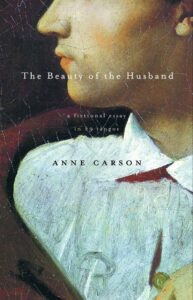
Anne Carson, Beauty of the Husband
In Carson’s “Essay in 29 Tangoes,” each vignette opens with an epigraph by John Keats as the speaker weaves together a meditation on Keats’ concept of beauty as truth and her husband’s beauty and infidelity. Subverting the question of “will she stay or will she go,” this book emphasizes the way love often involves obsession and denial: “I can think of no reason not to be with you,/ except the obvious one.” Pushing the boundaries of form, Carson shows us that there is no single narrative to a marriage, and that language, too, is a beautiful lie.
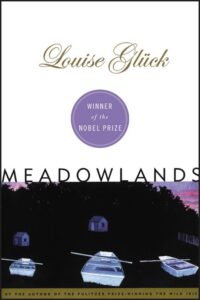
Louise Gluck, Meadowlands
If Anne Carson expands marriage into an aesthetic conversation with Keats, Gluck puts the dissolution of a marriage in an epic conversation with The Odyssey. Bringing together the private shattering of a home with the epic tale of homecoming offers Gluck a distanced, often ironic, stance on her life’s most painful moments. Weaving her own story with the familiar story, Gluck can also unweave the stories she has told herself, not out of loyalty to her husband (like Penelope) but as internal awakening. The Odyssey ends in a homecoming, driven by Nostos (hope for home). In Gluck’s poem “Nostos,” breaking up means a return to the original home as a source of reality that can be sustained: “We look at the world once, in childhood. / The rest is memory.”
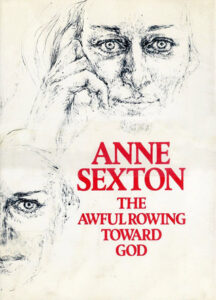
Anne Sexton, The Awful Rowing Toward God
Sexton wrote this entire collection in a span of 20 days, the same period of time in which she decided to leave her 25-year marriage. The collection opens with the lines “A story, a story! / (Let it go. Let it come.)” She portrays leaving the marriage as a rowing toward some new version of herself: “This story ends with me still rowing.” Breakups can be a way of going on. According to Sexton, divorce is both a door and a purging of “the rat inside of me.” Leaving a beloved may mean leaving the worst of oneself behind.

Tiana Clark, Scorched Earth
While this book doesn’t shy away from the grief after divorce, it ultimately is a celebration of Blackness, Motherhood, and Queer desire, awakening into a fuller sense of the speaker’s identity. In fact, loss expands the capacity to love. The afterlife of a love story involves a radical rebirth of self-love—there is only more and more love: “O tiana I want to love you there.” In a title poem, an ode to “Black breasts” Clark turns vulnerability into self-love. In the midst of feeling lost from oneself, self-touch becomes a reminder of being alive: “Do you want to see me / touch me? Sometimes, I touch myself / because I don’t know if I exist.”
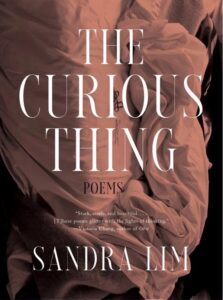
Sandra Lim, The Curious Thing
While there is an undercurrent of a breakup throughout this collection, particularly in the third section, what drives this book is a reorientation of the self in the world. How has the speaker been changed by places she has lived? How does the past bear on the present? In deceptively plain diction, the hurdle of one love relationship provokes an exploration of desire and belonging. Yearning is not a lack but an invitation to the imagination:
When there is anything
you want very much,
you are making up a story
all the time,
of how you will get it
and how it will be . . .
The clarity of questioning in Lim’s work reminds us that poetry, like desire, offers intimacy and containment in moments of crisis and estrangement.
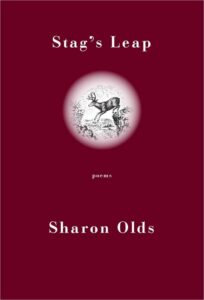
Sharon Olds, Stag’s Leap
I was in high school when I first read Stag’s Leap, Sharon Olds’ Pulitzer prize-winning collection. I hardly knew what poetry was, let alone sex, or marriage—or divorce! But I remember being stunned to feel so many antithetical emotions at once (betrayal, rage, despair, excitement, affection, nostalgia). Without the profound love and intimacy the couple shared while raising their family, I couldn’t have felt the devastation of the husband’s betrayal and hypocrisy. If these are divorce poems, they are also love poems. I think of Catullus’ “Odi et Amo.” Within a relationship or in its wake, love and hate often cohabitate.
In the poem “Last Night” the speaker relives the last time she and her husband had sex (My poem “If I Have to Look Back” depicts a similar moment in a marriage). Olds describes her physical movements as twisting from a chrysalis, an image of pain and rebirth. The familiarity of physical intimacy is also a shared act of dissolution, after which the speaker awakens:
That was love, and we woke in the morning
clasped, fragrant, buoyant, that was
the morning after love.
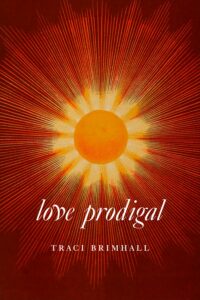
Traci Brimhall, Love Prodigal
Brimhall integrates the end of a marriage with the beginnings of new love, and news of a difficult medical diagnosis with the awakening of physical pleasures. Motherhood and Eros radically feed each other. The natural world invites previously unrecognized intimacies. This collection does not beautify quotidian messiness but shows us how love celebrates our imperfections. Through these poems, we see how love, like illness, is often a force beyond our control: “It is sudden as conversion, / worthy of radiant trespass.”
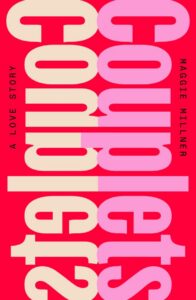
Maggie Millner, Couplets
In this tour-de-force novel in verse made up of rhyming couplets (in first person) and prose poems (in third person), Millner tells a queer love story that begins with awakening to oneself in the mirror. The proem begins “I became myself” and ends:
But I was wrong. My eye loved
everything it fell upon.
And then one day it fell upon
a mirror. And he was nowhere
in the mirror. And she was everywhere.
The rupture is not just with a man but with the idea of a heteronormative life. Falling in love with a woman, even though the relationship eventually ends, is the start of a process of getting to know oneself. Just as Carson plays with the form of “tangoes” to tell a non-linear narrative, Millner chooses the rhyming couplet to tell a story of fracture and mirror, becoming and being undone.

Katie Ford, If You Have to Go
Awakening after a breakup often begins the way that a poem begins, with an apparent contradiction: the conviction of uncertainty. When a beloved is lost, desire is displaced, but that doesn’t mean desire is gone. One must go on, even move on, without knowing what one means by that. Though desire loses its object (the husband), it charges its subject (the speaker). This quest to believe in love again, while doubting whether it can be found is akin to a spiritual awakening. In a sonnet sequence on divorce, Ford writes:
I don’t know what I mean,
but I mean it. I don’t know what to want,
but I want it. And when I say God
it’s because no one can know it—not ever,
not at all—. It’s a wall.
And it drops to the floor as I fall.
The motions precede understanding as the lines perpetually reverse, halt, and cascade toward discovery—more scar, than solution. In the aftermath of our greatest love, we may find that love is a higher power. The life we have built breaks apart, but the wall of what can’t be known also falls away as we are broken. Breakups may make us doubt ourselves, but sometimes they make us believers.
Writing The Going Is Forever made me challenge my own identity as wife, mother, and daughter. Yet in the throes of heartbreak, I heard what Sylvia Plath calls “the old brag of my heart: I am I am I am.” The more poems I wrote, the louder it got.
__________________________________
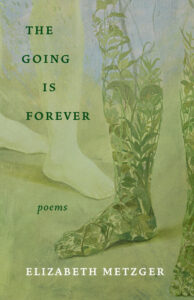
The Going is Forever: Poems by Elizabeth Metzger is available from Milkweed Editions.

Elizabeth Metzger
Elizabeth Metzger is the author of The Spirit Papers (University of Massachusetts Press, 2017), winner of the Juniper Prize for Poetry. Her poems and essays have recently appeared in The New Yorker, Poetry, The Nation, Boston Review, and Guernica. Elizabeth is the poetry editor of The Los Angeles Review of Books Quarterly Journal. She is Max Ritvo’s literary executor.