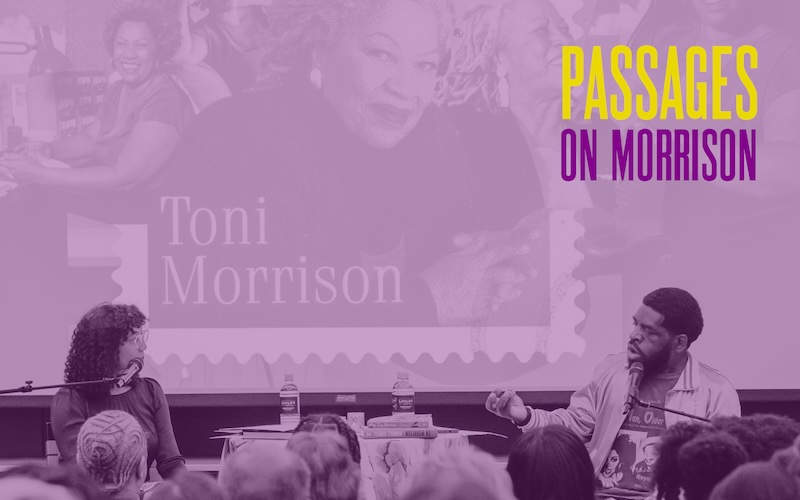
Namwali Serpell and Hanif Abdurraqib on Toni Morrison’s Song of Solomon
From the New Podcast PASSAGES: On Morrison
For the launch of Ohio’s year-long, state-wide celebration of Toni Morrison, Namwali Serpell flies to Columbus to talk with poet and essayist Hanif Abdurraqib. With the help of the audience, they read the ending of Morrison’s Song of Solomon and then open up the scene’s quiet violence and ambiguous action. The passage leads them to discuss the challenges of adapting Morrison’s novels for film, the power of evoking the inexplicable, and the influence of African folk tales on Morrison’s work.
*
*
From the podcast:
Hanif Abdurraqib: I think inherently in Morrison’s work, there’s a question of the sonic qualities of language, and she thinks about language in these ways that make it feel… I don’t know if she thought about herself this way, but it comes across that she is someone who is rigorous like a conductor would be, the conductor of a band, and not necessarily someone who is thinking language first, but also thinking about the sonic qualities, sound, of language and how they can transform the way a word arrives to us.
Namwali Serpell: She’s so good at explaining what she’s doing in some of her essays, right? She has this command to analyze herself, ’cause she’s, you know, a scholar and a critic and an editor, and one of my favorite things is there’s one version of her essay where she’s analyzing the opening of Beloved. She actually marks out the meter of “124 was spiteful,” like the way a poet would, or the way that a jazz musician would, right, where the emphasis falls. And she says, “I know ‘124 was spiteful.’ Full stop. ‘Full of a baby’s venom,’ is not grammatically correct. I know that,” she says, “but I needed to break those into two in order to get the rhythm that I wanted.”
So sound was more important than grammar there, right?
HA: Which I think, this is an important point because, I don’t know if other Black writers in the room are like, everyone can relate to, but I do think that you have to teach… I don’t know. I’ve had a Black editor for a while now, so I don’t really have to do this anymore..
NS: Oh.
HA: but, uh, there was a way early on in my work where I had to be like, “Actually, I don’t care about if something’s grammatically correct because that’s not how—
NS:: We talk.
HA: —the people I love speak,” right? Like I think that plays from the lineage of, like, Hurston, too. Like Hurston was very much where it’s like, “I’m going to write the way I hear my people speak.” And that’s so freeing and common to me, at least in my work.
But I remember the first time…the reason I had a Black editor for a while is ’cause the first time I had a white editor, I was like, “This cannot go on.”
‘Cause I remember the first time I put my work in front of the white editor, and I was like, “Well, this is common to me because I am writing the way that everyone…” I had these poems in the voice of my barber in my first poetry book, right? And I was writing literally in his voice, and my editor was like, “I don’t know what to do with this.”
Like, that’s just how he talks, right? That’s how he speaks. So I’m transcribing. And I think what Morrison does in her work in that way is afford a kind of dignity to the Black voice and the inherent musicality that exists within the Black voice.
I think what Morrison does in her work in that way is afford a kind of dignity to the Black voice and the inherent musicality that exists within the Black voice.
NS: And also the mystery, right? So the idea that, well, this isn’t clear to me—that doesn’t matter, right? For her, it’s the beauty, it’s the rhythm, it’s the way that it produces a kind of relay, you know, “One’s own mind dancing with another’s” is the way she describes reading and writing. But it’s not necessarily communicating a single message. Like, that’s not what she’s interested in.
I had a similar experience when I published my first novel. There’s a scene in a nightclub set in the 80s or 90s, I think, in Lusaka, in Zambia where I’m from. And I had written that a new couple, they’re dancing, and I say, you know, “She dropped it,” and then I explain, and my British editor was like, “Dropped what?” And I was like, “Uh…do I need to spell this out for you?” You know?
But also, like, Morrison gives us also this courage to not explain, to just be like, “No, you know, it’s okay if you don’t get it.”
HA: Yeah. One, I really wholeheartedly believe that being against explanation is the greatest thing that a Black writer can do. That’s the greatest position that you can put yourself in.
NS: Absolutely.
HA: So you look at, one, there’s a lineage of that, but two, you know, I think about, like, Gwendolyn Brooks in Chicago. The way to talk about Morrison as a poet and in touch with poets, the way that Gwendolyn Brooks constructed Chicago in her poems was different than the way that non-Black Chicago poets were constructing Chicago.
So I think it’s important to ask yourself, what in my work would be sacrificed if I chose to sit and explain things to people who don’t have that actual much interest in them anyway? Because we’re thinking in terms of clarity, and not urgency and necessity.
What people are asking for—and I love Morrison for this because in her work she was so against it—what people are asking for is comfort. They’re not actually asking for a better piece of writing.
NS: Yes. They’re asking to be placated. They’re asking for things to be translated. And, you know, one of the things that I adore about that aspect of Morrison…it really moved me to learn, as an African writer myself, that she got that sense of “I don’t need to explain” from African writers, from reading Chinua Achebe, from reading Bessie Head, from reading Camara Laye. I found that so compelling, and it really does help, I think, to approach her work in that way, where you’re not seeking explanation. You’re not seeking a single message. What you’re looking for is a way to interpret the richness of the language that’s coming to you.
I spent a lot of time with my students talking about how much rich tradition, crisscrossing traditions, is happening in this final passage. Some of you may know of the story of the flying Africans from, what’s the name of the children’s book? The People Who Could Fly.
HA: …which was written by Virginia Hamilton, another Ohioan.
NS: Yes, wonderful.
HA: Dayton.
NS: Morrison said that this was a story that she had heard in her family, and I also found some evidence that she had also read about this story in a book called Drums and Shadows, which is a collection of testimony from the formerly enslaved and their descendants, mostly from the Gullah Geechee people and that had been collected by the Federal Writers’ Project. And people would tell stories about, “yeah, and then they just up and flew off, you know? And that person just flew, and that person… “ And what she always found so compelling is that no one ever cast any doubt that they actually flew.
There’s probably a historical antecedent to this, which is the Igbo Landing, the enslaved people at Igbo Landing. The story is that they jumped off the ship into a creek and that they either walked or began flying back to Africa, rather than stay and be enslaved.
And for Morrison, she acknowledged that there were other legends hovering behind this image of flight that the novel ends with. “If it means Icarus to some readers, fine,” she said. “I want to take credit for that. But my meaning is specific. It is about Black people who could fly. It was always part of the folklore of my life. Flying was one of our gifts. It is everywhere. People used to talk about it. It’s in the spirituals and the Gospels.”
And what I read in this last passage is all of these references from Christianity, from the mythic traditions of the Greeks, right? Icarus disobeying his father Daedalus and flying too close to the sun.
HA: Yeah, one thing that also I think bears mentioning, to bring up Virginia Hamilton, who’s to me, I think, just really also one of the more important writers that we’ve ever had in Ohio, you know? And this echoes throughout Morrison’s work, but the reliance on or the investment in the African folktale specifically is interesting because many of them end on questions, or they end kind of open-ended, instead of these kind of rigid moral determinations.
NS: Yes.
HA: So many African folktales are taking a mirror and turning it towards the reader and saying, “Well, what do you…” So there’s kind of like a choose-your-own-adventure … kind of aspect at the end in Morrison’s work that runs through too, where it’s kind of like… I don’t want to delve too much into the idea of “difficulty” because I think we could talk about that for a very long time. But I do think that sometimes a reason why people were thinking about her, not just her as a person, but her work as difficult. It’s because they’re looking for a book to have rigid closure with a moral.
NS: A moral of the story. Yeah.
HA: But Morrison was kind of reaching toward the ethos of the African folktale through much of her work, I think.
Is that somewhat accurate?
NS: Yeah. For Morrison, that’s the purpose of having open-endedness. Um, the end of Tar Baby, she said, you know, people would ask her, “Well, what actually happens here?” And she would say, “You tell me.”
___________________________
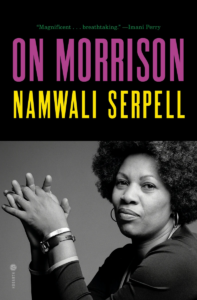
You can purchase On Morrison here and anywhere books are sold.
Cover art includes “Toni Morrison as Song of Solomon” by John Sokol (1981). “PASSAGES: On Morrison” is a production of the Random House Publishing Group.
Passages: On Morrison
“PASSAGES: On Morrison” is a podcast that takes reading on the road. Come along with Namwali Serpell, novelist, critic, and Harvard professor, as she joins fellow writers and skilled readers in conversation to pore over excerpts of Toni Morrison’s prose. Recorded throughout the book tour for On Morrison—Serpell’s electrifying, critical examination of Morrison’s writing—each episode welcomes listeners into rooms full of readers and discussions of how Morrison made her words sing. This show is the record of a traveling salon, a celebration of Morrison’s extraordinary work, and a love letter to reading closely in community.