More Than a War Diary: Angela Flournoy on Jean Said Makdisi’s Beirut Fragments
“She does not purport to be braver than she felt at any given time. Instead she is honest about her fear.”
Early in Beirut Fragments: A War Memoir, Jean Said Makdisi recounts a dinner party in Beirut during the nascent stages of Lebanon’s fifteen-year civil war. The distant thud of shelling punctuates the evening, refuting one guest’s optimism that the latest ceasefire agreement will endure. The guests fall silent, listening to a night suddenly made percussive. “Someone should record this madness,” another guest murmurs after a pause. “Someone should write all of this down.” The sounds of fighting draw closer; the dinner party disperses. Makdisi and her husband carefully make their way home to wait out the danger with their children.
Who is best fit to tell the story of a war—of wars within wars? Who should be granted the authority to “write all of this down”? Makdisi’s Beirut Fragments, originally published in 1990 and initially reissued in 1999, is simultaneously a modest and a radical response to these questions. An Arab woman is fit to tell the story: a mother, a teacher, a “noncombatant” who is no less enmeshed in the life of the war for being on the outside of its machinations. Employing a hybrid form that weaves together poetry, essays, and more diaristic entries, Makdisi fashions a narrative of life amid those fifteen years of violence that is at once intimate and expansive. Makdisi and her husband’s decision to remain in Beirut through so many seasons of uncertainty—despite their ability to expatriate with relative ease—is the central tension that undergirds Beirut Fragments. The result is both a chronicle of civilian life (and endurance) during wartime and a portrait of a city poised on the edge of obliteration: a work of witness, and an act of quiet, nonviolent dissent.
Beirut Fragments is less a memoir of survival than one of endurance, as survival implies an intactness on the far side of catastrophe—a wholeness that often exists only in the eyes of others.
Beirut Fragments opens with a stark, factual timeline of events, from the “sparking incident of the war in a Beirut suburb” in April 1975, through its major battles, to the first instance of Syrian intervention, the various meetings convened to broker peace, the Israeli invasion in 1982 and subsequent armed resistance against it, the pivotal assassinations, and finally, a seemingly tenuous ceasefire. This chronology offers readers a sense of the long, winding road of suffering that those who remained in Beirut were obliged to travel. The placement of the timeline at the memoir’s outset also gestures toward Makdisi’s desire to make clear what has too often been willfully muddled in Western understandings of the region and time period: this is not a conflict too complicated, too large and hopeless, to be made to adhere to chronology.
The narrative moves from the early days of the war to a glossary of Beiruti wartime phrases, then to Makdisi’s upbringing, and back to her memories of war and the people lost to it. The structure of the book belies its title: rather than fragmented, each section feels inherently linked to others as they work to paint a picture not only of Makdisi herself but also of Beirut—her city—as a living, changing secondary character.
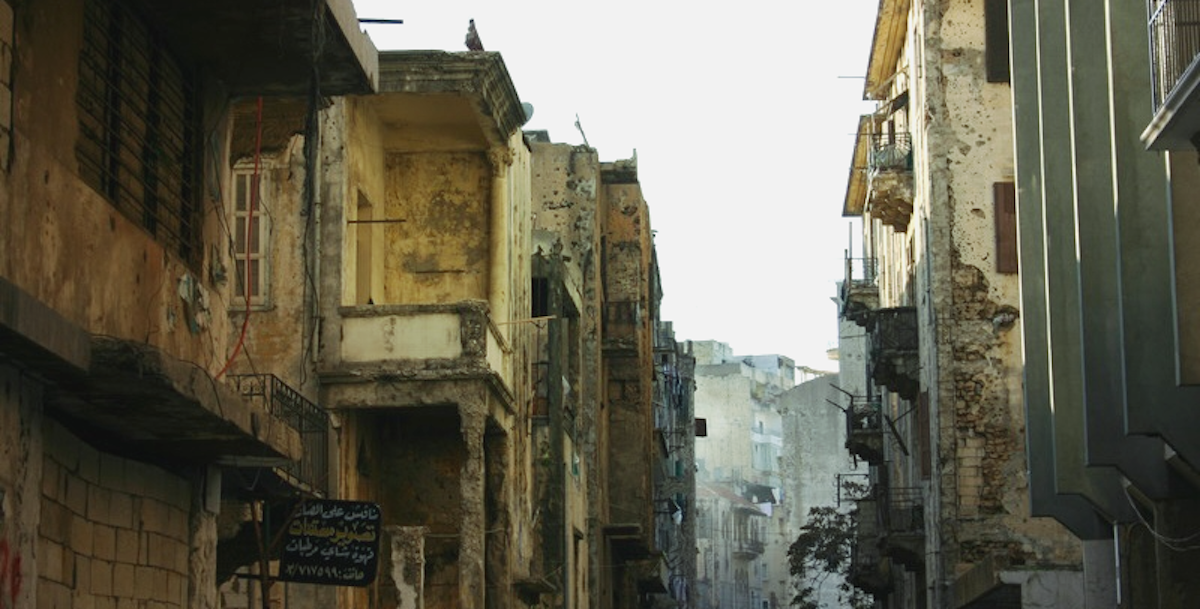
In a 2023 talk at the American University of Beirut on the legacy of her brother, the renowned scholar and public intellectual Edward Said, Makdisi praised Said for his ability to “talk back to empire,” a rarity for his generation, she said. “There was not a hint of the colonized sycophant or the man who—quote unquote—‘knew his place.’” In her own way, Makdisi does the same in Beirut Fragments. One of the most effective ways of talking back to an oppressive force is by speaking truthfully, by letting your experience rise above the noise of those who would flatten you and your kind into easy categories. Through her descriptions of Beirut’s varied architecture, a deep interest in the language of the place and its shifting idioms as the years of war drag on, as well as her focus on the individual lives touched by the war, Makdisi makes specific what others would rather keep vague and flat. And again, there is her choice to stay in the city, a rejoinder to the assumptions of Empire as much as it is an act of self-determination. “Embracing life instead of death, conviviality and solidarity instead of division and hatred, ‘carrying on,’ has come to mean not a blind and stupid clinging to a dead and buried past,” Makdisi writes, “but a clear statement of a perceived future in which the hostilities of the war have no place.”
*
At the opening of “Mirrors, or Contradictions: A Self-Portrait,” the most autobiographical chapter of the memoir, Makdisi writes, “I was born in Jerusalem, grew up in Cairo, aged in America, and died in Beirut.” It is a sentence that she subsequently dissects for its seeming contradictions (“I am the child in equal measure of Christianity and Islam”) and for the ways that it makes her both a likely and an unlikely person to recount a story of Lebanon’s wars.
Born into a Palestinian-Lebanese Protestant Christian family in Jerusalem, Makdisi and her four siblings attended school in that city until their father’s business in Cairo prompted the family’s relocation. The youngest of the first three children, Makdisi recounts her British colonial education, as well as her memories of relatives fleeing Palestine for Cairo after the 1948 Palestine War and the Nakba, Israel’s dispossession of Arabs from their homes and land. Despite Makdisi’s aunts, uncles, and cousins being part of some 740,000 displaced, their stories impress themselves on her for their singularity:
Much later, 1948 assumed in my consciousness the grandness of history, of justice and politics, of natural destiny and international morality. In a little corner of my mind, however, history will always mean the tragic smashing of individual lives by its cruel hands and the scattering of bewildered people reeling from its blows.
The Egyptian Revolution erupted four years later, followed by the Suez War when Makdisi was in her final year of high school. Memories of air raid sirens and searchlights live alongside her recollections of lighter moments during the end of her adolescence: marching to morning assembly at school; playing hockey, netball, and cricket; and going to the theater, where she “absorbed the hilarious comic tradition of Egypt.”
In the United States, where Makdisi enrolled in college, she was repelled by American anti-Arab prejudices. “Instilled into the American imagination [is] an image of the Arab world that was, to say the least, hostile,” she writes. She found herself having to “defend a whole culture against inexact accusation.” Makdisi also found the narrow understanding of female empowerment popularized by second-wave feminism frustrating, particularly the assumption that all women need the same genre of liberation. After completing her studies, she spent ten pivotal years in Washington, DC, in the 1960s, a period marked by movements for equality and protests against the endless wars America waged abroad. Makdisi drew much inspiration from the struggles toward progress in the country at the time, but was disheartened when the 1967 Arab-Israeli War showed her that “the same groups that vociferously supported the demand for justice in America often seemed oblivious to the parallel Arab demands for justice.”
The mere assertion of being unimpressed by life in the United States, by rejecting not only America’s prejudiced views of Arab life and culture but a future life in the country itself, is an act of refusal that helps the reader better understand Makdisi’s choices during her years in Beirut. In 1972, Makdisi and her family moved to Beirut, her husband’s hometown, where she hoped to “make a home, [to] settle down completely and finally.” A mere three years later war broke out, and many thousands began to emigrate. And yet the family remained. The power of Makdisi’s approach to this central choice—one she and her husband make not once, but again and again—in Beirut Fragments is that she does not purport to be braver than she felt at any given time. Instead she is honest about her fear, the many moments it overtakes her, and what might lie on the other side of being surrounded by so much violence. “As all this happened, and as I wrote, a new woman grew up in me, and my skin molted,” she writes.
Beirut Fragments is less a memoir of survival than one of endurance, as survival implies an intactness on the far side of catastrophe—a wholeness that often exists only in the eyes of others. It is a record of bearing the unbearable, of living for the quiet days, when the truce might hold, the taps might continue to flow, and the schools might open their doors. In the afterword that accompanies the 1999 reissue of the memoir, Makdisi explains that when she originally sent the manuscript to her editor, it was unclear whether the latest pause in fighting would last. The book was written not from the safe distance of resolution, but with the past still ablaze in the present.
Beneath the memoir runs a steady defense of everyday Beirutis and, equally, a condemnation of the world that distances itself from their pain. “All my life, it seems, has been passed in the shadow of violence,” Makdisi writes. “And still I have no defense except outright rejection, no argument against it except to point at the desolation around me.”
*
By the time the memoir was published in 1990, the West had long grown accustomed to discussing Beirut as an aberration, a place where the people simply could not stop fighting, just one obstacle standing in the way of the grabbag dream for “peace in the Middle East.” As if Western hands were not themselves implicated in the region’s suffering. Makdisi, deft in her use of description as critique, offers her strongest rebuke of this distancing Western rhetoric when she details the unmatched ferocity and technological superiority of Israeli weaponry during the 1982 invasion—power made possible by the support of the United States and its allies:
There was a peculiar relationship between Beirutis and Israeli planes: If one dared, one might almost call it romantic. In this attitude was a strange commingling of repugnance and desire, alienation and belonging, intimacy and coldness. It was part admiration for the breathtaking technology; for the sheer physical beauty of the gleaming, silver streaks in the clear blue skies; for their seductive elegance.
Many of the events in the chapter “Summer 1982: The Israeli Invasion” will strike today’s readers as eerily familiar. Leaflets urging evacuation dropped by Israeli planes moments before an air strike; humanitarian organizations’ requests for temporary ceasefires ignored; and a devastating multitude of civilian casualties, their images—“babies and old men, Palestinian and Lebanese, lying dead or dying; bits of bodies, shops, and cars; houses reduced to unrecognizable rubble; an old woman, wiping away her tears”—printed in ghastly profusion in newspapers.
Beirut Fragments is a record of lived testimony. It is interested in what it feels like to be trapped inside a café as a gun battle erupts out front and to return to everyday life afterward.
As I write this introduction in the fall of 2025, after nearly two years of Israel’s bombardment of Gaza, many millions of people worldwide have witnessed, on their smartphones, the daily human toll of such high-tech warfare. The connection between the shattered bodies and buildings and their own governments’ complicity is now unmistakably clear. But in 1982, the waters of public opinion were far murkier—clouded by distance, by denial, and by the convenient myth of neutrality.
When Beirut Fragments was first released, some reviewers described it as a book that steers clear of politics. But that is not what Makdisi is doing. In a war where there are many sides to be taken up, Makdisi chooses to take the side of the city itself. While she does spend time earlier in the memoir parsing the political logic of the series of conflicts that leaves many thousands dead and displaced, she devotes the bulk of her attention to chronicling what it felt like to have lived her life, and to have seen so many others try to do the same, amid layered crises.
Beirut Fragments is a record of lived testimony. It is interested in what it feels like to be trapped inside a café as a gun battle erupts out front and to return to everyday life afterward. To call on the same electrician for years and later learn that he and his family have been murdered in a massacre. War, Makdisi writes, “is a mass of contradictory and ambiguous experiences.” The memoir’s title, rather than reflecting the structure of the book itself, seems rather to allude to the ways that violence disrupts, how it breaks apart lives and memories and communities.
Much like the American newspapers when Makdisi completed Beirut Fragments in 1990, today’s media is focused on the Middle East. Again there’s talk of a tenuous ceasefire finally holding. And more than three decades on from Lebanon’s wars, a particular refrain is still spoken by politicians who have never lived through what Makdisi experienced: Bad things happen in war. It is a way to shrug off atrocity, the slain child, the besieged and starved city, yes, but it is not even the whole truth.
Good things happen in the midst of war, too.
Makdisi shows many of these good things. The man who valiantly shuttles Beirutis across the city’s no-man’s-land. The university office administrator who endeavors to decorate her space despite the seeming futility of coming to work at all. “In the underground shelter, I have sat with people of all religions and nationalities,” Makdisi writes. “We have comforted each other, shared food, water, blankets, candles.” Human beings continue to show one another kindness, some until their last breaths. They continue to disprove the lies heaped on them by whoever stands behind the gun, to condemn the gunman’s indifference with their own humanity. And they do hope, despite evidence to the contrary, that their circumstances might improve.
“It is not so easy to patch up the people,” Makdisi writes. “Some still sleep fully clothed. Some still refuse to leave their homes, sitting indoors, waiting. Some leap up, shaking, at the slightest sound.” It is not easy, but the people do patch them-selves up, as life necessitates one step to be put in front of another. They go forth imperfectly, yes, but admirably.
____________________________
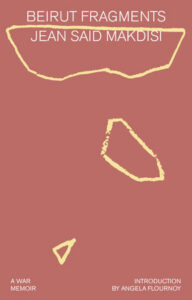
From Beirut Fragments: A War Memoir by Jean Said Makdisi. Introduction copyright © 2025 by Angela Flournoy. Available from Outsider Editions, an imprint of Knopf Doubleday Publishing Group, a division of Penguin Random House, LLC.

Angela Flournoy
Angela Flournoy is the author of The Turner House, a summer 2015 Barnes & Noble Discover Great New Writers selection. Her writing has appeared in The Paris Review, The New Republic, and The Los Angeles Review of Books. Her last essay for LitHub was on the literature of black neighborhood change. [www.lithub.com/the-disappearance-of-black-neighborhoods/]