Molly Crabapple on the Jewish Bund
In Conversation with Whitney Terrell and V.V. Ganeshananthan on Fiction/Non/Fiction
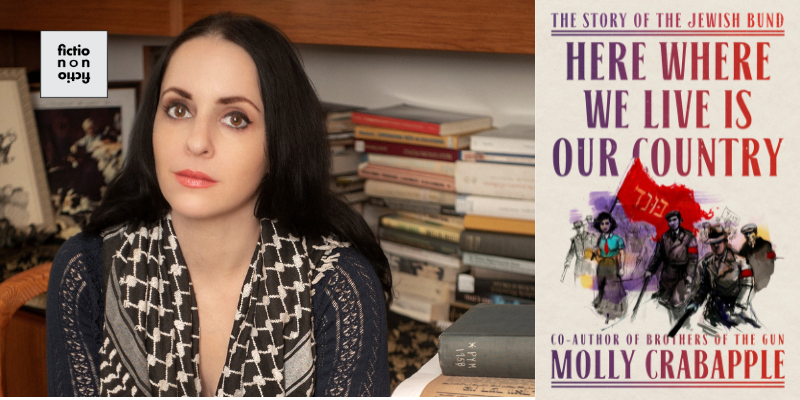
Artist and writer Molly Crabapple joins co-hosts Whitney Terrell and V.V. Ganeshananthan to talk about the Jewish Labor Bund and its socialist, secular, anti-Zionist principles. Crabapple, whose artist great-grandfather Sam Rothbort was part of the organization, discusses researching and writing her New York Times bestselling book, Here Where We Live Is Our Country: The Story of the Jewish Bund, which chronicles the Bund’s roots, founding in 1897, and development in the 20th century. Crabapple explains the Bund’s relationship to the idea of Hereness and their belief that diaspora was home and that they belonged where they lived; the Bund’s relationship to the Russian empire and to Jewish identity; and the fate of its leaders in the Holocaust. She also reflects on how she structured and shaped the Bund’s massive history following a random encounter with a fallen book on the street. She reads from Here Where We Live Is Our Country.
To hear the full episode, subscribe through iTunes, Google Play, Stitcher, Spotify, or your favorite podcast app (include the forward slashes when searching). You can also listen by streaming from the player below. Check out video versions of our interviews on the Fiction/Non/Fiction Instagram account, the Fiction/Non/Fiction YouTube Channel, and our show website: https://www.fnfpodcast.net/ This podcast is produced by V.V. Ganeshananthan and Whitney Terrell.
Molly Crabapple
Here Where We Live Is Our Country: The Story of the Jewish Bund • Brothers of the Gun A Memoir of the Syrian War by Marwan Hisham and Molly Crabapple • Drawing Blood • My Great-Grandfather the Bundist | The New York Review of Books
Others
Zinky Boys Soviet Voices from the Afghanistan War by Svetlana Alexievich, translated by Andrew Bromfield •The Amazing Adventures of Kavalier & Clay by Michael Chabon • U.S.A. The Complete Trilogy [The 42nd Parallel, 1919, and The Big Money] by John Dos Passos
EXCERPT FROM A CONVERSATION WITH MOLLY CRABAPPLE
V.V. Ganeshananthan: Arkady Kramer, who had previously been involved in the Vilna group, was one of the founders of the Bund. So who was he, and why was Vilna the place for the Bund’s predecessor to begin? I kind of went on a Vilna internet spiral after reading this.
Molly Crabapple: The Jerusalem of Lithuania, they used to call it. Vilna was just this huge intellectual center for Jews. It was a place religious movements came out of, it was a place literary movements came out of, and it was a place political movements came out of. Arkady Kremer is one of the thirteen original founders of the Bund, and usually considered the daddy of the group, even though the Bund was never a group that had a single omnipotent leader the way that the Bolshevik Party had.
Arkady Kremer was a boy from a poor family with a gloomy disposition, a bookworm, someone with a temperament so ascetic that he would not buy new pants, even though his pants had a lot of holes in them, and he was someone who was, as a grumpy young student, discovered by one of the heroines of the book, his wife, Pati. Pati and Arkady Kremer were two of a legion of young Jewish troublemakers who were looking at the decaying czarist empire with all of its repression, with all of its racism, with all of its famines, with all of its epidemics, with all of its backwardness, and they were thinking “There must be something better than this. There must be a better way to live.”
These young Jews, like many young non-Jewish subjects of the empire, were turning to revolutionary thinkers like Karl Marx, and in exchange for doing the most minor acts of rebellion—like let’s say setting up a book club—Arkady, Pati, and the rest of their milieu would get very early introductions to being arrested, to being beaten, and sometimes being locked in prison and sent on stints of internal exile. Now, Arkady and Pati founded what was called the Vilna Group in the late 1800s on the idea that was common in Russian revolutionary circles at the time, which was that the proletariat is the agent of history, but the Russian proletariat is really dumb, he’s really uneducated, there’s no way he can be the agent of history.
So in order to have a revolution in a backwards country like Russia, you couldn’t go about it straight away. You had to educate the worker. You had to set up book clubs, and I kid you not, the original theory of how the revolution would kick off in the Russian Empire was that young intellectuals would set up book clubs for workers who would then set up more book clubs who would then get more workers to come to their book clubs and eventually, if enough workers came to enough book clubs, revolution.
That was how the Vilna group started, but pretty quickly they realized that this is not actually leading to revolution. It is just leading to workers becoming hipsters, and talking down to other workers, and dragging their books around to look cool. They realize that they’re going to need a different tactic. Then as now, it is also true that workers have never needed professional revolutionaries to tell them that their job sucks. It is not a revelation to workers that they’re getting paid too little to work in conditions that are too tough for hours that are too long, and in Vilna and in other cities around the Pale of Settlement, workers were already starting to organize to do something about it. There were already the outlines of a primitive trade union movement with strikes and mutual aid funds.
So, Arkady, Pati, and their friends in the Vilna Group decide: How about we use our skills that we have as young, educated intellectuals to help these workers? How about we research employment law? How about we print up their pamphlets? How about we network in between cities and abroad so that they can get access to rich people in Switzerland to fund their strike funds? How about instead of talking down to them, we make ourselves useful? And it was really this meeting between these very educated and idealistic young Marxists and the incredibly practical and brass knuckles tough workers movement of the Jewish proletariat of the Pale of Settlement that led to the Bund.
Whitney Terrell: People in America have often criticized the Democratic Socialists as being educated people who live in Brooklyn who don’t actually know any workers. Making that connection between the intellectual class and the actual working class seems perpetually difficult.
MC: It’s also the story of every single revolution and every single movement. They’re all about the meeting between the working class and educated young intellectuals. That’s been the case since the French Revolution,
WT: Arkady writes about this a bit. You mentioned his book on agitation that Lenin ends up quoting, which I thought was fascinating. So, the Bund is created—the Yiddish word meaning organization—and they join the Russian Social Democratic Labor Party as representatives of the Jewish working class for the entire Russian Empire. About a year later in 1898, we bring in the character of your great-grandfather. One of their representatives comes to Volkovysk, where your great-grandfather’s a tannery apprentice, and when the apprentices go on strike to get Saturdays off, they succeed, and Sam Rothbort joins the Bund. How did that change his life?
MC: Sam was someone who grew up in a very religious world. His father was a Talmudic scholar, though he also was in the schmata business too in America. I don’t want to make this sound too glorious, but his father was an incredibly pious and learned man, and the way that the Jewish religion was practiced for someone like Sam was something that really consumed every aspect of your life. It determined how your marriage would go, what you would do on Friday versus Saturday, what sort of clothing you would wear, what you would eat, whether you would carry a walking stick on Friday night. It was a complete way of life. It wasn’t like something that you practiced in a religious building once a week. It was your entire world, and along with that, it came with a lot of separation from the non-Jewish world.
Volkovysk, where Sam was from, is about half Jewish, a quarter Polish, and a quarter Belarusian. It had a few Crimean Muslims there as well, but in general, Jews lived lives that were socially separate from their Christian neighbors. They also lived lives where they wouldn’t be reading secular books. Sam went to cheder, religious school, where he was studying the Talmud and the Torah. He was not studying math or science or Jules Verne or Charles Darwin. So for him to join the Bund was something that changed his life in the broadest and most intimate aspects. It meant that he could hang out with girls that he could date. It meant that on Friday nights, instead of being absorbed in prayer, he was sneaking off to revolutionary meetings. It meant that he was breaking the rules of Sabbath by carrying something on Saturday, and especially—I think this is the most important thing—it meant that he could no longer view himself as separate from the larger non-Jewish world. People who before he might have viewed as the rough Polish boys who threw rocks at him, or as the drunken soldiers who smashed shops, or as the local czarist authority that talked down to his grandfather, those people suddenly stop being aliens and instead non-Jews could also be comrades.
Transcribed by Otter.ai. Condensed and edited by Rebecca Kilroy. Photograph of Molly Crabapple by Daniel Efram.

Fiction Non Fiction
Hosted by Whitney Terrell and V.V. Ganeshananthan, Fiction/Non/Fiction interprets current events through the lens of literature, and features conversations with writers of all stripes, from novelists and poets to journalists and essayists.