Meet the shortlisted writers for the 2026 Women’s Prize for Fiction.
Today, the Women’s Prize Trust announced the shortlist for the 2026 Women’s Prize for Fiction, narrowed down to six from a longlist of sixteen. The winner, who will be announced on June 2, will be awarded £30,000 and a statuette known as the “Bessie,” created and donated by the artist Grizel Niven.
In the meantime, Literary Hub caught up with the shortlisted writers to ask them a little about their writing lives.
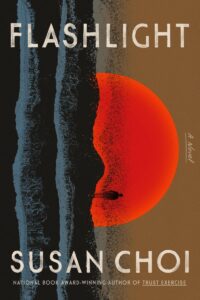
Susan Choi, author of Flashlight
What’s the best or worst writing advice you’ve ever received?
The best was from the mother of my first housemate post-college. My housemate was an aspiring painter, and she painted all the time, and I was an aspiring writer, and I worked at my waitressing job and talked a lot about writing and even on my days off I didn’t write. My housemate’s mother, when she visited us, was dismayed with me because of this, and said, “If you don’t open the store every day, how are you going to make a sale?”
Who is the person, or what is the place or practice that had the most significant impact on your literary education?
My dad. English was his third language, and he didn’t even read much himself—he was a mathematician—but when I was little he bought me the most incredible books, with an unerring sense of what I would love, always making sure there was a next book to read when I’d finished the last one. Mary Norton and Susan Cooper and Frances Hodgson Burnett and E.B. White and Roald Dahl and Lloyd Alexander and C.S. Lewis—I still don’t know how my immigrant mathematician father chose these books for me but they were the perfect books, and they made me a reader and a writer.
What part of your writing routine do you think would surprise your readers?
That I have no routine whatsoever. This may also surprise my students since I often harangue them to have a writing routine. But the fact that I don’t have a routine is an even stronger argument that they should! I’d be so much better off if I had one.
What was the first book you fell in love with (and why)?
Frances Hodgson Burnett’s A Little Princess. The reason I fell so hard was definitely the Tasha Tudor illustrations. They are so tender and lovely and sad. On the basis of those otherworldly illustrations I thought Sara Crewe was the most admirable girl who ever lived! I could not get enough of gazing at her both in her rags and—after the book’s absurd plot twist—her riches. I can now almost laugh at the story, which is as outlandish a piece of Victorian propaganda as you will ever find, but the illustrations still make my heart ache, with longing to either be Sara herself, or her very best friend.
If you weren’t a writer, what would you do instead?
Something with my hands, and outdoors—the opposite of writing, which is all in my head and done, in my case, mostly indoors squinting at a laptop. I have all sorts of absurd and unrealistic fantasies about my non-writing career, so I’m really glad you asked. I would be a person who delivers yachts to their owners after sailing them between amazing locations, or someone who counts trees in a national forest, or someone who builds beautiful wooden structures with beautiful tools—all these fantasies require a lot of training and skills and equipment that I don’t possess and don’t even know how to acquire. Maybe it’s a good thing I’m a writer.
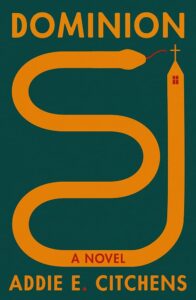
Addie E. Citchens, author of Dominion
Who do you most wish would read this book? (your boss, your childhood bully, etc.)
I want people who uphold the flawed, destructive, and hypocritical patriarchal structures that bid the marginalized to compete for their oppression to read this book and recognize the concept of dominion is relative, subject to the other party’s willingness to submit, and power, both the individual’s and collective’s, can summarily be reclaimed.
How do you tackle writer’s block?
I tackle writer’s block by relieving my work of the pressure that it must “go somewhere.” Sometimes, I simply write for the practice of it, for the music of it, for the release it allows me. When I am not writing I am observing, reading, listening, and taking notes, and in that way, I have all sorts of delightful words hanging about just waiting to get their story.
Who is the person, or what is the place or practice that had the most significant impact on your literary education?
That person would definitely be my mom. She was a teacher when I was young, and she taught me and my sister to read at home before we formally entered school. The librarian where my mom worked had a daughter who was a few years older than us. When her daughter outgrew her books, she gave them to my mother since she knew my sister and I loved to read.
Which book(s) do you reread?
I have less time now to re-read in trying to focus on my newer reading list, but I reread all types of books. Some of my favorites to reread are Toni Morrison’s Sula, Song of Solomon, and A Mercy; Lace by Shirley Conran; The Hunger Games by Suzanne Collins; Hatchet by Gary Paulson and the Little House books by Laura Ingalls Wilder; Glom Gloom by Jo Dereske;, Their Eyes Were Watching God by Zora Neale Hurston—those Hans Christian Andersen tales, or rather all sorts of short tales and legends as well. Also, some novels I loved but can’t reread because the first experience was too stunning or eviscerating.
What is your favorite way to procrastinate when you are meant to be working?
Music and dance breaks are my favorite means of distraction from the work!! My tastes are all over the place. I love classic 80s and 90s R&B, grunge and alt from the 90s and early aughts, 80s hairbands, disco, dancehall and soca, kompa, the Delta blues from the 30s and 40s, all the way to its evolution to Southern Soul—you name it, and I can blow some time creating intense and terrible choreography to it.
What book has elicited the most intense emotional reaction from you (made you laugh, cry, be angry)?
Tender is the Flesh by Agustina Bazterrica is one I wanted to fling across the room when I was done. It was dystopian, yes, and terrifyingly matter-of-fact in it’s dystopian-ness.
What’s one book you wish you had read when you were young?
When I was a kid, my dad was into speculative fiction, so I read most of his books of that type, but for some reason I never delved much into sci-fi/fantasy beyond my love of fairy tales, the darker the better, so instead of the one book I wished I’d read, I wish I had read more of the world-building genre.
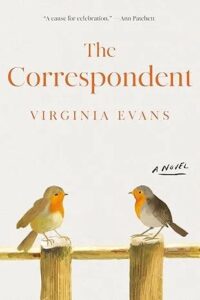
Virginia Evans, author of The Correspondent
What time of day do you work, and why?
I work in the morning. Once my children are off to school, once the house is quiet, I try to close everything else out and get to work. In the morning I feel fresh and my mind is open. If I can push the other matters of the day to the afternoon, I can reserve the morning for my thoughts to take root, or to bloom, depending on where I am with the project. If I’ve written in the morning, the rest of the day feels more surmountable.
Which books do you reread?
I tend to reread my favorite classics, some examples being East of Eden, Rebecca, and Never Let Me Go. These are the books that feel new each time. Sometimes I’ll reread a fun series. I tend to forget the details of novels, so often if I’m rereading, it’s as if I’m reading it for the first time.
What book has elicited the most intense emotional reaction from you (made you laugh, cry, be angry)?
When I read Stoner by John Williams, I got to the end and lay down on my back on the floor for a long time and cried. The book had swelled and swelled, filling me up with so much feeling as I’d read it, and when it was over, I was overcome by the enormity of the life of this simple man, how beautiful and agonizing it had been, and it made me think about the immensity of all the lives in the world, across time. The book still overwhelms me when I think about it.
If you weren’t a writer, what would you do instead?
I really think I’d have loved being an arborist, and there are times I dream about a second career with trees. I am mesmerized by trees. I walk around noticing dead limbs I’d prune, leaf patterns, their changes over seasons, bark, knots, the curve of trunks. Trees make me feel so good.
What’s the best or worst writing advice you’ve ever received?
I heard Elizabeth Strout say one time in an interview, and I wrote this down but don’t know if it’s precisely quoted: every scene with either a sense of quiet urgency or promise. I have this written on a small piece of paper on my desk and I probably test my work against the idea every day.
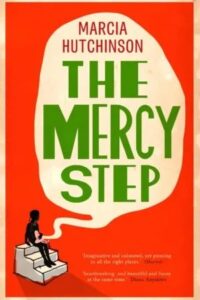
Marcia Hutchinson, author of The Mercy Step
What time of day do you work (and why)?
When I’m writing a first draft I tend to work first thing in the morning when my brain is fresh. I work very intensively in short bursts so that if things go well then by lunch I am almost semi-comatose with brain fatigue. But when I move onto the second or subsequent draft of a manuscript I can write anywhere and any time. I quite like editing on trains as it helps to pass the time.
How do you tackle writer’s block?
I don’t try to fight writer’s block; I simply accept it. For the whole of 2025 I only wrote two short stories but I knew that the ‘muse’, as it were, would eventually return. Being diagnosed with ADHD has helped me understand myself. I now accept that I work in fits and starts. I have once written as much as 10,000 words in a day but these days I try to aim for 2,000 words a day when I am writing a first draft. I also find that reading my work out loud to other writers at workshops and also one-on-one with my zoom writing buddies helps reignite my enthusiasm when I am flagging.
Who is the person, or what is the place or practice that had the most significant impact on your literary education?
The Identity Writers Group which has been run by Cultureword in Manchester for almost thirty years is my writerly spiritual home. I have no formal training in creating writing but going to their workshops every Wednesday for the last seven years, slowly but shortly helped get me from couch-to-novel. Peter Kalu, their Creative Director, (who has just stepped down after thirty years in the job) has been one of my (and The Mercy Step’s) greatest cheerleaders even back in the dark days when I didn’t even know if I would ever finish it.
What part of your writing routine do you think would surprise your readers?
I don’t actually write my first drafts, I dictate them straight into Google docs while walking around my local park. For some reason walking and talking helps my creative ideas flow. I’ve got into the habit of walking until I’ve completed 2,000 words. As soon as I get home I try and make sense of what is mostly gobbledygook, but there are usually a few nuggets of gold hidden in there. There is always still a huge amount of redrafting to be done but at least I’m no longer facing the tyranny of the blank page.
If you weren’t a writer, what would you do instead?
I’m already doing it! If I weren’t a writer I would continue to be a fitness instructor. I teach a dozen classes a week of Zumba, spin, yoga and weight training at gyms around Manchester. My ideal day consists of getting up, with any luck writing a chapter in the morning, chilling/ running errands in the afternoon and then down the gym in the evenings to dance the night away with my wonderful Zumba ladies. I find dancing to be such a stress reliever and doing my own choreography means that it is also another much needed creative outlet for me.
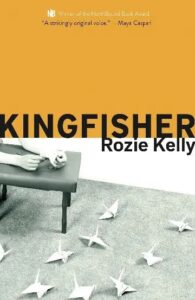
Rozie Kelly, author of Kingfisher
What’s the best or worst writing advice you’ve ever received?
There are two pieces of writing advice I think about every time I write. Jeanette Winterson’s simple yet perfect ‘get your bum on the seat’—get yourself in position, guard your writing time, and if nothing else just stare at your project. Everything else will follow. And ‘don’t flinch’, which was passed to me via various authors. This doesn’t mean writing should have to go to a painful place (although sometimes it does), but rather the place that makes you feel a bit uncomfortable, makes you jumpy and curious and scared—that’s where you’ll find the good stuff.
Which non-literary piece of culture—film, tv show, painting, song—could you not imagine your life without?
Buffy the Vampire Slayer. It is such a distinct, generation-defining piece of pop culture. It has counselled me through grief, introduced me to my first loves (Spike and Faith), and remains a masterclass in the momentum of storytelling. I could teach a class on it (and would love to if anyone’s interested!)
What was the first book you fell in love with (and why)?
Roald Dahl’s Matilda. Which must be the answer for so many people, particularly women around my age. I thought I was her—I was convinced I could move things with my mind. Her hunger for knowledge spoke to me as if it was a message for me alone. I even had an emotional support copy of the book which I used to nibble on (literally).
What book has elicited the most intense emotional reaction from you (made you laugh, cry, be angry)?
Two very different novels have made me snot-cry to an extreme—James Baldwin’s Giovanni’s Room, and Patricia Lockwood’s No One is Talking About This. The novels could not be more different and yet they achieved a similar thing—a sort of rawness, an understanding of the hopelessness life can sometimes serve up to you. Giovanni’s Room is just such a tragedy, an exquisite and utterly avoidable tragedy, whereas Lockwood’s novel blindsided me with her interpretation of grief.
If you weren’t a writer, what would you do instead?
I just am a writer, and I’d be doing it even if I were never published or read—but—in a parallel universe where this wasn’t my pathology, without doubt it would be something creative. I’d be a silversmith or a glass blower or a carpenter. Something that involved making beautiful things with my hands, out of tactilely pleasing materials.
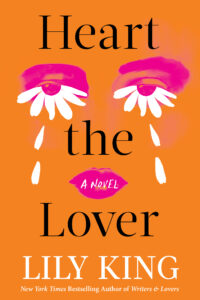
Lily King, author of Heart the Lover
Who do you most wish would read this book? (your boss, your childhood bully, etc.)
Anyone who is still obsessing about “the one who got away.” And my high school English teacher, who set me on this path.
What time of day do you work (and why)?
The morning has always been the most creative time of day for me. I discovered this in high school when I took my first creative writing class and we had to hand in a short story every Monday. I would write mine on Sunday mornings right after I woke up, before breakfast. My mind was clearest then, and still is.
How do you tackle writer’s block?
For me it’s not a block but a depletion. If I’m stuck, it means I’m creatively depleted and need to refuel. I don’t put any pressure on myself in those moments. I take the day, the week, the month—however much time I need—and read and exercise and listen to music and watch movies and look at art and just…live. I pursue whatever interests me. And pretty soon little creative impulses start sparking again and I’m ready to go back to it.
What’s the best or worst writing advice you’ve ever received?
I think the worst is something I’ve heard men, but never a women, say: you must write every day. That has just not been possible for me—not when I had three jobs, not when I had two little kids, not when I’m on book tour—and it was necessary early on to reject that persistent advice in order to stay sane and not feel like I was failing most of the time.
Who is the person, or what is the place or practice that had the most significant impact on your literary education?
I have to go back to that creative writing class in high school. It was taught by Tony Paulus, who had recently joined the English department of our small high school in Massachusetts. He’d taken writing classes at Stanford and brought that workshop model to this elective he offered to juniors and seniors spring semester. It was a class of seven or eight kids and we really did hand in a story every Monday morning. Mr. Paulus guided us and we learned together what was good writing, what worked, what didn’t, and how to fix it. I took it for two semesters and that was it—I never wanted to do anything else after that.
What part of your writing routine do you think would surprise your readers?
I have to eat eggs most days before I write, I have to drink strong black tea, and I have to write with a pencil. I can’t write fiction with a pen. I have to write first drafts by hand in notebooks and a good day is a page and a half. Not sure any of that is surprising, but it’s all I’ve got.
Which non-literary piece of culture—film, tv show, painting, song—could you not imagine your life without?
There are so many many songs I can’t imagine my life without, so many singers whose absence would create big holes in my life, but I really wouldn’t want to take away singing, years ago now, “Sweet Baby James” by James Taylor to my kids at night.
What was the first book you fell in love with (and why)?
I think the very first book I fell in love with, even before I discovered Judy Blume, was Sydney Taylor’s All-of-a-Kind Family. It’s a series of five books for new readers about a tight-knit Jewish family of five daughters growing up on the Lower East Side starting in 1912. I read them over and over, these stories made of small moments that were full of vivid details and came so alive for me: a button game their mother creates to make cleaning fun, the hot chick peas at the market, the chocolate babies at the candy store, the rituals of the Sabbath. It was the opposite of my life in small-town New England, the only child left at home with parents who couldn’t seem to be in the same room together, and when I was reading those books I actually felt like I was there, and a part of their family.
Which book(s) do you reread?
I return to Virginia Woolf’s To the Lighthouse and Mrs Dalloway again and again, for the language and the energy and deep feeling. And I go back to Persuasion, Pride and Prejudice, and Sense and Sensibility every few years, as well as Shirley Hazzard’s The Evening of the Holiday, Knut Hamsun’s Hunger and Tolstoy’s The Death of Ivan Ilyich.
What is your favorite way to procrastinate when you are meant to be working?
I will tell myself I’m going to write in my journal, but what I end up doing is playing around with the fountain pens and inks on my desk. Even though I can’t write fiction with ink, I do love nibs and inks and mixing colors. I’m always trying to find just the right shade of green.
What book has elicited the most intense emotional reaction from you (made you laugh, cry, be angry)?
Independent People by Halldor Laxness comes to mind. I’m not sure I can describe the emotion exactly when I finished it-—it was more a combination of elation and sadness and love and existential bemusement all at once. It was deeply powerful and lingered for months.
How do you decide what to read next?
When I’m writing a book, I can be very picky about my reading. I’m often looking for something specific and yet I don’t really know what that is, something that will somehow speak to some element of what I’m working on, but not too directly. It’s a bit of a dance. When I’m between writing projects, I’m much looser about the choice. I often start several books at once and see which suits my mood at the moment.
What’s one book you wish you had read when you were young?
I discovered Virginia Woolf in my late 20’s. I wish Mrs Dalloway had been assigned in high school. I know it would have blown my mind and I wouldn’t have had to go through all those years in the wilderness without her.
What do you always want to talk about in interviews but never get to?
Interviews are so rarely about the actual writing on the page, the sentences, the scenes, the small moments that a writer spends so much time on. I saw an online conversation during Covid in which the interviewer, another writer, simply read passages of the book to its author. There was no specific question afterward, just a request to comment on the passage. I loved that, I wish it were like that more often.
If you weren’t a writer, what would you do instead?
I would be a not-very-talented singer-songwriter and wait tables.