







We held the launch party for issue two, a rush job if there ever was one, at Scrublands, a bookstore-gallery-wine bar in the French Cleat District. Through the connections of everyone on the masthead except me, we had managed to draw an impressive crowd. In the low-lit space I spied a high-wattage cluster of lit-world celebrities—Hunter Duncan Harrison, Fan Hsu, Nadine Soud—in addition to representatives from the spheres of fashion, visual art, and music. Quentin Roseman of the Haldols was there, chatting with Veronica Vector, the director, by the table of vintage paperbacks. Anele’s squatmates huddled by the shelf of feminist and Marxist theory, Manda and David were DJing bleak house from behind the sales counter, and a handful of fresh hires whose names I had yet to learn were reading quietly together in the new releases section.
Lungs whirred about the room in an electric wheelchair festooned in feather boas and Christmas lights, studiously avoiding serious questions about whether his conveyance was a tasteless prop or a medical necessity. Even seated, he was the life of the party.
I stood by the bar, people-watching with Gregory Neyerwitz, one of my three new intern roommates. The other two, Molly Dogwood and Taylor Mosco, were circulating ably with the beautiful and naturally extroverted people.
“Oh my God, is that Ashley Braumaire talking to Richard Ngele over by the modern classics in translation?” asked Gregory, nudging my elbow in a spot that was starting to hurt from two-plus hours of such nudging. “I heard she hated his book and was going to write a takedown of it in Nu Jerusalem, but then her editor told her Valerie Hales was blurbing it and she completely changed her tune. And now look at them, carrying on like old friends. I wonder if he even knows?”
Gregory had a chillingly extensive command of lit-world gossip, hoovered up in his relentless calendar of readings and parties and talks and launches. Much of what he gathered on these outings was so inane I wondered how he justified the time commitment, not to mention the brain space given over to who said what about whom at so-and-so’s birthday happy hour.
By the same token, I had, on several occasions, made good use of the juicy morsels he fed me, in order to insinuate myself with an intimidating personality connected with the magazine—priority contributors, editors at rival pubs. I apologized to Gregory in my heart every time I ripped him off for my own strategic reasons, but in my gut I continued to disparage him as an opportunist and a climber, more hanger-on than genuine talent.
“I haven’t read him, have you?” I asked, indicating Ngele.
“Horsehair Fantasia is genius, utter genius,” said Gregory. “Everything else is terrible, absolutely terrible.”
Ruthless binary pronouncements, delivered without elaboration, were the extent of Gregory’s critical perspective. He had written a capsule review for issue two about a trio of recently released books proclaiming the death of community and human connection in the age of merciless technological advance. While his prose was polished and devoid of technical flaws, I found something inherently, almost imperceptibly, off-putting about it. With our other writers I poked and prodded their language until it hit my ear just right. But Gregory’s contributions I left strangely under-edited, as if wishing for his words to stand and fall on their own.
The bells above the door jingled and in came Camper with his work colleagues Tim and Mike.
“No way,” said Gregory, nodding at them. “I think that’s Lenny Dovekind with those two geeky guys.”
With the beard Camper did in fact resemble Lenny Dovekind, a California poet known for writing from the perspective of rocks and plants.
“He’s a good friend of mine,” I told Gregory. “I’m going to go say hi.”
Tim and Mike had never seen me not struggling to follow the byzantine rules of Pelt & Musket, so observing me in something closer to my natural element must have been surprising.
“I don’t know if we’re cool enough to be here,” said Mike.
“What are you talking about?” I said. “You guys are super-cool. Trying to save the planet, that’s definitely cooler than writing for some dumb little magazine.”
“$3,500 a copy?” said Tim. “That seems pretty expensive. Is there something I’m missing?”
He hovered his hand over a stack of issues set on a table, wary of touching them.
“That’s just for show,” I said. “We basically give everyone some kind of discount. Hell, why don’t I just give you a few for free.”
Even with my insistence, Camper and his coworkers were reluctant to take issue two of The Horn.
“Seriously,” I said, practically forcing the magazine into their hands. “No charge. They’re yours.”
The trio of city employees flipped through the issue with obligatory earnestness, straining to read in the dark and din of the party.
“It’s lovely,” said Camper. “Beautifully done.”
He rolled his copy into a tube and raised it to his eye like a spyglass to scan for the bar. Booze in sight, he took Tim and Mike’s orders and powered over.
Tim paused on the spread opener of Clara Forst’s feature about doing a lot of drugs and almost drowning in a pool in Thailand.
“Didn’t this writer die last year?” he asked.
“Yes, it was very tragic,” I said.
“This is, what, a kind of a tribute?” asked Mike.
“No, she’s our posthumous editor,” I said. “We run a new piece by her every issue.”
Mike and Tim did not seem to understand.
“OK,” said Tim. “And you don’t run into any problems with that?”
“Her close friend and literary executor manages her contributions,” I said. “You may know her name. Anele Natkin? Hey, Anele!”
I shouted to Anele across the room and waved for her to come over, but she was in the thick of a very serious-looking squat meeting and made eye contact with me only long enough to shake her head no.
“So this is her unpublished writing you’re putting out?” asked Tim.
“More or less,” I said.
“And what happens once you’ve published it all?” asked Mike. “Sorry if these are impolite questions, I’m just curious how it works.”
At that moment Anele appeared by my side, having apparently decided to heed my summons after all.
“Anele,” I said. “I was just talking to these fine gentlemen about how you select and edit Clara’s articles.”
“I really can’t discuss that,” said Anele. “I’m sorry to interrupt but I need to steal the managing editor for a moment.”
She pulled me away from Tim and Mike, into the storeroom where the magazine staff had stashed their bags and coats.
“Why are you sharing state secrets with those STEM lords?” she asked.
“Those are my friends,” I said. “They’re conservationists.”
She shot a probing glance in their direction.
“Alright,” she said. “But I don’t dish on the Clara arrangement for the general public. In any case, that’s not what I wanted to talk to you about.”
She dug through our colleagues’ bags until she found, buried at the bottom of the pile, a ream of issues bound in yellow twine.
“What I need for you to do,” she said, handing me the bundle, “is replace the top layer of magazines on that table by the door with these magazines instead.”
The coverlines gave it away: they were second editions. I had assumed, for reasons of said state secrecy, that we would not be distributing them at the launch event, a Lungs production through and through. But that plan appeared to be out the window.
“Won’t people notice?” I asked.
“Use your imagination,” said Anele. “Spill a drink. Say you need to give the ones out there to some VIPs.”
“Why can’t you do it?” I asked.
“Because if I do it people will definitely be suspicious,” she said. “You’re the managing editor. No one will question you. You’re basically invisible.”
She was right. I had been feeling invisible for most of the night, and to have that invisibility identified only made it clearer. At least now I could put my transparency to practical use.
“You’re a saint,” she said. “And while I have you, you’ve prepared for our production meetings tomorrow?”
“Meetings?” I asked. “Plural?”
“Yes,” she said. “Flagship at ten and second edition at noon. Were you not on the chain I sent?”
This was the first I’d heard of a separate production meeting for the second edition, which in the past had merely cannibalized content intended for the mainline version—a process requiring no coordination beyond Anele, the mastermind, and me, her humble servant. But with the recent uptick in staff it was no longer sufficient to appropriate existing stories. We had to spread the dirty laundry around.
Wearily, I confirmed my attendance. Anele saluted me and rejoined her squatmates. After a discreet interval, I followed with the stack of incriminating magazines. Halfway to the target table, Gilda intercepted me.
“Funny running into you here,” she said, and snickered.
The wine glass twisting in her fingers explained the added fizz to her personality.
“Hi, Gilda,” I said. “I’m actually in the middle of…”
“Don’t worry, I only need to talk to you for ooooone second,” she said. “At the production meeting tomorrow, you know not to mention my story, like at all, right? For the reasons we’ve already discussed.”
Originally slated for issue two, Gilda’s illegal dumping story had expanded significantly as new and damning information came to light. It was now, she told me, in the final stages of factchecking and would be ready for my first read in short order. Despite the secrecy, she maintained it was a strong candidate for the issue three cover. Her belief that I could slip it under the collective noses of the rest of the e-board and still manage to give it prime billing was flattering, but seemed to overestimate my yen for deception. Still, I had promised to do my best.
“No problem,” I said. “I can’t wait to read it.”
“Those bastards won’t know what hit them,” said Gilda. “It’ll be like when mommy took down Charles Hess and all those corporate raiders had to pay restitution.”
Her eyes fell on the bundle of magazines in my hands.
“What are those?” she asked.
“Just some issues to put out,” I said.
“But aren’t there already plenty of issues everywhere?” she asked.
“Yes,” I said. “It’s just in case we start to run low.”
“But people are hardly touching them,” she said.
“It’s no big deal,” I said. “Anele asked me to, so I figured what the heck.”
“Did she put explosives in them?” Gilda asked. “Relax, I’m kidding. Here, let me take some.”
She reached for the magazines and I recoiled.
“Oh, I see,” she said. “Well, I’m not going to beg for information. When you’re done running errands for our dear colleague, come and find me.”
She left to get a slice of pizza around the corner, leaving me with a clear path to the display table, where now only a single person stood, thumbing heatedly through the issue.
“Pardon me,” I said, cheerily. “I just need to move a few things around here.”
The person reading the issue lowered it to reveal a face tense with anger, devilishly exaggerated by his thin black beard and mustache.
“I’m sorry, do you work here?” he asked with the hostile, peremptory tone of an angry customer.
“I’m the managing editor,” I said.
“Good, you can help me,” he said. “Do you know who the fuck I am?”
I admitted I did not.
“That’s strange,” he said, “since you published an article under my name in your magazine.”
I was mortified. Of course this had been bound to happen.
“I am sincerely sorry,” I said. “I’m afraid we haven’t met yet, but thank you for your contribution to the issue.”
“See, this is what I’m confused about,” said the angry man. “As far as I know I didn’t contribute to your issue. I certainly wasn’t paid for a contribution to your issue. And now, looking at it, I’m pretty sure I didn’t write my so-called contribution to your issue, either.”
More apologies, I worried, would not cut it in this case. If what this writer said was true, we would need to arrive at a material remedy. Carlson and the suits would have to get involved. Not only were there legal as well as reputational risks to consider, there was also the open question of how many other unsuspecting writers out there were about to be similarly surprised.
“I’m as lost as you are,” I said. “I don’t know how this could have happened. Is it possible someone submitted work on your behalf? We sometimes get pieces from agents, personal assistants…”
“My agent has no idea who you are,” the man said. “I have no idea who you are. Imagine my shock when a friend of mine calls to ask why I have a story in this tiny, no-name journal he’s never heard of that costs $3,500 an issue. I had to come down and see it for myself.”
“Well, thank you so much for taking the time to check us out,” I said. “Here, why don’t you take some issues. We can also mail them to you if you’d prefer.”
“I don’t want your goddamn magazine,” he said. “What I want is my name out of your magazine.”
He flipped feverishly through the issue.
“Here, I’ll even do it myself,” he said.
He tore out a sheaf of pages from the middle of the book like chicken feathers and tossed them in the air.
“Please, I’m sure we can work this out without resorting to violence,” I said.
He ignored me and toppled the display table.
“Con artists,” he shouted. “Frauds. You’ll pay for this. You’ll never publish again.”
The room had fallen silent, all fixated on the man destroying every issue he could get his hands on. Exhausted and disheveled, the man spat in my face and stormed out of the venue.
A whirr to my left snapped me out of stunlock. Lungs pulled alongside me and handed me a silk hankie embroidered with his initials, LUK.
“Pissed-off writers, whoa boy,” he said. “What was his problem? Did we reject his story with a polite form email?”
“He said we published a piece under his name that he didn’t write,” I said.
Lungs bit his lip, weighing if this was a good or a bad thing.
“Did you happen to catch his name before he went on a rampage?” he asked.
I had not. The man had proven difficult to talk to in a cool, levelheaded way.
“Probably a harmless misunderstanding,” said Lungs. “Wouldn’t be the first time in publishing. The writerly ego is so fragile. I’m sure there’s a perfectly good explanation and he was just blowing off steam. A clerical error. A mountain out of a molehill. It’s only a teensy-weensy magazine after all.”
I would have liked to pick Lungs’ brain on how to prevent problems like this in the future, but he was already underway toward some shiny object in the crowd.
“Good luck running the production meeting tomorrow,” he called back to me, over his shoulder, wheels treading over the issues the man had hurled to the floor. “I unfortunately will not be able to make it, but you’ll do a great job whipping the new hires into shape. Toot-toot! Full speed ahead.”
No one from the magazine bothered to help clean up the mess, but Camper, Tim and Mike, until then occupying each other by the Golden Age of SF section, responded rapidly. Witnessing a spill, their conservationist instincts kicked in and they set to work, down on hands and knees, gathering the torn pages and triaging the mutilated issues by severity of damage.
“Are you OK?” asked Camper. “That guy seemed really upset.”
“I’m fine,” I said. “There was a minor miscommunication. It’ll get ironed out. Thanks for giving me a hand with this.”
Gregory Neyerwitz was suddenly there.
“I can’t believe he showed up,” he exclaimed. “His temper is legendary, so don’t take him losing it like that personally. He totally plays it up—that’s what my friend at Millridge says.”
“Who was he?” I asked.
“Come on, don’t tell me you don’t know,” Gregory said.
“I truly don’t,” I said.
“That was Adner Ross,” he said. “Prelude to the Guards. American Pig. Thirty under 30. Twenty under 45. The man is an institution. He might be the only angry white male author in the traditional mold with any contemporary relevance. What did he say to you?”
“He said we would never publish again,” I said.
Though I had not recognized him, I knew who Adner Ross was. He was the poster boy for literary machismo, notoriously unapproachable and prone to rage, with a grunting, laconic prose style halfway between Hemingway and Charles Portis. He wrote from the perspective of brutal, inarticulate, working-class men who possessed no interiority—cowboys, soldiers, minor-league baseball players, farmers, drifters, stevedores, heroin addicts. I had never made it past the first few pages of any of his books, but getting him for The Horn would still have been a remarkable catch. Too bad we’d have to throw it back in the form of a retraction.
“It’s really cool how Lenny Dovekind is helping you clean up,” said Gregory. “He always struck me as super down to earth.”
“Yes,” I said. “He’s a really good guy.”
“Are you still busy here?” asked Gregory. “I want you to meet some friends of mine from Luckless and Shrew Skull Press.”
I made apologetic eyes at Camper.
“Do you mind?” I asked him. “I’ll be quick.”
“No problem,” he said. “Do whatever you need to do.”
I was soon sucked into a vortex of publishing personalities. One conversation segued into another like an automated process, talking point to talking point. I shook hands with up-and-coming essayists, incisive critics, podcasting queens, pundits on the tech-lecture circuit. Time flew among the emerging or already gloriously emerged.
Camper, Tim, and Mike stayed in the back of my mind, dealing with the mess I’d left in their professional care. I kept meaning to return to them, loop them into my rounds. Whenever I turned to check they were still on the floor and hard at work, until I noticed with a start they were gone. I felt a hollow sense of relief. The guilt of doing badly by your friends may be a common side effect of hard-won success and recognition, not that I would know.
The party crackled on until 2 a.m., then broke up all at once as Manda and David switched the music over to 1930s Western swing. In minutes Scrublands was deserted save me and the interns. Together we swept, bagged bottles, poured wounded soldiers down the bathroom sink. The security deposit was in my name, ample incentive to make sure the bookstore was sparkling before we left.
On the way out I nicked a copy of Josephine K. Wray’s Crone Envy off the feminist critical theory shelf, a reward for an exhausting evening. I walked with my roommates-slash-underlings to the subway. They were all headed on to other parties, underground shows in outer boroughs, boyfriends’ apartments, and I was going home to sleep. They had keys and would let themselves in when and if they made it back.
“Don’t forget our production meeting tomorrow,” I told them as we parted. “I’m expecting great things from you.”
I wasn’t, really, but I figured they would appreciate the encouragement. The lies were reflexive now, ice crystals defrosting off the roof of my brain from the heat of my perceived power.
It was good to be in charge.
__________________________________
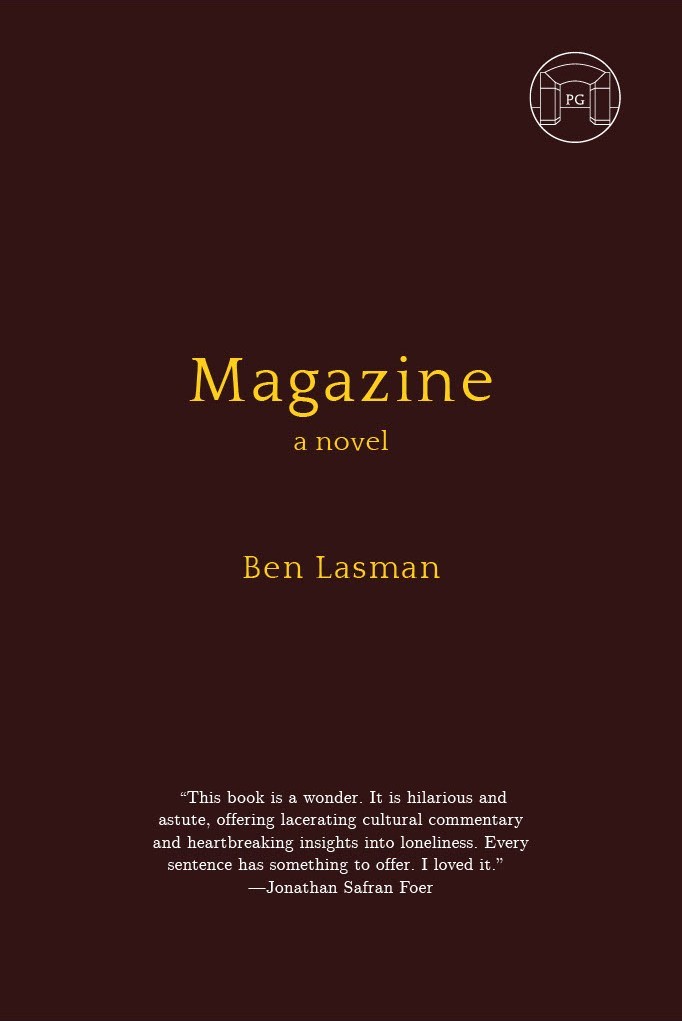
From Magazine by Ben Lasman. Used with permission of the publisher, Parade Ground. Copyright © 2026.