Landscapes That Tell Stories: On the Power and Personality of Trees
Aya Kōda Considers the Ways Nature Can Emotionally Affect Us
Early last summer I happened to observe the huge landslide site in Oyarei, Shizuoka prefecture, known as Oya-kuzure. I was shocked to see its effects. When I found out that the Abe river, whose source flows from the collapsed area, is also a dangerous river to contend with, I felt an indescribable desolation and sorrow for this ill-fated landscape.
This marked a turning point for me: my curiosity turned towards landslides and destruction, and, gradually, I began to journey to places such as the Osawa-kuzure landslide at Mount Fuji and the collapse scar of Mount Nantai. From these few examples alone, it became abundantly clear to me that the sites of landslides can vary immensely in both atmosphere and appearance. Some are still in mid-flow, raging and scattering earth, some are older and look as though they have started to settle down, while others seem just to be taking a short break. Some are brimming with a sense of terror, some exude grief, while others appear to be in a violent fury.
I think what ties them all together, though, is sadness. The rocks that each landslide throws out fall down the steep diagonal slopes and, by some kind of uncanny natural balance, end up piled on top of one another in multiple layers. When I stood right underneath their perilous resting places and—though trembling with fear—gathered my courage and looked upwards and around, I sensed that these stacks of rocks were steeped in an unfathomable sadness, as vast as themselves. Quiet and desolate though this scene was, I believe tragedy was truly at its heart.
I sensed that these stacks of rocks were steeped in an unfathomable sadness, as vast as themselves.
I’m not sure exactly when, but, as I observed these mournful scenes, I was surprised to find that somewhere along the way my understanding of trees had changed considerably. It has only been a few years since I first started walking through the woods, hoping that as I encountered different trees I would be able to draw inspiration from them. I had been lucky enough to receive support and guidance from experts each time, and so in a few short years I had been afforded the chance to spend considerable time wandering the forests feeling moved by all sorts of wonderful trees: from the spectacle of the Ezo spruces in Hokkaido, to the theatrics of the hinoki cypresses in Kiso, and the majesty of the sugi in Yakushima. These were journeys that both cleansed my soul and offered it a new kind of nourishment. Trees had become for me a form of medicine, or delicious food.
Then, at some point, while my attention was drawn towards landslides and raging rivers, I realized that my perception of trees and forests had begun to shift. I had started thinking of them as something anxiety-inducing, daubed with sorrow. It’s not as though the lines of tall, straight sugi trees had altered, or that the single outstretched branch of a camphor tree was different now than it had been when I looked at it before. The sunny days had not gone away, and neither had the blowing of the wind. But, somehow, whichever tree I looked at, I felt a sort of gloominess deep within me. My mind was overtaken with thoughts such as, What if this slope were to collapse, or these riverbanks crumble and wash away? If there was a landslide here, I feared that those beautiful trees would come down in one fell swoop. Supposing the river was to flood, the pines and willows along its banks would be uprooted and carried away in a matter of moments. I had been led by my new interest in landslides and rivers towards a concern for the life of the vegetation around them.
*
Days passed, and before I knew it, it was the end of August. I had wanted to make four visits to Oya-kuzure during the summer, but the heat had taken its toll on me and I struggled to embark on my plan. By the time I had recovered my strength, it was the tail end of summer. No matter if your interest is in ways of life, food or kimono, you can only really begin to understand something once you have studied it through all four seasons of spring, summer, autumn and winter. This is even truer of natural features such as mountains and rivers, which change far more often than seasonally, shifting their forms from morning to evening, in sunshine and in rain. If you claim to know these landscapes at all, you must really observe them at least four times in each of the four seasons. Summer was already on its way out by late August, and a fine rain was falling, but I braced myself and set out.
I took a path following the river upstream, and, as I left the town, I saw shining ears of susuki grass and the purple flowers of native asters dotted around, as well as the wretched fading green of the broadleaf trees. The grass had arrived in autumn, while the trees continued to bask in the remains of summer. The rain cast a thin veil over the mountains and rivers, and mists rose up around the valleys with the passing time. It looked completely different than when I had last visited. The Abe river is a wide expanse, filled more with pebbles than flowing water. On sunny days these stones appear dried out, white and grainy, while the thin trickle of water passing through makes up a mere fraction of the river’s width. On rainy days like this one, however, the stones glisten, the water swells and the speed of the current stands out. Meanwhile, the mountain valleys pour their thread-like streams of white water onto the bare earth surfaced by smaller landslides in recent years, leaving it dripping and fresh.
When I reached Oya, the slope affected by the landslide was completely shrouded in mist. I couldn’t see a thing. The air was cold enough to turn the tips of my fingers red, but it looked as though the mist was moving quickly and there would likely be a break in it, and so I waited, legs trembling, for the sky to clear.
The mist began to dissipate from the mountainside, and I was surprised to find, as it grew sunnier, that the slope with the landslide looked considerably smaller than before. Surely it couldn’t be that, in just these few short months, the mountain had crumbled so much that it had actually become smaller. In which case—had my eyes been playing tricks on me last time? There was an unimaginable difference in scale between the scene I saw then and the one before me now. I felt a sense of foreboding rise within me for a moment, wondering whether the mountain might somehow be bewitching me. Whichever way I looked at it, the collapsed area seemed to have shrunk. I was forced to question my own memories and the eyes I had seen with the last time, but still my doubts remained. Mists crowded up again as I was lost in these thoughts, and the shapes of the mountain ridges and rubble were gradually hidden beneath boundless thin, white clouds, until the only thing that I could be sure of was that the sheets of rain hitting my umbrella had grown heavier. Crafty devils, these landslides, I thought.
You could argue that it was not the landslide which was acting strangely, but rather the trees. When I visited at the beginning of summer there had been a number of trees on one patch of the mountainside, as there were this time, but their branches had still been naked; from far away they had looked indistinct, and had not obscured the area of collapsed ground. This second time, however, these same branches were adorned with leaves, and seemed to be rising up on the mountainside. Is it trees, then, which deceive us, making an area of the mountain look smaller than it is? Or is there something sorcerous about the color green? Again, I felt as though I had glimpsed a new side to trees, one I had never seen before. They are modest beings, who don’t walk or even talk, but there is more to them than the simple ease of their companionship; they can also hide stretches of earth and play tricks with their size. I imagine most living things have secrets or unknown sides to them. It felt as though, quite by chance, I had caught a glimpse of the games trees play. This is why I think that observing living things throughout the changing seasons, at the very least four times a year, should be considered the bare minimum for understanding them. I was glad that, though I had come belatedly at the end of August, I was still in time to see the summer leaves on the trees. If I had left it until after the leaves had fallen, I would never have noticed this relationship between the trees and the earth they stand on.
Even if I had seen the koyo without this context, I’m sure I would still have been foolishly excited. Perhaps trees possess a seductive kind of power.
As I pondered this thought while starting on my way home, I caught sight of some oleasters and willows growing densely on a sandbar of the river. They had been here when I last came, too, their trunks at that time thick and rounded, but the willows had since grown thin and slight, and started to drop their yellowing leaves. Nobody would plant seeds or seedlings somewhere like this, so I am sure these trees (which, from their height, looked maybe four or five years old) must have germinated naturally. This would suggest that this sandbank has been established for at least four or five years, and thus it has been at least that long since the river ran wide enough to shift the sand or destroy the bank. Oleanders and willows are brave souls, with pioneering spirits. They move faster than other kinds of plants, rapidly dropping their roots into the gaps between rocks on the sandy riverbed and then, with an indomitable force, growing rampantly in this nutrient-deficient environment. Once they have succeeded in establishing themselves, however, other kinds of trees spread out their roots and assert their strength while their predecessors go to ruin and disappear; the trailblazers’ glory becomes fertilizer for the next generation. I marveled at the poignancy of these pale yellow leaves in the drizzle, and the elegance of their slender frames standing against the banks of this desolate, rock-strewn river.
*
That October, I took a trip to Toyama prefecture, following the Joganji river upstream. The Joganji, whose source lies at the site of the great collapse of Mount Tombiyama, is so fiercely uncontrollable that it is sometimes known as a mecca for counter-erosion efforts. The collapsed mountain and this wild river share a twisted kind of fate. I would never have managed to follow the Joganji upstream by myself, so I enlisted the help of the Erosion Control Department of the Tateyama Ministry of Construction to embark on a four-day trip. On one of those nights, I stayed upstream of the river at the construction base, in a state-of-the-art o›ce on the only substantial area of level ground by the riverside, which was also the last stop for a diesel train.
In front of it stood an incredibly steep cliff. White rapids crashed down against the rocks—falling, needless to say, quite some distance—and still more cliffs towered steeply behind me, slender straight waterfalls coursing down them. The precipice I looked out towards must surely have stood there for a long time; one of its faces was now bedecked in a colorful brocade of koyo autumn leaves. The only trees to have taken root were those able to survive in high altitudes and cold climates, and so, in among the red, yellow, brown and orange leaves, there were a good proportion of deep-green conifer needles. There were all sorts of different species, but none had grown tall; they took miniature, bonsai-like forms instead, with the beauty of their changing leaves ornamenting the grim conditions of the cliff below. It was an achingly beautiful scene.
The next day, it was raining. The autumn leaves on the cliff looked all the more vibrant when wet, and what had been a single waterfall the day before became several separate strands of white thread. Without thinking, I murmured something about the wonderousness of the rainy scene. “You can’t say that,” the construction chief replied with a gentle laugh, explaining that all of this rain—the water that lands on the cliff, the countless droplets that run into waterfalls and the liquid that seeps into the earth—goes on to gather underneath the flat ground where the o›ce is standing. He explained that even this tiny area of level ground had accumulated from sediment from the old collapse, and that if a large amount of water were to flow beneath this weak foundation, it is not impossible that it, too, would give way. “I s’pose I can’t deny it looks nice,” he said, “but those of us who work here can’t really say that…” and then, amused, reassured me that it wasn’t going to give way right then and there. Nevertheless, there was a seriousness to his words: this smooth patch of earth had apparently been about three times its current size until a few years ago, and two tennis courts had even been installed as recreation for the workers, until it had all eroded away quite suddenly after some thawing snow or heavy rain. Huge amounts of sediment had fallen into the river, and the whole area was now washed away without a trace. Knowing that the ground at my feet could crumble and disappear in an instant, the valley beneath me looked even more terrifyingly far down. But when I looked back towards the cliff, its red autumn display still struck me as truly mesmerizing.
Red leaves are particularly enthralling in dangerous places. I noticed this all the more keenly because I was accompanied by someone well versed in the danger there, who shared the information with me; but even if I had seen the koyo without this context, I’m sure I would still have been foolishly excited. Perhaps trees possess a seductive kind of power.
____________________________
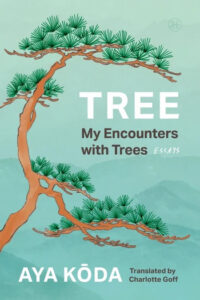
Excerpted from Tree: My Encounters with Trees by Aya Kōda, translated by Charlotte Goff. Reprinted with permission from HarperOne, an imprint of HarperCollins Publishers. Copyright © 2026.
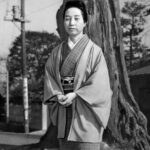
Aya Kōda
Aya Kōda (1904-1990) was an esteemed Japanese author and essayist of the twentieth century. The second daughter of Rohan Kōda (1867-1947), a famous literary figure in Japan, she began writing after his death and became a prolific writer of novels, essays and short stories. Her novels Nagareru and Ototo were adapted into successful films. She was the recipient of numerous awards for her writing, including the Yomiuri Prize, the Japan Art Academy Prize, and the Order of the Sacred Treasure.