Somewhere in time, a child is climbing up a hollow carved out between two hills. Her hand grips the unruly fur of an enormous grey dog, which stands as high as she does. The animal pads beside her, companion and protector, its golden eyes scanning the landscape around them for predators or potential dangers, as it has been trained to do. Lengths of sealskin have been tied over the soles of the child’s feet and she wears a string of pierced cowrie shells around her neck; the dog has been given a matching adornment, and it tolerates this indignity with benign resignation. The child’s head is lowered and she is allowing her hair to sway from side to side with the motion of her walk. The sound of the name given to her at birth, by her father, might be written as “Brith.”
Several steps behind—Brith can hear the swish of footfalls through grass—is her mother, who carries a smaller child on her back, and in her hand a basket, filled with lichen and a leaf-cup of hazelnuts. When they left the gates of the fort earlier, her mother had said they were going to gather mushrooms, but with the peculiar insight of youth, Brith knew that wasn’t true. Ever since her father left the fort almost a whole season ago, walking off into the darkening blue hills with both his hounds, never to return, her mother has taken to these long and aimless searches, sometimes with Brith and sometimes without. The other women of the fort say she is sore-grieving her man, she is still seeking him, that they must let her do as she will, but wasn’t he always an odd one, and that’s what comes of taking one of his kind as a mate, a stranger, a meanderer.
Brith’s course this morning—and it is hers because her mother seems to have no particular destination in mind, and is letting Brith choose their way—takes them to the exact place where, millennia later, Liam will stand waiting for his father to reappear from the copse.
The land, however, in the time of the child with the sealskin shoes, is very different from Tomás’s day. The mother with the basket, the wolfhound and the children move through thick woodland: trees, trees and more trees cover the slopes, through which fall scattered coins of sunlight. Their feet press down into the thick, blackened leaf-fall. Around them, the golden air is stitched with pollen and the inexplicable flight paths of bees, and teems with the sounds of a forest: birdsong, the creak of branches, the insistent tapping of a woodpecker, the drip of moisture from foliage, the secretive rustle of unseen creatures moving about the undergrowth.
Brith, who is ahead and in charge, is taking as her guide the stream, which sparks in the sunlight, cutting a narrow channel through the hillside, weaving itself around rocks and tree trunks, appearing and disappearing, diving underground then springing up in unexpected places. Brith likes its eddies and gurgles, the way it flounces over the ground, smoothing the pebbles in its path; she likes the way it cools the earth under her feet and the sprightly waving of long weeds in its current. She sings as she goes, a breathy, near-silent song, for herself and herself alone: Ai-yee, ai-yo, ai-yee, ly-ah, ly-ah.
The dog, which is in fact the one leading the procession, decides it is time to pause. It bows its noble, heavy head to the stream and commences a noisy lapping. Brith watches it for a moment, then unhooks a shallow wooden cup from her belt and dips it through the surface, watching as a matching cup rises up out of the water to meet it. The stream is icy, despite the warmth of the day, as if it has sprung from deep within the land, and it tastes of rock, of the colour green, of peat, and something else she can’t identify. The taste dances on her tongue; she swallows and feels it cutting a cool, confronting path through her middle.
Mother, she says, and she knows without turning that her mother is stepping past her—Brith is still at an age when proximity to a parent is a necessity, a means of survival. Taste this.
She holds out the cup, still half full. She cannot explain why but she wants to give this to her mother. She wants her not to be sore-grieving any more, and she has an obscure sense that the stream-water might help and soothe, might offer answers to questions they cannot articulate. And so into her field of vision bends her mother: sleek brown hair bound into long plaits, a smooth brow, a strong and freckled arm, dark lashes casting shadows on pronounced cheekbones. It will be a few years before Brith realises that her mother is an uncommon beauty, sought out as a bride by a passing stranger from an ancient wandering tribe, and the reason her father joined their hill fort, curtailing his journey to elsewhere, giving up his ways and taking to living in a hut, inside a fort, to putting his shoulder to a plough and his hand to a spade. For now, however, on this bright morning, she is just her mother, as constant a presence as the daylight or the sky, a person who gives her food, the one who lies beside her at night, the one who lights the fire each morning, the one who untangles Brith’s hair, who laces up her tunic.
Her mother’s lips touch the skin of the water. She drinks and swallows. Brith waits, anxiety building. Will her mother see? Will she understand how special this stream is? Will she, too, sense that it offers them answers to unknown conundrums? Her mother wipes her mouth with the back of her hand and smiles.
The dog watches them with its implacable amber eyes.
Laying a hand briefly on Brith’s head, she moves away, up the path, and as she does so, something in the stream catches Brith’s eye: there! A flash of gold. Seen and then concealed by a twist of water, then seen again. There it is now, caught in a cleft between two stones. Brith steps into the stream, eagerly, first one foot, then the other.
Instantly, her feet are encased in what feels like ice. She bends and slips her fingers into the water, her mind filled with the idea of an enchanted pebble or a nugget of amber. She will give it to her mother, no, her father, when he comes back, or she’ll keep it for the baby, when he’s older. She feels the silky glide of the water, stones that are slippery with brownish river-fur. Her thumb locates something hard yet delicate, and there is a slight clinking noise. Her fingers close over it and she lifts it out, and there, in her palm, as she stands in the appearing-disappearing stream that runs through this wood, between two hills, is a ring. Impossible to believe, and astonishing to see: wrought of beaten gold, with a swirling design of interlocking circles, and two scaled beasts, each swallowing the legs of the other. Brith feels the weight of it in her hand, its cool circumference, and she cannot draw breath.
She knows this ring. She has held the hand that wears it almost every day of her life. She has traced its woven paths, its smooth curves.
Brith closes her fingers over it, quickly, as if that raven circling the sky overhead might dive and snatch it from her with its blackened beak. She grips the ring fiercely. She brings her fist to her mouth to stave off the dread that is invading her; she squeezes shut her eyes. She will never tell. It will be a secret she’ll keep. The thought swings through her, like a burning stick through night air. She will tell, she will call to her mother and show her what she’s found and her mother will be able to explain it, will offer a reason as to why her father’s ring is here, at the bottom of this stream.
The ring presses a circle of pain into the clammy skin of her palm.
She won’t tell. She will. She won’t.
Brith lifts her head. The ends of her hair are wet from when she leaned over to pick up the ring. They stick like water-weeds to her tunic. Beside her, the dog shakes itself, droplets flying from it, then fixes her with an appraising gaze.
Her mother is a short way off and has seated herself on a flattish rock in the shade of an oak tree. She has undone the neck of her tunic, lifted the baby from her back and begun to feed him.
Brith waits for a moment, watching her mother, who is leaning against the oak’s rippled trunk, face turned up to the sun. She will be there for a while, Brith knows. Her younger brother is a hungry one: she has heard her mother telling her father this, and her father gave his laugh that showed all his teeth, lifting the baby from where he lay near the hearth, saying that it’s only right, for he is to grow up strong, and become a warrior and a hunter, like himself.
She thinks again of the word the other women had used for her father: meanderer. Brith had folded it into her mind as soon as she heard it and, unbeknown to her mother, had taken it to the fort’s teller. He lived in a hut at the edge of their fort, all by himself (although Brith had heard people say, often with a sidelong look, that he was far from lonely), and it was said that he held in his head all the verses and histories of their people. Brith liked the teller’s long beard, which was woven with beads and shells, the curved knife he carried tucked into his belt; most of all she liked his hut, which was decorated with feathers and whittled animals and switches of hazel and figures fashioned from the heads of corn. Her father had been a particular friend of the teller’s, and the two of them had spent much time working alongside each other in the fields or walking out together, to the woods and the shore, their heads bent in conversation. The teller had once told Brith that her father had taught him tales he had never heard, from the times before, when the land was new-made and the streams had just begun their flow.
So when Brith asked the teller about the word, “meanderer,” the teller had regarded her thoughtfully, his head on one side. He had been squatting in front of a dying fire in the long-hut of the elders, casting for them, to see what the future might hold, scattering seed-pods into its bright embers, watching them explode in the heat. Your father, he had replied, after a long silence, did someone say this about him? Brith had nodded.
It means, he had said, one who wanders, one who settles not in a single place.
But he settled here, she had cried, stabbing the ground with a finger, he did.
I know, the teller said, and he put a hand to her shoulder. I know he did. What this person meant was that your father was—and here he corrected his utterance, not unnoticed by Brith—your father is special, marked out. He belongs to a tribe who were here long ago, before us, before any of this. The teller’s arm swept around the long-hut, the circular walls of the fortress that enclosed them in its embrace. As you know, our people came to this land from far away, over seas and over mountains; we came and built forts and ploughed fields and grew crops and kept animals. But we were not the first: your father’s people were already here. They did not farm the land but instead walked among its valleys and hills, its shores and lakes, always moving, never settling.
Meanderers? Brith asked.
The teller nodded and gave her a smile. He reached out and stirred the embers in the firepit. In the shadows of the long-hut, the elders muttered among themselves—of portents and crops and weather and the storage of grain. Brith paid them no attention.
Nobody, the teller continued, knows where they all went, what happened to them. All we know is that they are not here now. Some say they left or sailed elsewhere in boats or died out; others believe that your father’s people disappeared into the ground, by some mysterious magic. That their roaming became harder, with so many of their places suddenly farmed and fenced, so they merged themselves with the very land itself, passing into the trees and the rivers and the stones and the bushes and the briars, never to be seen again.
Never? Brith had swallowed, forcing down something hard in her throat. Never to be seen again?
Perhaps never. The teller had taken her hand and filled it from his pouch with dry seedpods, closing her fingers over them. I believe, he said, that your father may be the last of his kind. He indicated that Brith should do a casting, should throw the pods onto the collapsing structure of the fire, and she did so, sending sparks up into the air. Unless, of course, we consider you, he had said, and your brother. For you might have his ways in you. You are half him, are you not?
Brith had shut her eyes, finding that the sparks were still living on the inside of the lids, vivid in their dangerous dark. I am, she’d whispered. I am.
To distract herself from this recollection—and where is her father, where did he go that night, he would never leave them, as some insinuate, but did perhaps something bad happen to him, did he meet an enemy or a person from his old tribe, someone he had wronged or deserted to be with them, for he cannot have magically dissolved into the land, as the teller suggested, he would never leave them—Brith buries her hand in the dog’s pelt, gripping the leather collar adorned with shells, and begins to push her legs against the swift-running current. Wavelets crest over her shins.
She swishes forward, along the bed of the stream, up the hillside, her sealskin shoes—made by her father, who slew the beast and carried it home on one shoulder, throwing it down at their doorway and kissing her mother, and saying, Now, shoes for all of us, and gloves for the cold season—slipping easily over the stones. She wades upstream, keeping one eye on her mother, still reclined against the tree, head resting on its bark, the baby at her breast, and the dog of course moves with her. The stream widens, narrows, turns a sharp corner. From branches above her is released a sudden shower of ash keys, which flutter downwards, whirring in circles, until their wild flight is put to a stop by meeting the water’s surface, where they are apprehended and whisked away downstream. She is surrounded by dense greenery now, and the ground is covered with small, mossy humps, and she is just about to turn around and go back to her mother, who will worry if she finishes feeding and can’t see Brith, when she sees something so surprising it stops her in her tracks.
A deep and startling pool, contained and protected on all sides by smooth and pale rock, its blue-green waters so utterly still that they hold a replica of the branches above. Brith stares, dazed, nonplussed. She has never seen anything like it, on all her wanderings around the place, either with her mother or her father. The land here is lush, marshy, wooded, running with rivers and streams, every hollow filled by a lake, covered with thick swags of greenery, fringed by wide beaches with fretted waves, but never has she come across the like of this. There is, she now notices, one area of the pool that purls and quivers, as if something live lurks just below, sending out concentric ripples, which trap the sunlight in shards that hurt Brith’s eyes. As young as she is, Brith knows that this is the place the stream begins: a spring, her father taught her, or the source. A willow bends over it, protectively, its outstretched tips disappearing into it. A single oak leaf wanders and skitters on its surface.
Brith gazes at it, mesmerised. She is assailed by contradictory impulses: to turn and slosh back downstream, to run, to return to her mother’s side, to stay, to keep looking, and also to move forward, to investigate, to perhaps immerse herself in those depths.
She does what she will at all moments of uncertainty and indecision: she strokes the fur of the wolfhound and inserts a thumb into her mouth, sucking it meditatively, the pad notched into the arch of her palate. It takes her a moment to realise that it carries the taste of the stream water—that tang, that purity—and she quickly pulls it out again.
Go or stay? Retreat or investigate the pool? She looks down at the dog, which raises its head to meet her gaze. She knows the right thing to do would be to go back to her mother, perhaps to tell her about it, and then they might look at it together. But part of her knows that her mother might well sigh and say the baby is tired, they should get back to the fort, they can come another day. Can Brith risk that her mother might say they should leave, that she might never get to return here?
She cannot: she takes a step forward, then another, her legs heavy now because the stream is getting deeper, the nearer she gets. The dog comes too.
Only when she reaches the lip of the rock does it become clear just how deep the pool is. Crossed spears of sunlight fall into it but only so far, and beneath their yellow illuminations Brith can see depths and more depths of water, darkening to obscurity. She peers downwards, her eyes straining for signs of the bottom, a rock, a shelf, anything, but there is nothing. It appears to be a watery shaft that falls from her feet, down, down, into the earth. The pool is endless. And she is pervaded by the strange sense that her father is near, that he is here, that she might turn her head and see him standing beside her, spear in his hand, hair held back from his eyes with a strip of leather. She turns her head, of course she does, but he isn’t there, and somehow the feeling shifts to the suspicion that her father is here but is somehow unable to make himself visible or audible to her, that he is held apart from her, shouting, calling her name, but try as she might she cannot see him, cannot hear him.
She is about to call to him, to say, I am here, where are you, when she sees, with a jolt, something in the depths of the pool.
Carving slow half-turns in the blue is a lithe and indistinct shape, with fins and a sinuous flicking tail: a lone fish is stirring the pool’s secret depths. Staring at it, she has the peculiar sensation that she is tipping forward, falling, drawn down by some strong and irrepressible force; she has to tighten her hold on the familiar, rough-haired neck of the dog, not to be lured into its watery snare.
Hello, she murmurs, without knowing why. Hello, fish.
The fish turns, almost as if it has heard her, its tail and head forming a near-circle, turns again, then rises up through the water, its scaled length flexing around the ripples, its colour brightening and brightening as it comes towards the light.
Brith, filled with a sudden dread, stands very still, watching it, and the dog, sensing something, emits a low growl.
The fin on the fish’s back breaks the water first, then the delicate splay of its tail. It swirls round twice before its mouth edges itself out of the pool: a wetted, lipless opening with a greyish tongue.
Give me the ring, a voice says, or seems to say.
Brith staggers, half falling into the water, soaking herself up to her waist. She flails, making a grab for the smooth rock but is sure to keep hold of the ring.
Who said that? she hisses, shivering. The voice was faint and rasping, like the sound of pebbles raked by a wave. She must have imagined it. She cannot really have heard it. People always say to her that she spends too much time dreaming, that she never keeps to a task. The dog is crouching low, its belly in the water, and it gives a volley of warning barks, and the voice comes again, unmistakably, and she knows she is not dreaming it, or imagining it, that it is not the sound of a breeze through the branches, or the gluggle of the stream.
Give me the ring. It’s mine.
She snatches her hand close to her chest and glares at the fish, whose gleaming beads of eyes hover just below the surface, its lips moving.
It’s my father’s ring, she says, her words shaking with rage and something like fear.
Give it. I need it.
The fish, whose silvery length is speckled with peculiar spots, each ringed with a paler circle, giving it the appearance of having numerous eyes all over itself, is of a type she hasn’t seen before. She has watched her father put brown trout into a trance with his hand, then snatch them dripping from rivers, seen her mother net pink-bellied salmon in the shallows of loughs, then roast them on sharp sticks over hot flames, and how delicious is the skin when its edges are blackened by fire?
But this fish looks nothing like them. It executes a circle of the pool, its tail giving angry flicks, its downturned mouth still above water, trailing a V of ripples after it.
You shan’t have it, Brith whispers. You shan’t.
Give it to me, quick, the fish orders, and Brith finds its voice so terrible and somehow so familiar that, without thinking, she puts not her thumb but the ring into her mouth—again that cold, clear taste—and holds it on her tongue.
The spotted fish thrashes angrily, disturbing the waters so that the pool’s edge laps against the rock. Brith tells herself she isn’t afraid, she is the daughter of a warrior who came from over the hills, accompanied by two huge dogs, a man who wore a yellow-bright ornament about his neck and a ring on his finger, and loved her mother, and her, and the baby. He loved her so much that he gave her a precious pup from one of his dogs, to protect her. He would never have left them, never, unless—
I will not, Brith starts to say, I—
And with the second “I,” her throat contracts and she gulps, without meaning to, and suddenly the ring is gone from her tongue and she feels it sinking down inside her. Down, down it goes, down her throat, which aches and protests, down her middle, into her stomach. Brith has swallowed her father’s ring.
She turns, sealskin shoes slipping on the wet stones, and runs, the dog crashing through the stream beside her, away from the pool, from the hateful fish, from its depthless watery spell-working, from the copse of drooping willows and the floating oak leaf, and when she finds her mother, she clings to her back like a sodden mer-child, sobbing about a fish that talked and a pool with no bottom and how she never wants to walk here again, and can they please, please, go home? Her mother embraces her tightly, with the spare arm that isn’t holding the baby. She rocks her to and fro, she croons to her, she sings her a song, and she fears a little, too, for this daughter of hers, who is so passionate and so singular, and who takes life not at all easily, but seizes it with both hands, and how this child does remind her, how like him she is, and what pain it gives her to see this. Pain and joy, an equal balancing, a vying bright anguish of the two.
The dog paces to and fro, hackles bristling, snapping at the empty air, its head turning one way, then the other, as if aware of invisible foes in the valley around them.
As it turns out, Brith’s mother is right to fear for her. In the years that come, her father never does return. The mother, being so fair and so good, has many offers but she accepts none because she will keep herself for her man, the father of her children, who may come back, he may, and these refusals, of course, make a few enemies. What does come to the fort is a bloating sickness that takes many of their young people, Brith’s brother included. They bury him at dusk, in a mound, with his little axe and his horn cup, so that he will never go thirsty or hungry in the next world.
__________________________________
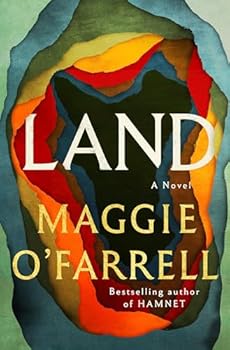
From Land by Maggie O’Farrell. Published June 2026 by Alfred A. Knopf, an imprint of The Knopf Doubleday Publishing Group, a division of Penguin Random House LLC. Copyright © 2026 by Maggie O’Farrell.