Jayne Anne Phillips Wonders What Happens to Writers If They Don’t Write?
“Silence, earned or merely present, is as natural to writers as writing.”
Kenneth Tynan’s widow Kathleen, in her introduction to his letters, states, Writers hate to write, almost all of them. She goes on to describe, in loving remembrance, her husband, blocked as a writer, turning to his journals, where he might deliver himself of a self-punishing complaint about his own indolent and hateful character. Writers do chastise themselves, with seriousness and skill, as though it were a matter of personal failure not to be steadily equal to one’s talent—to the talent one has displayed formerly, or even concurrently with the present hiatus. Some turn with relief to letter writing or diaries, free of the pressure of perfection, choosing words to entertain or communicate.
Happy at the prospect of a wholeheartedly interested listener, the writer engages a distant correspondent or some version of a private, non-artist self—the smaller self who stands always at the threshold of writing, like a person in a doorway who knows better than to enter the room. Others write their own work or nothing at all. They remain silent and use the pressure in their own way. Allowing themselves no comforts, they reserve the right not to write. Putting pen to paper, fingers to keyboard, is always a risk, as the writer well knows.
We might compare getting started on a story to starting a relationship (oh, that first time together, lying down skin to skin!), or beginning a novel to committing to a marriage. Each long-term liaison is laden with its own miracles and traps: There is the young marriage, the second marriage, the late marriage in which indolent time does not exist and all is revealed at the first touch. There is the ecstasy-inducing, doomed, bipolar heights-and-depths marriage, and the brain-shattering cataclysm that never achieves consummation but is instead an extended hallucinatory preparation.
There is the deep, long, enduring marathon that wakes and sleeps, steadily increasing as pages mount and the light shifts day to night, season to season. All are relationships that stay alive until the book is done and moves beyond the mind that lived within it. The love affair, like a years-long phase of sexual intoxication between lovers, is over, and the book takes with it a newly created soul bound to no human being, no physical time or sensory need. It is alive and it may live for many years, unsullied, undiminished. It may be read or lie dormant but remains supremely itself, tension strung, pitch and nuance attuned, a world preserved in love and grief, continually reborn.
Nothing more horrible, no failure of nerve more acute, than to be a writer and not write, to never write, perhaps, to stop writing, to decide to stop.
To what, then, do we compare not writing, not finishing the story, putting the novel aside in anguish? Admit it or not, we compare these to death, the little death or the big death, sexual connotations intended, and we think of not writing (in the pause between projects, in the stalled eye of a novel) as death itself. Nothing more horrible, no failure of nerve more acute, than to be a writer and not write, to never write, perhaps, to stop writing, to decide to stop, not to hope for writing or want it, to let go of writing, to swear it off like drugs, or sex with the wrong party, or some other terrible compulsion that will finally tear one apart—decimating the room and maiming anyone in the house.
The writer not writing is a wholly guilty party, like someone who through anger or terrible neglect has killed off his own life’s mate, counterpart, reason to live. Or the writer not writing is completely disengaged, a ghostly anarchist traversing Rimbaud’s desert mountains and plateaus, a purveyor of mule-team commerce seldom in reach of a human voice and never the accents of home, a gun-running, slave-trading mentor to wild boys, for the fire that consumes itself leaves more than ashes. A mesmerizing remnant haunts the barren sand and stone streets of Abyssinian Harar, an unrelenting centrifugal force that pulls into itself those drawn to conflagration, to total surrender, as though we might know—in an instant of silence—all Rimbaud made himself forget, all he denied when he turned his back on writing and lived beyond it, in exile.
*
Silence is the writer’s familiar. Silence, earned or merely present, is as natural to writers as writing. It fills the space between words, behind words. Silence, amniotic and replete, is the auditory equivalent of the empty page. Images and pictures float within it. The work of entering them remains organic and mysterious, like anything we don’t understand in thoughts, in words about. Personality or intellect can bite the hands that feed it, so to speak. The writer, inside or outside a book, may find herself in a suspended horror of confusion with everything at stake. The work of a skilled technician does not break through; work that lasts must glimpse the miraculous and exist apart, defining its own truth. At last, Frank Conroy told his first fiction workshop, you hold the story in your hands. It’s all there: the faultless curve of head and limb, the opalescent eyelids, the perfect little fingernails. Now you ask yourself, is it a dead baby or a live baby?
A writer stays alive because he or she is writing, or may write: the elusive divine exists. No such thing as a bad day, a poet friend grumbled sardonically, more like a bad decade. Another writer said, It may be my fourth novel, but this one doesn’t know I wrote the other three. That novel in you has to come out, says doctor to patient in a particularly mordant New Yorker cartoon. Writing is like heroin, said a writer acquainted with both. There’s this extended wham that you have to sustain by living with your veins open. Another comments, Writing? It’s basic to certain monstrosities. The despairing mother of four children and two novels said she was selfish enough, but she couldn’t think. If I could think, she said, I could write. Told she’ll write later, she responds, Later, it won’t be me. I won’t be here later. Asked about balancing writing/politics/maternity, Grace Paley told a group of young women in Iowa City, Don’t have a little, narrow life. Have a big life. A rather successful practitioner of humorous novels sniffs that she can’t stand hearing writers moan about writing; she wouldn’t think of spending more than two years on a book. Face it, says an award-winning essayist, we don’t write for readers. Why should we? Most readers would rather watch television. The Buddhist poet says that we write for the self we ought to measure up to, the Zen thread in the muslin shroud. The novelist known for her evocations of place says that James Agee was right: we write for the part of us that knows where we’re going, but on pain of death would never tell us. Ray Carver told a compatriot writer at a conference, See you farther along the trail. A fiction writer’s older brother queried her about making money doing readings: You mean people pay you to read things you’ve already written? She responded that she supposed audiences really should pay more if writers made up their work on the spot, but it didn’t work that way. One writer confides to another, after each is introduced as the other at a literacy benefit auction, Amazing. There’s always another way to humiliate a writer. Says a friend to a writer describing an excruciating writer’s block, But—it’s you. How can you not control yourself?
*
Control yourself? The question may seem aberrant, something a dimwit or sadistic mother might ask her charge during toilet training, but Americans do regard living writers as both needlessly and necessarily strange. They tend to regard dead writers as history. And history, other than the cinematic variety, is particularly anathema in our current cultural incarnation. History, as in he’s history, equates with nonrelevance. For those on the North American isle of relative safety, history is yesterday or last week; the big picture is never in focus. Americans don’t do politics—they do tribalism. It was true during the Civil War, the Jim Crow years, the civil rights movement, the Vietnam years, and so tribalism continues, on steroids. Today we live in a barrage of online reductions of ideas and events. Writers do politics despite themselves. Any story is a history in which politics and event are portrayed in human terms—not as tract or politics but as inquiry, warning, requiem.
How instructional to remember that the crises of history, the political firestorms of our own and other brutal centuries, have stopped writers only by killing them. In those times, imprisoned, diseased, mourning, the writer, as long as she can think and wonder, writes. Her family and country destroyed, Marina Tsvetaeva wrote. Following the shifting allegiances of her husband from post-Revolution exile in Prague and Paris back to wartime Russia, famine, and doom, she wrote. As the Germans advanced on Moscow, her fifteen-year-old son wanted to put on a uniform and fight. Concerned for his safety, she left penurious employment as a translator and moved them to rural Siberia in an attempt to join evacuated writers more acceptable to the State.
Ostracized, she was allowed no work permit and no work, even in the kitchens. A policeman in the village who allowed her to do his laundry was reprimanded. Finally, one daughter dead, her husband and surviving daughter imprisoned, excoriated for her part in their troubles by the son she adored, Tsvetaeva, who wrote in her journal, I do not want to die. I want not to be, and then, Rubbish…so long as I am needed, hung herself. Her son, whose fortunes she thought might be eased by her death, did not attend her funeral and enlisted immediately. A few months later, he died defending Moscow.
Writing, we cross the divide between self and others word by word. In the very act of completing the work, we are separated from it.
*
No longer needed! Jerzy Ficowski, in his introduction to Bruno Schulz’s The Street of Crocodiles, refers to the profaned time of everyday life, which relentlessly subordinates all things to itself and carries events and people off in a current of evanescence. Schulz’s material was the transformed history of his childhood and native town. A talented artist, a reclusive secondary school drawing teacher for twenty years, he was born in Drohobych, Poland, in 1892 and never stirred from the houses, streets, and history that informed his consciousness. His letters to a distant woman friend were the genesis of the stories not published in his books until the author was over forty. Ficowski gently asserts in his intro that in this way, Schulz alleviated his isolation without having it disturbed.
Encouraged but deeply troubled by critical praise, he changed no outward circumstance of his life, and the outbreak of World War II found him confined to the ghetto with the other Jews of his city. In the midst of historical juggernaut, he clung hard to everyday life and never used the false papers or money furnished him by Polish writers and underground organizations; he made no attempt to escape. A Gestapo officer who liked his drawings occasionally employed him. Armed with a special pass, Schulz was en route to the home of his protector on the morning of November 19, 1942, when a rival officer shot him dead outside the house. One hundred and fifty other passersby were killed in a limited action that day. Slaughtered, they lay where they fell until nightfall, but Schulz’s murder was evidently somewhat personal. I have just killed your Jew, his murderer is said to have jeered at the windows of a fellow Nazi who valued art over anti-Semitism. Hours later, under cover of darkness, a friend of Bruno Schulz carried his body to the Jewish cemetery and buried him.
No trace remains of that mourner, of the cemetery, or of Schulz’s unpublished works, which vanished along with those who held them for safekeeping
*
Do writers hate to write? I don’t think so. The sense of difficulty arises from the fact that writers defy time, writing words against the erasure of things and lives. We stand in an avalanche of forgetfulness, resisting the sway of disappearance. Faced with mortality, we mourn what we might have understood and communicated, not in opinion or advice but in the delivery of an invented world we might have saved. Writing, we cross the divide between self and others word by word. In the very act of completing the work, we are separated from it. One way or another, the writer loses writing: the writer loses the book. Opposing oblivion, we begin to understand: language is the way in and the way out.
Asks Bruno Schulz, Should I tell you that my room is walled up? In what way might I leave it? Here is how: Goodwill knows no obstacle; nothing can stand before a deep desire. I have only to imagine a door, a door old and good, like in the kitchen of my childhood, with an iron latch and bolt. There is no room so walled up that it will not open with such a trusty door, if you have but the strength to insinuate it.
__________________________________
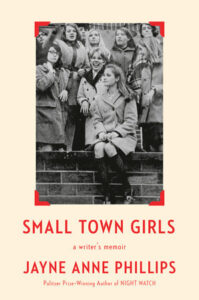
From Small Town Girls: a writer’s memoir by Jayne Anne Phillips. Copyright © 2026 by Jayne Anne Phillips. Excerpted by permission of Alfred A. Knopf, a division of Penguin Random House LLC. All rights reserved. No part of this excerpt may be reproduced or reprinted without permission in writing from the publisher.
Audio excerpted with permission of Penguin Random House Audio from SMALL TOWN GIRLS by Jayne Anne Phillips, excerpt read by the author. Jayne Anne Phillips ℗ 2026 Penguin Random House, LLC. All rights reserved.

Jayne Anne Phillips
Jayne Anne Phillips’ works have been translated and published in twelve foreign languages. She is the recipient of a Guggenheim Fellowship, two National Endowment for the Arts Fellowships, a Howard Fellowship, and a Bunting Fellowship from the Bunting Institute of Radcliffe College. She has taught at Williams College, Boston University, Harvard University, and Brandeis University, and is currently Distinguished Professor of English and Director of the Rutgers Newark MFA Program at Rutgers-Newark, the State University of New Jersey.