Is It Even Real? On the Conflation of Money and Things
J.W. Mason and Arjun Jayadev Consider How Money Reflects the Physical World
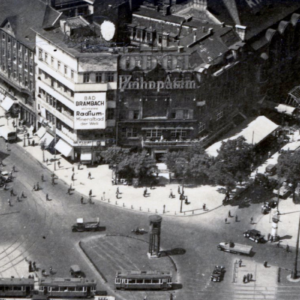
Walk down any street and look around. The buildings you see will vary in their construction: one, two, or many stories; made of wood, brick, concrete, and steel; heated with oil or gas, cooled with fans and air conditioners; with doors, windows, flat, or peaked roofs. You can give a physical description of them— casual for most of us, more detailed if you’re trained as an architect or engineer. If you could disassemble them, you could put numerical values on the buildings’ differences—so many bricks, that much length of wire and pipe, different quantities of tiles and glass.
The construction and maintenance of these buildings requires the coordinated activity of an enormous number of people, spread over space and time. Different people dug up the clay, shaped and fired it into bricks, carted them to the site, and mortared them in place. Human beings laid the wires and pipes, and others kept watch in the power plants and sewage treatment plants to ensure that the electricity and water kept flowing.
Part of the identity of the thing is what it means in terms of money.
All of these activities, linking people who will never meet or even be aware of each other, have to take place in sync. If you watched long enough, from enough vantage points, you could see all this activity take place just as you see the buildings today. Perhaps, if you have small children,you have stood by a construction site and watched and watched it. Each of us often has, with our own children.
But these same buildings have another set of qualities, which are not visible to the senses. Every building has an owner, a party with exclusive rights to it. Each building has a price, reflected in some past or prospective sale and recorded on a balance sheet. All of these buildings generate a stream of money payments— some to the owner, including from tenants to whom some of the owner’s rights are delegated as well as to mortgage lenders and tax authorities, whose need for payments keep people laboring so they can afford to live in the building.
Like the bricks in the building’s walls or the water flowing through its pipes, these qualities are quantitative: they can be expressed as numbers. But unlike the differences in those physical quantities, all of these can be expressed in the same way: as dollars or other units of currency. Part of the identity of the thing is what it means in terms of money.
It is impossible to observe this second set of qualities in the physical building, no matter how microscopically you examine it. These qualities are invisible, immaterial—no physical examination of the building will ever tell you who owns it or how much it cost. But these invisible qualities shape our relationship to the building as much as any of its physical properties. Where you carry out your daily activities of life and work depends entirely on who owns which buildings, which in turn depends on the invisible price tags they carry. And the collective activity of creating new buildings, and improving and maintaining existing ones, is guided by beliefs about the flow of money payments the buildings will generate.
These invisible qualities also involve coordinated human activities, including our collective capacities for coercion and violence. (This part becomes clear if you try to ignore the property rights attached to a building and someone calls the police.)
We take it for granted that our world has this double nature. Like most human societies, we all know that an invisible network of forces lies behind and directs the material world. But as much as medieval Christians or any premodern people, or many people of faith, we believe that we live at the mercy of invisible forces, that the objects around us have both a profane material aspect and a sacred immaterial one. If we listen to historians and anthropologists, this kind of belief is normal, even universal—a long-standing human shorthand for the necessary exchanges of life on Earth. But when we think about it as part of our own social universe, it also seems very strange.
The first answer is that the money world is not an independent reality but simply a convenient shorthand for describing the material world.
It is strange, isn’t it?
In daily life we don’t think much about the separation between the world of concrete reality and the world of money. If you pick up a real estate listing, you’ll read about a three-bedroom brick house for sale for $500,000 in the suburbs, or a flat in Mumbai for Rs. 20 crores. The size, location, and price are, it appears, a set of ontologically equivalent facts about the building, all on the same level. This is perfectly reasonable at the level of the individual participant, because monetary and material facts appear equally objective: The price of something is as black and white as the materials it’s made of. But when you look at the system as a whole, from the outside, the existence of these two superimposed worlds is far from natural or obvious. It’s a puzzle, and a problem.
To those whose vocation it is to understand the money world—economists and the like—there are two quite different answers to this puzzling coexistence of a money world and a material world.
The first answer is that the money world is not an independent reality but simply a convenient shorthand for describing the material world. In this view, you can in fact learn the price of the building by a sufficiently careful physical examination of it. The price simply reflects the building’s capacity for satisfying human wants—with the latter as well as the former physical facts about the world. Nor does who owns the building represent a distinct fact— the market system will ensure that whoever initially owns it, it will end up owned by whoever gains the most satisfaction from it, with satisfaction again conceived of as a material thing. So there is no distinct immaterial world of prices and money payments, there are simply physical activities satisfying physical needs, whose content is unaffected by the fact that we happen to use money values to describe them.
If barter and money produced the same ends, then why do we use one at the almost complete exclusion of the other? Are we really to understand that money reflects the physical world without changing it?
The second answer that an economist might give for the existence of a money world on top of the physical world is that the network of money values and payments coordinates the concrete physical activity that produces the building. Without a system of money payments, there would be no way for the anonymous labor of the clay diggers, the brick-makers, the carters, and the masons to take place in harmony, no way for them to work together without an inflexible, coercive authority from the top.
It is the homogeneity and anonymity of money that allows for productive cooperation between strangers. And it is the money prices and values on balance sheets that allow that productive cooperation to be directed toward its most valuable use. Without the lure of prospective rents, who would know whether to build an apartment building, an office, or a factory, or where to site them? It is, in this view, only thanks to the fact that we follow voices from the invisible world, that we are so successful in shaping the visible one.
There is a tension between these ideas— one that holds that money doesn’t matter, the other that money is useful or even essential. In economics, this tension is present from the first economics textbook students read. Students are taught that money is a great advance over a system of barter and that a world of money produces exactly the same outcomes as a world of barter. But both things cannot be true at once: If barter and money produced the same ends, then why do we use one at the almost complete exclusion of the other? Are we really to understand that money reflects the physical world without changing it?
These frictions are generally kept out of view, and the two perspectives cohabitate peacefully as orthodoxy in economics and public debates. But the contradiction remains. It’s something we have been struggling with since our earliest years as economists.
Sometime in the fall of 2001, while in our first years at graduate school, the two of us drove in a typically rickety graduate student car (a third-hand Ford LTD, built around 1983) across the breathtaking Berkshire mountains of western Massachusetts to Bard College, home of a think tank called the Levy Institute. There, tucked in a small liberal arts campus in the Hudson Valley, the most important figures in the Post Keynesian school of economics gathered to celebrate the life and work of Hyman Minsky, an American economist whose work on financial crises— and especially the role of debt and speculation in their formation—was foundational to the Post Keynesian tradition. The conference featured leading lights from academia, policymaking, and business.
For young graduate students, it was a fascinating and dizzying set of discussions. It also made clear how deep questions about money lay at the heart of other debates in economics—and how contradictory and unsettled the answers were.
At the time of the conference, the US economy was in the midst of an extended period of stability— a “Great Moderation,” credited to Federal Reserve Chair Alan Greenspan by some media (and some economists). This made the proceedings of the meeting— a discussion of financial crisis in the midst of extended financial stability— a vivid illustration of the tensions inherent in prevailing views about money.
A presentation by an economist from Bank One (a retail bank acquired three years later by JP Morgan Chase) cheerily forecasted continuing good times despite what the economist described as “frothiness” in the stock market— assets rapidly increasing in value at unsustainable levels. (The US would go into its first recession in a decade about six months later.) The hero of the economist’s talk was the Federal Reserve, the US central bank, and in particular Greenspan. The economist’s description of the Fed chair was admiring, almost tender— comparing him to a kindly gardener who knew just how much sunlight to bestow upon the plants, or to a father figure who could keep his profligate and dissolute children on the right path.
The turn of the century was the high noon of the central banker. Alan Greenspan’s long tenure as Fed chair and his helmsmanship of what was widely seen as a robust economy made for a hero worship that is hard to describe a quarter century later. Bob Woodward’s worshipful biography Maestro came out that year.2 In 1999, Time magazine had put the Fed chair and two others (Robert Rubin and Larry Summers) on their cover as “the committee to save the world” (the turn of the century was also the heyday for unabashed US triumphalism). The business magazine The International Economy went even further, putting him on its cover in full papal regalia, as “Alan Greenspan and His College of Cardinals.”
Dissenting perspectives on the economy were scarce in the early 2000s; the economist Marvin Goodfriend’s widely cited “How the World Achieved Consensus on Monetary Policy,” published in one of the American Economic Association’s flagship academic journals, is characteristic of the debates (or lack thereof) of the period.3 This new orthodoxy was centered on the absolute power of central banks to control a target interest rate and, with it, financial conditions throughout the economy. Macroeconomic policy, then, could be reduced to the question of how the central bank should best use this power.
As with all such settlements, the contours of the consensus became apparent only after the fact. But already by 2003, this policy approach was formalized by Michael Woodford, perhaps the best-known macro-economist of his generation. As he wrote: “What appears to be developing, then, at the turn of another century, is a new consensus in favor of a monetary policy that is disciplined by clear rules intended to ensure a stable standard of value, rather than one that is determined on a purely discretionary basis to serve whatever ends may seem most pressing at any given time.”
Woodford’s work was a departure among economists at the time for describing monetary policy without any reference to money; in his telling, the central bank simply sets the interest rate (somehow) and the rest of the economy responds, without any role for a special asset used for payments or settling debts. But even while he removed money from the models, his central claims about it were drawn from the long-standing catechism of monetary orthodoxy: That money can and should serve as a “stable standard of value,” something that implicitly exists independently of it; that low inflation was therefore the single goal in this sphere; and that there are an objective set of rules to bring this about, eliminating the need for choices between different ends.
The intellectual developments that flowed out of that period are fascinating, if also highly contested.
In short, that even when rendered invisible, money can serve as a neutral mirror of a preexisting set of “real” possibilities and trade-offs. What was perhaps distinct to this late twentieth-century moment, along with the elevation of the rational (or more precisely, economic model consistent) expectations of market participants, was the faith that central banks were already implementing such an ideal rule.
Woodford himself was quite explicit that his intervention was intended merely to formalize the existing consensus— to backfill a consistent theory behind an inchoate set of practices that had evolved through trial and error. After praising the “new monetary rules” followed by contemporary central banks, he explained that the goal of his own work was “to provide theoretical foundations for a rule-based approach to monetary policy of this kind.”
Behind this deference to central bankers lay a particular set of theoretical commitments. First, the trajectory of the economy was determined by factors other than money. To put it in terms familiar to students of economics: Money was neutral, a veil over an underlying non-monetary reality; money was unaffected by, and did not itself affect, the system that represented it. In the long term, money could not change economic dynamics.
Second, the central bank had complete control over the creation of money and could expand or contract the liquidity in the system by a careful manipulation of short-term interest rates; changes in the overnight interest rate set by the central bank would be directly transmitted to the terms on which agents throughout the economy could borrow or lend.
Third, the rules that defined the optimal monetary policy were objective and absolute, meaning they could be safely taken out of politics and handed over to a group of technical experts.
The financial crisis of 2007 upended this comfortable consensus. For the two of us, the aftermath of the Lehman collapse and the convulsions of the global macroeconomy marked a return to the interests that brought us to economics in the first place: a need to understand money and finance in a deeper way.
The years that followed saw an enormous upsurge in new approaches to money and monetary policy, including a resurrection of old debates. Alternative traditions, particularly those inspired by economists John Maynard Keynes, Karl Marx, and—in a rather different vein—Friedrich Hayek, appeared to offer a more robust vocabulary and better intellectual tools to make sense of the financial crisis and its aftermath than those of twenty-first-century economists. And because it was the hey-day of the blogosphere (and the early days of Twitter), many of these debates found wide public audiences, pitting often-brilliant laypeople against elite economists on newly equal terms— a landscape that would have been hard to imagine a decade earlier.
The intellectual developments that flowed out of that period are fascinating, if also highly contested. The famed Bitcoin paper by the pseudonymous author Satoshi Nakamoto in 2008 resurrected age-old questions about the value of money, its proper role, and what properties define it. Nearly two decades later, blockchains and cryptocurrency have become a ubiquitous feature of our lives, if of still doubtful real value.
On the other side of the political spectrum, some economists, including those of the Post Keynesian school, resurrected thinking about money as entirely an object of the state, something controlled and generated by the government. (This was not a new idea, but certainly a dormant one, though one well understood by scholars such as Jan Kregel, who preserved and disseminated these ideas for other economists in this century.) One particularly vigorous branch of Post Keynesian theory was what became identified as modern money (or monetary) theory. A group of scholars working decidedly out of the mainstream—Randall Wray, Stephanie Kelton, Pavlina Tcherneva, and Nathan Tankus and others—helped revive and popularize older Keynesian ideas, from Minsky and others, and creating a genuine movement that attracted young people in universities worldwide. Old debates that had seemed obscure and scholastic—for example, about whether money was endogenous (i.e., generated by the financial system in response to demand for it) or exogenous (fixed externally, by the central bank or by the quantity of gold or other reserves)—resurfaced, with mainstream organizations such as the Bank of England and the International Monetary Fund (IMF) publishing formal reports in response. The nature and origins of money, and of central banks, with debates extending to the actual practice of how central banks issue money. At the same time, the scope of monetary policy expanded enormously, from targeting a single interest rate in the market for short-term government debt, to interventions in the markets for almost every asset imaginable.
Thinking about money, in short, involves deep and difficult disagreements.
For anyone entering the world of monetary economics after the financial crisis, this foment produced a whole host of frameworks—many of them disagreeing—to analyze money. Each starts from its own axioms, and those axioms can be diametrically opposed. From one set of perspectives, money is said to be a thing that exists in a definite quantity—ideally gold, but now bits on a computer; ensuring that the right amount of money exists is the only way to avoid a host of macro-economic problems.
From another, money is seen purely as a unit of account, a measurement like a meter or a year, so that the question of how much of it there is, is a category error, like asking how many inches there are in Europe. Some people emphasize the private creation of money by the banking system; some people (sometimes the same ones) insist that money is inherently public and always ultimately issued by the state.
From one perspective central banks are seen as political institutions that are often the source of macroeconomic instability; from another, the rule followed by the central bank is a fundamental parameter of the economy just like the size of the labor force or the available production technology. The interest rate may be seen as a stand-in for immutable deep parameters like people’s rate of time preference, or as a price set within the financial system, which can be modified to achieve our collective goals.
Thinking about money, in short, involves deep and difficult disagreements. Those disagreements extend all the way to the origins of money and its fundamental role in society.
Let’s look at one particular source of confusion, one so deep that it is almost invisible. That is, the conflation of money and things. At one level, it is obvious that that money is not the same thing as the physical and social objects it stands in for— so obvious as to not require stating. The payment for something is not the same as the thing itself. And yet, in many contexts, money payments are treated as equivalent to the thing they give claim to, both by economic theory and in our day-to-day language.
A figure like GDP is the sum total of a set of money payments, but it is treated, almost universally, as a measure of the quantity of actual stuff that an economy has produced, or even as a sort of scorecard for the country where it happens. (The originators of purchasing power parity [PPP], the system used to compare GDP across countries, explicitly described their goal as a set of league tables “showing the comparative standing of various national economies.”) We speak of payments “to capital” or “to land” as if it were the things themselves receiving the income, and not the people who hold property rights over them. We talk about “real interest rates” or “real growth,” as if adjusting for a price index changes the ontological relationship between two quantities of money.
The first step, then, is to mentally separate the world of payments and balance sheets from the world of concrete material and social objects—to learn to look at money, rather than trying to look through it. It’s a way of seeing that takes concentration and practice, like one of those optical puzzles that seem to be a jumble of random shapes until, when you focus correctly, an image jumps out.
But that is only the first step. Once we conceptually distinguish money world from the concrete world of production, we must try to understand each of them on their own terms. If money quantities do not refer to some underlying physical quantity or value, what do they refer to? If the interest rate is not a reflection of the trade-off between the present and the past, where does it come from? If we cannot think of capital as a physical mass of tools, buildings, and other means of production, how should we think of it, and what does it mean to say that there is more of it in one time or place than another? If these payments and values and balance sheet entries don’t describe any of the concrete objects around us, why are our lives organized as if they do? Why does it have a quantity? And why does it control so many aspects of our lives? Conversely, when we stop looking at the world through the lens of money, we can no longer think of it in terms of commensurable quantities and discrete property rights. So how do we think about it? Is there a way of describing economic growth that doesn’t implicitly depend on some homogeneous, material substance that corresponds to measures like GDP?
The collapsing of these two worlds, the worlds of money and of things, is built into the language we use to talk about the economy, so much so that we take it for granted. But as with many things that are taken for granted, it’s worth looking at with a more critical eye.
__________________________________
From Against Money. Used with the permission of the publisher, University of Chicago Press. Copyright © 2026 by J. W. Mason and Arjun Jayadev

J. W. Mason and Arjun Jayadev
J. W. Mason is associate professor of economics at John Jay College, City University of New York. He is also a fellow at the Groundwork Collective. Arjun Jayadev is professor of economics and director of the Centre for the Study of the Indian Economy at Azim Premji University in India.