Introducing Lost Kite Editions, the Indie Press Bringing “Insurgent” Work to Minneapolis.
“The people most often kept outside publishing’s institutions should help shape its future.”
Rejoice, friends! The great city of Minneapolis is getting a new indie press.
Lost Kite Editions (LKE) is a new nonprofit publisher specializing in poetry and literary prose. The press aims to champion writing that is urgent and insurgent. Its mandate builds on the masthead’s long connection to the Minnesota Prison Writing Workshop (MPWW).
Since its founding in 2011, the MPWW has been fostering a unique literary community in Minnesota. The workshop connects incarcerated and non-incarcerated writers and editors around the state via classes, events, broadside publications, and a mentorship program.
Though the workshop is distinct from Lost Kite, key leaders—like editor Mike Alberti, and MPWW’s founder and artistic director, Jennifer Bowen—are steering Lost Kite’s editorial team.
And both MPWW and Lost Kite seek to create space for voices and literary practices that have been constrained, erased, or overlooked—by the prison system, in particular. In that liberatory spirit, the new press’s editorial process is integrative by design.
A board guides slate decisions. And the indie is committed to connecting writers and editors who’ve been impacted by the carceral system with those who have not.
As the launch team told Poets and Writers, Lost Kite is also a response to stagnant conditions in the publishing industry. The press grew from what Alberti called a “simple but radical premise: that the people most often kept outside publishing’s institutions should help shape its future.”
So, why “Lost Kite?”
In prison, a “kite” refers to a message, often a handwritten note that’s been folded up for easy passage between cells. But as Chris Cabrera told Publishers Weekly, the name specifically refers to “a broken system of communication. Kites in the joint are the literal forms that you submit to communicate with staff. But then they also become subverted when we take them and we use them, fold them into origami and then pass them through the units to get messages clandestinely.”
Cabrera is a veteran of both the MPWW and the Minnesota carceral system, and joins Lost Kite as a multimedia editor.
As the mission suggests, this new press is nothing if not tenacious. The team is nationally minded and committed to lifting as many voices as loud as possible. To this end, earlier this year, Lost Kite announced its inaugural chapbook prize, whose winner—to be selected by Hanif Abdurraqib—will be announced this fall.
And on May 9, the press officially launched its first two titles: a poetry collection, and a book-length essay.
According to the editors, both of these books embody the company’s ethos by modeling formal ambition, emotional depth, and a willingness to engage difficult questions. Both the inaugural authors are also incarcerated. Their work was feted at a celebration in absentia, with readings given through proxies.
Meet—or better, find?—the first kites.
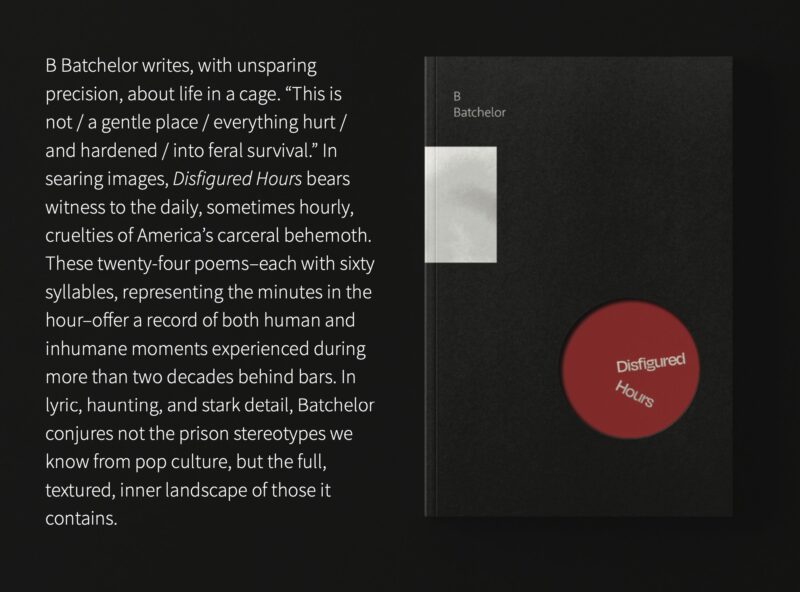
B Batchelor, Disfigured Hours
This lyrical collection from B Batchelor—a 2025 Haymarket Writing Freedom Fellow, and a recipient of multiple awards from PEN America—explores the way incarceration distorts time.
Batchelor’s poems have appeared in The Nation, Columbia Journal, cream city review, and elsewhere.

Kennedy Amenya Gisege, Twenty-One Birthdays
And this wrenching essay from visual artist and poet Kennedy Amenya Gisege considers the unique spiritual toll that incarcerated parents face. Gisege is co-editor of American Precariat: Parables of Exclusion. He is presently incarcerated at the Minnesota Correctional Facility in Faribault.
So what’s next for Lost Kite? We do well to stay tuned. This ambitious team aims to amp up its roster next year, publishing up to four titles.

Brittany Allen
Brittany K. Allen is a writer and actor living in Brooklyn.