How World War I Foretold Our Current Age of Competing Nationalisms
Odd Arne Westad on the Lessons We Haven't Learned From the Devastation of the Great War
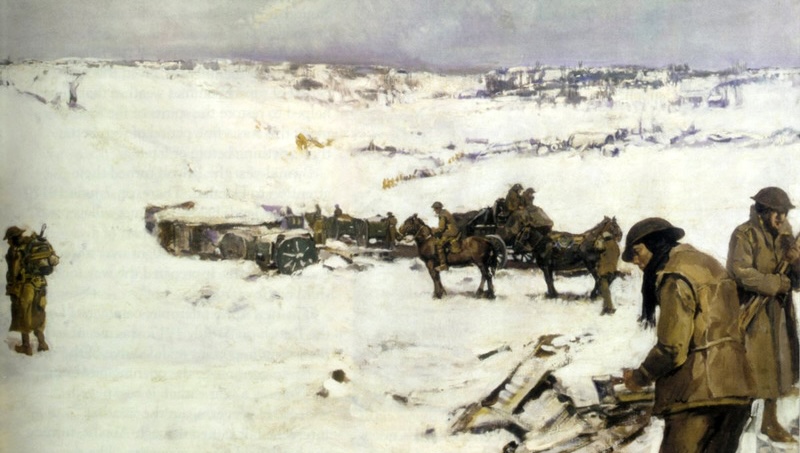
Close to Thiepval, a small French village in Picardy with about a hundred inhabitants, stands one of the most poignant memorials to the millions killed in World War I. More than fifty meters tall, the monument rises abruptly above the banks of the river Ancre, a tributary of the Somme. On its walls are commemorated more than 72,000 British soldiers still missing from the war cemeteries that dot the landscape of the Somme valley, 72,000 people whose bodies were never identified from the carnage.
The missing British dead represent only a small portion of those killed at the Battle of the Somme during World War I. From July to November 1916 there were more than 1 million casualties here. People from all over the world: German, French, British, Canadian, Australian, Indian, African, Arab, Chinese. The first day of the battle alone, July 1, 1916, saw nearly 70,000 casualties.
Many bodies were never recovered. Ten minutes down the road from Thiepval, on the other side of the highway leading to today’s prosperous French border city of Amiens, lies the German war cemetery at Fricourt. Among its black crosses are the graves of 17,000 German soldiers—merely a fraction of the 160,000 Germans who died here.
Such casualty figures can easily desensitize us. But behind every number is a person, a fate, usually of a young man who never got to live his life. Among the graves along the Somme are those of five young men who just happen to share the name Alfred Webb. All were twenty-one to twenty-three years old when they died in July or August 1916. They came from England, from Cheshire, Essex, Manchester. One was a recent immigrant to Fremantle in western Australia, from where he was shipped back to Europe to die at the Somme on August 7, 1916, his first day of battle. Alfred Louis Webb of the 48th Australian Infantry, age twenty-three, lies buried at Puchevilliers, among two thousand others: ironworkers, millers, farmers, drivers, scientists, writers.
This world is unlike anything any of us have experienced in our lifetimes. But it does look quite a bit like the world of more than a hundred years ago.
When you look up the hill at the Thiepval monument from the river, to the modern viewer it looks a bit like a set of gigantic Lego bricks, put together hastily and abandoned in that shape when play ended. It makes you think about something inadvertent, haphazard even. The memorial to the missing of the Somme, it brings to mind the war in which these young men died and how it came about through a set of interlinked decisions made by much older men far from the battlefield, some of which were accidental or even confused. This is how the bricks were connected when time ran out and the world went to war in 1914.
World War I was one of the biggest disasters in human history. There were about 40 million casualties in all, military and civilian. Those who survived were often maimed for life, in body and in spirit. To many of them, the world had become a terrible place, even if their names were not added to battlefield monuments. Beyond the physical destruction, the Great War, as it was then known, destroyed a world where many people believed in progress and gradual advance and replaced it with a cynical and desperate world, in which nations and ideologies were natural and necessary enemies. In turn, the damage caused by the First World War helped produce the Second and the Cold War that followed. “The war to end all wars,” as some of its protagonists called it, needed at least three generations for the suffering rooted in it to heal.
Today, less than half of one percent of the world’s population has experienced Great Power war. And, although many more have suffered the devastating consequences of other kinds of warfare, most people who are of age today have grown up in relatively stable worlds that were presided over by either one or two Superpowers. Those worlds were not peaceful, but they were to some extent predictable.
Our current world is becoming more complex and more uncertain. We are entering a phase where multiple Great Powers jostle for supremacy within regions and within human endeavors such as nuclear technology, artificial intelligence, or space exploration. Trade, which was becoming freer for two generations, almost back to where it was before World War I started, is increasingly more restricted and fragile, and trade wars are breaking out among major powers.
This world is unlike anything any of us have experienced in our lifetimes. But it does look quite a bit like the world of more than a hundred years ago, from the late nineteenth century to 1914. Back then we also had a world of many Great Powers that clashed with one another and sought to dominate their neighborhoods. Nationalism and populism were on the rise, and many people felt that the globalization of the day had not worked for them. Protectionism and tariffs increased, and growing numbers blamed the citizens of other countries for their problems. Immigration and terrorism were among the big issues. Leaders everywhere were fearful of military action but still prepared for conflict in ways that almost guaranteed that, if hostilities were to break out in Europe, the Great Powers would get involved.
That world ended in cataclysmic war, the one that claimed the life of Alfred Louis Webb and so many others. With whole societies destroyed, the effects of World War I made conflict flare up again and again after the four years of fighting were over. Global economic development was set back by decades. But the worst was the human suffering. British nurse Vera Brittain wished those who had decided for war could see the mustard gas victims, “burnt…all over with great blisters, with blind eyes…all sticky and stuck together, and always fighting for breath, with voices a mere whisper, saying that their throats are closing and they know they will choke.”
War in all of its forms is a terrible thing. But Great Power wars are more destructive than others because of their intensity and scale, because of the weapons used, and because of their tendency to spread. A Great Power war today would make all other current wars pale in comparison, even if the ultimate weapons of mass destruction were not to be used. Millions would die. Human development would be set back by a generation and our children would spend their lifetimes putting the pieces of progress back together again. If there are lessons from history, now is the time when we need to heed them, so that we do not end up in another Great Power war because of the fatal combinations of jingoism, fear, fatalism, and sheer stupidity that set off the first major war of the twentieth century.
Today the stakes are very high, and the conflicts are real. A large number of people who live within the Great Powers believe that those who live in other Great Powers, or at least their leaders, are out to get them. Two in five Americans said that it is likely that America will go to war with China in the next five years. In China, where reliable public opinion data is scarce, students frequently ask me when I believe a full-scale Sino–American war will erupt. Two thirds of Russians believe that the war in Ukraine is a life-or-death “civilizational struggle” with the West, and about the same percentage of Indians have an unfavorable or very unfavorable view of China. In Europe, a staggering three quarters of Germans and French view China unfavorably.
These are much higher numbers than the level of mutual suspicion that existed before World War I. If one of the most abiding lessons of that war is how quickly even relatively moderate amounts of general resentment can help produce a global catastrophe, then today’s popular views give real cause for alarm. While it is true that public opinion fluctuates, and that general standpoints never by themselves produce wars, there are enough structural and political conflicts between the Great Powers today to make major war a likely scenario. And it is in the kinds of crises where war threatens that the views of the population, and the impact they have on domestic politics, can play a very significant role in determining the outcome.
Today we must prepare to do better. The alternative, which we must also behold, is war on a scale that the vast majority of us have never experienced.
Much as in the pre-1914 world, nationalisms of various kinds play an increasing role in today’s politics. From Xi Jinping’s quest to regain China’s glory, to Vladimir Putin’s attempts at a new Russian empire, to the rise of populist anti-foreign attitudes in the United States, Britain, Germany, and France, negative views of others underpin many of the conflicts in today’s world. It is easy to see how such sentiments make major war more possible, because they make it harder for even the more sensible political leaders to warn against the effects of international conflict. Under such circumstances, few of those in charge want to risk their own political careers through defusing tensions with other countries. The bipartisan US consensus for confronting China is one example. Another is how Russian and Chinese political elites, and some in the United States, have aligned themselves with authoritarian agendas that many privately recognize could lead to disaster.
Another frightening similarity between today and the pre-1914 world is the conflation of complaints that Great Powers have against one another. This is particularly true for the relationship between the United States and China but can be seen elsewhere as well. Both in Beijing and Washington, everything that one of the countries does is treated as proof of its aggressive intentions against the other, from strategic posture, to naval policies, to alliances and friendships, to trade policy and technology. Almost nobody in the two capitals is attempting to disaggregate some of these issues and thereby make tensions more manageable. Such mergers of different sources of resentment were among the major causes for war in 1914.
Through most of the Cold War, nuclear weapons and other weapons of mass destruction were, in bizarre ways, supposed to contribute to stability or even keep the peace. The threat of mutually assured destruction was central to avoiding war, many experts argued. The same argument was made before 1914, but then about chemical weapons, battleships, long-range artillery, and aircraft. In a more complex world, with an ever-expanding number of nuclear powers, there are many reasons to fear that the threat of nuclear war does not have the deterrent effect that it had in a bipolar Cold War world. The 1914 example shows that the weapons of mass destruction of that time were not sufficient reasons for Great Powers to avoid war. My fear is that under today’s circumstances the threat of nuclear destruction, which may have contributed to keeping Great Power peace in a bipolar world, no longer holds absolute deterrent power.
*
We have had eighty years of sometimes shaky Great Power peace since the end of World War II. But the nineteenth century was also mainly peaceful in Europe and yet produced devastating war in 1914. In strategic affairs, as in finance, past performance is no guarantee of future returns. If we want to avoid war, we have to prepare for how to avoid it. Such preparation will have to come in many forms. One is at least temporary compromises on dangerous issues of sovereignty or territory, such as between the People’s Republic of China (PRC) and Taiwan, or between India and the PRC, or in the South China Sea. Another is ending ongoing wars, such as in Ukraine, Iran, and Palestine. A third is not to stifle global trade through tariffs and embargoes. A fourth is to limit arms races in sensitive technologies. A fifth is to cooperate where cooperation is possible, such as on climate issues, pandemics, and space exploration. There are many others. But at the moment, we are not moving toward any such compromises.
Instead, we are moving farther away from them. We also have to realize that behavior and rhetoric are essential elements of peace. War came in the summer of 1914 because of the all-encompassing fear that had gripped many Great Power leaders, looking for signs that they would be attacked. Much of that fear, which turned so debilitating in efforts to stop the war, was based on what opposing leaders had said in the past, publicly and privately, and what they believed they knew about the war plans of others. Patience and even guarantees, features that are often central to preventing the outbreak of conflict, had no place in such a scenario. Today we must prepare to do better. The alternative, which we must also behold, is war on a scale that the vast majority of us have never experienced.
______________________________
From The Coming Storm Power, Conflict, and Warnings from History by Odd Arne Westad. Copyright © 2026. Available from Henry Holt and Co., an imprint of Macmillan.

Odd Arne Westad
Odd Arne Westad is the Elihu Professor of History and Global Affairs at Yale University. He is a scholar of modern international and global history, with a specialization in the history of eastern Asia since the eighteenth century. Westad is the author of The Global Cold War, which won the Bancroft Prize, and Restless Empire, winner of the Asia Society Book Award. He lives in New Haven, Connecticut.