After Lorrie Moore and Kiese Laymon.
You chose this program based on money and because you never had a Black person of any gender teach you anything about writing or reading. You learned math and Black Studies and the safest way to blow and push life into another person from other Black people, but none of them had taught you how to tell a story.
There is a family legend about how you learned how to read, that one day you were sitting at a kitchen table, four years old, beads in your hair because you were fresh back from a visit to your Mom-Mom’s, and you said something like, “Good morning. I hate Mondays. Lasagna,” and your parents realized you were reading a comic aloud to yourself. Reading came to you like a sudden burst into fruit brought forth by unseen winds.
You wanted a lineage. Sometimes, creating one doesn’t take generations upon generations. It can be established, at least in the arts, with the right, thoughtful conversation or idea passed around a table in two hours and forty-five minutes on a rainy Tuesday afternoon.
I want to tell you that you’ll make it through this year. But did you?
The first time you all met as a class that semester, your most boring white classmate turned in a story that was about himself but named something cooler like “Alistair” or “Parker.” Last year, you had read an infamous essay about women and likability that he had found offensive. You had personally found the essay a little boring in the duh-yes-of course way essays can be when they take on something you have personally experienced. The only marginalia you had bothered to write was Girl, you are preaching to the choir. But this classmate had gotten somehow so upset with the author’s phrasing, the way she treated men, that he had cried in the classroom. You had seen him lurking outside of after-class Guinnesses—the cheapest beer in the happy hour special—crying still, face mottled red, and typing something on his cell phone. All his stories were about young, misunderstood white men gazing at water and thinking about misdeeds that they never actually did in-scene. You and your friends sometimes called him Mr. Flashbacks. Sometimes, you called him Mr. Future NBA in Fiction.
You listened to how your Black professor told him that his descriptions were “miraculous.” She talked about Carver and interplays of emotion and reality and wasn’t water ancestral? Her hair was thick and natural. You could see the effort she put into her curls being separated. Her glasses were red and slid down her nose. You were always a sponge for details. She was wearing a suit and a T-shirt underneath it with a picture of an iconic Black author and the word “free” in all caps. Most of your class was nodding along almost in perfect synch. “This,” your professor said in a serious, lovely voice, “is what literature should be. This is reality.”
And this should have been your first warning bell. Your idea of literature was always built in seeing a saturated world filled with people dealing with the uncanny. Once, you wrote a story that was about a woman who had been sexually assaulted off-screen and she spent the entire story turning into a tree, until at the end, the man who had assaulted her stopped in and chopped her into bricks and turned her into a poorly built chair. The workshop you were in called it “polemic,” “cruel,” and “weird.”
And you read a book by a white writer where strange things happened in a lyrical way, girls kept becoming puppets or cake or being murdered and reawakening as their killer’s Vitamix, and this was meant to teach you something about feminism, you knew that from being in the academy for so long, but in your heart, you felt like it was something people had done for years and years. You got it. Society made women feel like objects! But you spent the ninety minutes allotted for talking about the book mostly doodling because it seemed like almost everyone else found this profound. There was a phrase you hated but it felt appropriate in the moment: why yuck someone’s yum? And it was a relief to hear everyone take seriously a book that was marginally adjacent to work you might do.
You wrote a story with a main character based on a girl you hated winning the lottery and then being suddenly attacked by a pack of dogs on the beach for the ticket. They used the money to save their animal shelter. She was going to use the money to go to Paris and go on a shopping spree and change her name to Yvonne. Most of the people in workshop didn’t even bother to write a response to that one. Your only friend in the class wrote a letter but it was filled with puns like, “I woofed the moment when the gang of dogs appeared.”
To be honest, even you did not think these stories were good. There were times where you stayed up all night staring at your bedroom ceiling and wondering when you would get any better. But at least, you weren’t writing about writers, you would tell yourself and pull the covers over your head. Sometimes, you fell asleep. Sometimes, you thought about how your parents’ house was being foreclosed on, how some weekends you went home and figured out what to give away and watched as your dad burned some of your old school tests in the backyard. It was embarrassing to tell your parents that every day you cared so much about make-believe and style and fake people that it could keep you awake at night. You told them that you were enjoying yourself.
That semester, you were writing a story that at its heart was you talking to yourself about how you were constantly torn between never wanting to die and being sometimes suddenly so desperate to be done with this world. The summer before, so many Black men and Black children and Black women had been murdered for the most meager of real or imagined offenses. A toy gun in a park, an argument with the wrong person in public, shoplifting a soda, missing a stop sign, not being honest. You would read the articles and think about a time where you and your dad were pulled over. They took your dad out of the car. One police officer stayed with you, always slurring you in every question he asked, he asked you about drugs and prostitution and would you suck his dick, and the only thing you knew how to do was stay very still and call him sir and you could tell he liked that you were little mouse limp. Your therapist said you had PTSD but you didn’t want to believe it. Your dad had lived. You had lived. But here you were writing a haunted house story that if you looked sideways at it, there were all the things you could feel baking inside your brain and throat each time you read a news article that summer or read a tweet that began, Rest in Power.
Sometimes, I think we died that night. That we, too, were taken out of the car and beaten and thrown in a ditch. That our father died, too. And some great angel couldn’t stop the two of us from dying, but came down later and prayed and prayed until the heaven we had was one where we never died. She couldn’t erase what had happened to us but let us continue forward. Can you really have heaven if you die in the worst possible conditions? But maybe heaven is always predicated on a kind of benevolent amnesia where you have to breathe in clouds and sweet grass and breathe out every wrong until enough of the wrong inside you dissipates into a forgotten mist.
In your workshop story, a Black girl goes into a haunted house. On floor one, she is chased by white workers dressed as the wolfman and Ghost Face and killers. Floor two, there are actual monsters mixed in. On the final floor, she is met by an ancient evil that is wearing an expensive business suit. He kills her. She has paid ten dollars to die.
When you brought the story into workshop, most of your white classmates were silent and so was your professor. She let the brilliant writers of color around you talk about their ideas of reality and unreality, what is haunted house literature, and was the United States itself a kind of haunted house of racial reckoning? The type of questions that can feel profound or vastly stupid depending on where you’re sitting at the table. You were glad to hear their thoughts, but your gaze kept drifting to her, to the way she wouldn’t really look at you, at how she kept curling her hair around her fingers. There was something she wanted to say, you felt.
But you took notes and later, you could barely read what
you had written because so many thoughts were coming so quickly and as always you had stream-of-consciousnessed it, so that it looked like: is-it-too-much-that-all-the-workers-of-the-haunted-house-are white-and-i’m-so-hungry-why-did-i-forget-a-snack. You left happy that some people had taken your writing seriously but sad because you felt lonely in the way that only creativity could; your ambition and skills were still on two separate paths.
After class, you took a long walk and reminded yourself of a family story. Your Mom-Mom had a natural talent for piano is what your mom always said. She was never formally trained but could hear any song and figure out within a few minutes how to play it. And it was true. One time when you were a child, you watched as she went from playing “Moonlight Sonata” to “Hot in Here” back to the sonata and then into a beautiful rendition of “How Will I Know.” “Everything has notes,” she said. “Sometimes, I play the breeze going through the trees or the sound of your voice complaining.” And then that’s what she did. You could hear what could be recognized as the sound of you wanting to goto McDonald’s because your parents never let you go coming out of the black-and-white keys.
“Can I tell you a secret?” your Mom-Mom asked. It was as always not really a question.
She told you that when she was seventeen, all her best friends had been in the church choir but she had been cut. It was the first real disappointment of her life. And even though, you had been a little jealous of your grandma. You’d gotten the idea that every person older than you had to have had a worse life than you. Racism, no good technology, bad food, everyone was dying all the time from weird sicknesses, only rich people got to eat fries. But, your parents had moved to a nice suburb and you went to nice schools, so you couldn’t complain about things. And your grandma, she knew how hard things were for you. Even decades later, walking down the street with your headphones on, you rolled your eyes at the memory. Your Mom-Mom told you she felt so lonely and embarrassed that for weeks, all she thought about was how to have a talent. The rejection had set off a spiral of wondering if there was anything she was good at.
Not especially kind, couldn’t bake, could dance only in a group to blend into, was an okay driver, only decent at school, killed parts of the garden, and sometimes struggled to see the difference between some greens and blues. A boy had told her she kissed bad. Your Mom-Mom went out into the world and wasn’t sure what she was going to do. Maybe, the idea was to sulk. Maybe, something else. You remember a hesitant look on her face. As an adult, you’ve seen the own look on your face when you’re thinking about all the things that can chew on your brain and self-respect.
“I met a man out in the fields,” your Mom-Mom said.
“He was taller than any man could ever be, his skin was soft green in the light, navy in half-darkness. His voice was kind and sweet. I’ve never heard anyone sound like that. It made me trust him instantly.” He took your Mom-Mom’s hand and walked with her out in the high grass, listening to all her worries. Every single word was precious and she could tell he was taking everything she said seriously. The world filled with fireflies and rhododendron musk.
He told her that every single person held some of the universe’s song. People liked to pretend they were individuals, but every single one was a note on a fiddle. She loved that; you’d heard her say those words so many times and it had made you think before this talk that there was a secret nest of poetry festering in her heart. She told you that man was God. He had held her head in her hands, breathed on her, and made her promise to always know his will was true. Her voice would be beautiful forever. Never age. All she had to give him was her promise, a performance or two.
You were a child. And as an adult, you had cultivated the wisdom to let anyone who wanted to believe in something that didn’t obviously hurt someone else. If a friend wanted to believe the power of her thoughts cured her from pneumonia not the antibiotics regimen, fine, as long as she didn’t have kids or was a doctor. But you told your grandmother what was in your heart, that it sounded like a deal with the devil. You got your heart’s desires without any work. You had someone mysterious tell you his will was true. And maybe this is how you learned that wisdom because despite you being a child, her eyes welled with tears. It was one of your life’s big hurts that you could so casually do that to someone you loved so much.
As you walked, you turned this story over in your head and kept thinking about the note your professor had written you. She had written: One day, when you get over the monsters and all the ostentatious weirdness, you may write a book of real merit. You need to learn how to talk about race in an honest way. You had flipped the paper over to see if it was a joke or some computer error. There had to be more. But that was all she had given you.
Then you went home and pulled the copy of her most famous novel off the shelf; you had bought it when you got into the program. The praise on the cover called it a tour de force of racial reckoning. “A modern Nella Larsen!” said an unnamed reviewer. A Black woman goes to Africa and appears to be annoyed that every Black person in Senegal and Tanzania and South Africa doesn’t recognize her as some form of kin because she is light skinned. She sees every African kid—poor kids in markets, rich kids in restaurants—and thinks they could all have better lives with her in the United States but that is couched in the kaleidoscope of the main character’s infertility and loneliness, so it feels like you’re told not to judge. People were chocolate, cinnamon, wood, blue-black, obsidian. Everyone was mean but the woman in the book was coming off a bad breakup, so dear reader, give her a break. She was thirty-seven and the world felt so heavy and there was a line on her forehead that could be seen in very bright light. When she goes back to the US, alone and holding resentments toward everyone else in the entire world, there is an election happening. A white politician who had genuinely said Black Americans should go back to Africa won. The novel ended with the protagonist drinking a beer and wondering where in the world she could go next. Maybe Brazil.
You felt like you had chugged an energy drink by the time you were done reading. There was something so rancid to you, so much of a performance of what literature should be, that you had to walk it off or feel forever cursed. So, you walked to the park, past that to the one across town. Few cars were on the road. The tires sounded like wishes muttered a sad man’s breath. It was thrilling to care so much about literature. It was real loser shit to care so much about literature. The sidewalks became more cracked and uneven the further out of town you walked, then they disappeared, and it was only until you were on the edge of a long field that you realized how much your thoughts chomp chomping their way through your body had propelled you.
In summer, a farmer’s market was held in this field. You had gone once and someone had handed you a flyer about how corn was just as big of a contributor to global warming as cows. Corn fields sweating their way into sweetness could make the air hotter and more humid. You realized as you sat down to watch the night sky that you had never checked that fact. It seemed too silly to believe. Venus ascendant, sky blackened with the new moon, and acool breeze soothed you.
“I’ve been waiting for you,” a voice said. A man, too tall to be believed, his skin in the 4 a.m. gloom, navy. His hands were heavy with silver rings. There were faces and symbols carved into them.
You were certain in a sudden heart pound that again, you had died. You tried to trace back what could have happened. Had you walked in front of a car? Had you harmed yourself? Had someone found you, a lone, distracted woman in the night and felt relieved that here was something easy to snatch and never missed? There was a time where you asked your therapist if you had Cotard’s Syndrome and she’d said, do you see yourself as a corpse? Do you believe truly that you are beyond harm? Oh, you’d said lightly, every day hurts alittle.
He told you to tell him everything weighing on you. You told him about a poem you had read five years ago about two lovers who fucked each other so good that one believed he was the sky and the other felt like he was the cloud inside the sky, heavy and filled with lightning, and that you would never write anything that would hurt someone so wonderfully as that poem hurt you. You told him that the only thing you truly loved was reading. Writing didn’t even mean as much to you. He waited for you to ask about fame, to say wealth, universal acclaim. You told him about an interview you had read where a famous writer wrote about how the most meaningful thing to her were the early nights, before she became a capital-w Writer, where she sat at her desk and wrote only to please herself. He kept trying to hold your hand but you kept gesturing and talking. You told him that you had loved so many people but here, trying to write a book, this was your first great romance. He told you that if you gave him something, he could give you more than you might ever be able to consider wanting. You would only have to promise to give him something in return. I knew your grandmother, he said. You can trust me.
His eyes were silver in that moment. It made you want to write a poem. You could see yourself at your desk trying to push the glint you saw against starlight against the metal of the small pocketknife you kept in your pocket because you lived alone and the nib of the nice fountain pen that was the last gift your grandmother had given you. She had never written songs or sang anywhere but in her kitchen and her church. Her voice always wonderful to you.
I am thinking again what if I had said yes and taken his hand. Warm palm and smooth manicured nails and the hard metal of his rings holding onto mine for forever. He would have whispered an idea into my mouth that would have earned a million dollars and expensive shoes and a boring interview on TV to follow, and every day I would have known that it was never really mine. My parents might still own my childhood home, my father’s garden still intact. In the bookstore, my old classmate and teacher have books in the front window. They are both about characters feeling things in front of the ocean, both are called “modern classics” in large white print. I have my desk.
__________________________________
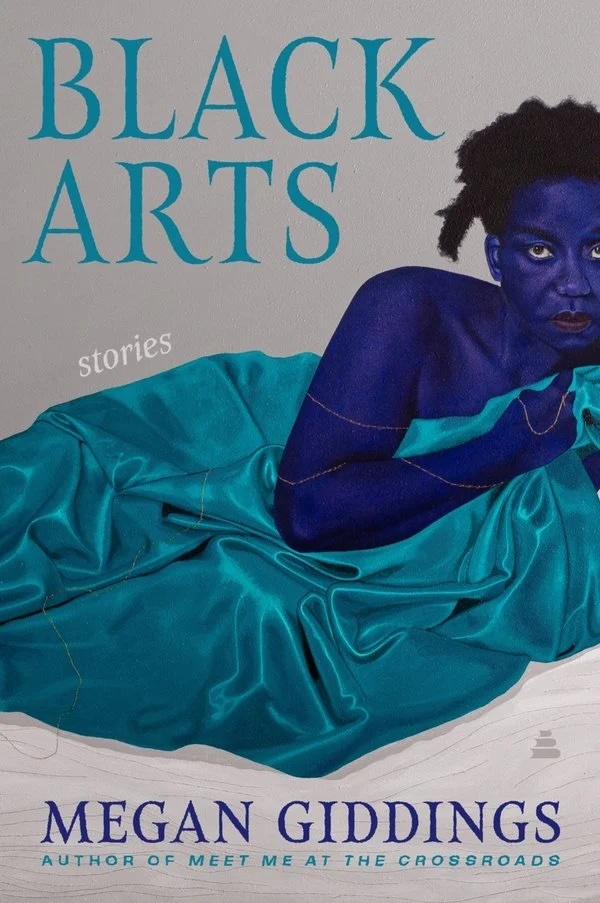
Excerpted from BLACK ARTS by Megan Giddings. Reprinted with the permission of the publisher, Amistad, an imprint of HarperCollins. Copyrighted © 2026 by Megan Giddings.