How Library of America Helped Shape the Modern American Literary Canon
Max Rudin’s Reflects on the History of the Press at the 2026 Whiting Awards Ceremony
Congratulations to the recipients of tonight’s awards. The honor of speaking at this distinguished ceremony is usually given to an eminent writer. I’m here rather as the President and Publisher of Library of America, as many of you may know a nonprofit organization dedicated to publishing authoritative new volumes of great American writing, and to keeping the American literary tradition a vital part of the culture. The series wouldn’t exist without the writers, scholars, and publishing partners who’ve worked with us over many years, some of whom are here tonight. A word about Library of America’s work:
What we now think of as American literature was more or less discovered—invented might be a better word—in the 1920s, by modernist writers such as D.H. Lawrence, William Carlos Williams, and others seeking antecedents more relevant than the genteel Victorians. Until then, readers and critics were handicapped by a self-constructed blind spot. As Herman Melville put it: “
Even with those Americans who look forward to the coming of a great literary genius among us, they somehow fancy he will come in the costume of Queen Elizabeth’s day,—be a writer of dramas founded upon old English history, or the tales of Boccaccio. Whereas great geniuses are parts of the times; they themselves are the times; and possess a correspondent coloring.
He was talking about Hawthorne, but it’s an even better description of Melville himself—a 19th century New Yorker who took subjects like commercial whaling and Wall Street law clerks and claimed them for a new kind of American writing. In the 1920s and 1930s an American canon we recognize begins to take shape.
After World War II, there was new interest in American cultural traditions and a huge flowering of American literature and American studies courses in the universities. But there were few reliable editions of American writers, even of major authors. The meticulously edited New York Edition of Henry James was one of the rare exceptions in American publishing, which was geared practically from the beginning to sell to a mass audience at low prices. The publishing marketplace, tremendously creative as it was and is, wasn’t structured to produce and keep available authoritative editions of the country’s significant writers.
Library of America was a response. Its founding was the result of about 20 years of work and persuasion. In the early 1960s, while scholars were lamenting the lack of reliable texts, Edmund Wilson called for compact readers’ editions of the collected works of great American writers, along the lines of the French Bibliothèque de la Pléiade. In 1979 the two aspirations—compact readers’ editions and authoritative texts—met in Library of America.
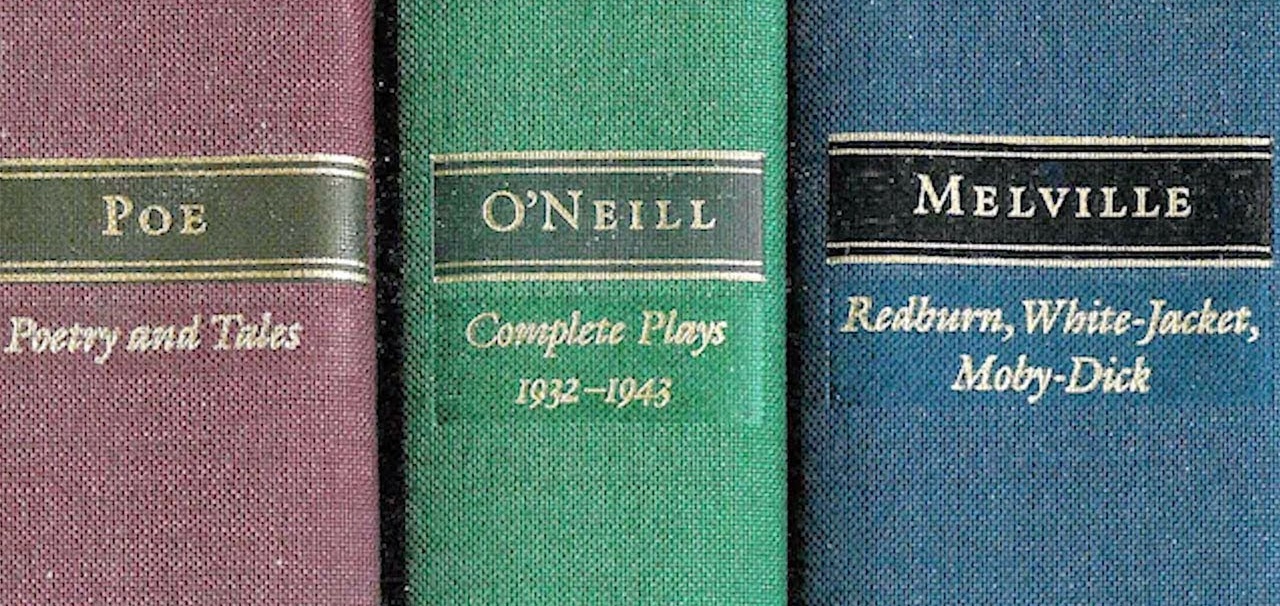
Our first four books were published in 1982: Whitman’s poetry and prose; Melville’s early romances of the sea, Typee, Omoo, and Mardi; three novels by Harriet Beecher Stowe, including Uncle Tom’s Cabin; and the complete tales and sketches of Nathaniel Hawthorne. The press was enthusiastic, and luckily the books managed to find an audience almost immediately. This spring, our 44th anniversary of publishing, there are 399 volumes in the series and over thirteen million books in print. Author with the most volumes: Henry James (sixteen: 17,000 pages and counting), with Philip Roth hot on his heels at ten. Hot on his heels is Ursula Le Guin at seven, including her collected poems edited by Harold Bloom—for both writers one of their last projects, and a tribute to their remarkable late in life friendship.
Roth by the way was the third living writer published in the series. Library of America was at work on the second volume of his collected works when he came by the office for a meeting. One of our editors spotted him stepping off the elevator. “Don’t I recognize you from one of our book jackets?” asked the editor gamely. “Yes,” Philip replied, “I’m Louisa May Alcott.”
Library of America is a unique publisher in several ways. For one thing we take the idea of authoritative texts seriously, researching the printing and publishing history of every work we publish. Sometimes this research strikes gold, as it did with Faulkner, whose radical modernist experimentation with spelling, grammar, and punctuation presented challenges his publishers weren’t prepared to meet. As a result Faulkner’s published works were filled with errors and misunderstandings; the editors of Pylon and Absalom, Absalom! went so far as to rewrite entire passages. The new, more faithful texts Library of America established have been a service to both readers and scholars, and are the ones that now appear in Vintage paperback editions.
Then there was the day in 1990 one of our researchers discovered at Yale’s Beinecke Library a set of page proofs of Richard Wright’s novel Native Son. Comparing it to the first book edition, he noticed many differences, including drastic revisions and deletions throughout one chapter and significant changes in several other passages. Further investigation revealed that the novel had been expurgated at the behest of the Book-of-the-Month Club. The Club wanted to offer Native Son as its first main selection by a Black writer—this was 1940—but felt that the sexual and racial content of certain passages would be objectionable to a mainstream audience. Wright reluctantly acceded to the changes, seeing the book club selection as a crucial opportunity for Black writing and a social and political milestone. The only thing that suffered was the work. Fifty years on we were able to publish Native Son for the first time as Wright intended it to be read. A few years later we undid earlier censorship again with a restored, unexpurgated text of Steinbeck’s The Grapes of Wrath, placing us in the enviable position of putting the spicy parts back in, in the name of Literature.
These are large canvas projects, like cleaning an Old Master painting. Sometimes it’s fine detail work—for example restoring the correct punctuation of one of the most famous last sentences in American literature. In the manuscript of The Sun Also Rises, Hemingway first ends the novel with Jake Barnes saying, “‘It’s nice as hell to think so.’”, then revises it on the same page to a rhetorical question: “‘Isn’t it nice to think so’” but with no terminal punctuation. Finally, in the typescript setting copy, Hemingway revised the line again to “‘Isn’t it pretty to think so.’” This time with a period. A copy editor replaced the period with a question mark—“Isn’t it pretty to think so?”—which is how it appears in the first and all subsequent printed editions. The line appears for the first time as its author intended in the Library of America edition, transforming a barbed retort into an evocative epitaph for the dashed hopes and illusions of the Lost Generation.
But the editorial task isn’t only textual. Sometimes, given the narrowness or absence of a received canon, it can involve proposing a new way to look at American writing, as with our wide ranging 19th and 20th Century poetry anthologies or our two-volume collection of women crime novelists from the 1940s and 50s, who’d been written out of a literary history that went from Hammett to Chandler to Ross Macdonald. Kevin Young’s African American Poetry: 250 Years of Struggle and Song, which restores a tradition created equally by women and men, and Rigoberto Gonzalez’s edition of Latino Poetry, are revelatory projects of cultural reclamation; as is our recent volume Black Writers of the Founding Era, a literary recovery project that invites readers to rethink what they thought they knew about the beginning of Black American writing and its connection with our complex and contradictory national origins.
Lastly: Some revelations are hiding in plain sight. It’s long been known that as the son of working-class French-Canadian immigrants, Jack Kerouac’s first language was joual, a blue-collar Québécois dialect, and he didn’t learn English until he was six. What wasn’t known, until scholars began working through the Kerouac archive at the New York Public Library, was that the young Kerouac wrote several important early works in joual, and, as his journals and essays make clear, thought of himself throughout his life as having a kind of dual French/English literary citizenship.
This is suggestive. Kerouac’s boyhood friends nicknamed him “memory babe,” and his writing is obsessed with finding language to recapture the feel of lived experience as it rushes through the mind and senses, not letting any of it go. What’s the connection between this lifelong literary memory project and Proust’s, whom Kerouac refers to often in his early writing? Kerouac is now seen as a quintessentially American writer, mining the American truths of his time and place as his heroes Whitman, Mark Twain, and Thomas Wolfe had done. (Wolfe, Kerouac said, “woke me up to America as a poem.”)
But these unknown early writings suggest that he may be better understood as an immigrant writer—one of the gifted, ambivalent outsiders who remade American literature after World War II—whose most astonishing achievement was the all-American voice of On the Road and the books that came after. These considerations led us to add the volume The Unknown Kerouac, with early journals and translations from the joual, to our ongoing multivolume Kerouac edition.
Book by book, season by season, Library of America has been doing this work for more than four decades. What has slowly emerged is a body of essential writing—essential and surprising—that honors the multivocal democratic spirit of our literary tradition. A living tradition, a deep reservoir of stories awaiting new writers and new stories to unfold their possibilities, to reimagine, revise, update, challenge, and join them. Another country of the imagination and spirit that embraces Gatsby-the-great and Ripley-the-Talented; Washington Irving’s haunted dreams of lost worlds, and Isaac Bashevis Singer’s, and Maxine Hong Kingston’s; Mark Twain’s vernacular wit alongside Abraham Lincoln’s and Zora Neale Hurston’s. It’s a fruition we couldn’t have anticipated when we started.
I was thinking about this—the unanticipated harvest of losing yourself in the work at hand—when, preparing for tonight, I read the description of the Whiting award:
The award can be used in any way that smooths a writer’s life or makes good work possible. We’ve heard from previous winners that they bought a much-needed new car, or put a roof on their house, and we consider these to be completely legitimate uses of the grant, which is intended to enable them to focus with joy and freedom on their creative work.
Fixing the roof made me think of the 32-year-old Brooklyn journalist and carpenter Walter Whitman, who in the four years it took his housebuilding business to fail, transformed himself into “Walt Whitman, a kosmos, of Manhattan the son”; and in startlingly beautiful, rude, extravagant, sensuous poetic lines, hewn and laid as strong and true as a carpenter’s crossbeams, delivered on a spectacular claim: “Stop this day and night with me and you shall possess the origin of all poems.”
There’s a deep vein in American writing that understands that the gift isn’t the finished Work but the working, the making, the engaging with the world in the work of writing. It’s an implicitly democratic idea, because it makes what writers do like what other people do, and it carries a belief in the transformative potential of all kinds of work. Thoreau in Walden talks about a day he lost himself in his farmwork: “It was not I who hoed beans, nor beans that I hoed.”
As my late colleague Richard Poirier, one of Library of America’s founders, described, Robert Frost worked this vein as profoundly as anyone. Maybe that’s why Frost seems so much in the American grain. That and his American plainstyle, beautiful and reticent, which a fifth-grade teacher first introduced me to, opening a door that stayed open. Like Whitman’s, many of Frost’s poems are songs of occupations. They generously assume that the work of writing poems, or publishing books, is like the work of picking apples, or mowing hay, or chopping wood. To lose ourselves in the rhythms of work we’re meant to do is to be in touch with more than ourselves.
The old apple picker in the poem “After Applepicking,” exhausted and aching after a season’s—and a lifetime’s—work, is blearily thinking over what he accomplished when suddenly his language shifts in register:
There were ten thousand thousand fruit to touch,
Cherish in hand, lift down, and not let fall.
For all
That struck the earth,
No matter if not bruised or spiked with stubble,
Went surely to the cider-apple heap
As of no worth.
“Ten thousand thousand” has the wonder, and ache, and maybe the regret of all completion. But “cherish in hand” is an odd way to describe picking apples, as is “lift down” and “not let fall” instead of “grab.” Also odd, the five lines spent on dropped apples consigned to the cider apple heap “as of no worth.”
The apple picker is reaching to express something fundamental about our relation to the world and to work. There’s a gentleness, patience, care, and concentration in meaningful work, an attentiveness close to love, that embodies the best in culture. It’s an answer to nature, which doesn’t cherish apples, lets them fall and rot, treats everything vulnerable or just unlucky as if it has “no worth.” Something natural decay shares with human indifference and brutality—war, waste, and rot, literal and metaphorical.
This isn’t the terrifying Frost of modernist criticism—although the poem is fully aware of darkness, and its world, on the cusp of World War I, like ours, certainly had its terrors. This is the Frost for whom “keep” and “kept” are central words: “I could give all to Time except what I myself have held . . . And what I would not part with I have kept.” “One aged man—one man—can’t keep a house/a farm/a countryside.” “Keeping” is the loving effort to attend to, and tend, something we hope might last, that we want to last. It’s the work of making homes, loving relationships, and poems. Poetry is a form of keeping. Library of America is a form of keeping. Good writing is a form of keeping.
Tonight’s awards are designed to allow ten writers to lose themselves in their work: and as our tradition understands, losing is finding, and finding is keeping. In difficult times it’s easy to deprecate this cultural work, the work of care and craft that creates meaning and preserves it from annihilation, the sometimes inviting oblivion of the dark and deep woods, the sheer inhuman blankness of the frozen lake. But we have work to do. Promises to keep.
“What we have loved others will love and we will teach them how,” says Wordsworth to his friend Coleridge in The Prelude. “How Love burns through the putting in the seed,” exclaims his American descendent, the farmer-poet-newlywed of Frost’s early song of spring planting. Both visionary and practical, it’s a fitting blazon to tonight’s spring ceremony, as we honor the Whiting Foundation’s enabling generosity and celebrate these writers’ well-deserved good fortune for this opportunity to lose and find themselves in the work they are meant to do.
*
You can see the winners of this year’s Whiting Award here.

Max Rudin
Max Rudin is President & Publisher of Library of America, which he joined 1980 soon after its founding. He writes on American history, literature, music, and popular culture and gives frequent talks on American writing. He has curated exhibitions and programs for the New-York Historical Society, the New York Public Library, and the 92nd Street Y, and created and hosted “Great New York Writers in Great New York Places,” a reading series co-produced with the New York City Department of Parks and Recreation. Since 2020 he has produced and hosted LOA LIVE, an online series on American literature and history that reaches viewers in all fifty states and seventy-two other countries and territories. He has directed several NEH-funded national public humanities initiatives, most recently “Lift Every Voice: Why African American Poetry Matters,” developed in partnership with the Schomburg Center for Research in Black Culture. He served on the Content Leadership Team for the new American Writers Museum in Chicago and as a judge of the James Thurber Prize for American Humor Writing. Rudin holds degrees in English and American literature from Princeton University and Columbia University. He has served on the Board of Directors of The Great Books Foundation, The New York Festival of Song, and Columbia Global Reports, a nonprofit publishing initiative of Columbia University. He serves on the Advisory Council of the American Trust for the British Library and is a member of the Century Association.