How Leprosy Was Used as a Weapon Against Hawaii’s Indigenous Population
Oliver Basciano on the Intersections of Illness and Colonialism in the Pacific
Father Damien was a dirty man. Everyone agreed on that. Dirt would accumulate under his fingernails; he rarely washed his hands. His clothes—his habitual cassock and wide-brimmed hat—were worn for days on end; he saw no reason to clean his hut in Kalawao, the leprosy colony on the Hawaiian island of Molokai. His detractors claimed he lacked elegance too: burly with a “piggish” head, they complained, he squinted from behind a pair of wonky wire-framed circular spectacles. He was eager to learn Hawaiian, it was noted sniffily, but otherwise he had little enthusiasm for languages. His Latin came only by official requirement, his English was sparse; a native Flemish speaker, even his French was stilted. The prose of his letters lacked refinement whatever their language: “coarse…headstrong and bigoted” was one particularly vitriolic posthumous assessment.
None of this worried Damien. Hawaiian did him fine. From that messy home, built in sight of Kalawao’s cemetery, Damien wrote to his brother Auguste, also a priest, to say that Molokai was exactly where he wanted to be.
We eat what Providence sends us. The calabash of poi is always full; there is also meat; water in quantity, coffee and bread sometimes, wine or beer never. As I have had to work all week and cook on Sunday, you will excuse me if my hands are not as clean as yours, which do nothing, I suppose, but turn the pages of books. Sometimes the plates are not well washed either. But what matter. Hunger and habit make us eat just the same. For dessert, we smoke a pipe. That finished, quickly back on the horse.
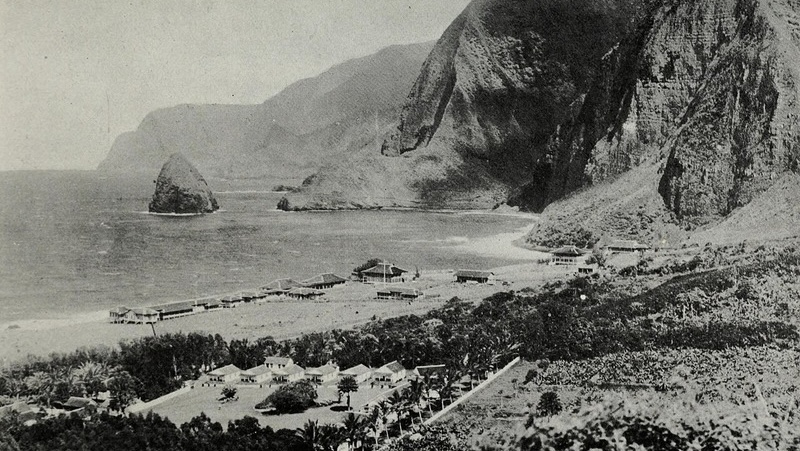
In the saddle, Damien would cross Molokai’s mountains; his parish over two thousand square kilometers, he rode down the island’s valleys beyond Kalawao itself, across water and through fields to find the most remote of his parishioners. Today it is a national park, wild garlic growing in fragrant profusion, its white flowers poking up between ferns, yellow hibiscus and amid the ki-tree, the roots of which were used to brew a potent beer. Across this paradise the finch-like honeycreeper flits, feeding off the red spindly flowers of the evergreen ‘ōhi‘a lehua tree. Damien would haul building material and basic medical supplies with him, eager to provide practical as much as spiritual comfort (though he never left without an ad hoc altar of four sticks and a plank). Sometimes he had to abandon the horse and mules to scale by hand and foot the sheer cliff faces which routinely stood between him and his flock. For Damien dirtiness brought him closer to godliness, the grime evidence of his graft.
Leprosy, however, had become totemic of a moral depravity or sexual freedom that Europeans had long imagined pervaded the South Seas. The leprous, lascivious body was a perversion that Western proselytizing could fix.
For his colonial masters, those disdainful of his personal habits, the priest’s life was alien at best and an affront to Western order at worst; religion was supposed to be a cleansing antidote to indigenous habits, a washing-away of the idolatry and idleness they projected onto the population, be they sick or healthy. Yet here was Damien, adopting their ways, it would seem, along with their language. His body and the leprous bodies of his parishioners were dangerously entangled even before he himself succumbed to the disease. This was 1872, and the pious (and patronizing) commentators of the time muttered that Damien’s unvarnished personality was due to his simple farm upbringing in rural Belgium. “It is absolutely beyond doubt that he contracted the disease through his careless ministrations and uncleanly personal habits,” a representative of the Hawaiian Board of Health tutted, though not without something approaching admiration, noting the priest “would have leper boys at work in his kitchen so that he could give more time to his ministrations for others, being busy from peep of day until long after dark.” Dirty of body, dirty of mind, would be the eventual assumption: sexual proclivity was whispered. Damien’s brother, reading Latin scripture in a clean cassock 12,000 kilometers away, faced no such danger and no such accusations of moral lapse.
*
Damien was never supposed to achieve the fame he did, a symbol of global imperial paranoia and catalyst of religious fetish: a bronze statue, in which he wears his wide-brimmed hat, stick in hand, now represents the state of Hawaii in the US Capitol building’s Hall of Columns. He was never supposed to be the subject of culture wars in his lifetime and long after: in 2020, Congresswoman Alexandria Ocasio-Cortez decried the choice of a white man as Washington’s symbol of the Polynesian fiftieth state. Damien was supposed to stay working in his parents’ fields in Tremelo, a dull village in a duller part of Belgium. The fact that celebrity landed upon him, plucking him from the obscurity of his mission to represent the burgeoning discourse on the disease, says more about the world that orbited him than his actions on the island or his own political nous. There were plenty of other missionaries, in plenty of other colonies, with plenty of other health issues, spreading religion and the soft arm of imperialism. Leprosy, however, had become totemic of a moral depravity or sexual freedom that Europeans had long imagined pervaded the South Seas. The leprous, lascivious body was a perversion that Western proselytizing could fix.
Damien was born Jozef, in 1840, the youngest son and seventh child of Frans and Anne-Catherine de Veuster. While Auguste and two of Damien’s older sisters, Eugenie and Pauline, were being prepared for religious service by devout Anne-Catherine, Frans wanted Jozef for the farm. The boy was burly and had a remarkable strength and energy that stayed throughout his life, only faltering in the very last throes of death. In Gavan Daws’s excellent biography of the priest, written in the 1970s as an academic antidote to both the mass-market hagiographic and poison-pen portraits that came before, the Honolulu-based historian says Jozef was taken out of school by the age of thirteen to harvest crops from the family’s fields.
The boy had other ideas, however, and on reaching adulthood, having visited his brother at his seminary in Leuven, Jozef broke the festive cheer of Christmas Day in 1858 to tell his parents that he too wanted to join the priesthood, lest he remain “unhappy forever.” Moreover, in his blunt Flemish, he warned them that “to forbid your son to follow the will of God…would bring down cruel punishments on you.” After the holidays, he packed his bag to join his brother. This obstreperous attitude is one he held to and it became apparent again five years later when Auguste, now ordained, fell ill with typhus and was unable to join a group of six priests and brothers who were due to set sail as missionaries to Hawaii. Jozef, still a seminarian who had entered the congregation and taken the name Damien only three years earlier, bypassed his immediate superiors and petitioned the higher orders in Paris to be allowed to take his place. On October 23, 1863, to his immense excitement, the young man boarded the ship R. W. Wood with his seniors from the seminary and a small platoon of nuns for the almost five-month voyage across the world.
*
For indigenous Hawaiians, leprosy arrived as Damien did, an unwanted visitor from across the sea. The disease may have stowed away as early as Captain Cook’s colonial voyage, but it only became regarded as a public health issue eighty years later. “The commander manifested a laudable humanity, in endeavouring to shield the population from the evil effects which so inevitably result from connection between foreign seamen and the native females,” wrote one sympathetic European account of Cook’s trip. The evil effects weren’t just moral turpitude, but disease too. “But his efforts were in vain. If the discipline of his own crew could have been strictly enforced, the eagerness of the women was not to be repressed.” Historically, this genesis, regardless of whether the women were actually consenting, inextricably linked sickness with sex in the minds of Hawaiian and colonialist alike, with the former’s lack of conformity to Western and Christian mores taking the brunt of the responsibility in the minds of the latter.
The haole—the white incomers—dodged blame from among Hawaiians for leprosy too. As cases multiplied, the disease became known as ma‘i pake, the “Chinese sickness,” named after the thousands of Chinese laborers who arrived on the islands at the invitation of American traders endeavoring to create an export market in sandalwood (a precursor to the sugar industry that would dominate the economy in years to come). “There seems but one way to prevent the whole of Oceania from becoming leprous, and that is the exclusion or the rigid control of all Chinese coolies,” a Scottish physician warned. Wherever it came from, contact was devastating for the indigenous Hawaiian population, which plummeted from the healthy 683,000 people Cook first encountered to just under 40,000 Polynesian islanders left after a century of colonial enterprise and disease.
By the mid-nineteenth century the Hawaiian throne, and the British, were both losing power as the growing cartel of US plantation bosses aggressively sought sway. Under the feudalist system, land was owned by the Hawaiian monarch and controlled by a hierarchy of chiefs, but before long two-thirds of the archipelago had been “bought” by foreigners, mostly US sugar companies. A newly convened Board of Health, which worked far from the traditions of the medicine chiefs of indigenous Hawaiian society, tackled imported epidemics of smallpox, influenza and cholera; but under pressure from the new business interests, the issue of ma‘i pake became its most pressing concern. William Hillebrand, German-born and, like six out of seven of the Board of Health officers, white, warned that the disease was “threatening to become more general.”
A few months into 1864, the assessment grew graver, with the English-language Pacific Commercial Advertiser thundering, “It appears that this terrible disease has commenced its slow [but] certain progress,” upbraiding the government for its lack of action. “One year ago there was but one case of Mai Pake in this district and that poor native is now in a state shocking to humanity, still no measures have been taken for his removal from amongst the people, but on the contrary, hundreds of natives have been compelled to go or send to the very house he lives in to pay their taxes!”
It was a much remarked-upon puzzle for the white population of Hawaii that the original inhabitants of the islands seemed to have little fear of the disease and suffered none of the reflexive disgust towards patients that the Westerners had internalized. In a journal entry of May 22, 1823, Charles Samuel Stewart, traveling with a group of early English Protestant missionaries, described how he encountered a group of Hawaiians “seated on the ground, eating poe—surrounded by swarms of flies, and sharing their food, with dogs, pigs and ducks, who helped themselves freely, from the dishes of their masters! The tout ensemble was almost too disgusting to be witnessed.” Even more distressing for Stewart was that people suffering from what he called the “most infective, and loathsome cutaneous disease” were sitting within this party “without reproach except in the eyes of a foreigner.”
In disbelief, he reports that he again encountered “the itch” when shaking hands with a senior member of the Hawaiian court. “Few seem to regard it as an evil, or take any measure to divest themselves of [this] curse of a God of purity.” It became a chorus call over the ensuing decades: a Californian doctor claimed Hawaiians “sleep with lepers without any suspicion of results”; an American naval medic complained that the Polynesians displayed none of the “wholesome horror” of the disease that other ethnicities did. Worse still, a British doctor justified his experimentation on a healthy inmate from Honolulu’s prison, inoculating him with leprosy in exchange for the man’s freedom, because the “Hawaiians view with ignorant contempt the fears of the foreigners.”
It was widely believed, too, that leprosy prevention laws were a useful weapon the settler industrialists could wield against any Polynesian locals who baulked at colonization.
At the same time as Hansen’s segregation policies were coming into force in Norway, in Hawaii, in 1865, American lobbying resulted in a royal charter, signed by the largely compliant monarchy of King Kalākaua, establishing two sites for the segregation of “any person alleged to be a leper.” These were a hospital near Honolulu that would assess suspected cases, and a colony, Kalawao, on the northern side of Molokai Island in which patients with confirmed leprosy would be marooned. The health authorities complained that many relatives of the patients attempted to shelter their loved ones from both doctors and the police who did their bidding, condemning themselves, they thought—like Verdi’s Aida hiding in her beloved Radamès’ tomb—to a certain death out of sentimentality.
The Hawaiians viewed the new rules as tyrannical; those with the disease were wont to hide in the hills of the islands, forever on the run. In the opera, the lovers die declaiming the “valley of tears” in which they are imprisoned; the Hawaiian government failed to recognize the similar trauma enforced on the patients. Lifted out of context, Edward Said’s damning verdict on Aida could be applied to the leprosy colony’s role in Hawaiian society: “an imperial spectacle designed to alienate and impress an almost exclusively European audience.”
On Kalākaua’s death in 1891, his sister and successor, Liliuokalani, attempted to restore a degree of indigenous sovereignty, her efforts answered by a US-backed coup d’état in 1893. Championed by the publisher of the Advertiser, a newspaper that carried the daily price per ton of sugar on its masthead alongside a weather summary, full annexation of the kingdom followed within five years (and in 1958 Hawaii became the fiftieth US state). It was widely believed, too, that leprosy prevention laws were a useful weapon the settler industrialists could wield against any Polynesian locals who baulked at colonization.
Chris O’Day was an American doctor who had been physician to Liliuokalani. He claimed that dozens were spuriously diagnosed with the disease after they refused to sell up to the sugar farmers. Once they were shipped off to the leprosy colony, the businessmen would seize the land; stuck across the water as a patient on Molokai, the local person had no access to legal remedy. “The last king of Hawaii stood with the sugar interests,” O’Day said during a series of condemnatory speeches. “Once the victim was landed on Molokai the world closed its doors against him, and more effectively than in the tomb was he swallowed up.” The Advertiser called the claims “spiteful perversions”—but his accusations chime with other Pacific Island narratives. There is a persistent belief among the indigenous islanders of Rapa Nui (Easter Island) that Chilean colonialists injected them with leprosy in a genocidal act, paving the way for expropriation of the land by business and military directed from Santiago.
Though there is no direct evidence to prove the veracity of either claim, O’Day’s speeches caused waves in Hawaii and beyond. The case was taken up by Appeal to Reason, America’s biggest socialist newspaper at the time, in which a correspondent decried that “the spirit of greed has stifled the white man’s conscience….Of all the damnable outrages ever inspired by greed for profits, I think this one stands clear and distinct as the most conscienceless.” O’Day was eventually granted access to Kalawao itself and found many perfectly healthy individuals stuck there, seemingly proving his theory. Under pressure, the government agreed to demands from almost two hundred Molokai residents that they be re-examined, with many consequently released. They were returned to their home towns and villages but found, Appeal to Reason reported, “modern commercialism had gripped their islands. They were lost. Their lands were gone. Their families had disappeared.”
Dwight Baldwin, a US medical missionary, was among those who championed institutionalization: “We have a foul and dangerous disease among us,” Baldwin wrote. “The native population are not too much alarmed. In this region the healthy are often seen mingling with the leprous, which thing ought not so to be.” His son, Henry, went on to bankroll dormitories on Molokai, using a fortune founded on sugar cane. Today, the company Henry established, the New York Stock Exchange-listed Alexander & Baldwin Inc., is one of the largest landowners in Hawaii.
____________________________
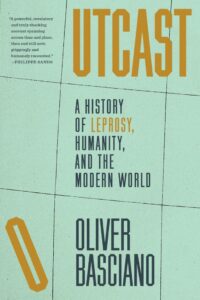
From Outcast A History of Leprosy, Humanity, and the Modern World by Oliver Basciano. Copyright © 2026. Available from Graywolf Press.
Oliver Basciano
Oliver Basciano is a journalist and critic. Outcast won the RSL Giles St Aubyn Award for Non-Fiction. He is editor-at-large at ArtReview, and his work has appeared in The Guardian, Times Literary Supplement, and e-flux Criticism.