








How Is Writing Like Nursing?
Theresa Brown on the Strange Alchemy of Moving Between the Two Disciplines
This first appeared in Lit Hub’s Craft of Writing newsletter—sign up here.
My writing career began unexpectedly, with a terrible and surprising patient death. I had been a nurse for only a few months, and nothing in school had prepared me for what happened: a patient who was ready to go home began coughing up blood and died. Haunted by the memory, I thought I might feel better if I put the experience into words. That didn’t work, but I actually liked the piece I wrote and sent it to The New York Times. When the Times published the essay, the response I heard most often was, “This is a voice we never hear—the voice of a bedside nurse.” I was tremendously lucky—that one column launched my writing career. But I also worked hard and embraced my writing as a mission: to tell the story of a job I love that often does not get the recognition or respect it deserves.
How, though? How does one become a writer of narrative nonfiction after getting a PhD in English, becoming a mom, and then going back to school to train as a nurse? My expertise was in academic writing, which I’d honed when literary theory was au courant. A lot of the “theory” I read in graduate school was incomprehensible, but even as I struggled to understand terms like “deconstruction” and “episteme,” my own writing took on the same dense, jargon-filled style of the academic work that often frustrated me.
As a nurse, though, I gratefully left all that verbal complexity behind. Nursing care is very concrete. Patients need their daily medications and their hearts, lungs and bellies must be listened to. Some patients need oxygen for shortness of breath, while others require narcotics for excruciating pain. There is nothing abstruse about nursing and I did not think about writing at all as I concentrated on learning the job.
Until that patient died so suddenly and horribly that I had to write to make sense of it. “At my job, people die,” the essay begins, and proceeds through being at the bedside, helplessly watching a resuscitation team try to save a patient who could not be saved. The experience was painful and bewildering. I knew that people died, but I had never had someone die in front of me while looking pleadingly into my eyes. My feelings came out in a torrent of words that ended, to my surprise, on a note of hopefulness: “What can one do? Go home, love your children, try not to bicker, eat well, walk in the rain, feel the sun on your face and laugh loud and often, especially at yourself.”
Some kind of alchemy took place when I began writing as a nurse. I turned the intellectual and emotional complexity of the job into spare direct human prose, choosing straightforward language to mirror the nature of the work itself. I also tried to never complicate my storytelling with verbal abstractions.
The one aspect of my doctoral training in English that I didn’t leave behind when I became a nurse-writer was my love of and appreciation for literature. My very first essay, the one that began my career as a nurse-writer, was woven around John Donne’s poem “Death Be Not Proud.” I had loved that poem, but after my patient’s sudden death I found it hollow. My second book, The Shift, might not have gotten written were it not for a few lines of poetry by William Blake. The book is about one shift during which my assumptions about two different patients were proven completely wrong. From that shift I learned that each nurse has twelve hours and twelve hours only to look after each of our patients. One windy day, a friend and I went for a walk to talk over this book idea. She quoted Blake to me in response: “To see a World in a Grain of Sand / And a Heaven in a Wild Flower / Hold Infinity in the palm of your hand / And Eternity in an hour.” Those lines of poetry convinced me that my idea could work, that I could show not just a day in the life of a hospital, but all the life in a day in the hospital, and Blake’s poetry runs through The Shift.
People used to ask me if I regretted giving up teaching English, leaving academia, to become a nurse. The answer I always give, which is true, is no. I love the work. But if I had not become a nurse, I also would never have done the writing that my nursing career made possible, and I love the writing, too. And, without my writing, I would not have become a well-known advocate for this job I love. So, the mission will continue. As I provide care I will also, as best I can, tell the story of nursing.
__________________________________________
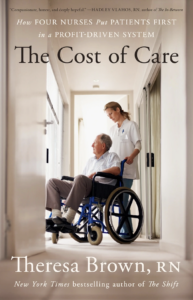
The Cost of Care by Theresa Brown is available via Algonquin Books.

Theresa Brown
Theresa Brown, RN, author of the New York Times bestseller The Shift, has been a contributor to the New York Times. Her writing appears on CNN.com and in the American Journal of Nursing, the Journal of the American Medical Association, and the Pittsburgh Post-Gazette. She has been a guest on MSNBC Live and NPR’s Fresh Air. Her first book was Critical Care, and during what she calls her past life, she received a PhD in English from the University of Chicago. She lectures nationally and internationally on issues related to nursing, health care, and end of life.