How I Learned to Love My Dog By Observing His Behavior
Anna Heyward: “If I watched and waited, open to what Freddie could show me, something would become clear.”
It was Sunday, a week since Freddie had arrived. He and I had just gone for a walk in the park near my apartment, our second of the day. In the park, old people sat around tables playing mahjong, and children swarmed the playgrounds. Forty-five minutes later, when we got home, I sat down on the couch, my shoes still on. Freddie jumped up beside me and stood to put two feet on my shoulder, tail wagging, watching. He yawned, producing a breath cloud of warm stink.
We’d been together all weekend, usually no more than three feet apart. I didn’t know what he wanted. I felt the weight of his expectancy in the air. I gave him one of his chewy treats, and he was occupied with that for a few minutes. Then he was back, wet nose on my cheek. It was only one PM, and I’d reached the end of what I knew to do with him: walk him, make sure he eliminated, feed him, let him do the one play activity he’d shown he could do. How did dogs spend their time?
Normally, by this time on a Sunday, I would have opened my computer and become absorbed for several hours in something joyless and not very useful, such as opening emails and marking them as unread again. But today there was Freddie, snuffling in my ear and staring at me. I turned and made eye contact with him, and his tail started wagging. I grew more uneasy. I was accountable, not alone, and I needed to do something more.
I realized, almost nothing about him. About how and why he did the things he did, what created or extinguished his responses to the world around him.
As a way of quelling the uncertainty, I went to my desk and found a notebook. On its cover I wrote “Freddie Log” in black pen and then on the first page began to list the events of the week. In doing so, I saw that I had done very little that didn’t involve the dog. I’d canceled plans, left events early, and skipped meals, appointments, work tasks, and other basic things that I couldn’t do with the dog, like grocery shopping. I was shocked to see, too, that I had spent nearly five hundred dollars on supplies (toys, food, treats, beds, items at the pet store that promised to resolve the separation anxiety, like pheromone sprays, calming blankets, toys that emitted the sound of a heartbeat—none of which had), all on my credit card, all without thinking about it or having planned to.
I hadn’t learned anything about how to manage his attention and energy. I knew, I realized, almost nothing about him. About how and why he did the things he did, what created or extinguished his responses to the world around him. I felt suddenly confronted by the fact that there was another being in my home, that he was dependent on me to understand him, and that my actions, and what I knew and understood, would determine his experience of life.
*
In Charles Darwin’s On the Origin of Species, published in 1859, there’s a chapter on what he called “instinct,” or the “natural” behavior of animals, which considers behavior as part of the theory of evolution, with its principles of heredity, fecundity, and variability. Before Darwin, much biological observation was done according to a taxonomy created by the Swedish botanist Carl Linnaeus, which organized species according to the hierarchical order in which they had been created by God. Animal behavior wasn’t really a formal subject of scientific inquiry at the time, but with Darwin, we learned to look at life as a series of natural processes subject to change rather than as arbitrarily granted and fixed forms. His writing opened a new set of possibilities for thinking about what animals did, and why.
In Europe, in the early twentieth century, a field of science called ethology coalesced around the Darwinian idea of “natural” behavior. Early ethologists worked by going to an animal’s habitat, because that was where the animal and its behavior evolved. These observations would then be used to create an ethogram—an inventory of typical behaviors performed by the animal, broken down into classifications: standing, foraging, digging, bathing, and so on. These units allowed for measurements like frequency and duration. Ethologists eschewed artificial settings like laboratories, and all the many hours of watching the animal in its natural habitat and creating detailed catalogs didn’t necessarily culminate in what we think of as the more traditional pursuits of science, things like forming hypotheses and conducting experiments to test them. For early ethologists, pure observation and description were worthy on their own.
When, later, I began reading the sometimes eccentric, sometimes outdated, and sometimes very sensitively prescient works of early European ethologists like Konrad Lorenz and Niko Tinbergen, I recognized the descriptive inventory-making approach as a way to demystify the world and detach it from Creationism from an unlikely source: The Gate of Angels, a novel by Penelope Fitzgerald set in 1912, around the same time that the early ethologists were working.
The novel pretends to be a love story, but it’s really a story about metaphysics, belief, and the limitations of both science and religion in explaining the things that happen in life. Early in the novel, Fred Fairly, one of the protagonists and a young physicist who holds a fellowship at Cambridge, is preparing to tell his father, a clergyman, that he is no longer a Christian. After a few years of training as a scientist, Fred is ready to dedicate his life to the study of nature and matter. He is done with the spiritual, and with the “comforting unseen presences” of God. From now on, he plans to use only the handrail of material reality: Fred has become “a man with a mind cleared and perpetually being recleared (because there was a constant need for that) of any idea that could not be tested through physical experience.”
Religion and God depend on mystery, Fred wants his father to understand, and on keeping things unexplained. What’s more useful in understanding the world is a straightforward accounting of it—a kind of double-entry inventory of its characteristics.
“You see the resemblances between things and the continuity of one idea from another, and gradually, through many lifetimes, everything becomes explained,” Fred says.
The true meaning of a thing, Fred insists, is nothing more than what we can see and detect; our job is not to obscure it or to assign it to another world, but just to give it an account. “What is completely described,” he observes, “is completely explained.”
To be curious about something, to observe without goal or agenda, appeared to me as the possibility for a deep kind of understanding and a direct kind of love.
Darwinian ideas, and the many scientific inquiries that came from them, including ethology, had to replace the idea of an all-causing God, and the idea that things existed just because. The radical implication was that something like behavior, something that can be described, could be explained. Ethologists differed from their predecessors, who often looked at animals as instruments of God, and therefore beyond true explanation, and also from many of their colleagues and successors, for whom animal behavior was seen as a conduit to the study of humans—classical ethologists were interested in describing animal behavior for its own sake. To believe in natural and physical processes as things with internal and consistent logic means that, through description, we can arrive at an explanation of the thing in and of itself. To stare at something for hours on end was a basis for understanding.
Konrad Lorenz wrote about behavior as a taxonomic character—a diagnostic tool that reveals one’s place in the world. In a standard ethogram, a cat’s stalk and pounce is classified as “hunting” when in the presence of prey, but as “play” when performed by a juvenile with a conspecific—the ethogram ascribes a purpose to the action, and reveals the way the cat conducts its life and interacts with others. As a taxonomic character, the relationship between behavior and other elements of life is made clear. An accurate description can illuminate other, interlocking parts of the world.
When a male three-spined stickleback, a small, spiky seawater fish studied by Niko Tinbergen, leads a female to his nest by swimming in a zigzag pattern like a sort of courtship dance, she enters and spawns; the dance goes under “reproductive behavior,” and we have given ourselves a way to look at it and think about it—and to understand it. The setting, time of year, temperature and conditions of water, and circumstances of the nest are drawn into the definition of behavior. Through the ethogram, behavior is made part of a system organized by natural forces, which gives it meaning. It’s through description that the nature of things is revealed.
On that Sunday, as Freddie and I sat together in the living room, he watched me and I watched him back. He began making a low, plaintive sound in his throat. Suddenly, he stopped, turned his head to the window, and contracted the muscles at the base of his ears to make them stand up, listening. After three or four seconds, he looked away and started up the plaintive sound again.
I did nothing, waiting—I wasn’t entirely sure what to do. But I did sense a new possibility as I held the notebook. Nothing he did was not of interest to me, because what I needed to do was to learn what he was. To be curious about something, to observe without goal or agenda, appeared to me as the possibility for a deep kind of understanding and a direct kind of love. If I watched and waited, open to what Freddie could show me, something would become clear.
_______________________________
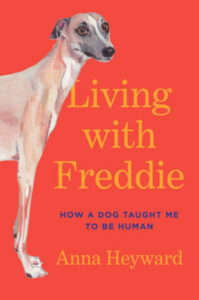
Excerpted from Living with Freddie: How a Dog Taught Me to Be Human by Anna Heyward. Copyright © 2026 by Anna Heyward. Available from Random House, a division of Penguin Random House, LLC. All rights reserved. No part of this excerpt may be reproduced or reprinted without permission in writing from the publisher.
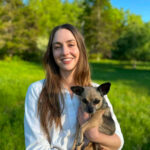
Anna Heyward
Anna Heyward worked on the editorial staff of The New Yorker and has an MSc in animal behavior and welfare science at the University of Pennsylvania School of Veterinary Medicine. Her writing has also been published in The New York Times, The New York Times Book Review, T, The Paris Review, and Vogue, among others. She was born in Melbourne, Australia and lives in New York.