How Howard Zinn’s Hard Lessons in WWII Shaped His View of the World
Dave Zirin on the Political Awakening of One of America’s Great Historians
Royan is a resort town in the southwest of France right on the Atlantic Ocean. Home to twenty thousand residents, a vibrant fishing community, and five beaches, it transforms over the summer when ninety thousand tourists swarm onto the scene. Most are there for the sunshine and advertised topless beaches. But Royan also attracts people interested in the unique ways that the town’s homes and buildings were built in the modernist style of the 1950s. Given that Royan was settled twenty-five hundred years ago, the architecture begs the question of why, instead of being an archaeological site, the town is studied for its total 1950s style. That’s because this onetime refuge of Pablo Picasso was bombed to hell less than three weeks before the official end of the Second World War. France had already been liberated, but Royan was said to be the site of a smattering of Third Reich dead-enders. They were the holdouts, remnants of the times when Nazi generals prioritized operations in Royan because of its coastal military value.
What could have been a police action was instead a full-scale bombing raid that killed three thousand civilians and just twenty-three German soldiers. Howard Zinn was one of the airmen who rained death on Royan. The bombs that Zinn and other US and British soldiers used also marked a new era of barbarism during wartime. These missions constituted the first time an army dropped massive canisters containing what Zinn heard officers call “jellied gasoline.” This jellied gasoline would stick to skin and burn it to the bone. Its stickiness meant that no amount of water could stop a body from feeling as if on fire. Zinn did not make the connection until years later during America’s war in Vietnam, but he had been dropping what became popularly known as “napalm.” In his book The Politics of History, he wrote: “At the time, it seemed just another bombing, with a slightly different target and a slightly different cargo of bomb…I remember distinctly seeing, from our great height, the bombs explode in the town, flaring like matches struck in a fog. I was completely unaware of the human chaos below.”
Zinn in the years to come was vexed both morally and politically by the impersonality of the killing as a bombardier.
Zinn wrestled with what he did in Royan, how his superiors could order the bombing and why he obeyed, for the rest of his life. While Zinn left the service in a state of personal moral crisis, he entered an eager enlistee who immediately disavowed the get-out-of-the-war-free pass he had been given.
“I could have remained in the Brooklyn Navy Yard, where I had been working for three years, and where our building of battleships and landing ships kept us exempt from military service,” he recalled. “But I could not bear to stay out of a war against fascism. I saw the war as a noble crusade against racial superiority, militarism, fanatic nationalism, expansionism.”
Without the knowledge of his parents, Zinn signed with the air corps. He preferred fighting the Nazis to fighting his parents, who, even though they supported the war against fascism and even though their own lives had taught them the dangers of leaving a deranged, authoritarian bully unchecked, already had one son, Bernie, overseas. As a result, Zinn couldn’t bear doubling their stress load, both by his being in harm’s way and their taking a financial hit by losing his dependable shipyard check. But Zinn wanted to stop the spread of fascism and would not be deterred. Upon receiving his letter of induction, he chose to walk it to his local draft board in Brooklyn instead of going to the post office.
Getting into the air corps was a snap for Zinn. The written exams were a breeze, and hard work in the shipyard, not to mention the union basketball team, had kept him in good enough shape to pass the physical fitness tests. Zinn at the time was well over six feet tall and just a hundred fifty-five pounds. “I was skinny,” he recalled, “but the military seemed not to mind.”
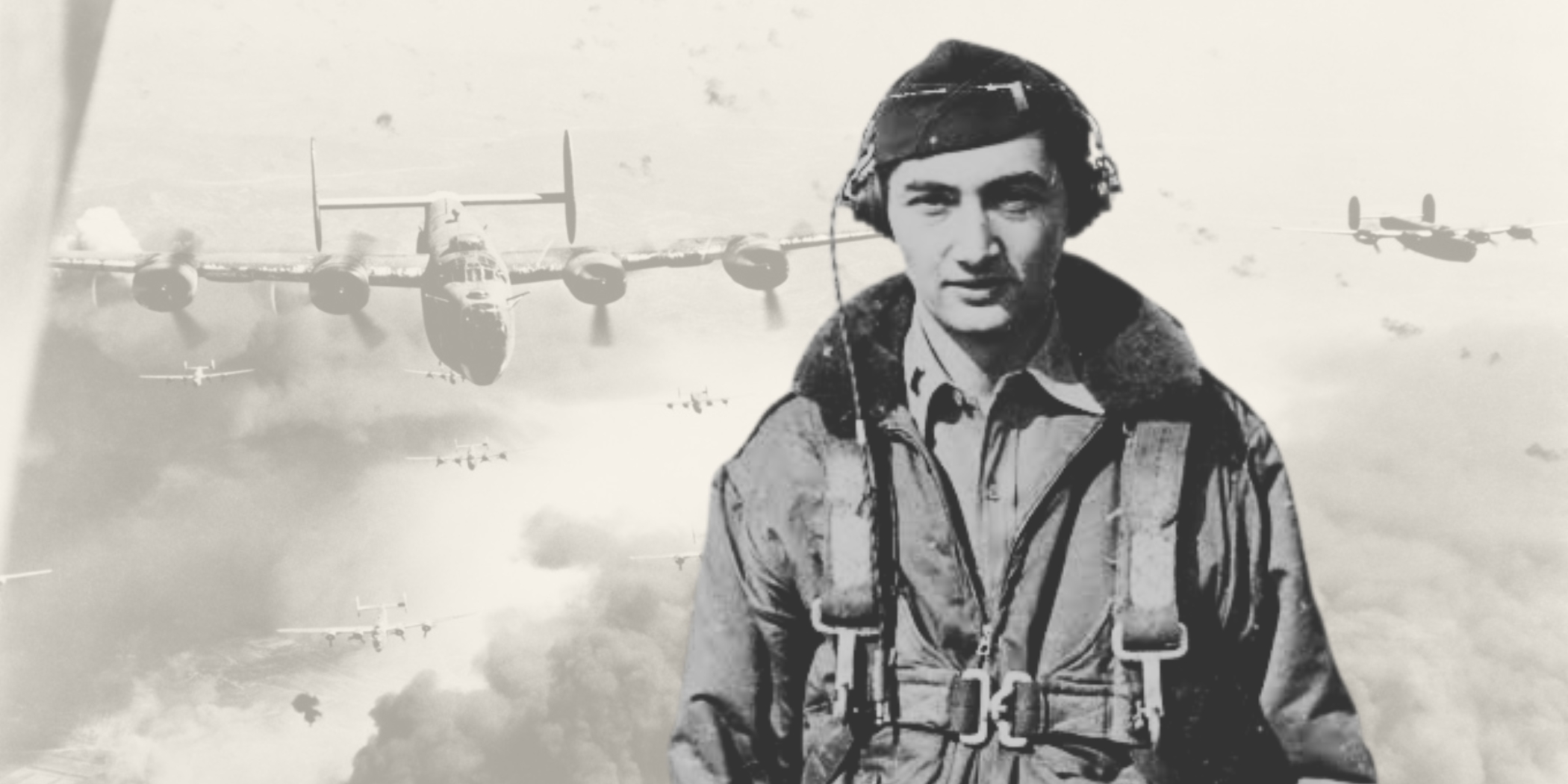
Zinn was assigned to be a bombardier and took to it quickly, graduating from flight school as a second lieutenant with gold bars on his lapels.
The bombardier is a cultural archetype: the daring airman risking life and limb to fight the war in the skies. Zinn saw that when he looked in the mirror: a human arsenal against fascism. However, in the future Zinn would feel an affinity for a different kind of bombardier. Save for Snoopy, the military airman in literature is perhaps most famously personified by John Yossarian in Joseph Heller’s Catch‑22, a book Zinn would someday count among his favorites. Yossarian is considered a classic antihero who detests war and believes words like “courage” and “honor” are ridiculous abstractions that will most likely get his fellow airmen killed. He, with an uncaring shrug, refers to himself as a “coward.”
By the book’s end Yossarian finds his heroism, but not through embracing the war. Instead, he refuses to take a deal from his superiors: an honorable discharge and return home if he will become a spokesperson for the greatness of the military. Instead, he goes AWOL to search for a fellow bombardier and friend who was shot down, but whose body was never recovered. Zinn also lived through some of the absurdities that Yossarian encountered. One of Zinn’s teaching assistants at Boston University in the 1970s, Cheyney Ryan, told me that Zinn shared with him that “if you were a bombardier, you were responsible for your own bombing equipment, so you had to make sure that it was in good working order. They would then line you up in the morning and say, ‘Alright, who wants to volunteer to go?’ And you had spent so much time doing this shit that you thought, ‘I might as well volunteer. I don’t want to go through the hell of getting ready again.’”
A bombardier protagonist fit Heller’s argument because it’s a statement about how bizarre it is—whether in fiction or nonfiction—that we crown bombers as being the apex of war heroism. These are not the grunts in the mud. Their killing is from thousands of feet in the sky as they rain death with consequences they will neither see nor experience. Zinn in the years to come was vexed both morally and politically by the impersonality of the killing as a bombardier. He spoke in 2005 with significant insight into the minds of the military drone operators in places like Creech Air Force Base in Nevada, dropping bombs on both military and civilian targets in the Middle East. He knew that being a distant deliverer of death came with its own cost. Sure enough, in the coming years, suicide rates among drone pilots spiraled.
Whether war was ever justified or whether there could ever be a “good” war was not the only new idea bouncing around Zinn’s head when he was between the ages of twenty-one and twenty-three. While he had had some Black coworkers in the informally segregated Brooklyn shipyard, he had never thought much about racism beyond the stories of Richard Wright. At first Zinn, in a manner he once described as “so typical of whites in this country,” did not notice the separate and unequal treatment of Black soldiers precisely because in the segregated basic training at Jefferson Barracks in Lemay, Missouri, they were largely out of sight and out of mind. This was the case until one day when Zinn took a long walk around the fifteen-hundred-acre base and looked up from daydreaming to see he was the only white person among a company of soldiers.
“Suddenly I looked around and there were black people!” he wrote. “I was astonished! I wasn’t aware of their existence [on the base]. It was America; it was really America where here are the blacks and there are the whites in a white neighborhood and they’re not even aware of blacks living twelve blocks away.”
In a practice he’d repeat during the Civil Rights Movement, Zinn observed a scene of Black fellowship in silence and it became etched in his mind.
“What I remember most vividly is a squad of black soldiers taking a break on the grass near me, singing, ‘Ain’t Gonna Study War No More!’ I was startled. I had never heard white troops sing that.” This was a eureka insight from Zinn, that parts of America lived in a distinct world from the “America” he knew. Then, once overseas, packed together with white and black troops, Zinn saw what systemic racism looked like up close, and he was irrevocably changed.
“I was with thousands of other soldiers on the Queen Mary, an enormous luxury passenger liner converted for troop use. There were sixteen thousand men who went across [a quarter of whom were Black]. We were all on the ship according to our race; the blacks were in the hold of the ship next to the engine room and the whites were above them. The officers were on the highest deck.”
Not only did the Black soldiers sleep adjacent to the cacophonous engine room, but they were also the last to eat, meaning they served themselves the coldest and most crusted over of the already unpalatable Army food. For the first time in his young life, Zinn practiced what would become known as “allyship.”
“In the dining hall, there were four shifts for eating for sixteen thousand men,” he recalled. “Imagine the huge dining hall that seats four thousand. It’s hard to imagine, right? Three shifts were white and the fourth shift was black. Each shift had to wait until the previous shift was finished. But one day the black shift came down before the third white shift had finished.”
As potential intermingling threatened this segregation, a white sergeant started berating the Black troops who already had their trays, shouting at them to dump their food and clear the room. Zinn confronted him in front of the Black troops. Lieutenant Zinn informed the sergeant that he could stay and finish his meal or throw it out and leave. At one point, Zinn recalled angrily shouting, “What in the hell is this war all about, Sergeant?” It was a sign that for Zinn, his belief as to what this war was in fact all about differed from that of the government and the armed forces. Zinn—and he was hardly alone—saw a war against fascism as one against racism and anti-Semitism, a war to put a stake in the heart of white supremacy. For many, this belief in the war’s aims would be shattered.
The young Zinn wore blinders in regard to the injustices the USA was perpetrating during the “Good War,” wrongdoings he would later write about in detail, such as the mass incarceration of Japanese Americans and the refusal of the United States to give safe harbor to the many Jews fleeing the Nazi Holocaust. He has described being “war-crazed, wanting to rack up more missions, not seeming to understand that the more missions we flew the more likely we were to die.”
These bombing missions were immersive. A crew would have to wake up before the crack of dawn in order to have five hours of meetings before daybreak. The planes were dangerously cold, so the men had to wear electrically heated suits along with flak vests, which Zinn described as “a heavy leaden monstrosity we didn’t bother to wear.” They also had massive helmets that, despite also being heavy leaden monstrosities, were worn—at least until superior officers turned their backs. And of course, the last thing crew members did was make sure their parachutes—fortunately never used—were packed properly. Zinn eventually received the Air Medal and two battle stars for distinguished service. He was also registered as a “qualified marksman” with a pistol, an accomplishment far more difficult than receiving that designation with a rifle.
As the months in combat wore on, the always politically minded Zinn sought out fellow troops to talk to about radical politics and there was no small number willing to oblige. More than one million people, it is estimated, passed through both the Communist Party USA and the many organizations its members launched in the 1930s. The people influenced by their politics overwhelmingly supported and joined the war effort against the Nazis, in part because of a commitment to fight fascism, which was seen as the mortal enemy of the international workers’ movement. It was also the case that by 1941, Stalin was no longer interested in a truce with Hitler—a truce that had caused many to leave the party. Instead, after Germany invaded the USSR, Stalin turned on a dime and howled—correctly—that Germany was preparing to wipe the Russians out. In a November 1941 speech—given one month before the Japanese bombing of Pearl Harbor—Stalin sounded the alarm: “The German-fascist invaders are plundering our country, destroying the towns and villages created by the labors of the workers, peasants and intellectuals. The Hitlerite hordes are murdering and outraging the peaceful inhabitants of our country, having no mercy on women, children or old people. Our brothers in the regions of our country seized by the Germans are groaning under the yoke of the German oppressors.”
Zinn’s illusions in the war, challenged already by lefties in the ranks and by seeing his friends killed, were permanently put to rest due to the bombing of Royan.
CPUSA members as well as many ex-members and fellow travelers joined the armed forces with gusto. It also meant that Zinn met and debated with people who had different analyses of the war beyond fighting the “Hitlerite hordes.” He met a fellow bombardier who said to him, “You know, this is not a war against fascism. It’s a war for empire. England, the United States, the Soviet Union—they are all corrupt states, not morally concerned about Hitlerism, just wanting to run the world themselves. It’s an imperialist war.”
Zinn answered sharply, “Then why are you here?” The man replied, “To talk to guys like you.”
This argument made by the unknown soldier—which included a sly criticism of the USSR—affected how the war-crazy Zinn was starting to reassess the entire operation. Zinn found himself “astonished and deeply impressed” that someone would risk his life on these planes and do so not just to defeat Nazis, but also to “wage his own political warfare inside the military, to persuade others of his point of view.” Two weeks after they spoke, this bombardier was shot down with his crew. Everyone was killed. Perhaps this was the seed of a famous Zinn quote made four decades later after Reagan’s bombing of Tripoli: “There is no flag large enough to cover the shame of killing innocent people.”
Zinn also started to think about a theme he would tragically revisit often: how the powers that be can manipulate the masses to think that war is at worst a tragic necessity. “They always claim to be fighting for democracy, for liberty, against aggression, to end all wars—but is that not a handy way to mobilize a population to support war, indeed, absolutely necessary because people do not instinctively want to fight?”
He certainly felt like he was part of the “good guys” making the skies safe for democracy. He told his Spelman College colleague Professor Henry West the story about how 99 percent of the time, he was so many miles up in the sky that he had no idea where the bombs were falling. But then toward the war’s end, his crew flew low to drop food and medicine packages onto starving, desperate populations. As the Germans had fled from Holland, they blew up the dams while in retreat, thus destroying crops and sparking a famine. When Zinn looked down toward the end of his food- and medicine-dropping humanitarian run, he saw “Thank You” spelled out in tulips.
Zinn began to think about whether the war was fruit from a poisoned tree: how could the Allied powers be seen as unimpeachable good guys if they also had histories drenched with “racism or colonialism or slave labor camps—one or another of which was a characteristic of all of the Allied powers[?] And of course fascism and Nazis were worse, but was war the answer? Was the only way to deal with fascism to engage in a bloodbath which left forty million people dead?”
It was two of the forty million dead people who pushed Zinn further into doubt. “I knew I was lucky to be alive, because my two closest Air Force friends—Joe Perry, nineteen, and Ed Plotkin, twenty-six—died in the last weeks of the war. They were my buddies in basic training. We marched in the summer heat together. We went out on weekend passes together. We learned to fly Piper Cubs in Vermont and played basketball in Santa Ana, California, while waiting for our assignments.”
When Zinn was back in New York City, he looked up Ed Plotkin’s wife. The night before Ed was to be deployed, he had gone AWOL from Fort Dix for one more night with her. She told Zinn that Ed and she had that night conceived a child who would never meet their dad. Years later at the end of class at Boston University, someone passed to Zinn a note that read simply, “Ed Plotkin’s daughter wants to meet you.” Zinn was able to tell her about the father she had never met.
But Zinn’s illusions in the war, challenged already by lefties in the ranks and by seeing his friends killed, were permanently put to rest due to the bombing of Royan. After the United States dropped atomic bombs on Hiroshima and Nagasaki, he felt that he was a party to a historic war crime. In August of 1966, Roz and he traveled to Hiroshima, Japan, at the invitation of a peace group. “I look back at Hiroshima, I look back at the bombings I participated in, and I feel sick,” he wrote afterward. “I learned a lot about how it is possible to commit atrocities. Hiroshima and Royan were crucial in my gradual rethinking of what I had once accepted without question—the absolute morality of the war against fascism.”
Over the course of decades after the war, Zinn sent the Department of Defense letters requesting access to the records of his bombing runs. Some of these asks were successful; others were stonewalled. He kept the few files they did send him in a folder called “WWII Photos of Bombings and Planes,” which he kept throughout his life. It included aerial photos of targets in Royan and elsewhere. At the bottom of the folder, he wrote two words: “Never Again.”
____________________________
From The People’s Historian: The Outsized Life of Howard Zinn by Dave Zirin. Published by Dutton, an imprint of Penguin Publishing Group, a division of Penguin Random House, LLC. Copyright © 2026 by Dave Zirin.

Dave Zirin
Dave Zirin is the sports editor for The Nation, a columnist for the Progressive, and the author of eight books on the politics of sports, including What’s My Name, Fool?: Sports and Resistance in the United States and A People’s History of Sports in the United States. He was named in Utne magazine’s “50 Visionaries Who Are Changing Our World” and was a finalist for the 2016 PEN/ESPN Award for Literary Sports Writing.