How an Egyptian Prison Poem Came to Structure My Memoir
Abdelrahman ElGendy on the Way Language Can Build a Relationship Between Author and Reader
I wrote my memoir, Huna, in English, which is to say I wrote it inside a contradiction. Huna is a memoir of the Egyptian revolution, six years of political imprisonment in Egypt, and my US exile. It enters English already burdened by the ways such stories are often received in this language: the Arab prison memoir as a torture spectacle for a detached reader on the other side of the world, where suffering can be safely consumed, at worst, as evidence of the Other’s barbarity, and, at best, as a well-intentioned exercise in goodwill empathy with the unfortunate Other “over there.” It’s a genre that often recalls what the Palestinian poet Fady Joudah described to me recently as a “parody of the self,” the self made to perform a recognizable, palatable version of its wound, even in dissent, in order to be legible.
That tension of writing Huna in English sharpened during the past years of genocide in Gaza. English was not only the language used to lubricate the killing, euphemize it, and authorize it; it was right there, stamped onto the missiles and rockets genociding Palestinian kin. It became impossible to write on as though this tension had not permeated my every line.
Western publishing tends to carry this pressure toward legibility: a bit of translation here, another italicization there, a footnote, perhaps, a handrail before the assumed target reader enters the foreign room. I’m not resistant to explanation, per se, on the contrary: it can indeed be craft, care, part of what a writer owes a reader. But in the particular political tension of this story, in this language, moving through this literary marketplace, uncritical explanation can also demand a steep price from one’s dignity. How transparent must a world make itself before the assumed reader deems it worthy of encounter?
This is what the duality of the ‘anbara’s language and content reaches toward: an invitation toward, more than anything, a mode of relation between author and reader.
So, while writing Huna, the question was no longer only why I had chosen English, but what English demanded from the book in return. I have written elsewhere that “when I reach for Arabic, I reach for radical love; when I reach for English, I reach for currency.” Currency as circulation, political reach, the ability to name. Also, the ability to build transnational solidarity across the very borders crushing our bodies. The craft problem, then, was how to write, imperfectly, a dignified work of literature in the currency of English without allowing English to become its sovereign.
I found it helpful to think alongside Édouard Glissant’s concept of the “right to opacity”: that a text need not submit to transparency before intimacy can begin. Why equate the sense of welcome into a text with mastery and conquest of the writer, rather than view opacity as an invitation into another kind of relation?
And so, sometimes I elaborated when elaboration felt like care. Sometimes I let meaning gather through rhythm, gesture, context when the demand for explanation enacted violence. And sometimes I left things untouched, inaccessible to the non-Arabic-speaking reader. But the most critical place where I worked through that tension is the very structure of the book.
Huna is organized in the form of an ‘anbara, an old Egyptian prison call-and-response tradition through which prisoners speak across cells, answering one another through the naddara, the small meshed opening in a cell door. The ‘anbara prison poem begins when a prisoner presses their lips againt a naddara and holler عنبر، كله يسمع, calling at the cell block for ears and tongues, for even the steel that made up the building, to abandon all else and grant the caller undivided attention. Then comes a ten-line poem. Most political prisoners adopt the late Egyptian socialist poet Ahmed Fouad Negm’s ten-line version of the ‘anbara opening, crafted during his eighteen years as a political prisoner himself from the fifties to the eighties.
I’d come to love ‘anbaras, how they carved out space for celebration, mourning: to announce a comrade’s release, ease a father’s sorrow over his distant newlywed daughter, narrate a story, or toast a reduced sentence—a communal holding of sorts.
Huna takes the holler and the ten opening lines of Negm’s ‘anbara as its structural frame. Each becomes an Arabic section header, untranslated, rendered as a lettering artwork by the Lebanese Arabic type designer Kristyan Sarkis.
If the reader does not know Arabic, they would encounter those headers that frame the book only as shape, weight, curves. The text is held together by something they cannot access, and so some may experience these foreign inscriptions as alienating. That discomfort is precisely where I wish for the reading to begin.
And because opacity is not refusal for refusal’s sake, I did not want it to become another parody, with English cleanly standing for empire and Arabic for resistance. However beloved Arabic is to me, I know enough to understand that languages do not fit neatly inside the political allegiances we assign them. Arabic has been the language of our prison poems, yes, but also our jailers; English has been the language of empire and one of the languages through which empire’s subjects have spoken back at it and reached toward one another.
The text is about relation; the text is relation. I do not have to become fully knowable to you in order for us to meet; you do not have to share my language to answer the call.
The ‘anbara makes sure the division is not Arabic insiders on one side and English outsiders on the other. An Arabic reader may understand every word of Negm’s ‘anbara and refuse its call, stand politically with the state that locked us up. Arabic gives them semantic access, but denies them political intimacy. A non-Arabic-speaking reader may understand none of those words and still feel called into what they enact and summon. This is what the duality of the ‘anbara’s language and content reaches toward: an invitation toward, more than anything, a mode of relation between author and reader.
The ‘anbara, then, also intervenes at the level of hierarchy. There is often an assumed dynamic in which a reader enters a text from the marginalized Other to offer empathy to the writer-victim. But in prison, the ‘anbara passes from the lips stuck to one meshed cell door naddara opening to the ears pressed against another. And if Huna itself is now an ‘anbara, a holler sent to my people behind bars, then the reader, too, can only receive such a ‘anbara by approaching the naddara of their own prison cell. The hierarchy is unsettled: the reader-empathizer becomes a prison mate; the writer-victim becomes a theorizer, the one issuing the call. The book’s structure then pushes the reader to confront the fact that nobody reads or listens unpositioned. What is the prison cell you occupy but have been blind to? Are you my accomplice or my jailer? Can you be honest about what cell door, what naddara mesh, you encounter me through?
In Huna, then I tried to take seriously what Sheira El-Malik, close-reading Glissant herself, posits when she says: “there is no distinction between literature and the worlds in which it is produced, or with methods or modes of study of that world; they all are of the world and they produce worlds.” I think of Huna’s craft, then, as a prefigurative literary microcosm for the world I wish to build, the world inside which I wish to make art and be in solidarity. The text is about relation; the text is relation. I do not have to become fully knowable to you in order for us to meet; you do not have to share my language to answer the call.
So, dear reader, hop to your cell door, press your ear to the meshed wire of your own naddara—listen in.
_______________________________
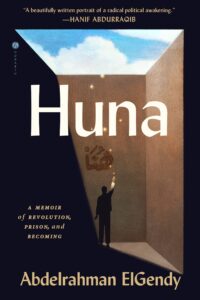
Huna: A Memoir of Revolution, Prison, and Becoming by Abdelrahman ElGendy is available from Hogarth, an imprint of Random House, a division of Penguin Random House, LLC.

Abdelrahman ElGendy
Abdelrahman ElGendy is an author and translator from Cairo. A winner of the Samir Kassir Press Freedom Award, he holds an MFA in Nonfiction Writing from the University of Pittsburgh, and his work appears in publications including The Washington Post, Foreign Policy, The Nation, and Guernica. His poetry and prose translations from Arabic appear in Ploughshares, Poetry Northwest, Literary Hub, Words Without Borders, and elsewhere. ElGendy’s work has received awards or fellowships from the Elizabeth George Foundation, the Heinz Foundation, the de Groot Foundation, Virginia Center for Creative Arts, and the Arab American National Museum. Huna is his debut memoir.