Grief, Rage, and Restraint: Zinzi Clemmons on Telling Her Own Story
Myriam Gurba in Conversation with the Author of Freedom: Essays
Being invited to interview a writer that one admires is so rewarding, and I’m thrilled that I got the chance to speak with Zinzi Clemmons about her new book Freedom: Essays. We need Clemmons’s voice. We need her critique. It was a pleasure to be present with her, watching her think from moment to moment as she carefully considered her answers to my questions. An intellectual who is as fierce as she is sensitive, Clemmons has major literary guts. She also has the power to inspire.
*
Myriam Gurba: Freedom: Essays is an elegant collection narrated with brilliantly cool restraint. How would you describe its sensibility?
Zinzi Clemmons: ‘J’accuse’ is the book’s spirit. Freedom is an indictment of systems, institutions, and people who have failed women, Black people, the young, the poor, and me. When I wrote my first novel, What We Lose, I hadn’t yet reckoned with much of the ugliness endemic to publishing. Freedom is different. I didn’t have to worry about selling it and that let me be confrontational. I love polemical rage, and I have the time for it. While writing Freedom, I was reading Riot Inside Me: More Trials and Tremors, an essay collection by Wanda Colemen. She’s an artist of rage, which I love, though that’s not the way that I write. Grief animates Freedom. In several essays, I return to the death of my mom, an experience fictionalized by What We Lose. That loss hangs over much of what I’ve written. I also tend to be very analytic and my anger and frustration go there. As a writer, I’m always trying to get to the root of an injury. I want to know and understand what wounds.
MG: Who is Freedom for?
ZC: Freedom is intended to change minds, and I’m very interested in speaking to young people, a category that I define broadly. When I started writing this book, I was thinking a lot about how wealth inequality affects Millennials. In 2019, an economic study indicated that Millennials had accrued less wealth than prior generations at their age. This inequality demonstrates a particular kind of economic and political harm that targets racially diverse and politically progressive young people. Donald Trump embodies the gerontocracy that inflicts economic inequality as punishment.
I hope that this isn’t clichéd, but my students influence my writing by keeping me honest.
Freedom opens with “Swan Song for the Republic,” a third-person essay inspired by Natalia Ginzburg’s fascist critique. Her writing addresses the impact of World War II, assessing how its weight divided older generations. I know that it’s a bit cliched to say this, but I find a lot of hope in the younger generation. If you pay attention to them, you can see that they’re experiencing a dynamic tension, a push and pull between nihilism and utopianism. “Freedom,” the collection’s title essay, addresses these tensions by setting them in a South African context. In the essay “Freedom Part 2,” I continue to explore these motifs within the framework of #MeToo.
MG: Adult supremacy is foundational to all other forms of supremacy, and your work exposes how infantilization is used to perpetuate abuse. I’m curious about how that awareness informs your classroom presence. How do your students and other young people shape your writing?
ZC: Every day, I learn from my son. Because of him, I’m constantly checking and reevaluating my assumptions. Being a parent requires me to ask myself, “Do I actually know better?” Being an effective teacher gave me the idea that I might be an effective mother. Teaching is connected to maternity, and my mother was an educator. For many years, she was a classroom teacher in Philadelphia and that role was one of the most important parts of her identity. She also administered the city’s Head Start program. When I was growing up, every dinnertime conversation in our home involved education.
I became a professor after the publication of my first book, and I’ve been teaching for ten years now. Some of the stories that I tell in Freedom came directly from my students. I write about Paul, the first student who I lost to suicide, which was horrible and gut-wrenching. His suicide also had a political dimension; Paul was one of the few Black students enrolled in San Francisco State. I hope that this isn’t clichéd, but my students influence my writing by keeping me honest.
MG: Whenever I feel the urge to apologize for repeating clichés, I remind myself that Toni Morrison praised them. She wrote that her stories would come to her as cliches and that clichés have staying power because they’re worthwhile. If cliches are good enough for Morrison, then they must be good enough for the rest of us!
ZC: Thank you for giving me that permission.
MG: You’re very welcome. Next, I’d like to dive into “Freedom Part 2.” This essay opens with a preamble that directly addresses your audience.
Perhaps you are reading this out of some morbid desire for gossip: to know the who, what, where…Women’s pain is always made into entertainment, our tears turned to dollars, black women especially…Why write? Why fucking bother? I almost stopped altogether because it brought me nothing but pain, but not writing brought me nothing but sadness, and then I found my answer, which is not an answer but a statement of being: This is who I am. This is me, being.
What follows is your account of surviving sexual harassment. You pseudonymize the perpetrator, transforming him into “The Author.” Can you discuss the narrative choices that you made around disclosure?
ZC: I started that essay in 2018. I had no idea if it would ever be published, but I felt that I had to write it. It began very raw, a play-by-play of everything that happened. I didn’t talk to many people about it as I was working on it because the subject isn’t something that I feel comfortable talking about. At later stages, I shared the essay with some writer friends. The author’s name was never part of it. I wanted it to explicitly be my story. It was about the emotional impact that the experience had on me. I’ve never been interviewed for a reported article about what happened. I tried to orchestrate an interview for years and I was devastated that one never took place. A huge PR machine promoted The Author’s point of view, making him look better by damaging me and the other people who spoke out against him. That really damaged my faith in journalism.
One of the things that I’ve learned to do is to give myself permission to step away when I need to.
I could have written my own exposé. I had the sources and the story, but I was, and am, too close to it. It’s emotionally difficult. I changed with this book. I was very unused to the idea of emotional preservation and self-care, and I had to learn how to do those things when I worked on this book. I’ve excluded some material from the essay to protect myself. That’s why I held back certain identifying details.
MG: What did that literary self-care look like?
ZC: After I had a collapse in 2018, I began intensive therapy. I was surviving major depression, feeling suicidal, and struggling with undiagnosed PTSD. I felt like I needed to step away from writing for a little bit. Therapy helped, and I had been out of it for about a year when I started editing Freedom. Going through that process made realize that I needed more support, so I went back to therapy to deal with the book’s impending publication and make it through revisions. I kept seizing up whenever I had to go back into “Freedom Part 2.” One of the things that I’ve learned to do is to give myself permission to step away when I need to. I’ve sometimes felt guilty for doing that, so I’ve also had to learn to forgive myself. I’ve always drawn self-esteem and self-worth from whole-heartedly committing all the time. Sometimes that was on the page. Oftentimes, it was with other people.
MG: When you talk about going back into an essay, you remind me of how essays become temporal and spatial substitutes. An essay can become ‘that time’ and it can become ‘that place.’ My own writing often becomes a surrogate place, and I think of it as its own geography. At times, the terrain is a haven. At other times, it’s a battleground. Do you ever think about what you’ve written as a place?
ZC: Yes, the vocabulary that I use for writing is often spatial. I have a line that echoes in my head, “Go to the page.” That is writing as a refuge. I’m working on my second novel right now, and it involves utopia as both place and idea. Writing has always been about expression, and it’s a place where I can create, be myself, and make my own worlds. Those ideas are so powerful and eternal. Those ideas inspire me in the classroom. I want to give my students this special place of their own.
MG: In the spirit of utopia, which of the essays is your favorite?
ZC: The first short essay. Maybe my feelings for it are less complicated than they are for the others. I like the kind of play that I was doing with the first-person plural perspective. It requires a fictional leap that’s fun.
MG: What does your utopia look like?
ZC: I’ll start by saying that I think we’re getting closer to it. There’s more consensus around what needs to go. So much of it comes down to economics, to not being freed from unethical labor practices. What does a society look like when people have houses and care for their children? What does a society look like where everyone cares for children? What does a society look like when we don’t have to survive sexual harassment because we need to pay the bills? I remember reading a study about homelessness and you know what solution it offered to the problem? Giving people homes. What we need is freedom. And that means freedom from certain impediments. So many obstacles are created by capitalism. Its reductive to say that it’s the only problem but it creates so many of the problems that we’re experiencing.
MG: In “A People Without a Nation,” you scrutinize the legacy of Richard Wright, examining him through a kaleidoscopic lens that centers and de-centers Afropessimism. You identify our present moment as one of desolation and uncertainty, and you emphasize that you look to Wright, wondering who will lead us forward. Do you think that we can be led forward?
ZC: I’ve been thinking and writing about Watler Benjamin’s essay on the concept of history, the one in which he articulates a profound skepticism in the narrative of history as progress. That essay, written in 1940 — the same year Native Son was published — is suffused with profound hopelessness for what was indeed to come. He died shortly after writing it, then of course World War II happened. Both Benjamin and Wright were visionaries who were able to see the historical moment very clearly and were swiftly punished for that vision.
I believe in the potential of visionary leadership, but it must be constantly exposed to critique and improvement. I’m not talking about a singular leader or writer, but rather the power of many voices to stand with courage and point in a different direction. I see that happening every day, so it is less an article of faith than an observation. Faith comes in the belief that these voices will drown out the conservative forces. I believe that will happen, and I think of that day with relish. It’s one of the only things that gets people like me out of bed: the knowledge that one day your enemies will be face down in the pile of shit they’ve created. It will happen, and when it does, I will laugh, either here on earth or in heaven.
__________________________________
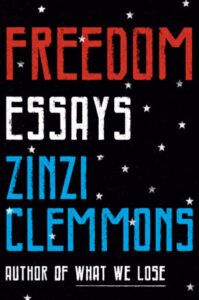
Freedom: Essays by Zinzi Clemmons is available from Viking Books.

Myriam Gurba
Myriam Gurba lives in California and loves it. She teaches high school, writes, and makes “art.” NBC described her short story collection Painting Their Portraits in Winter as “edgy, thought-provoking, and funny.” She has written for Time, KCET, and The Rumpus. Wildflowers, compliments, and cash make her happy.