From Birdsong to Sheep’s Eyes: How Nature Helps Us Tell Time
Cathy Haynes Explores the Many Ways One Can Discern the Hour by Paying Attention to the Natural World
We used to tell time by shadows shrinking or the midday glow over a mountaintop. We called a phase of darkness “cockcrow” and named lively flowers for when they open and close. When working, we may have synchronized a task by singing. We’d notice the quality of the light changing at dusk, and we might mark time at night by the motion of the stars.
*
Is it possible to tell time by the sequence of birds joining the dawn chorus?
In the mid-1800s, several English-language journals broadcast the curious news from “foreign journals” that “a German woodsman has invented an ornithological clock.” Before dawn in summer, according to the reports, the chaffinch—“the earliest riser among all the feathery tribes”—starts singing from one-thirty to two o’clock and is followed at half-hour intervals by the blackcap, the quail, the hedge sparrow, the blackbird, the lark, the “black-headed titmouse” (coal tit?), and finally, from five to five-thirty, the sparrow.
“Queer horology that!” quipped one of the journals’ editors. “Quarter-past quail, half-past sparrow and about eleven minutes of blackbird.” How absurd, indeed, to imagine wild birds giving time like the mechanical songsters on an ornamental clock. Naturally, living birds are not so strictly regimented. Dawn song depends on the season, the location, the variety of species present, and the impact of environmental change or habitat loss. The timing of the chorus moves earlier as the Sun rises earlier—and may be influenced by temperature, weather and moonlight. And of course, birds don’t pace themselves in precise half-hour intervals. The dawn chorus doesn’t follow an identical pattern from day to day or month to month.
Learning about the time kept by birds promises to draw us into a world of glorious song and vibrant patterns of life that feel remote in urbanized places.
Yet the general idea is borne out in experience: different species do join the dawn chorus in a broadly predictable sequence. Birds with better vision in low light are among the first to sing, like the large-eyed blackbird here in England. There’s “a correlation with height,” too, which may help explain why the skylark, rising up over the meadow, is another early singer.
*
My partner Rosie and I are staying at Court Lodge Farm in Sussex on the warm invitation of her cousins, farmers Marian and David and their daughter Clare. Later today, over a fine Sunday lunch, they will introduce us to their friend Danny, a retired chestnut coppicer. When I ask Danny how the chorus sounds where he lives, he answers without a pause. “It usually starts off with a blackbird—but sometimes a robin—just before it gets light. The blackbird really chortles away. Then, of course, all the others start coming in as it’s getting lighter.”
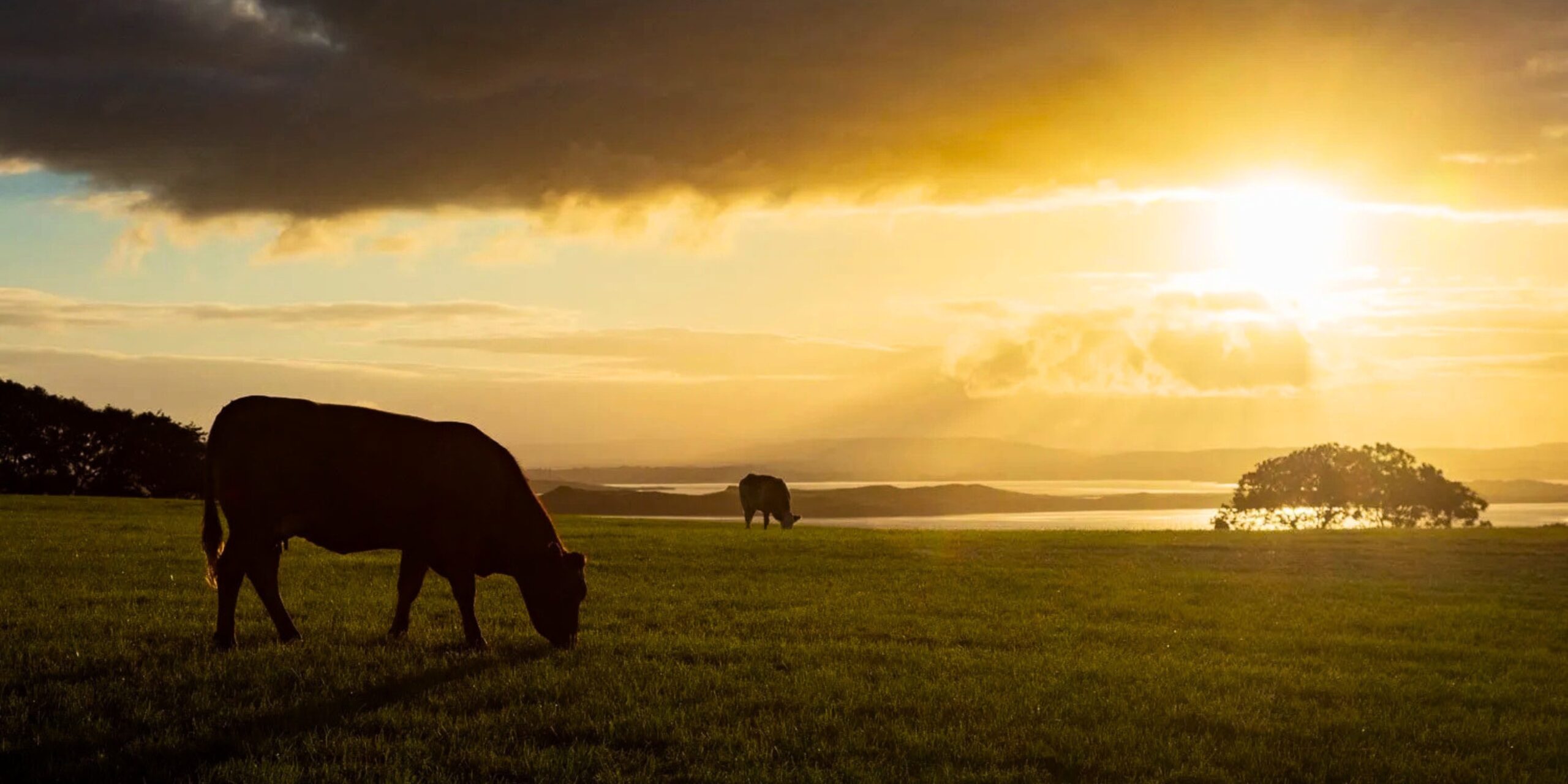
Everyone here is deeply aware of the rhythms of all the creatures in their surroundings. (David has shown us with excitement the different moth species currently on the farm.) For outdoor people, it’s not a revelation that the dawn chorus generally builds up in layers as different species join in. I’ve always had a broad sense of it, because the morning birdsong is a familiar part of life on the farm where I grew up. But only in the last few years have I begun to understand the pleasures of waking early to fully absorb the dawn chorus. And there’s nothing like the disorienting effect of standing in darkness in an unfamiliar place to quicken the senses and sharpen the ear. So, on this cold morning in early March, just before first light, I walk out into the farm. The robin and blackbird are already in beautiful voice, and soon I catch the trilling of the skylark rising over the cow meadow. And as the brightening world starts to resume familiar form, the glorious chorus swells with the songs of blue tits, goldfinches, chaffinches.
I wonder why the German woodsman’s “ornithological clock” was considered newsworthy in the 1850s and 60s. Perhaps the notion appealed to nineteenth-century tastes for cuckoo clocks and ideas about mechanistic, orderly nature. Or, possibly, it seemed delightful and curious because it appears to bridge two remote entities, the abstract calculative time of the clock and the vivid sensory qualities of time given by the rhythms of living creatures. For me as a city person now—and maybe for readers in industrial cities in the nineteenth century—learning about the time kept by birds promises to draw us into a world of glorious song and vibrant patterns of life that feel remote in urbanized places.
*
On Court Lodge Farm, after the daylight grows strong enough to see the treacherous puddles, I walk back from the songful pasture to the handsome old barns with black corrugated roofs. In the corner of the yard, the rooster is crowing away in boisterous voice. He started long before I went out at the end of the night, and didn’t seem to be tiring.
The cockerel’s bright call in the darkness lends its name to times of day around the world. In Old English, to give a local example, one part of the night after midnight and before dawn was named han-crēd (cock-crow). And there is a very old and widespread tradition that cockcrow marks successive times through the night. In Ireland, for instance, a diary written in the early nineteenth century lists how country people divided the day and night: midnight is followed by “first cock-crow,” “second cock-crow,” then night draws to a close.
Cockcrow could be a sound with profound significance. A rather lofty account given by Henry Bourne in the Antiquities of the Common People, published in England in 1725, says laborers distrusted going to work before cockcrow dispersed “the Midnight Spirits.” “Hence it is, that in Country-Places, where the Way of Life requires more early Labor, they always go chearfully to Work at that Time [cockcrow]; whereas if they are called abroad sooner, they are apt to imagine every Thing they see or hear, to be a wandring Ghost.” The sound of cockcrow, it was believed, prompted malevolent spirits to fly away. But cock-crow could be untimely: to hear it at the wrong time of day was considered to be a deathly omen.
*
The bird I heard rising in the dim light this morning—the lark—is “messager of day” in Chaucer’s Knight’s Tale and “herald of the morn” in Shakespeare’s Romeo & Juliet.
In “The Morning Quatrains” by the seventeenth-century poet Charles Cotton, after the cockerel crows to announce that “the day’s bright Harbinger,” the dawn light, is peeping over “the Eastern Hills”:
The merry Lark now takes her wings,
And long’d-for days loud wellcome sings,
Mounting her body out of sight,
As if she meant to meet the light.
Once the lark rises to welcome the day in Cotton’s poem, the human household springs into action. The “old Wife sits down to spin.” The milker takes her pail and goes to “strip” Mull the cow’s “swoln and stradl’ing Paps.” The laborers and manufacturers prepare to graft. The cultivator “yokes his Oxen to the Team, / The Angler goes unto the stream,” the woodman to the wood. The shepherd “drives her Flocks, / All night safe folded from the Fox, / To flow’ry Downs.”
Cotton paints a dainty, idealizing picture of English country people neatly divided by the labor they perform (and superimposed with classical imagery and symbolism). His poem suffers from the painful prejudices of his age. Yet Cotton plausibly describes a life where human routines are deeply entwined with those of other creatures and the cycle of the Sun. Where I stand now on this twenty-first-century farm, so much is different from Cotton’s day. Yet tangible links remain between the rhythms of the birds and the rise and fall of daylight, and between the routines of people and cows.
*
When I first went out this morning, the beam of a torch was moving around at the other end of the farmyard. This was Archie, the young herdsman, getting ready for milking. The cockerel had been crowing for a good while before that, but today Archie was literally up with the lark.
Now the cows are waiting expectantly outside the milking parlor, where Archie is clattering about to set up the milking machine. He opens the parlor gate and adds his own calls and whistles to the songs of the birds and the lowing of the cows. “Come on, girls! Wheeip!”
Over the next hour and a half Archie will usher groups of cows in relay into the parlor. The milk needs to be ready for when the dairywomen arrive to make yogurt and labneh. Then, this afternoon, either Archie or Simon, the farm’s senior herdsman, will bring the cows back for the second milking.
I didn’t grow up in a dairy-farming community. And when I bump into Simon by the barn, I stop him for a chat between jobs. The aim, he tells me, is “to try and get a nice level gap between the two milkings. So, you milk at five in the afternoon, and five in the morning.”
Simon has been milking for forty-eight years. “It’s a gorgeous life,” he says. And, I know, a very arduous one. But he’s “all in” and cares deeply for the animals in his charge, like David, Marian, Archie and almost every farmer I’ve known. “I wouldn’t stop it for the world,” Simon tells me. “I mean, the winter could be a bit rough now. I’m getting on a bit. But the summer. Coming out in the summer, quarter to five, to get the cows in—it’s just lovely. It’s peaceful, you know. The wildlife here is just tenfold.” David and Marian converted the farm to full organic status in 1998 and rent land on the Sussex Wildlife Trust’s Pevensey Marshes Nature Reserve. Along with the birds I heard this morning, there are marsh harriers and bearded reedlings.
It’s early March now. As summer draws nearer, sunrise will move earlier and the dawn song will follow. But milking will continue on the farm here at more or less the same clock times.
Milking in the morning and evening is a very old pattern (though I’d speculate that, before the clock, the timing fluctuated as the days grew longer and shorter). And there are likely to have been different milking times across places and eras, as there are today. A seventh-century Irish law text on keeping bees, Bechbretha, explains that the range covered by foraging bees is “as far as a cow reaches in grazing before milking time.” The word used for milking time, “etrud,” appears to mean midday. In short, the bees travel the distance a cow walks in the morning. That measure of bee-flight by cow-walk gives a glimpse of just how familiar people were with their daily routines.
For people passing by a traditional dairy farm like this today, the sight and sound of a farmer calling and the cows gathering for milking still gives a broad sign of the time of day. And in the past, if not as much now, other sights and sounds in the working life of a farm would provide a familiar rhythm.
When shadows grow long, writes Charles Cotton in “Evening Quatrains,” the sheep are brought to the fold. The bees return to the hive. And the cock is cooped for the night, “[f]or he must call up all the rest.”
Tangible links remain between the rhythms of the birds and the rise and fall of daylight, and between the routines of people and cows.
That concluding event in the day of the rooster—his return to the roost—brings to mind an old name for a time of day: cockshut. In A Worlde of Wordes (1598), John Florio translates the Italian expression cane e lupo as the time of “cock-shut, or twilight, as when a man cannot discerne a dog from a Wolfe.” The same phrase appears in French: entre chien et loup, between dog and wolf. Maybe it meant being caught between two kinds of threat. But I’m more convinced that the saying evokes the trickster state of twilight when it’s hard to tell between guardian and predator, friend and foe, benign day and dangerous darkness. No wonder wise chickens withdraw to the coop without prompting at cockshut.
In lowland Leicestershire in the English Midlands, where I grew up, the sheep graze in hedged paddocks and are not penned in a fold overnight. But at shepherding time—usually after tea (the evening meal) and always before dark—Dad would go around the fields checking the flock was fit and well. He would be especially vigilant in the lambing season. Rotund ewes are sometimes prone to getting pinned upside down in hollows by their own weight. And a thick hedgerow is no deterrent to foxes sneaking in to snatch small lambs. (When the ewes and lambs were most vulnerable, they’d be brought into the barn.)
In wilder places, where you might actually be caught “between dog and wolf,” no doubt itinerant herders would be especially alert to the creeping approach of dusk. Nina Gockerell’s rich essay “Telling Time Without a Clock” (1980) reports that on overcast days the Hutsul shepherds of the Carpathian Mountains would observe their sheep’s pupils for a rough guide to the time. The shepherds “knew that the pupils of sheep’s eyes were oval throughout the day but became circular at just about the hour they were driven home to their folds.” According to Gockerell’s source, Polish farmers similarly checked their cats’ eyes. Was the practice very widespread? “The goats’ eyes were my clock,” wrote the eighteenth-century diarist Ulrich Bräker of his youth as a herder in the high Swiss valleys.
You might say I was a child shepherd, too, if you’d count the decidedly patchy efforts of a shell-suited teenager running down hedged lanes after her lost sheep. My sister Lizzie, who worked alongside Dad, has shepherded for most of her life. In contrast, I lack the temperament and the skill.
But after reading Gockerell’s essay, I decided to see what happens to sheep’s eyes for myself. One late afternoon in summer I wandered through the farm to see if anyone was about who could help me bring in the sheep and take a few photos. As I recall, a yellowhammer, perched on a telephone wire, was singing his distinctive appeal for a-little-bit-of-bread-and-no-cheese. Somewhere in the distance, a tractor was moving around. But the yard and sheds were empty of people and sheep-dogs. So I walked out alone into the field. With unexpected success, I shushed a dozen obliging ewes into a pen. Then I looked hard into their eyes.
I couldn’t tell where the Sun was hiding behind the blanket of cloud and, although it was late in the day, it still felt fairly bright outside. At this stage the ewes’ pupils were a narrow pill shape, as you can see from my first photo, below.
Around three quarters of an hour later I came back from a walk to take more photos. Already, as the second picture shows, the ewes’ pupils had morphed into rounds.
It was quite startling to see these changes because I wasn’t especially aware of how much the light had dimmed. Presumably that’s partly because my own vision, too, was adapting to the failing light. By my subjective and unscientific field experiment, I reckon the sheep’s pupil test would be a useful prompt if you need all the signs you can get for the time to retreat for the night.
__________________________________
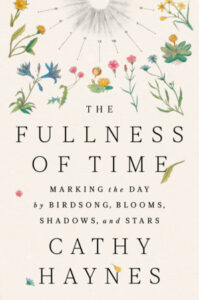
From The Fullness of Time: Marking the Day by Birdsong, Blooms, Shadows, and Stars by Cathy Haynes. Published on April 21, 2026 by Riverhead Books, an imprint of Penguin Publishing Group, a division of Penguin Random House LLC. Copyright © 2026 by Cathy Haynes.

Cathy Haynes
Cathy Haynes is a curator, writer, artist, and educator who has been developing a creative practice on aspects of time for more than two decades. She has been Timekeeper in Residence at University of College London’s Petrie Museum, Artist in Residence at the Chisenhale Gallery, a curator for Art on the Underground at Transport for London, and a founding faculty member at Alain de Botton’s School of Life. She has contributed to Cabinet Magazine, The Guardian, The Human Zoo on BBC Radio 4, and Monocle Weekly. She lives in London.