For Marx, Capitalism Was Always Going to Destroy the Environment
Kōhei Saitō on the Myth of Free Market Solutions to Climate Change
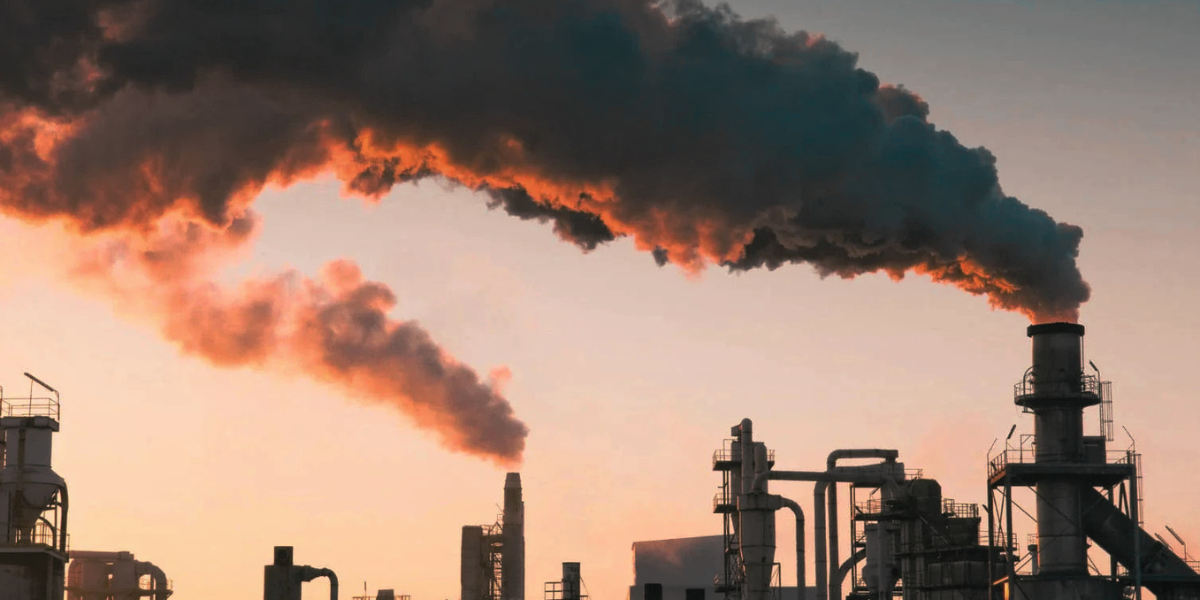
The worldwide environmental destruction brought about by the explosive advance of global capitalism has plunged the planet into crisis. The amount of fossil fuels consumed by the world population after 1990 now equals half that consumed during the entirety of human history up to that point. This massive consumption of fossil fuels is causing climate change. Related disasters are occurring everywhere: major flooding in Pakistan, wildfires in California, droughts in Africa, rising ocean levels caused by melting glaciers and ice sheets. The effects of climate change have become unignorable even in Japan, which has seen increasingly heavy rainy seasons and intense typhoons, among other natural disasters.
Meat-centric diets have led to extreme deforestation and the worldwide loss of biodiversity. Many scientists believe that these phenomena are partially to blame for novel viruses emerging and causing pandemics among humans.
Environmental destruction has now reached the point that it can never be fully reversed. Many scholars, in emphasizing how capitalism has fundamentally changed the workings of the planetary environment, have begun using terms drawn from geology to characterize the present era: as the Anthropocene—an age defined by human intervention into the natural world—or even, more specifically, the Capitalocene.
As you might expect, the Capitalocene is characterized by extreme inequality. Capitalism’s rapacious use of the planet has run up a tab to be paid by both future generations and the poor currently living in the Global South. The superrich elite traveling the world in private jets and luxury yachts are responsible for a huge share of the current crisis, yet they refuse to take any responsibility. Perhaps they think they’ll be exempt from its effects.
Ultimately, Marx clarifies, capitalism diminishes societal wealth for every one.
One must ask: Will we survive if we leave the future of humanity up to the forces of capitalism? Will capitalism really generate advances in technology that will save us from catastrophe?
The origins of Marx’s ecological turn can be found in the work of his con temporary, the chemist Justus von Liebig, who taught at the University of Munich and published the book Organic Chemistry in its Application to Agriculture and Physiology (better known as Agricultural Chemistry), whose seventh edition came out in 1862.
Liebig was a harsh critic of then-current farming practices, which quickly depleted the soil in pursuit of high yields (and profits), calling this failure to replenish the land a “robbery system.” He went on to argue that if such practices continued, they would destroy the very basis on which the nation was built, leading to the eventual collapse of civilization. This famed chemist had previously extolled the virtues of fertilizer as the answer to soil exhaustion, so his sudden reversal on the issue left a lasting impression on his contemporaries.
Marx was no exception. Liebig’s discourse on modern agriculture’s robbery of the soil was of particular interest to Marx, and he produced a set of meticulous research notes on Agricultural Chemistry. Later, in Capital, Marx warns that soil depletion caused by the heedless exploitation of nature would threaten the physical foundation of society itself.
The same blind desire for profit that in the one case exhausted the soil had in the other case seized hold of the vital force of the nation at its roots. (348)
Marx’s excavation into capital’s propensity to loot resources caused him to see that soil depletion and the exhaustion of human vitality shared the same origin: the “blind desire” of capital for endless growth.
Moreover, in chapter 15 of Capital, Volume One, “Machinery and Large-Scale Industry,” Marx discusses the large-scale landholdings supporting the capitalistic management of agriculture. He points out that this looting by capital “disturbs” the metabolic relation connecting humans to nature while also exacerbating the divide between rural and urban workers:
Capitalist production collects the population together into great centers, and causes the urban population to achieve an ever-growing preponderance. This has two results. On the one hand it concentrates the historical motive power of society; on the other hand, it disturbs the metabolic interaction between man and the earth, i.e. it prevents the return to the soil of its constituent elements consumed by man in the form of food and clothing; hence it hinders the operation of the eternal natural condition for the lasting fertility of the soil. Thus it destroys at the same time the physical health of the urban worker, and the intellectual life of the rural worker. (637)
Agricultural production conducted by capital with the aim of making the most money in the least amount of time leads to heedless monocrop farming (the cultivation of the same crops in the same soil year after year). It takes time, though, for soil to replenish the nutrients consumed by crops. Capitalism might accelerate, but natural cycles remain constant. A rift is thus exposed between the temporality of capital and that of nature, the end result of which, in this case, is soil exhaustion. The land’s fertility withers, and harvests dwindle.
Marx also discussed forestry as another example illustrating the same process. It takes decades to grow trees, but capitalism can’t wait that long for forests to renew themselves. Instead, cap i tal ists cut down entire forests in search of profit with no concern for natural cycles of regeneration. As technology advances, the pace of deforestation only quickens, resulting in the penetration and destruction of even the most remote wildernesses. Accordingly, the wastelands left behind capitalism grow only more vast.
Capital takes no responsibility for the exhaustion of the soil or the destruction of the forests. Unable to sync itself with the temporality of nature, capital simply takes what it can to transform into commodities and sell with no concern for the future. Après moi, le déluge!—this is the slogan of the capitalist. While urban lifestyles become richer, as they are ground zero for commodity consumption, the price of this wealth is paid by the rural areas that suffer from issues like soil depletion and the destruction of the landscape. As a result, the quality of life of those that work and live in these rural areas deteriorates.
But as Marx notes in the previous quote, even workers in the urban centers “blessed” with commodities are forced by capital to toil for long hours at the expense of their physical health and well-being. Ultimately, Marx clarifies, capitalism diminishes societal wealth for every one.
Marx studied and wrote about soil exhaustion in the nineteenth century, but the looting of nature continues to this day, albeit in slightly diff er ent forms: from the extraction of fossil fuels and rare metals from the earth to the destruction of the Amazon rainforests.
Just as life in industrial urban centers in the nineteenth century caused hardship in rural villages, the profligate lifestyles enjoyed by those of us in the Global North are underwritten by the immiseration of those in the Global South. Après moi, le déluge—this attitude becomes even more explicit as we pass the environmental costs of our present actions on to future generations. This is what is known as “externalization.”
In Brazil, both the Amazon rainforest and the vast grassland known as the Cerrado have been rapidly transformed through clearing and logging operations into pastures and cropland. Why? Because of the production of beef for export to the Global North—the land is cleared to both raise cows and grow the crops to feed them. To take another example, the production of smartphones and computers uses large quantities of rare metals found in South Amer i ca and Africa. The mining of these metals frequently involves human rights violations, including the use of enslaved labor and child labor—the ILO (International Labor Organization) estimates that over 50 million people are currently working in conditions of enslavement.
Externalization occurs in Japan as well. Japan is the second-biggest importer of lumber in the world, bringing in considerable quantities of wood from Southeast Asian countries like the Philippines, Malaysia, and Indonesia, as well as from Siberia. Paradoxically, almost 70 percent of Japan is covered in rich forestland, providing enough resources that local cedars and cypresses are left unharvested and mountains covered in wild forests, yet large amounts of cheap lumber from overseas are imported anyway, leading to the decline of the domestic forestry industry. In this way, simple cheapness becomes the rationale for pumping yet more carbon emissions into the atmosphere to import lumber produced through the destruction of overseas forests.
We’re so preoccupied with cost-performance thinking, diligently weighing the cost of a steak against the cost of a computer, that we lose sight of the true cost of the things we use to make our lives.
All of this is ultimately unsustainable. It reflects how the metabolic relationship between humans and nature has become so distorted on the global scale. Marx predicted this outcome, writing in a draft version of Capital’s third volume about this metabolic rift:
In this way, [large-scale landownership] produces conditions that provoke an irreparable rift in the interdependent process between social metabolism and natural metabolism, resulting in the squandering of the vitality of the soil, and trade carries this devastation far beyond the bounds of a single country (Liebig).
The endless movement of capitalism commodifies the entire world while allowing only a small subsection of the population in a small subsection of the planet to profit—this is the monopoly form (or, as in the previous passage, “large-scale landownership”). Globalization has expanded the rural-urban divide far beyond the boundaries of the nation. However, while capitalism seeks the limitless increase of value, the planet itself is limited. Capital always works to externalize the costs of its operations, but the planet acts as a limit on this “externality.”
After the collapse of the Soviet Union, the globalization of capitalism sped up even more, globalizing the environmental crisis as well; now we can say with confidence that there is nowhere on earth the crisis has not touched. Even countries like Japan and the United States, well ensconced in the Global North, aren’t exempt from the effects of climate change, as super-typhoons and extreme heat have become routine occurrences. The “metabolic rift” has deepened to the point of no return.
The metabolic relationship between humans and nature was once a cycle—a process that could be represented as a circle. But the movement of capital is one-way. It unilaterally extracts what it can from workers and the natural world, while foisting the costs of this extraction onto a perceived “outside” in a similarly one-way fashion.
By contrast, ecological systems are complexly interconnected, meaning that when one element is disturbed, all the other components linked to it are affected, too, spreading the disturbance throughout the system. Capitalism is unconcerned with such complexity and mutual interdependence. Money empowers and encourages us to assign a price to all things, making them directly comparable and exchangeable with one another. There’s certainly a convenience to this, but it’s a simplification that can have extremely violent effects, as it allows things that were originally incomparable—like forms of societal wealth and use-value—to be measured against one another according to the abstract concept of “value.”
The mutual interdependence of an ecosystem and the valorization of capital operate according to two completely differ ent logics, and it’s impossible to reconcile the great divide between them. The simplifying logic of capital, which seeks to commodify anything and everything and which operates solely on the basis of the “value” of the commodified object, cannot ever truly grasp the complexity of the process by which an ecosystem—a system that includes humankind!—operates.
The same holds true for us as individuals. We’re so preoccupied with cost-performance thinking, diligently weighing the cost of a steak against the cost of a computer, that we lose sight of the true cost of the things we use to make our lives. What went into producing that steak? How much carbon dioxide was emitted to feed the cow it came from? To deliver its flesh to us? We simply don’t think about it.
It is precisely this sort of simplification that is necessary for capital to increase itself so swiftly and completely, opening up a rift in our metabolic relation to nature and in turn causing the current environmental crisis. We can no longer afford to keep the true cost of commodification and the valorization of capital out of sight and out of mind.
Don’t misunderstand me—Marx, too, recognized the fact that capitalism had, in its fashion, enriched our lives as well. However, he also saw that its fixation on raising profits by recklessly increasing productivity by any means necessary was also a major hindrance on humanity’s ability to protect collective planetary abundance for future generations. Marx speaks to this in a famous passage from the preface of his 1859 treatise, A Contribution to the Critique of Political Economy:
At a certain stage of development, the material productive forces of society come into conflict with the existing relations of production or—this merely expresses the same thing in legal terms—with the property relations within the framework of which they have operated hitherto. From forms of development of the productive forces these relations turn into their fetters. Then begins an era of social revolution.
It’s impossible to raise productive forces any more under capitalism without completely destroying the planetary environment. We cannot manage the environment—a resource that ultimately belongs to no one—in a sustainable way as long as we operate within a system founded on ceaseless exploitation in the name of private ownership and profit seeking. We’ve reached the point at which capitalism itself has become the “fetters” on society’s development.
We can thus say that Marx advocates for revolutionary change that would usher in a completely different social system, a change that urgently needs to happen before the “irreparable rift” in the metabolic relation between humans and nature destroys civilization for good.
__________________________________
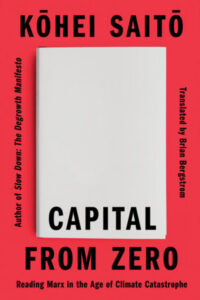
Excerpted from Capital From Zero: Reading Marx in the Age of Climate Catastrophe by Kōhei Saitō, translated from the Japanese by Brian Bergstrom. Published by Astra House. Text copyright © 2026 by Kōhei Saitō. Translation copyright © 2026 by Brian Bergstrom. All rights reserved.

Kohei Saito
Kohei is Associate Professor of Philosophy at the University of Tokyo. He received his Ph.D. from Humboldt University in Berlin. He works on ecology and political economy from a Marxist perspective. His recent best-selling book, Capital in the Anthropocene, has been credited with sparking a resurgence of interest in Marxist thought throughout Japan. Wanting to continue his research on post-capitalism and the Anthropocene, he felt the need to interact with theories and practices that are rapidly developing in Europe, especially in Germany, in response to the deepening climate and economic crises.