







Five Books About World War II for Young Readers
Stuart Gibbs Recommends Alan Gratz, Jennifer Nielsen, Gordan Korman, and More
From a very early age, my son Dashiell was fascinated by World War II. I know exactly where this started, and it certainly helped that he comes from a lineage of history buffs. His great grandparents lived in Palm Springs, when Dashiell was only three or four, his grandfather Barry and I started taking him to the Palm Springs Air Museum. This is a wonderful facility where vintage warplanes are restored to working order, although there is plenty of other historical information as well. Dashiell loved one display in particular, a diorama of Pearl Harbor, with narration about the attack recorded by Tom Brokaw. He watched it over and over again.
There were several WWII veterans who volunteered at the museum. They were always thrilled to see my son and often regaled him with stories of their service. All of this sparked Dashiell’s interest in that war, which continued to grow throughout his childhood.
So Dashiell and I were always on the lookout for books he could read that told stories set in World War II. I suppose it’s not a surprise that my first non-fiction book is set during that time as well.
I’m kicking off a new series, Spy School Secret Files, in which I share true stories about real spies and the daring, innovative things they did. For me, it made sense to start with stories from World War II, because that’s when the groundwork for the CIA was established—and of course, because there are lots of great espionage tales from that time. In Totally True Tales From World War II, you’ll learn about daring agents, code breakers, inventors, scholars, double-crossers, commandos, propaganda, shark-repellant, bomb-carrying bats and exploding pancake batter.
To write it, I did plenty of research (including working very closely with the CIA), but I am also indebted to the great books listed below. These books, which I read with my son (and occasionally my daughter as well) show how rich a setting World War II is for middle grade readers. Even though most are fiction, there is obviously a great deal of research behind each one. And yet, you don’t have to be a history buff to enjoy them. All are wonderful blends of adventure, action, character and heart.
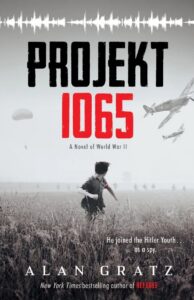
Alan Gratz, Projekt 1065
Although just about every fan of middle grade fiction knows Gratz as the writer of Refugee, my son and I became fans of his due to this amazing book published a few years earlier. Based on real events, it follows the story of Michael O’Shaunessey, a boy originally from Ireland whose family now lives in Nazi Germany. Like everyone else his age, Michael is a member of the Hitler Youth—but unlike them, he’s actually a spy. (And so are his parents.) When Michael learns about Projekt 1065, he must navigate the delicate line between appearing loyal to the Germans and helping the Allies, his life hanging in the balance the entire time. Like Refugee, Projekt 1065 is a gripping, suspense-filled page-turner that also has great emotional resonance. (Don’t skip the Author’s Note, where Gratz gives the staggering—and heartbreaking—details of how many children were forced to fight by the Nazis.)
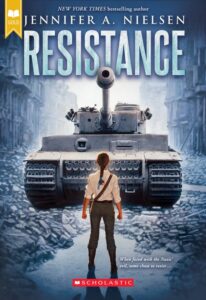
Jennifer Nielsen, Resistance
This amazing book tells the story of a teenager risking their life to fight the Nazis—but from a very different perspective. Chaya Lindner is Jewish, living in Nazi-occupied Poland, where her religion puts her life in grave danger. Determined to protect her family—and others like her—Chaya joins a resistance cell to fight back. But after a raid goes terribly wrong, Chaya finds herself on a journey that will place her in increasing peril as an even larger uprising looms. Nielsen has written great books across many different genres, but her historical fiction stands out to me because of its research and resonance. Resistance is rooted in the true—but little-known—stories of Jewish resistance cells, and many real members of those cells appear as characters in the book. (Once again, don’t skip the author’s note.) Chaya is a great character, at once daring and brave, but also understandably frightened by her extreme circumstances and worried about the fate of all the innocent people who were targeted by the Nazis.
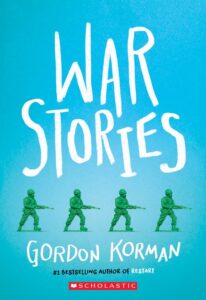
Gordon Korman, War Stories
Korman has now published well over a hundred books, but this has always been one of my favorites. It has a brilliant conceit, following the stories of two teenagers as they grapple with World War II—at two different time periods. One of them is Jacob Firestone, a young US soldier, who we follow through his training and deployment (including storming the beaches at Normandy on D-Day), while the other is Trevor Firestone, Jacob’s great-grandson, who accompanies Jacob as he returns to Europe in the modern day to accept an award from the French village he helped liberate. A huge fan of war-themed video games, Jacob is thrilled to accompany his hero ancestor, but as they get closer to the village, Trevor discovers there’s more to the story than he thought. The dual storylines are an ingenious way to tell the well-researched tale of a young man at war, but to also confront the idea that the history we’re told might not always be the complete truth.
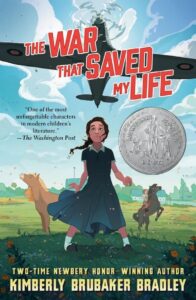
Kimberly Brubaker Bradley, The War That Saved My Life
It’s important to realize that World War II had effects on millions of people well beyond the battlefields. Bradley’s story focuses on ten-year-old Ada, one of the thousands of children evacuated from London to the British countryside to protect them from the blitz. While this is a trying and frightening ordeal for Ava—as it was for all children—it ultimately changes her life for the better. Ada’s mother is cruel and mean, humiliated by Ada’s birth defect, a clubfoot, although the woman Ada is sent to live with, Susan Smith, is used to caring only for herself and unhappy to have Ada and her brother forced upon her. But as time goes on, the two of them form a touching relationship while Ada discovers that, even despite her foot, she is still capable of helping the war effort, aiding in the British evacuation from Dunkirk and hunting enemy spies. With its richly-drawn characters and original background, this was one of my daughter Violet’s favorite books as a child.
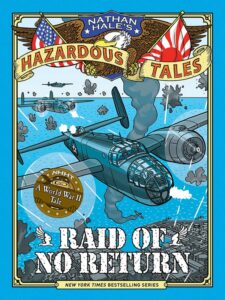
Nathan Hale, Raid of No Return
This story is a true one—and there’s no one better at relating true stories to middle grade readers (or adults) than Nathan Hale. A talented storyteller and illustrator, Hale’s graphic series, Nathan Hale’s Hazardous Tales originally told well-known stories from history, like that of Hale’s namesake ancestor, Nathan Hale, or the Donner party. (Personally, I think his Treaties, Trenches, Mud and Blood is the best concise history of World War I there is.) Recently, Hale has started telling stories that are less well-known, which is where Raid of No Return fits in: It follows Jimmy Doolittle’s daring, top secret air assault on Tokyo in the aftermath of Pearl Harbor. I had heard of the raid before (although I am guessing many younger readers hadn’t) but didn’t know much about it. Although now, thanks to this book, I do—and I know a lot about Doolittle and his intrepid crew of pilots as well. As usual, I am in awe of how Hale isn’t merely a great writer, but also a great illustrator, deftly handling such disparate elements as layout, structure and humor.
__________________________________
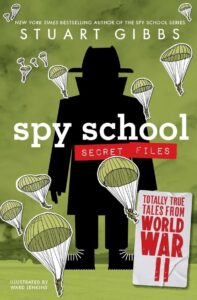
Totally True Tales From World War II by Stuart Gibbs is available from Simon and Schuster Books for Young Readers.

Stuart Gibbs
Stuart Gibbs is the New York Times bestselling author of the Charlie Thorne series, FunJungle series, Moon Base Alpha series, Once Upon a Tim series, and Spy School series. He has written screenplays, worked on a whole bunch of animated films, developed TV shows, been a newspaper columnist, and researched capybaras (the world’s largest rodents). Stuart lives with his family in Los Angeles.