Everything But the Burden: Greg Tate, John Henryism, and the Cost of Solidarity
Steven W. Thrasher on the Reissue of Flyboy in the Buttermilk—and what it can teach us about solidarity
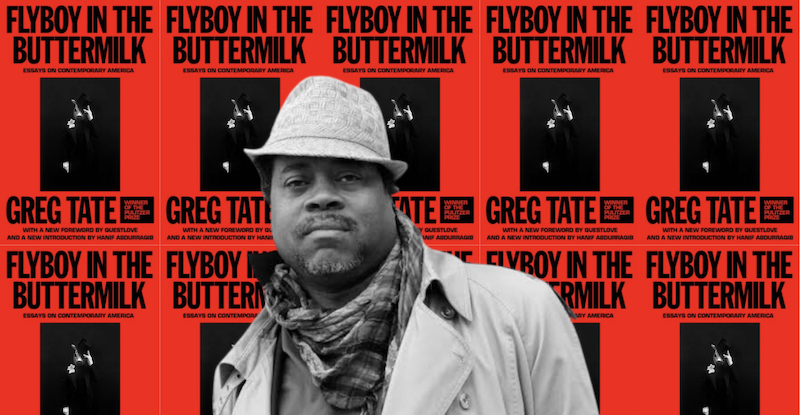
Praise be to Akhenaten, to Cleopatra, to Ra, Sun Ra, Iris, Osiris and all the ancestors and ancestresses: Flyboy in the Buttermilk, by the late, great Greg Tate—that posthumous Pulitzer Prize-winning polymorphous polymath, the heppest cat to ever done bee bop in the pages of the Village Voice and Vibe—is back in print.
Subtitled Essays on Contemporary America, this collection of 40 articles is as relevant today as it was when it was first published 25 years ago. Whether he was writing about sports, politics, music or art, Greg left an indelible mark on American arts and letters. Along with bell hooks (who died the same week as Greg in December 2021, both leaving black holes in the expository cosmos), Greg done changed the game for cultural criticism—imbuing it with a Black down-beat street sense that could still soar higher than Miles hitting a high G on Kind of Blue or Alvin flying over floorboards in Revelations.
OK, that was my modest attempt to write in the style of Tate himself. But there’s no competing. How can you compete with the G.O.A.T.? How can you compete with the brother who could bang out one sentence after another on the legacy of Wynton Marsalis in “Baby Miles and Bay Wayne” ( “Neither freemen fuzhacks, nor funkateers, the Marsalis brothers, on evidence of the trumpeter’s CBS debut, declare themselves adroit student archivists of acoustic jazz’s last band of ‘inside’ futurists’”) and on Skip Gates in “Yo! Hermeneutics!” (“Merely conceiving a poststructionalist version of this deteronomic tribal scroll is enough to make me feel like a one-man Harlem Renaissance—at least until Thelonius asks if I’m hip to Henry Louis Gates, Jr., blood up at Yale (Cornell by the time you read this) who guest-edited two issues of Black American Literature Forum on the subject of semiotics and the signifyin’ monkey”) alike?
You can’t compete. It’d be like trying to beat old head LeBron at horse, or trying to get the ball away from young blood Yamal.
In being himself—with all the burdens of Black genius that came with it—Greg blasted the door off its fucking hinges
But here was the thing about Greg: as a critic, he could be sharp as a samurai sword slicing through skin (“To fully appreciate the sickness of [Michael] Jackson’s savaging of his African physiognomy you have to recall that back when he wore the face he was born with, black folk thought he was the prettiest thing since sliced sushi.”) He could praise a cat with the grace of Brunson making a three-pointer with four seconds to go (“Before he was cutting vinyl, George Clinton was cutting hair; before he got involved with the recorded process, my man was chemically processing hair-mixing down wave, curl, and conk jobs for all the slick splib hustlers that ran the streets of Plainfield”) and he could merk that same man down to size (“George Clinton’s Computer Games is a work of genius and a piece of shit”) with an assassin’s speed and the murderous meticulousness of Mbappé gutting a game with his god-given golden boot. Maybe not until earlier this month—when our sister-with-a-white-mama-and-mister Emily Wilson played her bow and plucked her arrow into the neck of fellow Homeric interpreter, ‘bruh Nolan, with so much force that her o’dyssey dyss track crashed the London Review of Books website like a Laestrygonian’s lobbed boulder blowing a trireme to smitherines—has anyone struck a fellow traveler with as much precision as Greg did when he wrote about bad art made by artists he loved.
And yet, as a writer amongst other writers, he was the sweetest guy—and he was never competing with you.
Even if he mentored you, he didn’t try to make you write like him. He tried to make you sound like you.
In being himself—with all the burdens of Black genius that came with it—Greg blasted the door off its fucking hinges with all the G-force (and care) of afrofuturist Victor Glover piloting Artemis II towards lunar slingshot glory…because he wanted you to be you.
No sir, no ma’am, none of us who received his mentorship—really, anyone who’s filed culture for Vulture or Gawker or BuzzFeed or Lit Hub or the Nation in the last couple of decades—would be naaaaaaaaaaaan without gregarious, luminous, generous Greg, and his downtown, no-clown, throw-down, new sound concertos about David Bowie, Sam Delaney, Don DeLillo, Dawn Suggs, Daughters of the Dust director Julie Dash, and—of course—the collection’s eponymous “flyboy in the buttermilk” himself, Jean-Michel Basquiat.
Like a runaway hack-hack-hacking through an antebellum field of sugarcane with a machete under a moonless midnight sky, Tate tore a new trail for us all.
*
Originally published in 1992, Flyboy has been out of print for many years—something that bothered Greg terribly when I interviewed him a decade ago upon the release of Flyboy 2. It bothered me, too, as a professor: I always wanted to teach the original Flyboy in its totality and never got the chance. (If students of journalism could only study one book to teach them many concepts in a sole volume—sentence construction, rhetoric, narrative control, dialogue, wordplay, humor, writing in your own voice, high theory, low theory, words as music, writing as rhythm, prose as poem, craft, craft, CRAFT— Flyboy in the Buttermilk would be a good contender.)
Too many subjects of this wheezing colonial empire want a proximity to Blackness without any responsibility for what ails Black people.
Greg practiced criticism as love. Sometimes that was tough love, as when he dissed Bad in “I’m White! What’s Wrong with Michael Jackson” (“Proof that God don’t like ugly, the title of Michael’s new LP, Bad, accurately describes the contents in standard English… The only thing Bad has going for it is that it was made by the same artist who made Thriller.”) Sometimes, that was the love of grief, as in “The Man in Our Mirror,” an obituary for the ages banged out in a day. That cover essay, which I have read dozens of times over the last 17 years since I first pulled it out of a red Voice box on Cooper Square, is both a brutal cry of pain (“Michael’s death was probably the most shocking celebrity curtain call of our time because he had stopped being vaguely mortal or human for us quite a while ago, had become such an implacably bizarre and abstracted tabloid creation, worlds removed from the various Michaels we had once loved so much. The unfortunate blessing of his departure is that we can now all go back to loving him as we first found him, without shame, despair, or complication”) and an indictment of corroded, commercial art in the US (“What Black American culture—musical and otherwise—lacks now isn’t talent or ambition, but the unmistakable presence of some kind of spiritual genius: the sense that something other than or even more than human is speaking through whatever fragile mortal vessel is burdened with repping for the divine, the magical, the supernatural, the ancestral.”)
This is a running theme in Tate’s work: reading people like Michael to read America (white and Black) to itself.
Too many subjects of this wheezing colonial empire want a proximity to Blackness without any responsibility for what ails Black people. (I can imagine what he might say about billionaire Beyoncé’s billionaire beau, Jay-Z, teaming up with Target as boycotters blackballed the retail behemoth for dismissing DEI.)
Or, to riff on the title of another Greg Tate joint, when it comes to Blackness, too many Americans want “everything but the burden.”
*
Released about a decade after Flyboy, 2003’s Everything But the Burden: What White People Are Taking from Black Culture is an anthology of essays by the likes of Robin D.G. Kelley, Michaela Angela Davis, and Arthur Jaffa, and edited by Tate.
Riffing on Chief Parliamentarian of Funkadelic land, Tate told us, “As George Clinton likes to say, ‘Without the humps, there’s no getting over.’”
In other words: to make art, you need some of the burden.
Greg credited the phrase which made up the title of his collection—as he credited many thinsg—to his mother, Florence, known to his readers as “Mama Tate.”
The idea behind was simple, but powerful: White (and, as I build on Greg and Mama’s argument in The Overseer Class, some “historic first” Black people) wanted everything everyday Black folk got…except for one thing:
They wanted the music.
And the art.
And the style.
And the cool.
And the clothes.
And the rhythm.
And the hoops
And the blues.
They want the bee bop.
And the hip-hop.
And the scat-jazz,
and church-soul.
They even want
Basquiat’s strokes,
and Richard Pryor’s
off color jokes.
They crave all this shit—
(and bag quite a bit)
but for one thing:
the burden!!!
Just as they wanted to enjoy the imperial nostalgia of Native American dreamcatchers without having to live on a genocide-created reservation, when it comes to Black culture, white people wanted everything but the burden. They didn’t want the cost of being Black—the health disparities, the racialized poverty, the redlining, the police state on your back.
And they sure as shit didn’t want to hear about (let alone suffer from) John Henyrism—that very real way Doc Sherman James proved how the grim reaper comes-a-knockin’ early for Black men due to the blood-pressure-and-heart-stress of racism. Named for the Negro folk hero who died trying to swing his hammer faster than a steam engine could, John Henrysism took my father at 67, just as it took his father at 57—and just as it took Greg at 64. (Shortly after Greg died, the artist John Simms—that brilliant brother behind How to Hang a Confederate Flag—told me he’d had breakfast with Greg a few weeks before, they’d talked about me, and Greg had said he was proud of me. That meant the world to me, and made me warm to talk to John about…until, that is, John Henry came for John Simms just a few months later—and ferried him across the River Styx to the afterlife after just 58 too-short years on this earth.)
A theory, my teacher (and OG queer theorist) Lisa Duggan taught me, is just an idea that helps people to think. If it’s a good theory, it’ll help people think about any number of subjects the cat who coined it never dreamed of.
Like a peripatetic apostle pondering a prior pastor’s prized psalm, burdenology is a theory I’ve been coming back to since October 2023.
Tate has long helped me understand how cultural appropriation works. But inversely flipping Tate’s theory of burdenology on its head has helped me understand why claims about appropriating Palestinian culture have been so scant in recent years—especially as the proclivity for non-Palestinian activists to wear keffiyehs exploded over the last few years.
I began wearing a keffiyeh I had owned for many years more frequently in October 2023, when the United States-backed Israeli genocide against the Palestinian people shifted into a new level of lethal intensity. Many others did the same.
Yet despite the ubiquity of new keffiyeh wearers who, like me, were not Palestinian—and in stark contrast to the dynamics of other protest movements I have covered—I have observed very few charges of “cultural appropriation” in the wearing of what amounts to the Palestinian national garment.
While its history stretches across centuries all over the Middle East, the keffiyeh was historically “worn by nomadic communities—or Bedouins—in historic Palestine,” journalist Linah Mohammed told NPR in 2023, adding that “over the last century, the black and white one has become synonymous with Palestinians.” More specifically, they’ve become a symbol of Palestinian armed resistance. This began even before the Nakba (النكبة), or catastrophe, of 1948. By then, the keffiyeh had already been associated with Palestinian freedom fighters since the early 1900s, when Arabs adorned with them tried to stop Britain’s increasingly obvious plan to use Zionist Jewish emigration as a way to colonize Mandatory Palestine for European imperialist aims. The keffiyeh was sealed as the major fashion symbol of Palestinian resistance in the 1960s, when Palestinian Liberation Organization leader Yasser Arafat wore one at all times.
Wearing a keffiyeh was not like rocking Air Jordans or hanging a dreamcatcher.
As I’ve observed and joined millions of people who’ve taken to the streets around the world for the Palestinian people over the last few years—and as a habitually online person—I have seen a few (very few) call-outs about cultural appropriation regarding Palestinian culture, music or dance… but I can not remember ever seeing any non-Palestinian called out for wearing a keffiyeh as an act of cultural appropriation.
In the US at least, even a non-Palestinian or non-Arab person wearing a keffiyeh creates very different material conditions than, say, a white person sagging and bagging or wearing a WuTang t-shirt. It is not a gesture isolated for fashion and stripped of associative risk.
To be sure, those of us wearing keffiyehs in Europe and North America are not facing the same existential, genocidal violence the people of Gaza have been facing for the last 77 years. Still, many people marching in the streets or camping on college campuses faced brutal state violence, and nearly everyone publicly supporting Palestine risked losing their jobs (and many of us actually did), careers, diplomas—or even their freedom from jail or deportation.
Wearing a keffiyeh was not like rocking Air Jordans or hanging a dreamcatcher. It ain’t akin to blasting Jay-Z while you plot to displace a Black neighborhood for a data center or putting up a poster of Tupac in your Harvard dorm room before you go earn your bread at Boston Consulting.
Wearing this garment involves risks and rewards, which can be quite thrilling. As one of my Palestinian cousins, Suzanne Barghouti, once told me, putting on a keffiyeh in the United States before you go out feels like putting on a lion’s mane, or a suit of armor.
But it’s also very much an act of putting a bullseye for the military industrial complex on your back. It draws danger to you—especially as it signals the wearer’s support for the legally justifiable armed resistance with which the keffiyeh has been associated for decades.
Many people I know who have started wearing them did so in community in some way or another. In getting to know someone you care about, you don’t just share in their prizes and accomplishments; you share in their vulnerabilities, risks, fears, and burdens. Hopefully—like a mama bird flapping her wings to draw a hungry cat away from the chicks in her nest—the gesture of wearing this garment may even draw a bit of danger away from those who are most vulnerable (or at least dilute the danger by spreading it around).
In shouldering a tiny piece of the burden, I certainly found, there has been a great welcome from Palestinian family, friends, and comrades to share, in an honest relationship, a symbol of their culture.
I wish I could talk to Greg about Mamdani, and the Knicks championship, and the recent rent freeze for a million New Yorkers.
This is why I was impressed when Zohran Mamdani began his video on July 21 with the words “Benjamin Netanyahu is a war criminal.” Though it was disappointing to many, including me, to hear him say he did not have the legal authority to arrest Netanyahu, I deeply appreciated Mamdani not just calling Netanyahu a war criminal and listing his litany of verifiable war crimes—including his murder of nearly 300 journalists who are ignored by almost all US politicians but whom Mamdani brings up repeatedly (as he did with Al Jazeera’s Ahmed Wishah).
I cannot speak for the Palestinian people. But as someone who has been severely punished for speaking about the apartheid state of Israel at my job—in 2019, and again over the last couple of years—I deeply appreciate Mamdani walking into the place where he earns his bread, saying “Netanyahu is a war criminal,” risking a bounty on his head and a target on his back, and taking on some of this burden.
*
I wish I could talk to Greg about Mamdani, and the Knicks championship, and the recent rent freeze for a million New Yorkers. I wish I could talk to him about everything that’s gone down in the last few years.
We are so lucky we can now easily read Greg’s words again.
But that, too, is only bittersweet: I wish that Greg had lived to see the reissue of Flyboy—that he could read the loving new foreword by Questlove and introduction by A Tribe Called Quest biographer Hanif Abdurraqib. Just as I wish he’d lived long enough to enjoy seeing Cats: The Jellicle Ball mark Broadway, ‘bruh Coogler conquer the Oscars and break the box office block with Sinners, The World of Black Film chronicler Ash Clark as chief curatorial cat at the Criterion Collection, When Chickenheads Come Home to Roast scribe Joan Morgan directing the Center for Black Visual Culture—and his mentee publish The Overseer Class.
God, do I wish he’d been given his flowers while he was alive—most of all his long overdue prize from the procrastinating Pulitzer people—and the kind of institutional base he needed not just to do his genius work, but to support him while he supported so many of us for free.
“Slavery, minstrelsy, and black bourgeoisie aspirations are responsible for three of the more pejorative notions about blacks in this county,” Greg wrote, “blacks as property, as ethnographic commodities, and as imitation rich white people. Given this history, there’s a fine line between a black entertainer who appeals to white people and one who sells out the race in pursuit of white appeal. Berry Gordy, Bürgemeister of crossover’s Bauhaus, walked that line with such finesse that some black folk were shocked to discover via The Big Chill that many whites consider Motown their music.”
Unlike Michael on Bad, Greg did not pander to a society obsessed with “producing young black men and women who conceive of their African inheritance as little more than a means to cold-crash mainstream American and the cold-dis—if not merely put considerable distance between—the brothers and sisters left behind.”
He did not leave us in life—he was only taken, in death, by the same ism that took John Henry.
He loved us.
And we love you, Greg.

Steven W. Thrasher
Steven W. Thrasher, PhD, is the author of the critically acclaimed books The Viral Underclass: The Human Toll When Inequality and Disease Collide, which was longlisted for the 2023 Carnegie Medal for Excellence in Nonfiction and won Best in Literature at the 2022 POZ Awards, and of The Overseer Class: A Manifesto. A regular contributor to Literary Hub and the Intercept, he won a 2025 Pulitzer Center Global Reporting Fellowship to document how the second Trump administration’s cuts to public health funding were affecting HIV/AIDS and LGBTQ health in Africa, Europe and the Americas. You can find him on Bluesky and Instagram @thrasherxy.