Esther Kinsky on Is Beauty Good, the Novel by Rosalind Belben
“Beauty is a concept as vast as it is vague.”
Many years ago I spent a summer in southeastern Poland. One day, on a hike, I came upon a gathering in the late morning sun. A group of people had assembled on a meadow just outside a village, an audience in waiting as it turned out, standing quietly against the backdrop of the Tatra Mountains. The craggy scarps were distant and blue, afloat in the thin dove-grey haze of early September. The musicians were arriving, one by one. All of them men, each of them with a moustache, most of them elderly—or so it seemed to me at the time.
Some of them carried battered black instrument bags, others came cradling their shiny trumpets, French horns and trombones in their arms. A brass band. They all wore stiff dark woollen clothes, too warm for the season and the sun, I thought. And they wore hats, at least that’s what my memory tells me now, black bucket-style hats, perhaps made from felt, water-repellent and cosy, suitable for all sorts of outdoor pursuits. It took a while for each musician to take up his place at the bottom of a gentle slope facing the audience. Everybody apart from me seemed local. They knew what to expect. Occasionally someone in the audience shouted encouragement or the name of a piece of music they wished to hear, or maybe a joke, or whatever their tradition may have recommended for the occasion.
The most striking feature of their music seemed to me its embrace of a certain dissonance, its reliance on an element of friction which was never jarring.
I had so far shunned brass bands and wouldn’t be able to say why my curiosity prevailed there and then. But soon I realised that not just the outfits and scenery set them apart from the parades I had occasionally happened on when I was a child in West Germany. No stomping rhythms here, no shrill blasts in unison, no sweaty masculinity souring the air, no red faces. Each of the men in their dark woollen outfits spun his own thread of sound, and each of them knew how to weave his recognisable thread into the shared texture of a melody. The most striking feature of their music seemed to me its embrace of a certain dissonance, its reliance on an element of friction which was never jarring.
Rather, it emphasised a melancholy undercurrent that was anchored not in the melody but in the tiny tonal interstices which opened up where the tuning diverged ever so slightly, little gaps and cracks, each telling their own wordless tales of some past or present affliction and sorrow. It was an unexpected lesson in dissonance as an ingredient of beauty.
As I read ‘Air Ride’, the second chapter of her novel, it was perhaps this element of dissonance in Rosalind Belben’s writing that brought back my memories of the brass band in rural Poland many decades earlier. There were no gondolas in Poland, no gleaming tubas in the sunshine as far as I remember, but there was nature (whatever that may mean these days), there was landscape, there were mountains, there was history, and with history inevitably also melancholy.
Beauty is a concept as vast as it is vague.
In borderlands the ground is always disturbed by history, and south-eastern Poland is no exception. Traces of fight ing, oppression, destruction and of the unspeakable horrors of genocide overlap and mingle. Everything is infused with melancholy, the unfailing indicator of the fundamental rift between humans and their natural environment. The talkative protagonist in this chapter tries to find the language for this very rift: ‘Nature listens, but nature is helpless to act, nature is at the mercy.’
At the mercy of what? The sentence trails off. History comes into the picture (‘These mountains have seen a lot of fighting’), as does human unwillingness, or inability, to listen to something other than one’s own voice. However poignant the speaker’s statements, they leave gaps, they’re unfinished, disjointed, dissonant, marked by omissions. Lacunae have a poetic weight of their own. Through the cracks in Sepp the tuba player’s monologue, readers may try to catch a glimpse of the taciturn listener stuck in the gondola with him. The gondola swings back and forth and ‘swims’ when Sepp gets agitated. ‘Air Ride’ echoes across the Alpine scenery as air raid; a traumatic past and an unresolved conflict are mentioned without being specified. Other chapters—such as ‘The Summer Child’—suggest a scenery and events associated with Alto Adige and its fraught history of being torn between Austria and Italy.
In ‘Air Ride’, the narrator’s—and apparent interlocutor’s—consistent silence emphasises the erratic nature of Sepp’s elaborations on beauty, music, frocks and landscape. The absence of an exchange leaves the reader fingering loose threads and, in the absence of plot, listening into tonal shifts and ruptures. Loose threads are a feature of Belben’s writing; they match the dissonances and, like them, eventually turn out to be the most important part of the fabric.
The title of the novel—and is it a novel? I did ask myself from time to time—mentions beauty. Beauty is a concept as vast as it is vague. It raises questions. Where do we begin with a definition? Do we need one? It is treacherous terrain in the absence of a consensus about the norms defining beauty. Guides for the aesthetically perplexed have lost their meaning. Concepts of the beautiful diverge as much as concepts of what is ‘good’ in an ethical sense. Nature as environment, as landscape, as a force beyond the rational, and as a place where beauty and a primeval absence of bad intentions come together, has become either a commodity or an endangered space. Disturbance, distortion, destruction are the words that come to mind when we think of nature today.
Belben’s novel, however, originally published in 1989, doesn’t seem to be concerned with a definition of beauty. Is beauty good, asks the title. Or does it? Is the absence of a question mark of significance? Is it a question at all? Or is it perhaps just a frame, a mock window offering a view of fragmented and occasionally absurd scenes located somewhere between nature, goodness and the beauty of humans, dogs and horses? These scenes are not designed to accommodate readers’ expectations of a storyline: what holds them together is language, individual words which, not unlike fairy-tale pebbles, help the reader to navigate the changing texture of the narrative.
The chapters seem like episodes, or fragments of episodes spread out like pieces of a puzzle, with a lot of blank space between them. There are fields of white silence, fertile ground for the imagination to shift them around, find matches or mismatches, wonder about sequences or connections. Questions around beauty and longing recur, as do keywords (such as ‘password’), names, references and scenic features, but what fascinated me most is that in principle each episode could be read as a little patchy universe on its own. There is Fritz wondering about the effect of beauty on mind and soul on his daily tram journeys in a city that seems to be Berlin.
Apparently he is a guard at the Berlin Wall, observing passing pedestrians through his binoculars. Regardless of the oppression his job has come to stand for, he is concerned with questions of beauty and its potential uselessness. Wouldn’t it be wiser to inure oneself to aesthetic sensibilities? To sail through life unbothered by what one sees outside, taking pleasure in little private comforts (coffee, biscuits, cake after work) without being enraptured by beauty and insulted by ugliness? ‘There is little that is moral about beauty,’ Fritz declares. ‘Is beauty good?’ he asks, but what he really seems to mean is: what good is beauty? His utilitarian pondering has a ring of fundamental hopelessness, but it points the reader in an interesting direction: is there a connection between beauty and hope? And would that make beauty good? Does it matter?
Two chapters later, a man called Kai remembers Fritz’s musings when he’s asked to come up with a password in a military context. ‘Is beauty good,’ he proposes, and his suggestion is approved and welcomed by his comrades with a hearty laugh. Both his suggestion and the jolly appreciation seem out of tune with the situation ‘far from home’, which may be a military manoeuvre involving mock battles and bayonet practice, or a preparation for actual combat. The reader won’t find out. Kai embarks on meandering reflections reminiscent of Sepp the tuba player.
He’s less concerned with the ethical potential of beauty than with a soldier’s reading of landscape as a place for shelter, inspired by associations with the female body. The keyword here is longing. ‘Human beings are so full of longings,’ remarks Kai towards the end of the chapter ‘Tears for Streams’. While beauty remains elusive and evades definition, it is longing which emerges as the real motor of life. Longing is the Insatiable Wheel of the title of this first part of the novel, the little boy pedalling his tricycle at breakneck speed towards the mountains, again and again, no matter how o!en he is intercepted and taken back home:
The third child, says the peasant in broad dialect, has a little tricycle, a toy thing for very small children, and he goes pedalling off on it, for miles and miles, at the age of three, when no one is looking, he has the urge to pedal miles, to the mountains, at the age of three, on a baby’s tricycle; and the old dog always goes with him; I meet him miles from home, pedalling along like a fury, and the dog running alongside, he slips out when no one is looking, and the dog like his shadow [. . .] I call to him, Franzi, was machst du hier?, wohin?, and he smiles radiantly, not naughtily or guiltily, and says in his baby voice, bicycling, to the mountains he says, and the old dog too; and I try to explain it’s dangerous, he’s too young to be out in the country miles from home alone, and he smiles, and smiles, and there’s no stopping him; it’s my wheel, he says, my wheel is hungry, it eats and I can’t stop it, it’s terribly hungry, me and the dog takes it out to eat; and he waves to me, cheerfully he waves to me, a three-year-old, and off he pedals . . .
His gaze remains fixed on what he perceives as perfect beauty. The pedalling boy who never gets to where he wants to be is human longing personified. But where there is longing, there is also hope.
The characters in the novel are not introduced: they happen, and they talk. There is a polyphony of reflections, impressions, snippets of memories, of conversations, musings and observations, occasionally taking the reader to the edge of puzzling situations and predicaments whose significance may gradually, partially, come to light in the course of the novel. There is a constant sense of movement, of visions and voices converging, diverging, allowing gaps and silences, but also a sense of subterranean connectedness.
And with every new miraculous pattern apparently forming naturally, we are more inclined to hope that beauty can be good.
As a reader, occasionally unsure whether I was reading stories or a novel, I couldn’t help thinking of a microscopic web of filaments running underneath the textual surface, much like a network of mycelia manifesting itself in the occasional fruiting body of a mushroom but being in itself infinitely vaster and stronger than those manifestations. The voices and visions play tricks and offer surprises, and there’s a sense of humour even when tragedy is lurking in the wings. But they also expose fundamental problems of communication, the vulnerability and inconsistency of our common currency of language, its help lessness. Belben’s writing catches something at the root of human existence, a state between dream and reason where all sense of belonging is suspended, making way for longing to define the self. It is also a state between words, concerned with the tiny stillnesses, the white spaces harbouring endless possibilities without which language couldn’t exist.
The novel is set mostly outside Britain, partly in Berlin (West Berlin at the time), partly in Alpine regions where German is spoken. Occasionally German words and expressions crop up, without comment or translation. One thread that runs through the entire novel is an element of Fremde between the lines. Fremde is a German word, difficult to translate, although it shares its root with the English ‘from’ and originally just meant ‘coming from another place’. In its modern meaning it sits somewhere between strange and foreign and alien, a quality that strikes me as the perfect definition of what makes Belben’s writing timeless. The various voices in the chapters of this novel develop into a choir defined by dissonances which shi” and go round in circles.
Surprisingly, I came across Rosalind Belben’s work only very recently. Her poetic wit, her sense of the absurd and, above all, her subtle sense of Fremde as a way of being in the world is something I was missing in English literature at the time when this book was first published. Perhaps, having just arrived in the UK from Europe, I was looking in other literary directions. Fremde is a much underrated feature of human life, and Belben’s engagement with it is something every reader can benefit from, aesthetically as well as ethically. Reading her writing, I was sometimes reminded of a kaleidoscope in all its deceptive simplicity: a cardboard tube with mirrors and colourful shards at one end, the shards rearranging themselves into dazzling new patterns with every turn of the tube. And with every new miraculous pattern apparently forming naturally, we are more inclined to hope that beauty can be good.
__________________________________
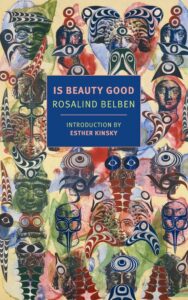
From Is Beauty Good. Used with the permission of the publisher, New York Review of Books. Copyright © 2026 by Rosalind Belben, introduction by Esther Kinsky

Esther Kinsky
Esther Kinsky is the author of books of poetry as well as novels, including Rombo and Seeing Further, both published by New York Review Books. A prolific translator, Kinsky has translated many notable English and Polish writers into German, including John Clare, Henry David Thoreau, and Olga Tokarczuk. Her novel River was longlisted for the German Book Prize in 2014.