Elizabeth Alexander on Finding Life in the Second Spring of Middle Age
“I learned many things during my study of dance that have everything to do with the writing of poetry.”
If I could have been a dancer, a real dancer, beyond those years at St. Mark’s, I probably would have done it. But my gifts were not that lavish, and my considerable drive was directed toward more than just dance. I danced in college among many other activities, and by the time I was twenty-two my body—never slim, but nonetheless strong and capable and expressive and elegant—had begun its march away from that potential life.
Or so I remembered; my years-ago exchange with my college friend suggested otherwise. Into my mid-twenties, as I moved between cities for jobs and school, I found dance communities wherever I was. I would fib about my age, keeping myself a late teenager so that I could take the difficult classes in the professional training programs. The last of these episodes was in Philadelphia at the Philadanco school, where I was lucky enough to study with legendary teachers Denise Jefferson and Milton Myers, and Jimmy Truitte. Mr. Truitte was one of the very first practitioners of the Horton technique, so present and vital in the choreography and pedagogy of my favorite company, Alvin Ailey, and a technique that suited my body’s strengths much more than ballet or Graham technique.
We add countless words to our brains at an early age, and writing is the deep-sea fishing expedition to find them again.
The other classical techniques readily available for study. Ruthless self-assessment is crucial for an artist, and dance is where I learned it, the cool ability to assess strengths and weaknesses honestly and unflinchingly. I was strong and flexible, especially in my back. I did not have distinguished feet, merely adequate. I had excellent extension. My turnout was average, and my hips were stiff. I was a high jumper and wide leaper; I loved to cover ground. My feet were precise but not particularly quick. There is simply no point in being anything less than honest.
The writing life did take over, and it was the right one, and the years went by, and the dance life was done. I thought a lot about my dance life when I had children, at thirty-five and thirty-seven. It certainly wasn’t easy—why should anything so mighty be easy?—but it was efficient. I heard the voice of Mary Craighill: “Being a dancer is the best preparations for natural childbirth. You know how to ride the waves of pain, and you know how to breathe.”
I learned many things during my study of dance that have everything to do with the writing of poetry and the life of a poet. I have thought about the relationship between bending the body to music in dance and the way we move words on the page to make music. I have counted so many beats in my life in the middle of a dance studio that I think I just count, without thinking about it. The worn, wooden dance studio floor has a clear relationship to poetic form. It is an austere blank space upon and within which anything can happen. In the rectilinear studio, curves and patterns are made. The studio is literally the blank page. When there are no bodies or words in it, we start all over again.
The devotion to dance is daily. Every morning or every day you warm the body and bring it into the new day and its possibilities. You perform your ablutions, and each of those days adds up to weeks, and months and years add up to a technique that will be daily refined and daily coaxed and welcomed with a similar set of movements. There is no substitute for the work of today. There is no way around it. Dance taught me, in short, discipline, without which there is no art. The simple practices, the five positions, the same exercises done over and over again that mean the body can move, bend, make shapes, speak, fly.
I can still feel Mary Craighill’s sharp index finger in the small of my back, a drill between the shoulder blades, and then everything pulls up straight and comes into alignment, or Cara Gargano’s pinching my bottom cheeks together with equally sharp fingers and hissing in my ear, “Tighter,” as she prowls the room, her eyes which miss nothing lighting on each student, finding something, always something. Engage your center. Lengthen your spine. Drop your pelvis but do not tuck under. Lengthen. That is how you align your back and achieve a beautiful line. That is also how I smooth the bumps out of line of poetry. My body can remember doing so many things. We add countless words to our brains at an early age, and writing is the deep-sea fishing expedition to find them again.
And a teacher must touch you, to teach you.
You can do anything in second spring, she said.
Dance taught me how to be self-critical. The gimlet eye of criticism called “corrections” in dance class is swift and precise. Left foot is fixed, not pointed. Hips thrust right. Soften your hands, unclench your jaw. Tilt your head a smidge to the left. Straighten your knee all the way. And then the exhortations to reach, pull, turn, twist, tuck, scoop. Despite what we might learn or teach in poetry workshops, eyes like that on a poem must be your own eyes. Exhortations must come from within.
There’s technique, and then there’s dancing. Once the body knows what it is supposed to do, it must move through space, not just string steps together. The profound question is, what is the difference between steps and dancing? Dance teaches you how to make sudden changes of direction while maintaining integrity and composure, how to change pace, how to build speed, and how to stop on a dime. There is keen estimation and calibration involved in running in a circle that is an exact circle that follows a strict perimeter, how to feel that sense of line and design. Once the poet has practiced these aspects of craft, then she must sing.
All movement begins from a strong center. Even if you cannot see the center, there must be a core. Even if the poem is off-center or eccentric, there must be a center, as “eccentric” describes tilting off the axis or veering from center.
No cheating. There was simply no getting away with anything in dance class. No cheating. Same thing with poems. For me, dancers nobly model the life of an artist. What does it mean to do the work with no expectation of remuneration commensurate with the work it takes? The most difficult, the most lavish, the hardest, the luckiest, the grittiest, the most glamorous. The prima ballerina is showered with flowers and bows to her subjects. Offstage, her feet bleed inside toe shoes that are often discarded after each performance because they are worn through. And not just the feet: the everything else that hurts and is sacrificed to make art. It is not easy to do this. And it is a privilege.
It is the rigorous, ruthless honesty of the study of dance that has given me the most. It is a value in my life and in my work: the truth of the poem formally—that is to say, is it cleanly achieving its highest possibility? How do you know or measure that? And then, the honesty of what is said inside, not necessarily every little detail tracking against the details of life that inspired it, but rather, the deep truth of art that searches for the unpaved path.
Soon after visiting my friend, I took a ballet class for the first time in twenty-five years. The Chinese acupuncturist who I saw regularly (for the hips, an old dance injury, as I love to say, even though I do not love the injury) was very happy that I went. She told me that I was entering my second spring, that women in their mid- to late forties enter this stage and can be like their younger selves, only better, because they are wiser and more judicious. You can do anything in second spring, she said.
The work waits for you every morning.
My college friend with cancer was a nationally ranked fencer at the age of forty-seven. Now, healthy in her sixties, she is still a nationally ranked fencer. She never gave up the dream of her body, never turned from what her body knew and how it excelled. She fences wearing her armful of antique Chinese gold bangles and so makes music with each movement.
Middle age, the involuntary step over an invisible midpoint line, waiting for the other shoe to drop. And yet, also, when you can begin fruitfully to remember what you might have forgotten about who you were, therefore who you are, and the relationship of the selves to each other, beads on a string, one after the other.
When my children were about seven and eight, our family climbed a mountain in Maine, not a huge one, but one that was huge for me. When I was just shy of the summit, I made the mistake of looking back from the clearing where we were gathering our strength for the rest of the climb, and all I could see was what looked like a sheer drop. I panicked, afraid to go forward and afraid to go back. Hard as I tried, and as much as I did not want to fall apart in front of my young sons, I could not overcome my fear. I had to turn around and go back. I felt so disappointed in myself. I wondered, where was my courage? Why couldn’t I find it? Where does it reside? I was not afraid that my body would fail me, I was just plain afraid.
No words, no words, no words.
And then I thought, what we have of courage does not manifest in everything that we do. Perhaps the physical courage I once had when I danced every day, the courage that took me into something unknown, past pain and past shame and past certainty, past even my ability, is also present in other parts of my life. It doesn’t matter that it is not in my mountain climbing. It is in other places where I am courageous and strong and surprising.
Some of that courage lives in my writing, both in the act of making art and hopefully in the work itself. A courage that does not seek to call attention to itself but is the result of hard and honest work.
Even the smallest gesture is beautiful, a place to be expressive, a call to poise.
The work waits for you every morning.
The body knows far more than it can express.
In middle age you begin to see the patterns of the years before the midpoint. Ahead is the sum, and something else.
__________________________________
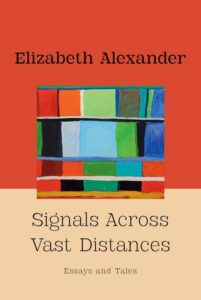
Excerpted from Signals Across Vast Distances: Essays and Tales. Copyright (c) 2026 by Elizabeth Alexander. With permission of the publisher, W. W. Norton & Company, Inc. All rights reserved.

Elizabeth Alexander
Elizabeth Alexander is a celebrated poet, essayist, and scholar. She is the author of more than a dozen books, including six volumes of poetry.