Eight Simple Rules for Dating Your Historical Fiction
Paraic O’Donnell Offers a Primer on Effectively Situating Your Novel in the Past
This first appeared in Lit Hub’s Craft of Writing newsletter—sign up here.
Consider these opening lines. Their source is far from obscure, so there’s a good chance you’ll recognize them right away. Take a moment over them anyway:
“So now get up.”
Felled, dazed, silent, he has fallen; knocked full length on the cobbles of the yard. His head turns sideways; his eyes are turned towards the gate, as if someone might arrive to help him out.
One blow, properly placed, could kill him now.
The excerpt is taken, of course, from the first page of Wolf Hall, for which Hilary Mantel won the Booker Prize in 2009. Not exactly a deep cut as historical fiction goes, but for my purposes a near-ideal example.
Of what? Well, in the rules I’m about to set out, I warn of the ways in which we can get historical fiction wrong. And Wolf Hall—from its opening lines to its final page—is as complete a demonstration of technical excellence as we could wish for. We’ll discuss some examples in just a moment, but first a bit of procedural housekeeping.
You will object, I’m sure, that literary craft is infinitely nuanced and that rules like the ones below are reductive and arbitrary. Plus, you might argue, they get broken all the time, and by unassailable giants of the genre.
The thing about literary giants, though, is that they tend to know what they’re doing. When they break a rule, they generally understand it thoroughly and weigh their decision carefully. When you break one you’re just doing it wrong. Good? Good.
Yes, Susanna Clarke did it, but (a) she did a lot more besides, and (b) you are not Susanna Clarke.
Also, one last thing: In case anyone missed my tiresome play on words, the “dating” in the title refers to the various techniques you can use to situate your novel in time and place. You may be familiar with some or all of these, but you should still pay attention. Most require a light touch and a clear notion of the desired effect. Some, though, should be approached like they just oozed from a meteorite in a puddle of hissing slime.
Okay, team, let’s have fun out there!
Rule No. 1: Go Easy on the Period Diction
Language is what books are made of, and all prose and dialogue must be outfitted in some sort of style. If your setting comes stocked with pungently recognizable idiom—with prithees and sires and by-your-leaves—there’s a temptation to help yourself in great armfuls.
But look again at the Mantel excerpt. Her chosen milieu is Tudor England, and she has a scholar’s intimacy with the flavors of Early Modern English then in use. But a modern novel crusted stiff with pre-Shakespearean locutions would no longer be a modern novel; it would be a wearying parlor trick.
Mantel cleaves instead to a felicitous simplicity, to constructions that achieve consonance with the period but stop short of mimicry. She begins as she means to go on. The boy on the ground is Thomas Cromwell, who will one day be Lord Privy Seal and the unsparing architect of the English Reformation. His public utterances will brim with courtly niceties, and with legal and ecclesiastical arcana. Mantel will show us just enough of all that when the time comes.
For now he is just a boy, cowering before his brutish father. His world was not wide before, and now it has shrunk to a few miserable particulars: a blunt taunt, a cobbled yard, a beating. Now as then, the words for such things are simple.
Rule No. 2: Spell Like a Normal Person
Say you’ve pitched up in England at some point from the early Georgian era onwards, or in America a little later on. You’ll have made the exciting discovery that your primary sources include actual novels.
Let’s imagine, too, that in a spirit of dauntless thoroughness you’ve sought out the unmodernized editions of Defoe or Fielding or whoever. It’s a worthy philological undertaking, if nothing else. Our modern conventions of orthography, typography and speech-marking took a long time to solidify, and it’s instructive to see that process unfold.
It’s not without its perils, though, particularly when you reach the relatively familiar climes of the nineteenth century. Here you’ll feel mostly at home, and when your eye is caught by such archaisms as Jane Austen’s spellings you might find yourself wondering what harm it could do. You certainly wouldn’t be the first.
But listen, this is not the way. You are not going to fast-track your way to authentic Regency by putting “chuse” for “choose.” Yes, Susanna Clarke did it, but (a) she did a lot more besides, and (b) you are not Susanna Clarke.
Rule No. 3: Don’t Use Your Research to Accessorize
You’re writing a historical novel, which means you’ve been putting in some serious hours at the library. (You have, haven’t you? Because this is in no way optional.)
And having done all that research, you might form the view that none of it should be wasted. Like, that one detail about the turning radius of Shillibeer’s Omnibus—that has to go somewhere, surely? The answer, alas, is usually no.
You should read widely about your period and deeply about those particulars that naturally arise in your story. Most of that reading, though, should be kept off the page or confined to the gentlest cross-hatching. That way, the reader will attend gladly to the details you do alight on, having come to trust that they matter.
Treat the rest of your shiny trinkets like in that mirror-twirl trick when you’re getting ready to go out. If it catches your eye immediately, take it off.
Rule No. 4: The Past Is Another Country, but Your Characters Live There
Choosing a point of view is a consequential decision for any novelist, but in historical fiction the stakes are heightened. Omniscient narrators are a thing, to be sure, and they were much more of a thing in centuries past, along with chatty and freely moralizing perorations to the Gentle Reader. However, managing such conspicuous anachronisms requires consummate skill (see Eleanor Catton’s The Luminaries for how it’s done), so don’t say you weren’t warned.
I most cases, though, you’ll be using either the first person or the near-default close third. This means that in any given scene, you’ll be relating the proceedings from the perspective of a specific individual shaped by highly particular circumstances. That individual should want, care about and notice a closely circumscribed subset of things.
Her own clothing? Maybe, if some occasion requires it and she has the means and leisure to change it. The streetscape, the shopfronts, the hansom cabs, the coal smoke, the gaslights, the stink? Unless she’s new here, then not without some particular reason. Just like you, she’s probably preoccupied with something (so tell us that instead), and just like you, most of what she sees every day is all but invisible. Choose carefully.
Rule No. 5: Stop Worldbuilding Like It’s Westeros, Dammit
All this pontificating might give you the wrong impression, so I should make it clear that I, too, am a trash human with terrible habits. Exhibit A: Your boy watches way too many video essays on YouTube. These are all far too long, and too many are about fantasy fiction and its weird fixation on the Everlasting Medieval.
I bring this up because I’ve developed a pet theory, which is that the quasi-historicism of fantasy fiction has opened a portal to a parallel genre, infecting historical fiction with Certain Tendencies. Among these are the egregious outbursts of exposition that are tolerated in the cause of “worldbuilding,” as if having an official term somehow makes it okay.
There’s no excuse for wheeling in some talkative NPC just to explain why the townsfolk are acting skittish. As with most technical problems, find a solution that’s natural and unobtrusive.
This carry-on usually occurs under flimsy pretexts. “We had all heard the tales,” someone will begin, and the tales that follow will bespeak an oral tradition of near-miraculous efficiency. We will learn of the ills wrought by this or that king; such-and-such a usurper; one bunch or another of interlopers, of idolaters, of haughty conquerors, of benighted rabble. The glories of some former age may be lamented, and our sympathies directed to parties judged righteous or wronged.
Decades, even centuries, may be encompassed by these marvelously comprehensive surveys. Some readers may even welcome them, on the grounds that there’s just so much to cover and it’s, like, hella convenient. That’s no excuse. This isn’t Elden Ring, and there isn’t supposed to be a hotkey for lore. Reveal your world as someone experiences it, or don’t reveal it at all.
Rule No. 6: Stop Set-Dressing Like It’s Downton Abbey
Again, I don’t issue this edict from some kind of high horse. I still know every single number in that one musical episode of Buffy, so it’s not like I don’t love me some high-fructose TV. I’m not coming for anyone’s comfort reads either. There’s a place in this world for book covers with someone’s lush decolletage and a font from a wedding menu.
Given that you’re six points deep into this particular list, however, I’m going to assume that Bridgerton is not the vibe you’re going for. And at the grownup table, sad to say, you don’t get to blow the budget on wardrobe and production design then call it good.
No one’s saying your text has to be barren of ornament. There can be sumptuous frocks and silk wall hangings, but the gaze that gets drawn to them should not be your own. Because again, who is doing the seeing here?
Is it someone awed and out of their element? Someone briskly assessing workmanship or disparaging a social inferior? Someone taking brusque possession while sneering at all this decadence?
Moments like these may occur, but they must arise in the natural course of your story. Otherwise, make do like the rest of us and save your fire takes on eveningwear for posting about the Met Gala.
Rule No. 7: Your Characters Aren’t Tour Guides
Worldbuilding aside, you should be wary of any explanations that arrive at oddly convenient moments. There is the common practice, for instance, whereby some minor character is briefly seconded to a protagonist’s service, only to be dispensed with again once the required payload of information has been delivered.
These are perfunctory roles by definition, so lackeys of one kind or another are often favored. Innkeepers may be pressed into service, or drivers, porters, errand boys or grooms. Discontented domestics are perennial favorites too, as are enterprising sex workers. Anyone will do, really, as long as they stay long enough to say something useful, but not so long that they become a nuisance.
And look, I get it: exposition is hard and perfect verisimilitude is neither possible nor desirable; we all make our small accommodations. There’s no excuse, though, for wheeling in some talkative NPC just to explain why the townsfolk are acting skittish. As with most technical problems, find a solution that’s natural and unobtrusive. That’s pretty much your whole job.
Rule No. 8: Historical Fiction Is Still Contemporary Fiction
I’ve saved this rule for last because it’s the one nearest my heart. If I have indulged myself elsewhere in this list, veering now and then towards puckishness or provocation, in this I am entirely sincere.
As historical novelists, like writers of any kind, we should be faithful to our subject and to our reader. Yet subject and setting are not the same, only closely entwined. We do justice if we can to the substrates of our chosen worlds, but we make no claims to true scholarship. We are inventors of moments, of days, of lives, and truthful only after our own fashion.
We are attentive visitors to the past, yes, and we tread its ground carefully, but we are not museum-keepers or archaeologists. We do not unearth cities but remake them; do not raise the dead but summon in their place the newly living.
In doing so, we never conjure the same spectre twice, and it is no fault that we catch our own voices in theirs; that they wear our many skins and tremble with our many kinds of love. We honor their imagined worlds, but we make them for the one we live in.
_______________________________________________________
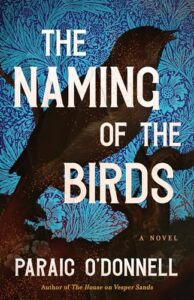
The Naming of the Birds by Paraic O’Donnell is available via Tin House.

Paraic O'Donnell
Paraic O'Donnell's essays and reviews have appeared in the Guardian, the Spectator, the Irish Times, and elsewhere. His first novel, The Maker of Swans, was named the Amazon Rising Stars Debut and was shortlisted for the Bord Gáis Energy Irish Book Awards. His latest novel is The Naming of the Birds