Eight Memoirs About Medicine, Illness, and Healing
Fazlur Rahman Recommends John Bayley, Danielle Ofri, Ayaz Virji, and More
Nothing is more personal than illness and healing. So medical memoirs are not monolithic, and are written by doctors, patients, the loved ones of the sufferers, and others. The eight memorable memoirs here, from the past to the present, the best ones I believe, consist of writers of different racial and economic backgrounds, genders, and faiths.
*

John Bayley, Elegy for Iris
A moving, affectionate tribute to one of the most brilliant minds of her time, a Booker Prize-winning novelist and a philosopher, Iris Murdoch, whose intellect descended into oblivion due to the cruelty of Alzheimer’s disease. This tribute is rendered by no less a figure than John Bayley, a literary critic and novelist himself, a past chairman of the Booker Prize Committee, an Oxford professor, and Iris’s husband of 43 years.
Even with her ravages, he loves her just he as did when the “entrancing, youthful philosopher stole his heart at Oxford’s St. Antony’s dance in 1954.” About one particular Christmas Bayley writes:
…We listen to carols and Christmas music. And I have the illusion, which fortunate Alzheimer’s partners must feel at such times, that life is just the same, has never changed. I cannot imagine Iris any different. …We are born to live only day to day.”
The tragedy is that no amount of love thwarts the march of this disease that gnaws at the victim’s body and soul bit by bit until they give out. This anguish is familiar to loved ones of Alzheimer’s victims from all walks of life, everywhere in the world.

Vincent van Gogh, Ever Yours: The Essential Letters by Vincent van Gogh
This is a memoir of a different kind. Through the artist’s letters to others, mainly to his younger brother Theo, van Gogh shows the destruction of the mind in another way. There are plenty of collections of van Gogh letters, but the definitive collection is this volume by Yale University Press. His letters are a treasure trove for art and literature lovers.
That van Gogh was a genius artist is well-known, but what’s less known is that he was also a thoughtful and intelligent man, and expressed himself in eloquent language in his numerous correspondences to Theo. Many of the letters narrate his thoughts that were a strange mixture of fatalism and optimism. At a certain point of his life, he had a series of attacks of mental illness, accompanied by fear, confusion, and hallucinations. He was put in an asylum with strict surveillance. From there he wrote to Theo: “I want to tell you that I think I have done well to come here, first, in seeing the reality of the diverse mind or cracked people in this menagerie, I am losing the vague dread, the fear of the thing. And little by little I can come to consider madness as being an illness like any other.”
When it comes to mental illness, even in our so-called modern society, how many of us have the astute insight that van Gogh did? That “madness as being an illness like any other”?
In the end, he couldn’t bear to live in agony anymore. One day when he went to paint in the countryside, as he often did, he shot himself in the chest. Two days later, all his suffering ended forever.
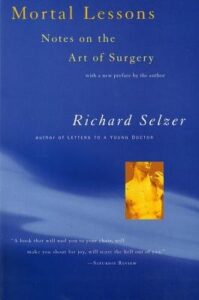
Richard Selzer, Mortal Lessons: Notes on Art of Surgery
I am partial to surgeon-writer Richard Selzer for being a pioneer in medical humanities, and I am a strong advocate of teaching medical humanities to medical students and trainees to make empathetic doctors out of them. This teaching is more urgent now because of tech-heavy medicine and the coming onslaught of AI in patient care.
Selzer’s contemplations bring together literature, history, philosophy, medicine, and ruminations. Ancient Greek names come to him like any other English word to look for clues to medical secrets. He wants to remedy his patients’ affliction and asks, “Is there no mathematical equation that can guide me? So much pain and pus equals so much truth?” He knows his limitations and failings as a surgeon, which check his vanity, and he seems to have more faith in poets than himself: “No, it is not the surgeon who is God’s darling. He is the victim of vanity. It is the poet who heals with his words, stanches the flow of blood, stills rattling breath, applies poultice to the scalded flesh. It is elusive as the whippoorwill that one hears calling incessantly from out the night window, but which, nestling as it does low in the brush, no one sees. No one but the poet, for he sees that no one else can. He was born with the eye for it.”
Selzer also compels us think of something we humans tend to avoid: our mortality. We presume it will not happen to us and not at least for now. Perhaps he thought the same way about himself, too. Then a surgical patient dies on him. “Now there is no more sorrowful man in the city,” he says, “for this surgeon has discovered the surprise at the center of his work. It is death.”
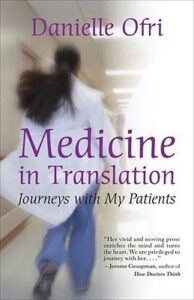
Danielle Ofri, Medicine in Translation: Journeys with My Patients
Many well-known authors of medical stories such as Oliver Sacks and Siddhartha Mukherjee tend to be specialists in one area and work in prestigious private hospitals. Ofri is different. She has a broader reach to the patient world: she is a practicing internist, and she has spent her entire career of more than thirty years in a large public hospital, Bellevue Hospital in New York City. She is a professor, speaker, and editor in chief and co-founder of the Bellevue Literary Review, a respected magazine for medical humanities. She is also a mother of three children and has written six books so far.
The world of Medicine in Translation and Bellevue are a microcosm of the world we live in: a tapestry made of diverse cultures and roots. “What, then, did it mean to be a minority?” Ofri muses. “To some degree, everyone at Bellevue was a minority—whether religious or ethnic—within larger American Society: Muslims, Jews, Hindus, Buddhists, Blacks, Hispanics, Asians.”
To tell their stories, she uses both seriousness and humor in equal measure. On one Yom Kippur, she forgot to block off her time from the clinic, and taking leave required a ninety-day notice. So, it was too late to cancel her patients’ appointments. Now, she felt that her obligation to patients overrode any religious obligation, and the Torah gives room for lapses for the sake of doctoring. But her patients of various faiths admonished her for not observing the most sacred Jewish holiday. One patient cautioned her, “Don’t mess yourself up next year, Dr. Ofri, God’s watching.” The following day she blocked off her schedule for the next Yom Kippur—364 days ahead! Her reasoning: “I couldn’t verify whether or not God was watching, but I knew for sure that my patients were.”
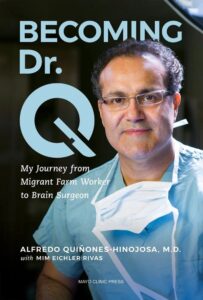
Alfredo Quinones-Hinojosa, M.D, Becoming Dr. Q: My Journey from Migrant Farm Worker to Brain Surgeon
It’s a story of struggles and failures, and triumphs—an inspiring tale in the truest sense. He faced prejudices and brushes with death as a farm worker, and still made a success of himself in medicine.
His nickname was Freddy at first, and then Q to shorten his name. He was born very poor in the tiny village of Palaco, Mexico. At the age of nineteen, he crossed the border to better his future, courting dangers, and became an undocumented migrant farm worker in central California.
He tells of the harrowing hardships and risks the farm laborers endured, and how they were treated as faceless nonentities. When his uncle, also a migrant worker, collapsed in the field after long hours of toil in summer heat, it turned out to be from dehydration, and salt and water brought him around. But Freddy asked his supervisor to get a doctor to make sure his uncle was all right. Freddy was shocked by the boss’s reaction: “He looked at me like I was loco, an insane person. Medical services for migrant workers?” What if his uncle had a more serious illness like heart attack or stroke? “My God…we’re naked out here—completely vulnerable, less than nothing.”
He didn’t know English and took night classes, and through his travails and trials, went to UC Berkeley and Harvard Medical School and became a star student in both. Then Dr. Q. became a world-renowned brain surgeon, a caring doctor and researcher, dedicated to finding the genesis and cure of a menace: a deadly brain tumor, glioblastoma multiforme.
The book is full of wisdom and about offering people a chance. In our dark times, he asks us to remember this: “[The] ability to see the light, to recognize what matters, can be a gift.”
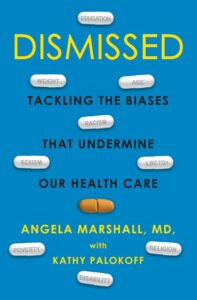
Angela Marshall, M.D., Dismissed: Tackling the Biases That Undermine our Health Care
This memoir is an essential reading and should get more attention from all those who work in medicine. Marshall writes compellingly about her experiences as a Black woman working as a primary care physician, noting that only 2% of practicing doctors in the U.S. are Black women.
Biases in medicine are pervasive in many places, and Marshall narrates the story of the biases she faced growing up poor, as a medical student, as a patient, and in other spheres of living. She also recounts the plight of others due to biases. As a physician and a medical leader, she dissects the myriads of maladies that encompass race, ethnicity, gender, sexual orientation, body size, mental illness, disability, and different cultural factors. Each of these factors shape the diagnosis and treatment of patients, and how we observe and listen. All this makes a difference between suffering and healing, and at times, between life and death.
Marshall shares the cardinal fact in caring for patients: “You cannot really listen to, respect, show empathy for, and believe people if you are operating with an attitude of bias, mistrust, dismissal, or fear.” She gives guidance to ameliorate and reverse this problem. Lest some think it’s an intractable issue, she quotes James Baldwin: “Not everything that is faced can be changed; but nothing can be changed until it is faced.”
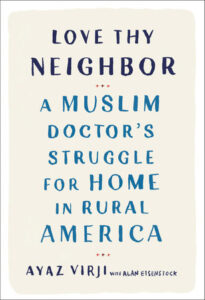
Ayaz Virji, Love Thy Neighbor: A Muslim Doctor’s Struggle for Home in Rural America
It’s a tale about how hate and religious prejudice in our politics can poison the minds of Americans, rural Americans in particular. But they are the victims as much as those they hate.
Dr. Virji received an elite education at Georgetown University and its medical school, and Duke University. He joined a major hospital in Harrisburg, Pennsylvania. He had a high income. But he was unhappy. Why? “Because I was on a clock, forced to attend to a certain number of patients per day, I found myself focusing only on Mr. Smith’s chest pain and not on Mr. Smith.” He wanted to practice “dignified medicine.”
Rural America has a severe shortage of doctors, and Virji wanted to help an underserved community. He moved to Dawson, Minnesota, a tiny farm town of about 1,500 people. He and his family were welcomed, and in short order he improved the town’s medical care. His wife founded a thriving business. And they made friends.
Then came the 2016 election and the hate speeches against Muslims from the reckless politicians. Virjis were the only Muslims in town, and received the brunt of the hate. One of his post-op patients said, “Well you know why we have to get rid of these people from North Africa? They are Muslims.” Virji then said he was a Muslim himself. The patient countered that she didn’t see him that way because he was born here and not there. But though Virji grew up in Florida, he was born in Kenya.
When he wanted to leave Dawson, a friend, Pastor Mandy France, persuaded him to stay. Together, they spoke out to dispel Islamophobia, saying: the basic tenets of Islam are the same as those of other major faiths, and among them are loving and helping your neighbors.
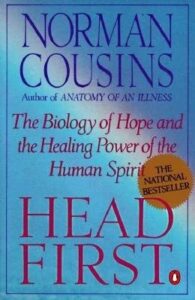
Norman Cousins, Head First: The Biology of Hope and the Healing Power of the Human Spirit
At the UCLA School of Medicine, Cousins taught medical humanities—learning the art of medicine through arts, literature, and philosophy. Science alone isn’t enough to care for patients, because science can’t feel our anguish, our fear. Hence, the humanities is necessary to get insights into human emotions.
His basic theme is this: panic, depression, hate, fear, and frustration damage our health; while hope, faith, love, purpose, and laughter can help fight serious disease. Head First is the follow-up to his Anatomy of an Illness as Perceived by the Patient, in which he describes his disabling autoimmune disease and his healing from it. He felt that sustaining his hope and uplifting his emotion (and taking vitamin C) led to his recovery. Afterwards, he left his editorial job at The Saturday Review to teach his ideas.
These ideas, however, are not new. Over 2,000 years ago, Seneca, the Roman Stoic, explored the same theme in his famous essay, “On the Tranquility of Mind.” He said: “This dislike of others’ success and despair of their own, their minds become enraged against fortune…until they become sick.’’ Later, British philosopher James Allen reiterated the theme in his seminal treatise, As a Man Thinketh: “Good thoughts bear good fruit, bad thoughts bad fruit.” Then my own mentor at Dhaka Medical College 60years ago, Professor S.M. Rab, taught me the value of mind-body medicine, long before it became acceptable in the American medical curriculum.
Still, Cousins counsel in Head First to the graduating medical students at UCLA and Harvard is timeless: “…Even as you attach the highest value to your science, you will never forget that it works best when combined with your art… For, ultimately, it is the physician’s respect for the human soul that determines the worth of his science.”
__________________________________
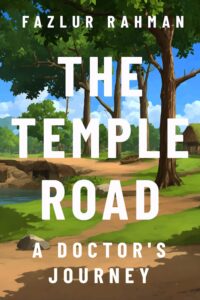
The Temple Road: A Doctor’s Journey by Fazlur Rahman is available from Texas Tech University Press.
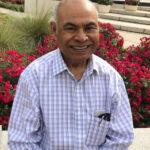
Fazlur Rahman
Fazlur Rahman, M.D. was born and brought up in what is now Bangladesh. After his medical education in Dhaka, New York, and Houston, he practiced cancer medicine for thirty-five years in San Angelo, Texas. He is an adjunct professor of biology (medical humanities and ethics) at Angelo State University, a senior trustee of Austin College in Sherman, Texas, and an advisory council member of the Charles E. Cheever Jr. Center for Medical Humanities and Ethics at the University of Texas Health Science Center in San Antonio. His articles, essays, and stories have appeared in many publications, including the New York Times, Wall Street Journal, Guardian Weekly, International Herald Tribune, Christian Science Monitor, Newsweek, Harvard Review, Short Story International, Dallas Morning News, and Houston Chronicle. He is the author of Our Connected Lives: Caring for Cancer Patients in Rural Texas and The Temple Road: A Doctor’s Journey. He and his wife, Jahanara (Ara), have lived in West Texas for most of their lives and have raised four children. They love walking in nature and going on wildflower adventures.