Eight Books About Women With Secret Lives
Bonnie Friedman Recommends Deesha Philyaw, Azar Nafisi, Annie Ernaux, and More
Women’s lives are prone to secrets. There is so much about ourselves that we are punished for publicly acknowledging – our political and business ambitions, our desire to be rewarded for our achievements, even the existence of sexism itself.
I was driven to write about a woman with a secret in my new novel, Don’t Stop. Ina Rosenbluth is a married Eugene O’Neill scholar who becomes involved with a troubled man who unlocks erotic appetites she never suspected. This affair — ecstatic, but so strange and sequestered away it seems fantastical — begins to threaten the rest of her life. Can she give it up? How, when, although it has utterly infiltrated her being, she hasn’t allowed herself to know it is real?
I have always turned to books to imagine a secret, other life. Here are 8 books that reveal covert lives, truths that society forbids or shames, and an effusion of vibrant spirit.
*
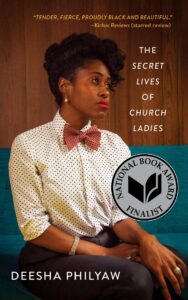
The Secret Lives of Church Ladies, Deesha Philyaw
Stylish, frank, sexy, and full of the song of spoken English, these are first-person stories of women caught between righteous respectability and actuality, and often particularly between a struggling mother’s harsh (and hypocritical) judgment and a daughter’s bone-deep yearning for acceptance and love. Celebratory, juicy, and often packing a punch, Philyaw’s work feels intimate, the sharing of a blessedly honest girlfriend, utterly life-affirming.
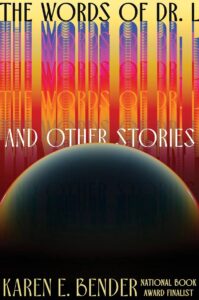
The Words of Dr. L., and Other Stories, Karen E. Bender
Suspenseful speculative fiction about isolated women hiding something dangerous. Pregnancy and a quest for the illegal means to end it in a surveillance society features in one story; people becoming physically (and to them shamefully) invisible due to their being treated with an oblivious daily cruelty that has become endemic centers another. Further stories illuminate emotional realities burrowed deep within enormously likeable characters, often moving the reader (or this reader anyway) to astonished tears. To read it is to sit at the feet of a master of the short story form. Speculative fiction has never been my thing. This book changed that.
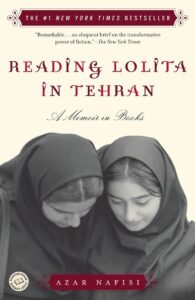
Reading Lolita in Tehran, Azar Nafisi
I read this memoir when it was first published in 2003, and savored its depiction of covert discussions of American novels in a brilliant, expelled professor’s home. Rereading it now, I was chilled to find that as much as Orwell provides a prophetic guide to our times, so does Nafisi, who chronicles daily life as the Islamic revolution transforms Iran. Universities are restructured and faculty dismissed to conform to the new government’s rigid ideological agenda, books are banned, culture leaders targeted, and laws are imposed on women that require they be harshly and even violently policed. The thrill of the secret gatherings remains, but a situation that had seemed impossibly distant now feels disorientingly near.
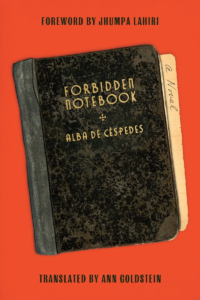
Forbidden Notebook, Alba de Cespedes, translated by Ann Goldstein
Elena Ferrante kept this bestselling Cuban-Italian’s work near, finding it “an encouragement.” Um, endorsement enough for me! Forbidden Notebook is a novel in the form of a diary kept in post-Fascist Rome by a conformist mother. The diary writing nurtures an internal life by giving oxygen to what previously had been ephemeral, easily self-mocked as inappropriate, or troubling. “I have to destroy the notebook, destroy the devil that hides in its pages,” jots our heroine at one point. Sometimes one’s own true wants are infernally difficult to bear.
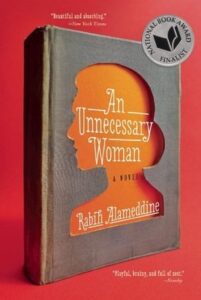
An Unnecessary Woman, Rabih Alameddine
An utterly delectable novel set in Beirut during and after the Lebanese Civil War, about a 72-year-old translator of Western novels into Arabic, an eccentric steeped in books who shares with us her capacious literary sensibility and often bemused vision. Nobody in her often-ravaged city knows about her work. Hers is a life devoted to art despite the fact she was yanked from school and married off at sixteen. A joy of a book, it brims with life perspective. My copy has stars all over the margins.

A Girl’s Story, Annie Ernaux, translated by Alison L. Strayer
A transfixing memoir about a girl transfixed by eros and by a desire to break with the stultifyingly life imposed by her staunch Catholic mother, a life rooted in the town of Yvetot, which Flaubert defined as smug provincialism itself. At the age of 18 (an emotionally young 18), Ernaux is hired as a counselor in a summer camp, her first time away from home. She arrives besotted with the promises of the songs, fashions, romance novels and films whose images permeate the culture, and utterly intent on emerging into a fully lived life. Nobody back home discovers what happened, but that summer brands her with shame and alters her course for years. Ernaux’s signature method of resisting interpretation and incarnating the past plunges us into this girl’s experience. A masterpiece.
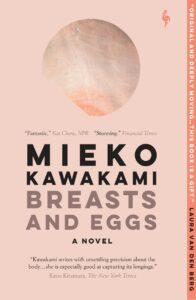
Breasts and Eggs, Mieko Kawakami, translated by Sam Bett and David Boyd
Kawakami is marvelous company. She writes in colloquial, grounded, keenly observant, compulsively readable prose. This pair of novellas is about a middle-aged woman, the heroine’s sister, who comes to Tokyo intent on obtaining breast implants and a protagonist contemplating artificial insemination in a culture that doubts the procedure’s morality. Kawakami puts you in a good mood to read her, as she details the instant ramen and discount beer that the characters have, as well as the wrenching longing that makes the older sister want an augmentation that breaks the younger sister’s heart.
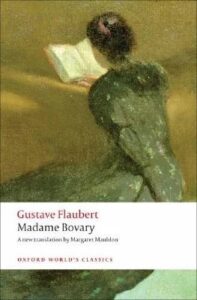
Madame Bovary, Gustave Flaubert, translated by Lydia Davis
“You cannot understand that,” said my high school English teacher when her glance fell on this novel on my desk. I rankled. I understood it perfectly! It was about a woman having an affair. Because I knew the literal meaning of the words, I thought I understood the story they told. And I wondered at this teacher’s greedy need to own and to mystify.
But of course she was right. Since then I’ve read this book at least four times, once a decade. Even now I feel Emma Bovary’s novel has more to teach me, about the ways that fantasy can pollute one’s mind, about how appetites aroused can grow ever larger, ever more corrupt, about how ordinary, mundane life itself can seem an affront, and, beyond this, about the construction of magnificent sentences that are marvels of precise detail: “the musicians cooled the tips of their fingers on their tongues” “she put away . . . her satin shoes, whose soles had been yellowed by the slippery wax of the dance floor. Her heart was like them: contact with wealth had laid something over it that would not be wiped away.”
Every story of an affair has some point of contact with Madame Bovary, and one feels somehow the way that high school English teacher did, possessive, wishing to make special claims, as if the book itself had a tender, intimate message that the Charles Bovarys of the world—i.e. everyone else—can’t understand.
__________________________________
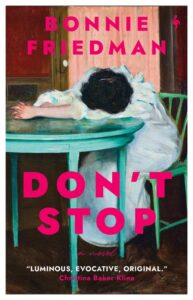
Don’t Stop by Bonnie Friedman is available from Europa Editions.

Bonnie Friedman
Bonnie Friedman is the author of the bestselling book Writing Past Dark: Envy, Fear, Distraction, and Other Dilemmas in the Writer's Life, which has been anthologized in six different writing textbooks. She is also the author of the memoir The Thief of Happiness, and, most recently, Surrendering Oz: A Life in Essays, which was longlisted for the PEN/Diamonstein-Spielvogel award in the Art of the Essay. A three-time Notable Essayist in The Best American Essays, her work has been selected for inclusion The Best American Movie Writing, The Best Writing on Writing, The Best of O., the Oprah Magazine, and The Best Buddhist Writing. Her personal essays have appeared in The New York Times, Ploughshares, Image, The Michigan Quarterly Review and other literary journals.