“Effaced...” A Poem by Jawdat Fakhreddine
Huda Fakhreddine: “I have been reading Jawdat, my father, and his poetry all my life.”
“Effaced…”
by Jawdat Fakhreddine
translated by Huda Fakhreddine
Effaced, our villages,
squares and skies.
Nothing remains but smoke,
and fires roaming freely.
Houses, gardens, fields,
all gone. The spring choked.
No one was there
to say farewell.
The villagers scattered
in all directions,
drowning distant cities
in dark bewilderment.
Effaced, our villages,
carried off by endless war.
It had come for them before,
again and again.
Destroyed, not defeated,
we have reclaimed them many times.
The spring would choke on its waters
for a moment but then
burst forth again.
War has taken over now.
Nothing but smoke and fires
roaming freely, invading
even our graves.
The sky has shattered,
shards fill the alleys.
The roads, rubble on rubble, broken.
Every horizon that once greeted us
now fades, a failed illusion.
Effaced, our villages,
squares and skies,
And our blood, a scattered people.
The spring choked on its own waters.
No one was there to say farewell.
Memory waves in ruin.
Hills bend over valleys like graves
for what remains of us, past and present.
Perhaps our ashes will awaken
to a morning, one day.
Perhaps our homeland will return.
Perhaps it will.
Perhaps we will.
Perhaps…one day.
*
Translator’s Note:
“Effaced are the abodes”… so begins the celebrated muʿallaqah of Labīd b. Rabiʿa, the pre-Islamic poet. A muʿallaqah is a poem that marks time and is not marked by it. “Timeless” is a tired word. In the Arabic tradition, seven poems—sometimes ten, depending on the account—have marked time in this way. The story has it that they were called “the hung odes” because they were written in gold on sacred walls or because they hung in the mind, clung to memory, and marked it too. Whatever the account, these are poems that have not simply endured time, but have mastered it, capturing it in their movements, their tides.
Many before Labīd and many after him across the long arc of Arabic, have begun their poems by standing upon ruins. Since Israel launched this latest round of its genocide against the Palestinian and Lebanese people, we too have found ourselves returning to ruins, again and again. We return to mourn our homes and ourselves, yes—but also to confront time with the music of words, familiar and unforgiving words that alone can steady the shaken soul and trace a passage back. They trace a return from ruin, from aloneness, from grief, if only momentarily, into the fragile possibility of bearing witness, and of continuing to speak.
However, if Labid’s abodes are effaced by time’s slow tyrannies: abandonment and distance, Palestinian and Lebanese abodes are methodically, maliciously, monstrously, erased: effaced and desecrated by the deliberate genocidal Zionist settler-colonial project that has turned life in the region to rubble since its creation. If some, over that last 78 years, were able to look away before, where can one look now when rubble piles up in every direction?
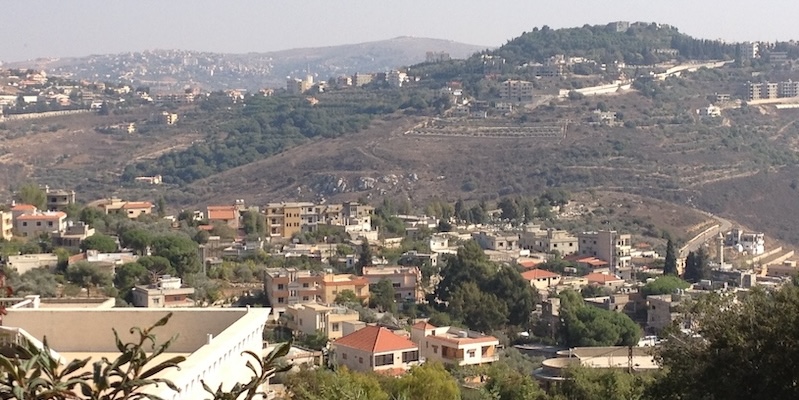
Jawdat Fakhreddine is a poet from South Lebanon. He grew up in a village called Soultanieh. It is named often these days in the list of villages rehearsed on the news. Like many, he has a house that rises from rubble again and again. For this poet, the first place of childhood and language is his village in the South, a place that has continued to exist in defiance of some of the most brutal forces of occupation, aggression, and now unabashed annihilation. And poets need their first places the same way they need an alphabet. Jawdat is the author of twelve poetry collections. Many of his poems since his debut in 1979 converse with the city—Beirut, and many other cities he found himself in through the accidents and treacheries of time. Yet the spark of language, the magic that compels one to build with words in the face of the material history of ruin, always remains in and of the village for Jawdat: that small place where the self knows itself without mediation, hesitation, or translation.
Jawdat composed this poem after the latest round of Israeli terror that was launched on South Lebanon on March 2, 2026. We hear that whole villages are leveled, houses violated, families ordered to evacuate or else face the Zionist death machine as it ravishes the land and its people. He composed this poem in a modernist variation on the same meter Labid chose for his poem, al-kamil: a full sound, homogenous, comforting, complete, a fitting way to hold the shards and pieces of lives we are saving to put together again.
I have been reading Jawdat, my father, and his poetry all my life. At the age of 19, I decided that his best work was a collection titled Manaraton lil-ghariq, originally published in 1996 by Dar al-Nahar, one of the major Lebanese and Arab publishers, which is no longer operating. I began translating it into English. It appeared many years later in the English translation Lighthouse for the Drowning (BOA Editions, 2017). At first, it was an act of rebellion. I wanted to claim my father’s voice as my own in another language, a language he cannot speak. I was too afraid of Arabic—his Arabic—to claim to be a poet, so I became a translator.
But translation, over the years, became more than just an escape; it became a site for negotiating my relationship with my father, my mother tongue, and a poetic tradition to which I belonged but from which I needed, adolescently, to step away. In that wasteland, where the translated text is evacuated of itself and before being reconstructed, however partially, with the material of another language, I learned to want to be in Arabic more fully. To be whole without the effort of stretching oneself out, without the exercise that leaves a bitter taste.
And now, in genocide, the violences of translation lodge themselves in the soul with a different resonance. When Jawdat sent this poem in a text message one morning this past May, amid the news of unrelenting destruction in our village, I found myself confronted once again with the continuity of his grief: a lifetime of worry grounded in language. The poem was both new and old. Urgent yet also our status quo. It repeated an ancient litany of sorrow even as it stood atop a new pile of rubble.
Translating it became, once again, a way of stepping away, of guarding myself through the mediations of another language. Perhaps, I thought, it would lose something of its music there, something of its resonance in my mind. Perhaps I would read it without hearing my father’s voice. Perhaps it would become more bearable. Translation, in this sense, becomes the resort of the distant: those of us who must busy ourselves because helplessness is otherwise unendurable. We move grief from one grammar to another. We mediate and approximate. We play our tricks on the original text, which remains, despite all our skills and maneuvers, an undisputed fact. The original poem exists and belongs to a time much longer than this one. It exists without performance, in a language that neither requires nor desires translation. It simply exists.
And perhaps this is why poetry from South Lebanon and Palestine has always been an affirmation of existence itself. Existence is resistance, not as a right awaiting recognition, but as a fact of the land and its memory. Palestinians and Lebanese exist and persist in their land the way a tree grows and a rock rests. “Who asks a tree for its name? Who asks the valleys who their mother is?” writes Darwish in his poem “Passport,” speaking as a stateless Palestinian, exposing the arbitrariness and injustice of states and their artifices.
We are here, and that is that. Here we are. We leave only to return, without permission, without justification. And we sing. We sing our laments because this is how we intervene in the texture of time, in the way it is lived and remembered.
We stand over the rubble of our homes and call upon our ancient kin—Labīd, Imru’ al-Qays, and others—to join us, so that our grief may remember theirs, and our memory in the places we love may persist as theirs has, still echoing in the ears of time.
–Huda Fakhreddine

Jawdat Fakhreddine and Huda Fakhreddine
Jawdat Fakhreddine is a Lebanese poet and professor emeritus of Arabic literature at the Lebanese University in Beirut. He was born in 1953 in a small village in southern Lebanon. He is currently based in Beirut. He has published over ten poetry collections and two works of literary criticism. He regularly contributed to newspapers and journals across the Arab world. His collection of children’s poems, Thirty Poems for Children, won the Sheikh Zayed Book Award for that category in 2014. His poetry has been translated to French, German, and English. Translated works include Lighthouse of the Drowning (BOA Editions, 2017) and The Sky that Denied Me (University of Texas Press, 2020). Huda J. Fakhreddine is a writer, translator, and Associate Professor of Arabic Literature at the University of Pennsylvania.