







I was twenty-one and taking a train to Prague. The sun was blazing through the dirty windows of the old Czechoslovakian carriage as passengers looked out at the scenery and blew smoke. I was traveling alone, hungover and weighed down with luggage. The compartment reeked of beer and Pelinkovac liqueur, which we’d polished off the night before to celebrate my going away to film school. The parting gift my friends surprised me with was the matching tattoo that still burned on my ribs, but made me feel brand-new, as if it had buried the innocent shy geek whose inhibitions had tortured me since first grade. I was sure of myself—my new self—soaking up the summer sun and the intimations of a bona fide life.
After passing through Slovenia and Austria, the train raced across Czechoslovakia’s monotonous plains. The landscape became flatter and flatter, the tracks older, the conductors sterner and rounder. Before I left, I was told that Czechs were friendly and not to worry about not knowing the language, since Czechs had vacationed on the Adriatic for generations and understood a few phrases in our language. And they were fond of Croatians—especially the women. But failures in communication didn’t scare me. On the contrary, the thought of becoming an exotic foreigner—who smelled of the sea and cited Southern temperament as grounds for her imbalances—thrilled me.
Somewhere in the vicinity of Brno, the train abruptly stopped. I jolted awake. For hours my head had rested against the cold window, my back twisted out of shape, my butt caved into the dusty upholstered seat. The backpack I’d filled with toiletries and makeup lunged from the luggage rack and slammed against my head. I stood up and put it back, feeling the stiffness of my entire body. I stretched and peered out the window into the fog of an unfamiliar landscape. Police lights ate away at the featurelessness of that autumn day. In the adjoining compartment, an older red-haired woman with a tired face and caked pink lipstick stared out the window in the same posture as me, visibly alarmed. I turned my head in the other direction and observed countless other passengers peering through the fog in search of an explanation for screeching to a halt.
“What happened?” I asked the red-haired woman in English, but she merely shrugged and popped back inside her compartment with a shake of the head. She said something in German, but given that I spoke none, I continued to stare into the fog, at the scattered blue and red clouds.
Modřice read the blue sign above a small, one-story house. I sat back down and took a sip of water. I reached for a pack of almonds, but it was empty, and had been for most of the journey.
People stirred about like headless chickens. The sounds of whistling railroad workers, shouting, police sirens, passengers’ unceasing questions in all manner of languages. Soon enough, it became clear the journey from Rijeka to Prague—normally twelve hours—would be even longer. Half an hour passed before we received any information to explain the delay: an accident on the tracks. The conductor rushed through and said in truncated English that the train would be stopped in Modřice for at least another two hours, until the tracks were fully cleared and the accident investigated. For those either hurrying or traveling light, she suggested the bus to Brno, and from there an alternative train to Prague. Since I had two colossal suitcases immobilized by the amount of clothes and shoes, along with a tote full of books and two backpacks, even the thought of catching another train wouldn’t have crossed my mind in time. Plus, I’d already made myself quite at home.
I asked the conductor what kind of accident it was.
“Sebevražda,” she said, shaking her head. Then, taking note of my calflike expression, she added in English, “Suicide.”
Sebevražda—what a funny word, I thought, given it sounded to me more like hexing yourself. Studying screenwriting in Czech would be interesting.
Some guy had thrown himself in front of the train. Information traveled from one compartment to the next through peculiar channels not always ascertainable. All of a sudden, everyone seemed to understand one another. Language barriers vanished where death was concerned. An hour and a half into waiting, I left my seat and went through the now-congested corridor to the bathroom, and the red-haired German-speaking woman stopped me to relay information she’d gotten from a young woman in the first compartment of our train car, a Japanese woman about my age traveling to Berlin with her European boyfriend and two large contrabasses. The suicide had been an older man, about sixty, a local. Railroad workers had supposedly seen him that morning, standing on an overpass and crying, but no one had reacted. The conductor said that around lunchtime they’d tried chasing him away, but the man seemed harmless. He was rooted to the spot, waiting for the train, and boy did he ever.
“Goddamn it—why our train?” a woman from our parts threw in as she passed, pulling a wailing child by the hand.
I thanked the red-haired woman for the information and continued to the bathroom. I stared at my dark-yellow urine, careful not to let the backs of my thighs touch the toilet seat, and weighed the likelihood I would die of thirst if the train stayed where it was for another hour. I had a monster hangover. My body contorted with hunger, and all the food I’d consumed by this point—oatmeal, a banana, a cheese sandwich, an apple, a pack of almonds—had fully dissolved in alcoholic acid. I figured, if nothing else, I’d look thinner for my first day of film school, and the thought drove away my hunger.
The train sat there for four more hours. Night fell. There was blood everywhere, said a guy in the compartment to my left, an Austrian. The wheels had sliced the man’s torso in half, and the investigators and railroad workers were forced to poke around the entire train to eliminate every bit of flesh and bone to ensure we could safely continue on our journey. In that time, I sat in my compartment and wondered why this old Czech man had killed himself. Was it poverty? It was a common cause in the history of suicide, but who knew if it was true now. Had he been unlucky in love? Did he have PTSD? I remembered my nona telling me of her youngish aunt Margita who, at sixteen, had jumped out of her apartment window, a victim of unrequited love. Aunt Margita had fallen for a married man—in an era when marriage was considered an obligatory correctional facility for women. Wanting to end her pain, she had hurled herself from the fifth floor and finished in the courtyard, her skull blooming into flowers. Poor Aunt Margita, I thought. Had she lived some seventy years later, she’d have been bragging about the affair to her girlfriends, not defenestrated. But the old Czech man’s story was likely very different. For some reason I found it hard to believe that someone living in Modřice, of all places, would kill themselves over unrequited love. When I imagined what he might have looked like, I kept conjuring up a double exposure of Václav Havel and Miloš Forman—the only two Czechs whose appearance I knew. All Czechs looked like well-meaning alcoholics, or so I thought, until I undressed a couple of them in the following year.
I was moved, thinking I’d played a part in a person’s death wish. I’d been a passenger on a train that had transported the man to the ultimate destination. I attached terrible importance to it. It couldn’t have been mere coincidence, I thought, there had to be a reason I’d found myself at that very intersection of place and time. Back then, I wasn’t a believer in coincidences. I felt the universe orchestrated everything so I’d always end up where I needed to be when I needed to be there.
The man remained anonymous to me, as did his reason for jumping, though I had only a half-baked curiosity about the matter. I was more interested in my story, my conjectures about his life. I reveled in my projections, which often prevented me from seeing people and things as they really were.
In the daze of thirst and hunger, compounded by how cold it was on the train, I thought back to the summer event that had catalyzed my departure and explained how I’d come to find myself in this situation. Two weeks before I left for Prague, my father celebrated his birthday. It was late July, the heat unbearable, as if the sun had tantrically hoarded its energy and decided to release it all that week. We were in Krk, and I was sitting on a bench overlooking the water, staring at all the people my father had invited to his party, at their white linen clothes, their red noses, sunburned shoulders, salty hair, wrinkled eyes, and sagging paunches. I watched that parade of shambling drunkenness and let the sea waves lull me into a meditative state. I wanted to flee from everything I had known, to discover new people, new places, forget my language and my everyday. I reflected on the beauty of life by the sea, how the Vltava River could never replace the vastness of Kvarner Bay. That much I’d been right about, as it turned out, but I wanted to feel that longing for the sea, the drought you experience from within when you live far from a large body of water.
My father had, in light of this being his fiftieth, put together quite a celebration, chartering a boat to take us from the city harbor to a restaurant off the coast of Krk and ordering a hundred liters of wine for fifty guests, a hedonism not uncharacteristic of him, an anesthesiologist who, though surrounded by death, always found ways to celebrate life and love. His job was to numb the flesh and alleviate suffering, to tame the body so death would arrive not as a shriek, but a wave of warmth that carried you gently onward in your journey. Death’s omnipresence had made my father chronically depressed and, to me, rarely comprehensible. And yet, in a way, I’d always understood him, with few words. He’d been crazy about my mother from the moment they’d met, and considered love—including love for life itself—the center of everything.
He’d say things like: “Greater the knowledge, shorter the life. Only idiots never die.” Even when I was in elementary school, his words kindled my daydreaming about the intensity of true love. “It will absolutely shatter you,” my father would say when I asked how you knew you were in love. “You’ll know, don’t worry.” But romantic love I often ridiculed, and I didn’t believe my father, instead investing my energy into becoming a fearless feminist in a friend group filled with them. However you spun it, waiting to be shattered was just one giant distraction. After the rose-colored-glasses cycle — as my nona called the lovestruck phase — came the cycle of waist-deep shit, which was why I had no desire to fall in love before finishing college and figuring out what I was supposed to do with my life.
The birthday celebration kicked off Saturday morning. At noon, people decked out in white linen gathered around the boat in the harbor, awaiting the official start of festivities — the moment when they’d embark on dulling their senses with chilled booze. In the first hour, my father politely mingled with the guests alongside my mother, who had no trouble entertaining people. She had a kind of innate mechanism for hospitality and sociability, a talent — as the catechist had put it, to my mother’s delight, during my First Communion — for running a household and child-rearing. To me, it was less a matter of talent and more social convention, which my mother mastered with such devotion that femininity and motherhood seemed part of her blueprint. All the guests arrived in pairs.
The women were my mother’s friends, the men my father’s, and they sat accordingly: the women on the upper deck, the men at the bar downstairs. My younger brother, Nino, a medical student and poised bodhisattva with thick eyebrows, was the only other person besides me without a wedding ring or stomach ulcer. We wandered back and forth together from the circle of men to the women, observing these old people, snatching booze and cigarettes, and, mainly, getting bored.
Among my father’s friends was the hairdresser Srdjan, the man I’d lost my virginity to. At seventeen, I had expressed a wish to color my hair blonde, and my mother suggested I see Srdjan, who, at the time, had the best hair salon in Rijeka. Srdjan wasn’t married, but he had twenty years on me and, as my mother liked to mention, a gambling problem. One bleach and three color sessions later, with the desired shade achieved, Srdjan invited me for coffee. It was my final appointment, which he’d scheduled for the end of the day. I was terribly shy around men, but my eyes had that gloss of adolescent desire I neither could nor knew how to conceal. I found Srdjan attractive — like a Liam Gallagher at his career peak. During that coffee, our polite chatter gave way to decoding the sultry subtext. He asked if I had a boyfriend, to which I replied that I had no interest in having one. I wanted only sex — to have something to gossip about with my friends next time we skipped gym class.
Srdjan was drunk, and I was screaming from the pain when it finally happened. Not long after, I let my natural hair color grow out.
We greeted each other briefly on the boat, the kind of exchange hairdressers have when they run into clients on the outside. The farthest thing from my mind was to flirt or give him any false signals. As it was, I preferred fantasizing.
The boat was halfway to Krk when Srdjan and the rest of the men began jumping into the water, elated they could, at least for an hour, release the suppressed teenager within. The women stayed put, civilly drinking their bevanda, their curves concealed with clothes they no longer liked but still wore out of habit. Since beige collared shirts had become just short of a uniform, the women all looked the same: mothers to the grown men at their feet who were splashing around in the sea. I remember thinking how painful it must be, living with the burden of such self-control. No wonder their autoimmune diseases, rashes, allergies, the dark circles of accumulated sadness under their eyes . . . All women started resembling one another as they got older. Maybe because they so rarely heard their own names. Feeling so unlike them, I figured there lay a veritable universe behind the four letters of my name, a universe of limitless freedom, no mistakes or consequences, no gravity or Newton’s third law. A universe where you couldn’t use silence to keep your head above water.
The party soon relocated from the boat to the small harbor on the north side of Krk. Within minutes the picturesque fish restaurant transformed into an open-air nightclub. Welcome drinks were served as guests entered, signaling the party was only just beginning, despite the overall energy having been tempered with the unbearable heat and lukewarm wine. We sat in a section my father had reserved for the occasion. Two of his friends threw themselves into improvising a stage. A band formed, and nostalgic songs filled the room. Although my father had aged before his time, in his total intoxication he sang as if in a stadium. He would occasionally glance at me in invitation, but I left him to solo. I couldn’t dance in public, especially not in front of Srdjan.
Dinner served as a respite from drinking, and then the crowd went wild again. Three of my father’s friends unbuttoned their sweat-soaked shirts and unleashed their hairy chests to the utter horror of the tourist women at the marina. Nino and I made bets on who’d pass out first. Passersby stretched into giraffes, stopping for a view of the stage where my father’s best friend, Julio, had appeared, mic in hand. When they were children, my father and Julio met at the playground in front of the no. 2 bus terminus in Pećine. They were both five and planning to run away from home. Julio was very handy, particularly skilled at building with wood and stone, so he engineered the escape, while my father took care of the vision. After spending a few weeks building a raft from wooden boards dug out from the Rječina River, the two set off on their Huckleberry Finn adventure — although, to be fair, it ended almost as soon as it had started, with the raft sinking the moment they pushed off from shore. Julio’s mother caught them despairing, wet and hypothermic, on the riverbank, and consequently forbade them from playing together. Forty-five years later, the boys remained friends, still without a boat of their own, or the courage to try running away again.
Julio was telling this story about the raft when a young Englishwoman suddenly ran up to him and snatched the microphone from his hand. She pleaded for help, shouting that a doctor was urgently needed. Confused, everyone looked in the direction she was pointing. My mother was convinced it was some tasteless prank the friends were playing on my old man. But the Englishwoman was trembling, and there were two women standing by a docked boat, waving toward the restaurant, the air pierced by their screams. My father ran for the boat. Nino followed. At that very moment, a waiter had come out onto the terrace, pushing a cart with an enormous birthday cake. Discomfort swept through the restaurant like a tsunami. The band stopped playing. In the cluster of fishing boats at the very edge of the quay running parallel to the restaurant, a fisherman had succumbed to the heat. Heart attack. My father and Nino jumped onto the boat, where the fisherman lay unmoving. My father began resuscitation and ordered Nino to massage the fisherman’s chest. An ambulance rushed into the parking lot, and two bewildered young paramedics ran to the boat. My father grabbed adrenaline shots from their bag and injected them into the fisherman’s neck some minutes apart. This would be the time to mention that the birthday cake was shaped like an anesthetic syringe.
Nino massaged the man’s chest, while my father blew air into the ever more lifeless body. We watched from a distance, lined up like seagulls on the pier. High on his own adrenaline, Nino followed my father’s instructions and imitated his hands. The bond between father and son became more real somehow, almost tangible. As if we could see, even from this distance, the connection being born, the making of a new umbilical cord that would forever connect Nino to our father.
The fisherman died. The two women, his wife and his teenage daughter, sat wailing beside his body on the waterfront. We watched the colorful summer scarf on his wife’s head turn into a black veil. Off to one side, a black dog was barking as he scratched at the white wood of the boat.
We returned in silence to the restaurant. Nino sat down beside me, downcast, his mouth dry and hands trembling. My mother approached and hugged Nino, telling him to go to the bathroom and wash the sweat from his face. Julio signaled the band to continue with the birthday program. The waiter returned with the now-molten cake. My mother’s eyes searched for my father. He was standing on the waterfront, comforting the newly widowed woman. He then climbed down onto the boat and covered the body with a sheet. The coroners soon arrived, and my father came back into the restaurant. He drank a double cognac and cut into the cake. He grabbed my mother around her waist and pulled her toward him.
They danced to a Sinatra ballad. Sweat dripped from his forehead onto my mother’s shoulders, and my mother held him as if she would never let him go.
The train was finally moving again. They’d scraped the old Czech man off the tracks, and the train set off full speed into my future.
__________________________________
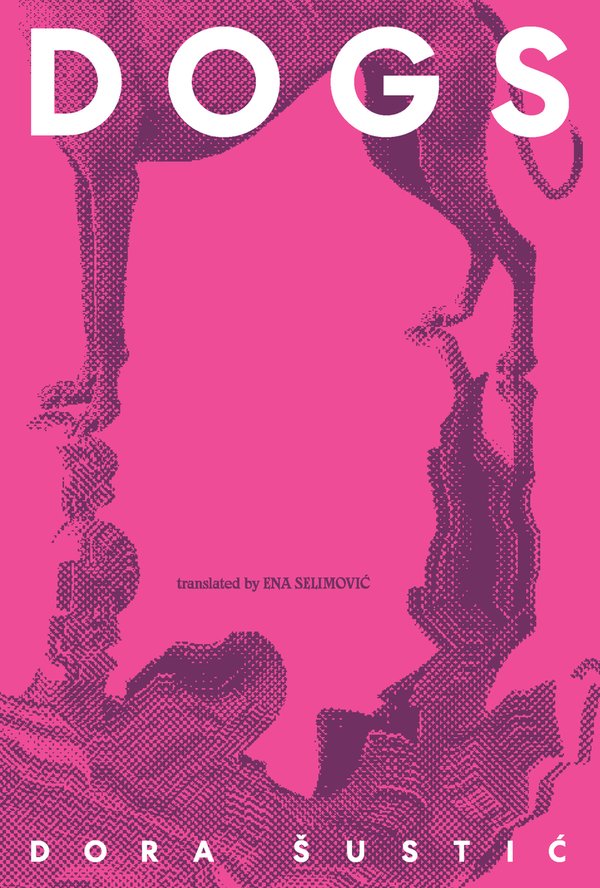
From Dogs by Dora Šustić, translated by Ena Selimović. Used with permission of the publisher, Sandorf Passage. Copyright © 2026.