Do Smartphones Belong in Fiction?
Ankur Thakkar on Navigating Technology on the Page
This first appeared in Lit Hub’s Craft of Writing newsletter—sign up here.
The novel has always been obsessed with technology. You can trace realist fiction’s evolution along advances in religion, banking, engines, and cities, because all of these technologies changed how we think and move through the world. The rise of major metropolitan centers around the world, for example, brought with it Baudelaire’s flâneur just as transcontinental railroads made narrative skips in space and time more legible. As the efficiency that came with industrial factories made it impossible for any individual to fully understand the world’s systems of production, the focus shifted inward, giving us the rise of free indirect discourse, a screw that modern novelists have been turning ever since.
Which brings us to the internet. My novel Blow Yourself Up begins when smartphones make their way into high schools and follows the rise of platforms and influencers, ending just before the dawn of AI. So it was natural to include texts, notifications, comments, and voice commands. But what is the right way to represent digital media in a novel that not only includes the internet but is about the internet?
Contemporary novelists have experimented with this in many ways, some even building the entire text from digital artifacts. I’m thinking of Calvin Kasulke’s hilarious Several People Are Typing, composed of Slack messages, or Jennifer Egan’s “Black Box,” an 8,500 word short story first delivered in 607 tweets. Then there are novels that just feel online, deploying punchy paragraphs with ample white space, juxtaposing the everyday with the incendiary, the poetic, and the absurd. Patricia Lockwood and Jenny Offill are masters of the form.
But these approaches didn’t feel right for Blow Yourself Up, because while other media are prevalent, the story is told in traditional prose through sequential scenes. For this type of novel, authors have used type treatments, unique sections, chat bubbles, or timestamps to give the reader a clear visual distinction between the text and a text, which I didn’t love, because it insinuates a hard distinction between real life and screen life. I realized, when trying to articulate this to my editor, that an underlying thesis of my novel is that everything happens so much. We drop memes into conversations. A text from a friend is no less important than what they say in front of you. We integrate what’s on our phones with the world around us.
I don’t mean to suggest that looking at a painting on your phone will ever come close to encountering it in a museum. Or that to take a photo at the top of your hike is the same as remembering it later (recent studies have proven otherwise). I’m unequivocally on team embodied reality, a phrase whose existence saddens me. But the digital ephemera in Blow Yourself Up is as unadorned as possible, because I don’t think we see the bubbles around our text messages. We just read them. I’m trying to complicate the supposed boundary between the digital and the real, and bring them both into the characters’ interiority because this is how the internet actually feels. It’s the most accurate rendering of actual cognition.
There’s a scene where my main character, Payal, is on a date with a nice man from an app. The date is going okay, she isn’t in danger of anything besides boredom, but then she gets a notification: her video has gotten reposted by a huge account. Anyone who’s experienced this knows that what follows isn’t the best. She’s balancing the influx of likes, comments, and followers, with sitting at the dinner table. She’s in two worlds, the digital enmeshed with the real. Because Payal’s date isn’t aware of what is happening, I was able to dramatize the gulf between them. As he signals for the check, the date marvels at how close his apartment is to the restaurant. Poor guy.
Readers will decide if this approach worked. Blow Yourself Up is a love story that tracks the evolution of the internet from toy to utility to hellscape, the core technological advance of our lifetime. If I succeeded, the internet should feel as ordinary as the glass portals in our pockets, freeing the fiction to examine who we are and how we’ve changed because of it.
__________________________________________
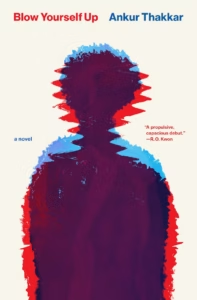
Blow Yourself Up by Ankur Thakkar is available via Triquarterly Books.

Ankur Thakkar
Ankur Thakkar is a writer and multimedia artist whose stories have appeared in Guernica, [PANK], and TriQuarterly. He was a 2025 Sewanee Writers’ Conference Scholar and his artwork has been exhibited at the Palais de Tokyo and La Friche la Belle de Mai. He lives and works in Brooklyn.