“Do Indians Still Exist?” On Intergenerational Trauma and Indigenous Resilience
Blair Palmer Yoxall Remembers the Family History That Inspired His Debut Novel
Treat Them as Buffalo fertilized when I was five, riding in the backseat of my mom’s blue minivan along Cowboy Trail in the Alberta foothills.
“Do Indians still exist?”
I’d seen Indians in Westerns and comics and TV. They frightened me. From the rearview mirror, my mom seemed embarrassed when she chuckled. I knew my mom and I were Indigenous because her dad was. But the Indians I’d seen in movies dressed nothing like the people in my mom’s family. The Indians in Westerns had war paint and whooped like savages. The Indians in my family were all cowboys and cowgirls.
Then when I was thirteen, my maternal grandfather passed away. My mom remembers my grandpa having an uncomfortable relationship with his mother. But I was close with my mom. Why couldn’t grandpa be close with his? By that point, I’d lived a pretty white life except the time I’d spent playing hockey on Stoney Nakoda and Tsuut’ina land, and watching the Calgary Stampede with Blackfoot and—I now recognize—other diasporic Métis people and people who are mixed. Other than being close with my enormous extended maternal family and some other unglamorous aspects of my mom’s family that distinguished us from my white dad’s family, I didn’t think much about being Indigenous as a preteen. I didn’t know what Métis was, but I knew I wasn’t ‘real Cree’ because I didn’t live on a reserve. Whatever kind of Indigenous my mom and I were, I thought it died with my grandpa.
Learning about my grandpa’s and great-uncle’s presences in residential schools, I recognized that the echoes of racism and shame in my family carried colonial vibrations, and subsequent embarrassment for being colonized.
After he died, my mom struggled to fill out his Common Experience Payment forms for being a residential school Survivor. Before then, I’d learned a bit about residential schools in classes. I learned they were government-mandated and church-run institutions that brutally forced Indigenous children to assimilate into a hostile culture. I learned how some children were abducted to attend schools, how other children were sexually and mentally abused by Christian men and women they trusted, how mean bullied children could be to other children, how so many children came home as interlopers in their own ancestral cultures. I knew that residential schools usually left generations of abuse and trauma behind—shorter lifespans, suicide, alcoholism and addiction, poverty, shame—which had their respective echoes in my family’s closets. At their most effective, residential schools left Survivors ashamed and confused about being Indigenous. When I learned my grandpa was one of those Survivors, I knew we were ‘real’ Indigenous people too.
Before he died, my grandpa told my mom that he blamed his mother for sending him and his brother to residential school. He thought she abandoned them. He told my mom in his old age he realized his mother didn’t choose to send his brother and him to residential school because she didn’t love them enough; she sent them to residential school because she had to.
Learning about my grandpa’s and great-uncle’s presences in residential schools, I recognized that the echoes of racism and shame in my family carried colonial vibrations, and subsequent embarrassment for being colonized. The combined disgust, discomfort, ignorance, and fascination with our Indigeneity that unsettled my aunties and fascinated my cousins made more sense to me.
I wanted to write a novel for my grandpa and his mother. I knew I had to reimagine my grandfather’s relationship with his mother in which he could understand how much his mom loved her son and wanted to keep him—I had to reimagine a world in which my great-grandmother gets to save her son from the horrors of colonization. I wanted to write a book I wish my grandpa read so he could see power in himself and his mother as Métis people. Treat Them as Buffalo is, in part, my attempt to respect the lives and decisions of my great-grandmother, Sara Desjarlais, and my grandfather, John Palmer.
I centered my novel on Indigenous motherhood and colonial interference into Indigenous motherhood to embody forms of state sanctioned child abuse towards Indigenous women and children. At its core, the novel emphasizes communal resilience and individual survivance. We still exist. Like I embody my ancestors’ legacies, Treat Them as Buffalo is my legacy. I hope my novel makes it safer for more Métis people, Indigenous women, and Survivors of abuse to tell their own stories.
______________________________
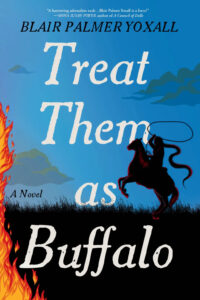
Treat Them as Buffalo by Blair Palmer Yoxall is available from Algonquin Books, an imprint of Hachette Book Group.
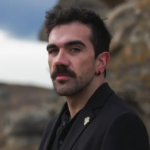
Blair Palmer Yoxall
Blair Palmer Yoxall (he/him/his) is a writer and poet. His fiction won the 2015 Striking Prose Competition Sponsored by Terry Whitehead and the 2019 James Patrick Folinsbee Prize in English, and has been shortlisted for a 2017 Norma Epstein Foundation Award and a 2019 Indigenous Voices Award. His poetry and fiction have appeared in glass buffalo, The Fiddlehead, and Carving Space: The Indigenous Voices Awards Anthology. Yoxall is a citizen of the Métis Nation of Alberta and of Métis and settler parentage. He holds an M.A. in English in Indigenous Literatures and Westerns, and enjoys fly-fishing in the Alberta Rockies. Treat Them As Buffalo is his debut novel. Follow him on Instagram @atayookee.