Claire Vaye Watkins on Writing a Love Letter to the Mojave Desert
Jane Ciabattari Talks to the Author of Yellow Pine
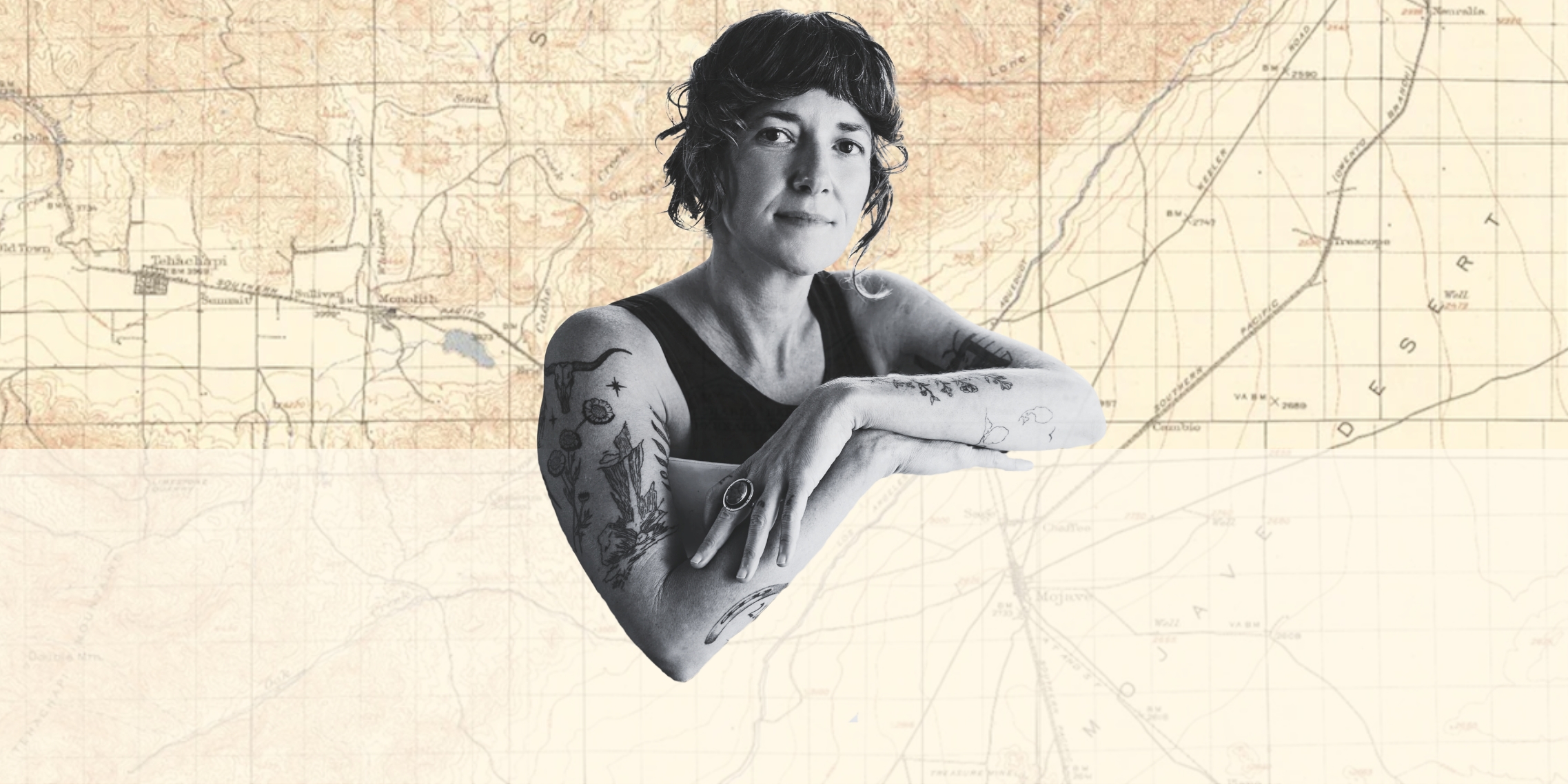
The Mojave Desert is in Claire Vaye Watkins’s DNA. She was born in Bishop, four hours away from Tecopa, the town in Death Valley where her parents lived, which had no hospital, raised in Tecopa and across the state line in Pahrump, Nevada. Growing up in the Mojave, she told John Freeman for Alta’s California book club, your reality is “draining lakes and bombing places…making them toxic for effectively ever.”
The Mojave looms over the stories in Battleborn, her first collection. Battleborn was launched in May 2012 in New York City at the home of her agent Nicole Aragi and then Granta editor John Freeman, at a desert-themed party co-sponsored by Riverhead Books, Granta, the Paris Review and One Story, featuring cacti, geodes, and custom cocktails named after the opening story, “Ghosts, Cowboys”: The Ghost, a smoking absinthe corpse-reviver variant involving dry ice, and The Cowboy, a tequila grapefruit drink.
The book put Watkins on the map, winning the Story Prize (I was one of the judges), the New York Public Library Young Lions Fiction Award, the American Academy of Arts and Letters Rosenthal Family Foundation Award, and garnered her a Guggenheim award and a spot on the National Book Foundation’s “5 Under 35” fiction writers of 2012. I picked Battleborn as one of my top five story collections of the year at NPR.
Her first novel, Gold Fame Citrus, is also set in her desert homeland (“though much of the Mojave is buried under a giant sand dune in that one,” she points out to me), as is her novel I Love You but I’ve Chosen Darkness, in which a new mother facing postpartum depression retreats into the desert.
“The place is my muse,” Watkins acknowledges. “I’ve returned since I moved away at eighteen, and now I have a sweet little trailer here in my hometown. I’m lucky to work semi-nearby at UC Irvine and get to come out here when I’m not teaching. I think I used to be more romantic about it, more nostalgic, driven by grief and longing. Living here again as an adult, I’m getting a sharper and more complex sense of the place as it is today. I feel closer to seeing it as it really is. I’m mellowing out, letting the place reveal itself to me.”
The Mojave simmers deep beneath the surface of her new novel, Yellow Pine, which follows Rose, who returns to the desert she knows well, reconnects with a former love and aligns with an activist group resisting the incursion of a corporate data center. “Yellow Pine is home to about 90,000 old-growth yuccas and, until recently, 139 adult desert tortoises.” Watkins writes in an essay for The Believer. “It’s an undulating creosote sea that I credit for making the air I breathed throughout my girlhood….from Yellow Pine one looks up to Mount Charleston, the highest peak in the Spring Mountains and a key site in the Salt Songs, the ceremonial creation myth song cycle of the Nuwu.”
*
Jane Ciabattari: The opening lines to Yellow Pine—“Miles came back to Rose transformed. I mean transformed! Not a cell of him was where she left it”–set up an intimate love story that has its starts and stops not only in the past but in the weeks to come. (I do wonder who the first-person I is?) What inspires you to write about returning to love, trying again—such a vulnerable endeavor?
Claire Vaye Watkins: That first-person I voice is a mystery, isn’t it? Maybe the mystery. It reappears one or two other places, depending on how you count it. I’m thinking of something Flannery O’Connor wrote: “Fiction is the concrete expression of mystery—mystery that is lived.”
In my fiction I try to say (as beautifully as I can) what I see. I try to see the land as it sees me. Maybe I write to show myself what I believe in.
The vulnerability involved in a reunion drew me to that plotline for sure, especially the courage required to try anything again. Partly this came from my relationship with the form, from me facing the daunting prospect of writing a novel again, after the years-long Herculean dead lift of the last one. And because I’d moved back to the desert and spent a lot of time watching the sky, I became obsessed with return, circularity, the recursive. I was seeing all these loops everywhere, wondering to what extent do we ever do anything “again.” And I noticed that reuniting lovers freaked people out, which interested me. Because retreat and return is a natural pattern. Relationships ebb and flow—if they’re alive (and the good ones are) they undulate. Not just between lovers but parents and kids, friends, neighbors, one’s relationship with herself and beyond. This is not to suggest I’ve mastered riding these waves! Mostly I was riffing on moment in a Joy Williams essay from her collection Ill Nature, which my main character Rose carries around with her like a talisman: “Time is repetition, a circle. This is obvious. Day and night, the seasons tell us this. Even so, we don’t believe it.”
JC: Rose, who is working as a fundraiser for the Sierra Club, is turning forty. She is put on leave and relocates to Nothingness Flats, “a cinder-block cabin on five acres of treeless desert in Tecopa, a defiantly unproductive jackrabbit homestead.” “Thoreau in the Mojave,” as Miles puts it. She’s returning to her desert home, only forty miles from where she grew up, as well as to Miles. How crucial do you see these returns, these rediscoveries, to her midlife reawakening?
CVW: This book is about disillusionment and re-enchantment. Re-enchantment requires re-seeing. Rose is a helper, an idealist desperate for a better world, which for her means decarbonizing the economy by building a better society in the process. Obviously, that is not happening. She is profoundly frustrated by decades of deny and delay, despairing even, completely fed up with our impacted social order and trying to force a different future. The stupidity and greed of the status quo threatens to drive her insane. What keeps her intact is her rootedness, what Wallace Stegner called being “a placed and not a displaced person.” That she’s in her home, has neighbors and friends she loves, knows the history and culture of the place, has opened herself up to the various thinkers and seers there, including people from her past, including the dead. The returns are deepening. They give her ballast so she can face the truth of here and now.
JC: What motivated you to center this new novel, indeed name it after Yellow Pine, a place you call “ a construct,” “an invented place, invented to be owned,” a “new name given by NextEra Energy—a Florida energy conglomerate valued at $175 billion—to a five-thousand-acres trapezoid of formerly public land”? Is this a real development?
CVW: Yes, Yellow Pine is a real for-profit industrial solar array near my house. I started going out to the site during the pandemic, before there were stakes in the ground. Watching Yellow Pine be built, it struck me as a perfect setting for a righteous parable about how absurd it is to trust capitalism with the energy transition. The goal of an investor-owned utility (like NextEra, the corporation that built Yellow Pine) is profit. The goal of a renewable energy transition would be the preservation of life on Earth. Going back to Flannery’s notion of fiction being the concrete expression of the mystery, Yellow Pine struck me as a concrete site from which we might watch these incompatible goals cleave, and watch people live into the mystery of what that does to their psyches, spirits, etc. to be subject to such profound sacrifice for such a dumb reason. How to carry on in the face of that. I also just wanted to see the place before it was killed, and writing is how I see best.
JC: What were the names for this place in past eras?
CVW: Yellow Pine is in the South Pahrump Valley, part of Newe Segobia, unceded territory of the Western Shoshone Nation, which is entitled to the land per the Treaty of Ruby Valley. “Pahrump” in the Southern Paiute language means water from the rock, a reference to its being on the Amargosa River, which is largely subterranean and surfaces as a chain of springs. (Sadly the spring near Yellow Pine has gone dry from groundwater depletion, as have other springs on the Amargosa.) The area is important to many tribes, including the Timbisha Shoshone and the Pahrump band of the Southern Paiute. It is also on the Salt Songs Trail, a mythic ceremonial song cycle and oral map of the region sung by the Chemehuevi band. It’s on “the Old Spanish Trail,” a 1600s trade route from New Mexico to the California coast used by Spanish colonizers. It was briefly the southern frontier of Deseret (the Mormon nation). The U.S. eventually called it Clark County, Nevada. Most of the time it was unnamed yucca-creosote forest, home of desert tortoises and kit foxes and countless other creatures since at least the last Ice Age.
JC: The building of data centers in relatively isolated areas is a 21st century phenomenon, happening on a global level. How extensive has this building become in the Mojave?
CVW: Experts (like my friend Patrick Donnelly, the Great Basin Director at the Center for Biological Diversity, or the local environmental watchdog Basin and Range Watch) describe the industrialization currently underway in the inner mountain West as an absolute bloodbath, and I agree. The entire region is being transformed from beautiful, wild, healthy, relatively intact and super biodiverse habitat to an energy sector sacrifice zone. The scale is mind-boggling—Yellow Pine, huge as it is, is just one tiny square on a vast patchwork of industrial arrays proposed or under construction on public land across the whole region. Boosters of these huge energy projects, like “Green Link” in Nevada, have been very cagey about where the electricity will go. It’s not going to the local communities most impacted by the change, we know that. As they’re going forward we’re seeing evidence that much of the energy from a place like Yellow Pine will probably be used for data centers.
So it’s not serving regular people’s need for renewable electricity, but going to power AI and other unnecessary, destructive tech shenanigans. Taking it all in, the social and environmental cost of this junk is, I think, even worse than most data center opponents realize, which is shocking. A tragedy. And in the Mojave and Great Basin it’s not just industrial solar: geothermal, mining and unsustainable agriculture are also doing irreversible damage out here. This is some of the last unspoiled land on the continent, habitat for many, many endangered and endemic species, but sadly it’s being killed by Silicon Valley and Wall Street.
JC: How long have you been tracking the green-energy gold rush in the Mojave? What have you seen? What luck are the residents of this area having in resisting?
CVW: I’ve been watching waves of attempted plunder out here my whole life, but started paying attention to the “green energy gold rush” around 2016. Watching the Yellow Pine array closely, through the whole process, got me deep into the issue. Partly this is because the array is in the valley where I grew up, but even more it’s because the gatherings there were the most surprising protests I’d ever been to. The group included people from across the political spectrum and beyond it, many of them people who otherwise didn’t participate in politics at all. The language there was clear and plain and persuasive. When I talked to regular people about the issue they were shockingly curious about the distinction between privately-owned industrial solar on wilderness versus distributed solar in the built environment and on already-ruined land. It’s common sense—people want solar panels on their roofs, shade in parking lots, a more resilient local grid. They see free renewable energy as a human right. People I talked to about Yellow Pine were not as entrenched and defensive as most of us have become on most issues. We probably did not agree on many other issues.
At the risk of being corny, I think helping people transform that fear of the desert into something more loving is one of the reasons I’m here.
There have been a lot of wins: a solar moratorium in Nye County and a temporary mineral withdrawal to prevent lithium mining on the Amargosa River watershed. There’s been an upswell of support for a proposed Amargosa Basin National Monument. There was a great piece in Harper’s on the impact of Green Link in Beatty. Over the years I’ve noticed environment writers being a little more precise and discerning about solar. Most immediately, activists got the Yellow Pine site to be smaller than it was going to be, and also insisted the vegetation be “mowed” in some places, rather than the whole thing scraped completely. So they saved that much clean air and water and a whole lot of living things, including a Joshua Tree forest in the array’s original footprint. Wins happen all the time, but they’re temporary, and usually the enemy’s wins are permanent. Realistically, without dramatic structural reform, these companies will more or less keep doing whatever they want.
JC: Is there a real-life model for Fran, the “ecofeminist Whitmanic poetess of equine bearing on hiatus from her PhD at UNLV, [who has been] living at Yellow Pine since the array’s initial application was approved”?
CVW: Yeah, Fran is partly inspired by my friend Shannon Salter, a poet who did live out at Yellow Pine for a long time, watching, hosting gatherings, and documenting what she saw. There’s some Laura Cunningham (of Basin and Range Watch) in there too, some Amy Noel, and of course the legendary Dann Sisters.
JC: You write with loving detail of the natural world—the “ancient and winsome yucca colonies shining with supernatural stamina, the creosote rings haloed,” the Joshua trees, the hundreds of endangered tortoises living at Yellow Pine. Nature is as rich in the Mojave as other places, yet is considered” empty” or “barren” or a “wasteland” by the “malevolent swindlers who needed it so: mining, energy, peddlers of cheap, ugly, toxic housing developments and warehouse park exurbs, the defense-sector barons cashing in on the bases blasting the living land into oblivion…” Is your writing of this landscape a way of preserving a memory, perhaps saving it?
CVW: Thank you for calling it loving. I try for that. It’s an attempt to say thank you, I think. The way I see it, this place is being destroyed for no good reason and most of us have not even looked at it. It reminds me of another observation of Flannery O’Connor’s (forgive me, I am rereading her letters, speaking of returns) that “there is a fine grain of stupidity required in the fiction writer.” Whatever the opposite of ADHD is, fiction has it. And (good) fiction’s way of looking is not passive. “It is popular to believe that in order to see clearly one must believe nothing,” Flannery says. “This may work well enough if you are observing cells under a microscope. It will not work if you are writing fiction. For the fiction writer, to believe nothing is to see nothing.” In my fiction I try to say (as beautifully as I can) what I see. I try to see the land as it sees me. Maybe I write to show myself what I believe in.
JC: The Mojave was not a “beginner’s wilderness,” you write. “It was the sage’s country, rewarding study and slowness, humility and mystery. The Mojave favored a mystic bent…” How did you develop the stages of desert wisdom Rose is exploring, and Miles begins to experience? (The first stage, fear. Then the Hills Have Eyes stage, then expansion—Rose begins to connect with an inner voice, a “calm clear voice” the “voice of the horizon.” )
CVW: I developed this theory half-jokingly over the course of many years hosting visitors in the desert and watching its effects on them. I probably started this watching in the rock shop and museum my mom ran, where part of her job was to interpret Death Valley for tourists so they could experience the sublimity they came for without, you know, dying. Fear is a good instinct in the desert. It’s also the instinct the capitalist tries to exploit when framing the desert as empty, barren, dead and therefore killable. That thinking enables compulsive accumulation via extraction and war—we notice the Mojave is riddled with military bases—the despoliation at Yellow Pine is an extension of that of the Nevada Test Site, Creech, etc etc etc.
Most people arrive terrified and as Dune famously advised, let their fear move over them and through them. That’s when things get interesting. They change their minds, notice all the life in a place that seemed scary and lifeless. Watching that process has inoculated me against my misanthropy. At the risk of being corny, I think helping people transform that fear of the desert into something more loving is one of the reasons I’m here.
JC: Ambivalence about motherhood is a throughline to your recent novels. What inspired you to write of a woman who yearns to have a second child and sets out on a determined quest to become pregnant—first by Miles, her former partner, and then through a “Swirl,” with a range of men she knows?
CVW: I mean, basically I just thought it would be hot. In a few ways. It takes a lot of energy to write a novel. I need to mine molten emotional states to do it. I’ve experienced very few conditions more intense than wanting to have a baby. Rose is not ambivalent about motherhood; she’s monomaniacal about it. But it’s not something she can will into being. Bill McKibben is fond of saying that the challenge with decarbonization is it’s a “timed test.” So is trying to having a baby in midlife. Pressure like that is great for story, the sense of a ticking clock, the monthly reminder that Miles and Rose, two people trying to figure out how to be and how to be together, must do that in time. Contrary to the death-cult logic of endless growth they so oppose, Rose and Miles know they are up against real limits. They are alive, subject to the mystery. Tough to live that, but fun to write it.
JC: You make continual references to and quote from writing about this West, including writers like Joan Didion, Ed Abbey, Mary Austin (the “Whitman of the West”), Lydia Davis, and Melville.What other authors inspire this work?
CVW: Writing this book I became fascinated by the Buddhist/Taoist idea of interdependence, and a similar idea in the published speeches of Corbin Harney, the late spiritual leader of the Western Shoshone Nation and one of the leaders of the global peace movement that stopped nuclear testing not just at the Nevada Test Site but all over the planet. It’s easy to be rosy and woo-woo about how we’re all connected, but I find that idea really knotty actually, especially in a society as sick as ours. Rose’s instinct (one I find very tempting) is to become a hermit, to retreat from the society that hurts her. She thinks she’s a rugged individual, which is a pretty painful way to think, and in my view totally mistaken. I wanted her to be confronted by the fact of interdependence, to have to contemplate the complexity of it.
So she communes with books and tries (with varying degrees of success) to use them to connect others. I had a lot of fun writing a long, wacky scene where she’s riding her bike around town with a backpack full of her favorite bummer nature books drunkenly haranguing everyone she meets. She’s right, but also self-righteous and at times a snob. But also if it weren’t for books and art, someone like Rose would probably go immediately mad. She’s a loner, but can sometimes become unalone through the art of people like Kim Stringfellow, Sallies Zanjani and Denton, eco-socialists like Ben Ehrenreich and Ashley Dawson, musicians like John Craigie and Lucinda Williams, a bunch of religion and nature writing, and anonymous Twelve-Step literature.
JC: What are you working on now/next?
CVW: I have a couple new book projects going, and I’m also writing a documentary. It’s kind of a tour of everything discussed above, all the beautiful and strange lifeways along the Amargosa River. It’s called Lorehole. To underscore our Luddite sympathies it’s being shot entirely on film. It’s another return, another pass over the same terrain trying to show people what’s a stake out here, to look long where the profiteers would rather we look away.
____________________________
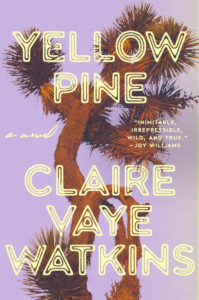
Yellow Pine by Claire Vaye Watkins is available from Riverhead Books, an imprint of Penguin Publishing Group, a division of Penguin Random House, LLC.
Jane Ciabattari
Jane Ciabattari, author of the short story collection Stealing the Fire, is a former National Book Critics Circle president (currently on the Advisory Board ) and a member of the Writers Grotto and Page Street. Her reviews, interviews and cultural criticism have appeared in NPR, BBC Culture, the New York Times Book Review, the Guardian, Bookforum, Paris Review, the Washington Post, Boston Globe, and the Los Angeles Times, among other publications.