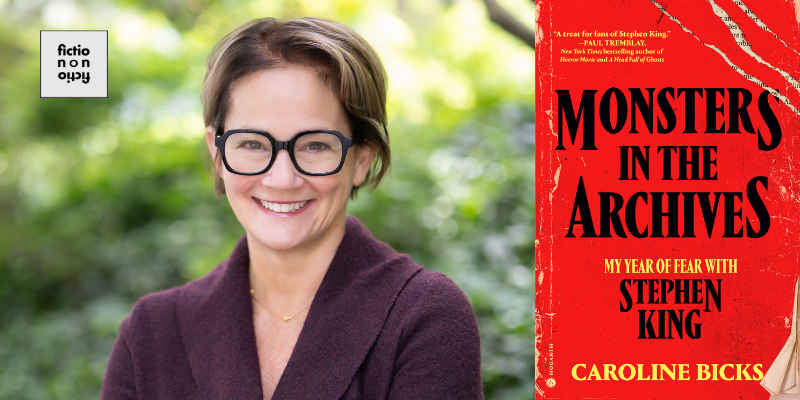
Caroline Bicks on Stephen King’s Archives of Horror
In Conversation with Whitney Terrell and V.V. Ganeshananthan on Fiction/Non/Fiction
Writer and scholar Caroline Bicks, the Stephen E. King Chair in Literature at the University of Maine, joins co-hosts Jennifer Maritza McCauley and V.V. Ganeshananthan to discuss her time in King’s archives, an experience which resulted in her new book Monsters in the Archives: My Year of Fear with Stephen King. Bicks talks about meeting King and exploring his early drafts, dramatic revisions, exchanges with readers and editors, and undergraduate columns. She situates five of King’s earliest novels in the context of his personal experiences and deepest fears and also considers how she understood the books as a younger reader, as well as what it was like to revisit them. She reflects on King’s writing process and his unique use of language, showcasing how King is not just the king of horror but also a master of craft. Bicks, McCauley, and Ganeshananthan discuss their experiences with King’s novels and the intimate and personal nature of horror writing. Bicks reads from Monsters in the Archives.
To hear the full episode, subscribe through iTunes, Google Play, Stitcher, Spotify, or your favorite podcast app (include the forward slashes when searching). You can also listen by streaming from the player below. Check out video versions of our interviews on the Fiction/Non/Fiction Instagram account, the Fiction/Non/Fiction YouTube Channel, and our show website: https://www.fnfpodcast.net/ This podcast is produced by Jennifer Maritza McCauley, V.V. Ganeshananthan and Whitney Terrell.
Monsters in the Archives: My Year of Fear with Stephen King • Cognition and Girlhood in Shakespeare’s World: Rethinking Female Adolescence
Other texts by Stephen King & screen adaptations based on his work
The Shining • Carrie • “IT: Welcome to Derry” | HBO Max • On Writing: A Memoir of the Craft • The Stand • It • Salem’s Lot • Night Shift • Pet Sematary
Others
EXCERPT FROM A CONVERSATION WITH CAROLINE BICKS
Jennifer Maritza McCauley: One of the things that I thought was really interesting is how you talked about micro-crafting and you also talked about the sonic and aural qualities of Stephen’s work, and “how much attention he pays to the sound effects of his word choices.” I love that. So I was wondering what makes Stephen King’s writings King-esque to you? What makes it have that special spice?
Caroline Bicks: That’s a great question. I don’t know if I would say, “Oh, his writing is so much more special than another.” Because I’m coming at this with my Shakespearean eyes, because Shakespeare is my first love language, I could see the ways that King is doing the same kind of work of mobilizing word sounds to tap into human emotions and to capture experiences. So, something like “Tomorrow, and tomorrow, and tomorrow/Creeps in this petty pace from day to day,”—that famous Macbeth speech—King has that same ability, that gift, that ear for taking a concept, and mobilizing the word sounds so that they get embedded. You’re feeling them all the way through you. This is how I feel about Shakespeare. A particular Shakespeare line will not just get in my head or I’ll feel it in my body. I feel like King and Shakespeare are masters of the same kind of ability. What’s the secret sauce, I suppose, is just understanding the power of word sounds. And I’ve been thinking a lot about this, like how Shakespeare was writing for the stage, and so, of course, his words are meant to be heard, but also that horror stories are connected to an oral tradition, and I feel like King appreciates that. There’s more to be done with that sort of thinking about the power of an oral narrative and how you have to do different things with word sounds to make an oral narrative stick.
V.V. Ganeshananthan: Jennifer’s question makes me think about, he’s also a writer who’s so attuned to music, and who is always referencing music, and who is himself a musician. There’s a snippet in this book where he’s talking to Amy Tan, who he’s in a band with, and that’s how they met; it’s in the forward of On Writing. They’re complaining to each other about how they love doing events, but no one ever asks them about the language.
CB: No one ever asks about the language, and that was inspiring. I went back, and I was like “I’m gonna write a book that’s about asking about the language.” When I went into the archives, I didn’t have a grand plan. I knew the five books I was going to focus on, because those have been the five that had scared me the most when I was a kid. And I really wanted to write something different than an academic book. I wanted this to be accessible. I wanted it to reach all kinds of people. And I wanted to be able to bring my whole self to it, not just my Shakespeare professor brain. I really wanted to be able to talk about fear, re-experience fear, re-experience reading these stories again and write about it in real time. How did it feel to have to revisit the woman in room 217 ten times, because he has so many drafts, and having to read her again and again and again? I wanted to write about how it actually felt, not just how cool it was for my brain and things I was discovering, but also how it felt. Because I think again, great stories stick with us because they hit us in all the places.
JMM: So the book is filled with specific close reads which are incredibly useful from a craft point of view. I wanted to ask you about some changes King made to the title character in his famous novel, Carrie. As you describe in your book, Carrie changes quite a bit from King’s early drafts of the final version, including the fact that she originally began to grow horns. Can you trace the evolution of that character?
CB: She probably was the most shocking change that I ran into, although the original ending of The Shining that I found was probably the most shocking. But I would say character-wise, Carrie was the one that went through the biggest transformation. If you’re a King person, there’s so much lore around Carrie, because it’s the first novel he published, and it’s the one that made his career and allowed them to move out of their trailer in Herman and finally get a phone with a connection, and all these things; it was so transformational. And the whole story about how it almost never got written, because he wrote three pages, put it in the garbage, and was like, “I don’t know anything about girls.” And then Tabitha, his wife, pulled it out of the trash and said, “I think you have something here.” From the beginning, it’s a story that has so much lore around it about him, and this important moment in his development as a writer.
That first draft that she pulled out of the trash is lost, but the next one that he wrote is very similar, and has all the same hallmarks to that first one. And she is completely unsympathetic. She is like something out of a comic book. By the end, she’s just a giant brain sack, and her head explodes. I don’t know if you remember that final scene, but Sue, who’s been the good one, who’s been trying to help Carrie by letting Tommy take her to the prom instead of her, and that she’s the one who finds Carrie dying at the end. In the original version, Sue just starts running away screaming because the head explodes. There’s nothing about her having to mind meld with Carrie which is the end sequence that’s so powerful. You get so drawn into Carrie— all the good and the bad and all of the horrible experiences she has to go through in the emotions. And what really struck me is that as he’s crafting her and revising her, he’s really thinking about how to make her someone that’s a lightning rod for all human emotions. Each of the characters, as he’s redrafting, starts to connect with her, with her brain, or her emotions. In what ends up getting published, Sue is running away in fear, but only because she was forced to experience death with Carrie. She had to feel it because Carrie grabs onto her mind and takes her with her.
The evolution for me as I was tracking it and thinking about it, I had just written a whole book about cognition and girlhood in Shakespeare’s time. I was really fascinated by this topic. We’re not giving girls their due. You go back 400 years, they understood that something special happened to girls’ brains when they hit puberty. And King calls it mental puberty, when Carrie gets her period and starts having telekinetic powers. But he’s not just pathologizing her. I mean, he did in the first draft. I think he was just thinking, “This will sell. This is sensational.” But as he was redrafting her, she’s very sympathetic. And what comes alive in her brain is not just her telekinetic powers, but also her ability to remember, which really struck a chord with me. I don’t know if you remember this from the book, but she ends up remembering all the trauma that she experienced when she was three, when her mother tried to kill her, and she hadn’t remembered it until then. To me, that really spoke to what I see happening to girls’ brains. Certainly during Shakespeare’s day and his characters and in the medical literature, their brains light up, their memories, their imaginations, their intellectual abilities, and, yes, maybe telekinetic powers.
That was a really cool conversation to have with him, because that’s a book he doesn’t like. He actually is like, “I don’t reread that book. I think it’s the work of a young man who thought he was better than he was.” But as we were talking, I was like, I think you should reread it because the ending, to me, was especially powerful, and really, to me, very Macbethian about death and what you see when you die. That was a pretty special conversation about how and why he changed her. He said, “I wanted to make her an All-American girl.”
Transcribed by Otter.ai. Condensed and edited by Rebecca Kilroy. Photo of Caroline Bicks by Leah Ramuglia.

Fiction Non Fiction
Hosted by Whitney Terrell and V.V. Ganeshananthan, Fiction/Non/Fiction interprets current events through the lens of literature, and features conversations with writers of all stripes, from novelists and poets to journalists and essayists.