Beyond MLK: On the Women Who Made the March on Washington
Marcia Chatelain Considers the Overlooked Yet Vital Role of Black Women in the Struggle For Racial Equality
Lula Patterson was feeling rebellious. It was the summer of 1963, and Lula, a reporter for the Baltimore Afro-American, had received a story assignment that was as intriguing as it was insulting: She was asked to write a puff piece on the unquestionably puff-free 1963 March on Washington for Jobs and Freedom. It was meant to be a “color job on the women,” as her editor had put it: “how they look…how they dress…the hats.” Lula wasn’t opposed to pomp and circumstance.
Like many woman reporters of the early 1960s, she had made her name filling society pages with stories of high teas and cotillions. Her often chatty, sometimes dishy articles were a respite from the serious news items and editorials in the Black press, mostly about the fight for racial justice. And if spray roses and finger sandwiches could bring her readers some levity, then she was happy to serve them. But the March on Washington was just not that kind of event. Weaving through the gathering crowds that Wednesday afternoon in August, she could feel the difference. The march was unlike any other protest, any other demonstration of race pride or political consciousness, she had ever covered. How could she possibly think about the hats?
Washington, D.C.’s characteristic swampiness had shown up well before the first marchers arrived around 7:00 AM. Lula followed shortly after to scope out the scene. Her day had started at the west end of the National Mall, near the Washington Monument, a few blocks from where marching was to begin. Male leaders were to travel down Constitution Avenue; woman leaders down Independence Avenue. There, she saw throngs of people huddled around the press tables and the stage known only as Site 3, where the march organizers planned to welcome dignitaries, activists, and celebrities before the masses swelled. Early birds were treated to appearances from Broadway legends like Ossie Davis and Ruby Dee, as well as musical numbers from the folk standouts Bob Dylan and Peter, Paul and Mary.
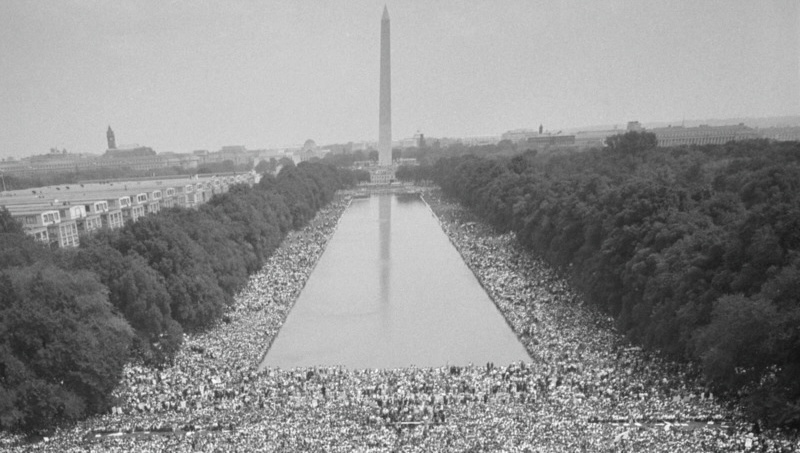
Everything had been accounted for and planned meticulously. There were water trucks, stations handing out sack lunches, and friendly marshals directing people toward their respective routes leading to the Lincoln Memorial. But as the day moved closer to the official procession time of 11:30, the magnitude of the moment became clearer. The march, more than two decades in the making, had drawn more than double its estimated 100,000 participants.
The march was about Black women. It was about their relentless dreams, which so many had fought to make real despite a movement, a nation, and a world that so often belittled them.
Lula was wonderstruck by it all. The sheer number of people and the late summer heat could have easily overwhelmed her, but she was doggedly focused. Jotting in her notes, she said she was confined to “six square inches of turf, jammed between bodies on four sides.” The women’s procession was so congested, “if you so much as applauded you jammed the ribs of your neighbor.” But none of that seemed to matter, to Lula or to anybody else. “The ardour of a determined surge toward freedom sent a ripple through the throng with every breath,” she wrote.
Lula watched the women and girls among the sea of faces as closely as she did the speakers, singers, and stars who breezed across Site 3, and she noted the young women from the Wilmington, North Carolina, chapter of the National Association for the Advancement of Colored People (NAACP) in their “crisp white blouses,” a staple among the march uniforms. But as the day wore on, Lula began to chafe at the direction of her article. If her editor wanted her to write about glitz and glamour, that was fine. But she was more interested in the grit of the grassroots folk, the organizers and the activists who were the heart and soul of the movement. A Black woman’s sartorial choices were never just a matter of frills and flounces; Lula knew this. The civil rights movement, and the many movements for Black freedom that had come before it, took careful consideration of how its people looked. It was a matter of respectability. Through the years of move-ment sit-ins, walkouts, and marches, Black activists had used military dress, three-piece suits, and their Sunday best to make a case for equal citizenship. It might never have occurred to Lula’s editor that the women of the movement had more to contribute than just how they sported the latest in trends. But Lula knew better. And by the time she sat down to draft her piece, she was resolved to correct the record with a bit of caustic wit.
“The women, thousands of them, came in slacks, shorts, cotton frocks and knits,” her rebuke began. “They were bareheaded or wearing babushkas, and the sneakers, sandals, flats and loafers were the vogue in footwear.” But make no mistake, the march was “no high dress affair,” she wrote. “This was a working march.”
*
The 1963 March on Washington has long been remembered for its crowning moment: the stunning oratory of Dr. Martin Luther King Jr.’s “I Have a Dream” speech. The often-quoted address spoke to centuries of fighting for Black freedom, and it ended with his vision of interracial harmony and friendship. At the time, King was the leader of the Southern Christian Leadership Conference (SCLC), and as the closing speaker at the march he made it clear why he had become such a sensation. He was undoubtedly the most recognized and revered figure among the cohort of men who organized the march, and among the overwhelmingly male lineup of speakers. King’s leadership during key movement moments—the Montgomery bus boycott, the Birmingham Campaign, the Selma to Montgomery march, and his establishment of the Poor People’s Campaign—has not had the same cultural resonance and historical permanency as his pronouncements at the March on Washington.
His assassination in April 1968, nearly five years after his appearance at the march, and his gradual canonization as the greatest of all the movement’s martyrs, have inextricably linked King and his iconic address with that day. His bravery and commitment deserve mountains of reverence, of course. But often, this image of King as the singular hero of the civil rights movement has come at the expense of other stories, and of a more nuanced portrait of the struggle. Few people, for example, know much about the March on Washington beyond King and his legendary speech. Rarely do we talk about the demands that sparked the demonstration, or the organizers who pulled it all together, or the people beyond King who carried the day.
First among this unsung cohort are the women of the march, who have been all but erased from the record. Although Black women were actively fundraising, strategizing, organizing, sacrificing, and resisting on behalf of the movement since its inception—and for an array of causes, from school desegregation to voting rights to ending police brutality—they were routinely portrayed in the press as appendages to movement leadership, as helpmates and spouses. Feminist historians have striven to right this wrong for decades, publishing biographies and monographs on Black women in civil rights, collecting oral histories of woman activists, and curating and designing public exhibitions to tell their stories to the greater public. The March on Washington is yet to be understood as more than just a reflection of King’s moral imagination. The March on Washington was about the unfinished business of emancipation and Reconstruction. It was a righteous out-pouring from an exhausted and exploited people, and it was a test of the fragile bonds that brought so many communities together under the banner of “the movement.” The march was about Black women. It was about their relentless dreams, which so many had fought to make real despite a movement, a nation, and a world that so often belittled them.
By widening our lens, we can more truly appreciate the complexities at the heart of social change, and the idealists who tried so hard to make it happen.
The need for correctives is extensive, and the work is well under way. But it’s a difficult task. In pieces commemorating the anniversary of the march, journalists have sometimes focused on the lack of women’s voices on the day. But these well-meaning retrospectives often rely on inaccurate accounts of the women who were honored that day, as part of the program’s “Tribute to Negro Women Fighters for Freedom.” But the constant publishing and republishing of unexamined histories, coupled with the fact that very little has been written about the lesser-known women who were invited to attend and who were there, renders these articles more confusing than clarifying.
Much of Lula’s writing about the march focused on the tribute, but she couldn’t have known the behind-the-scenes wrangling that made it possible. The decision to include the tribute was made in the eleventh hour, and it was more the result of a concession than a concerted homage. In fact, the presentation was deemed so superfluous that, according to King’s biographer Jonathan Eig, during a conversation just days before the march, King said he was worried about the amount of time it would take for all the speakers to say their piece, so he suggested that they make the day longer, and that they cut “the number of women on the program from four to one.” And on the day of, when it came time for the actual tribute, the labor leader and march’s creator A. Philip Randolph, who served as the official master of ceremonies, struggled to remember many of the women’s names who were listed on the program. These slights and oversights have continued for decades, until now.
My book, How Bright the Path Grows, is a new narrative history of the 1963 March on Washington exploring what has been obscured by the long and looming shadow of King. In the spirit of Lula Patterson, I offer this book as a reminder that there are many ways of looking at the past. By widening our lens, we can more truly appreciate the complexities at the heart of social change, and the idealists who tried so hard to make it happen. How Bright the Path Grows is an opportunity to sort out the facts from the fictions, fantasies, and failures of a famous day in civil rights history, all of which speak volumes to the sexism of the time and the stories we tend to silence.
My book centers the lives of those women who were seen, yet hardly heard, at the march, and how they lived their race and gender across shifting eras and terrains of Black struggle, from the terror of Jim Crow’s rise to the sit-ins, boycotts, and antiracism campaigns of the post-World War II era. Some of these women came from big cities; others only knew life in small towns. Some were educated in elite classrooms; others lived by the invaluable lessons you only learn out in the streets. Some walked right toward activism, and others discovered freedom work by accident. They were all so different, yet bound to one another—not simply by their inclusion in the march, but by the violence and the victories that came with being women of the movement writ large.
______________________________
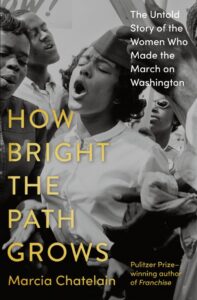
From How Bright the Path Grows: The Untold Story of the Women Who Made the March on Washington by Marcia Chatelain. Copyright © 2026. Available from Pantheon, an imprint of Knopf Doubleday Publishing Group, a division of Penguin Random House, LLC.

Marcia Chatelain
Marcia Chatelain is a Presidential Penn Compact Professor of Africana studies at the University of Pennsylvania. She is the author of South Side Girls and Franchise, which won the 2021 Pulitzer Prize in History, the James Beard Foundation Book Award for Writing, the Hagley Prize for Business History, and the Lawrence W. Levine Award from the Organization of American Historians. An active public speaker and educational consultant, Chatelain has received awards and honors from the Ford Foundation, the American Association of University Women, and the German Marshall Fund of the United States.